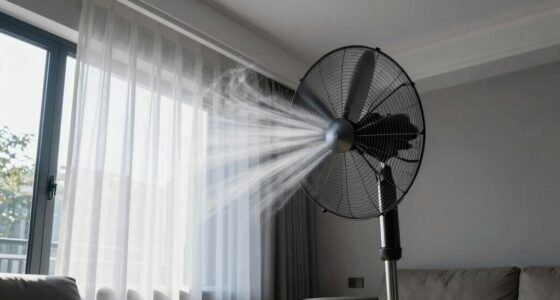
The essential airflow diagram shows how air moves, highlighting direction, speed, and pressure changes using arrows, streamlines, and color gradients. It helps you understand how air interacts with obstacles, surfaces, and different pressures, revealing turbulence, stagnation zones, or smooth flow paths. Recognizing these visual patterns allows you to optimize ventilation, reduce drag, or improve aerodynamic designs. Keep exploring to access deeper insights into how airflow works and how to apply it effectively.
Key Takeaways
- The airflow diagram with arrows and streamlines visually shows flow direction, speed, and turbulence around objects for quick understanding.
- Pressure contours and color gradients highlight high and low-pressure zones, demonstrating how air moves and accelerates.
- Visualizing airflow around obstacles reveals flow separation, stagnation points, and turbulence, essential for aerodynamic and ventilation design.
- Recognizing flow patterns helps identify dead zones and inefficiencies, guiding improvements in system performance and safety.
- Combining diagrams with measurement data ensures accurate interpretation, preventing common visualization errors and optimizing airflow systems.
The Components of the Airflow Diagram
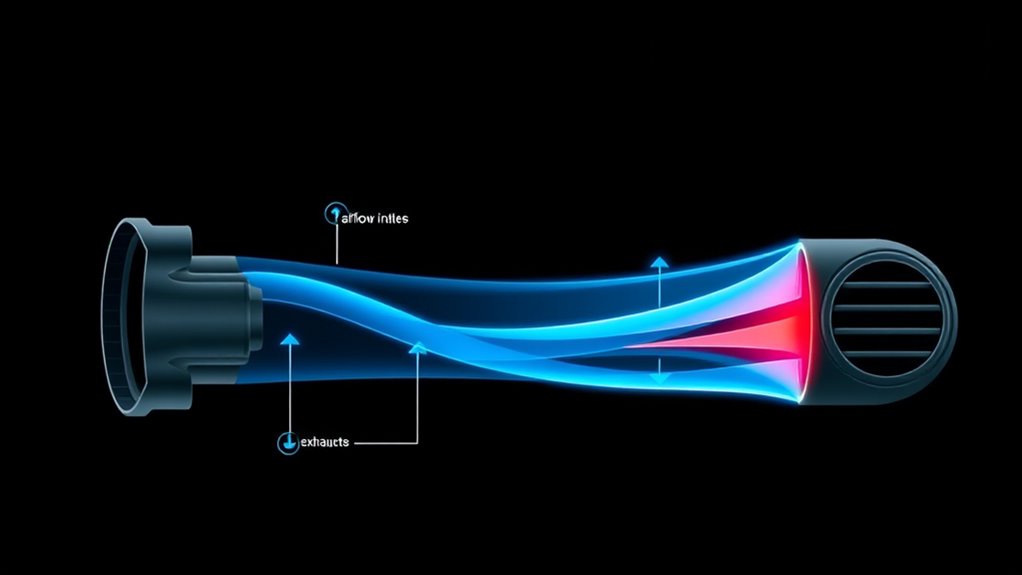
Understanding the components of an airflow diagram is essential because they visually represent how air moves through a system. These diagrams use symbols and lines to show airflow paths, making airflow visualization clear and straightforward. You’ll see arrows indicating the direction of airflow, while different line styles can represent varying speeds or turbulence. Airflow measurement tools are often integrated into these diagrams to help you assess flow rates and pressure drops. Recognizing the importance of color accuracy in visual representation can improve the interpretation of airflow patterns. By understanding these components, you can quickly identify problem areas or inefficiencies in the system. The diagram’s clarity allows you to see the entire airflow process at a glance, which is crucial for designing, troubleshooting, or optimizing ventilation, HVAC, or industrial processes. Mastering these components enhances your ability to analyze airflow accurately, especially in complex systems like airflow control mechanisms. Additionally, recognizing pressure differences within the diagram can help in diagnosing system performance issues more effectively.
Understanding Airflow Direction and Speed

To interpret an airflow diagram effectively, you need to grasp how airflow direction and speed are represented. Airflow visualization uses arrows or streamlines to show the flow’s path, indicating the direction air moves within a space. Longer arrows typically signify higher speed, while shorter ones indicate slower airflow. Pressure mapping enhances this understanding by illustrating pressure differences that drive airflow, often shown with color gradients or contours. Recognizing these visual cues helps you determine how air circulates, identify zones of stagnation, or turbulence. Additionally, studies in sound healing science suggest that sound vibrations can influence cellular regeneration and overall health, which can be relevant when considering airflow in healing environments. By connecting the flow patterns with pressure variations, you gain a clearer picture of how air moves. Understanding pressure gradients is essential for optimizing ventilation and ensuring effective airflow distribution, especially in sensitive settings. Recognizing how airflow patterns relate to environmental comfort and health outcomes can guide better system design. Mastering this interpretation allows for better planning and optimization of ventilation or airflow systems. Moreover, awareness of airflow speed variations helps in identifying areas needing airflow adjustments for improved efficiency. For example, adjusting airflow in specific zones can improve thermal comfort and energy efficiency in buildings.
The Role of Pressure in Air Movement
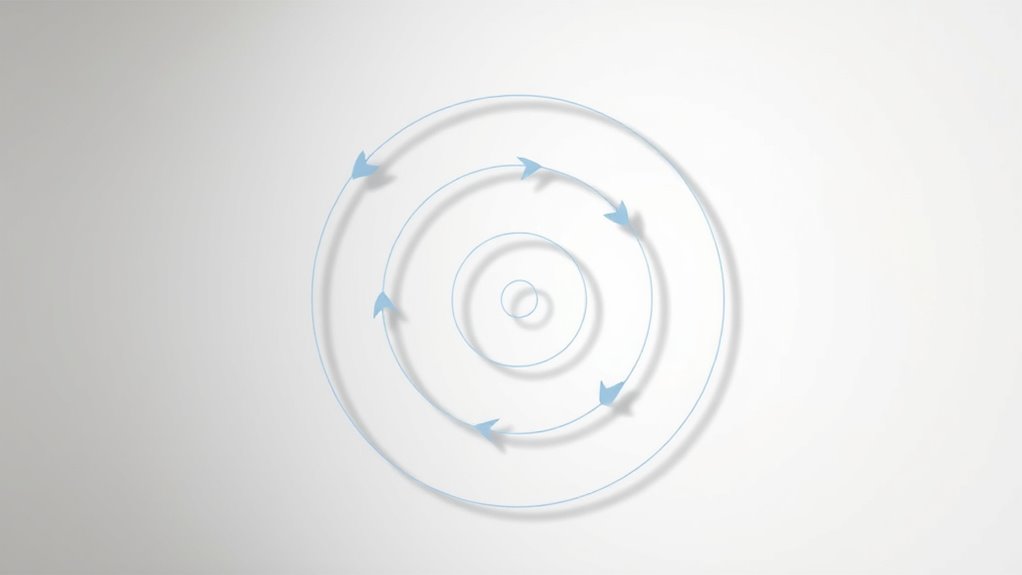
You’ll notice that air moves from areas of higher pressure to lower pressure, creating flow. The greater the pressure difference, the faster the air travels. Understanding this relationship helps you predict and control airflow in different situations. Knowing about pressure gradients can further enhance your understanding of airflow dynamics.
Pressure Difference Drives Flow
Pressure differences are the primary force that causes air to move. When there’s a higher pressure on one side and a lower pressure on the other, air flows from the high to the low. This movement is explained by the Bernoulli principle, which states that as air speeds up, its pressure drops. The venturi effect is a specific example, where narrowing a passage increases air velocity and decreases pressure, creating a significant pressure difference. This change drives airflow, such as in ventilation systems or air intakes. Recognizing how pressure differences, influenced by the Bernoulli principle and venturi effect, cause air to move helps you understand the fundamental mechanics behind airflow in various applications. It’s the key to visualizing how pressure differences control air movement. Understanding airflow is essential for many fields, including aerodynamics and ventilation design. One important aspect is how pressure imbalance can be created intentionally to optimize airflow in different systems. Additionally, factors like air density can affect the magnitude of pressure differences and airflow efficiency.
Higher Pressure, Faster Movement
When air moves faster, it often indicates a region of higher pressure, which might seem counterintuitive but is essential to understanding airflow. This occurs because pressure gradients can create unexpected relationships between pressure and velocity. In areas where pressure is higher, airflow velocity can increase due to the pressure differential. Recognizing these dynamics helps explain how air moves efficiently through spaces. Additionally, understanding the different pressure types involved helps clarify the complex nature of airflow movement. Awareness of pressure variations is crucial for designing systems that optimize airflow efficiency and safety. Moreover, factors like wave and wind can influence how pressure differences develop and interact in various environments. This understanding is similar to the fluid dynamics principles that govern how liquids and gases behave under different conditions.
How Air Interacts With Obstacles

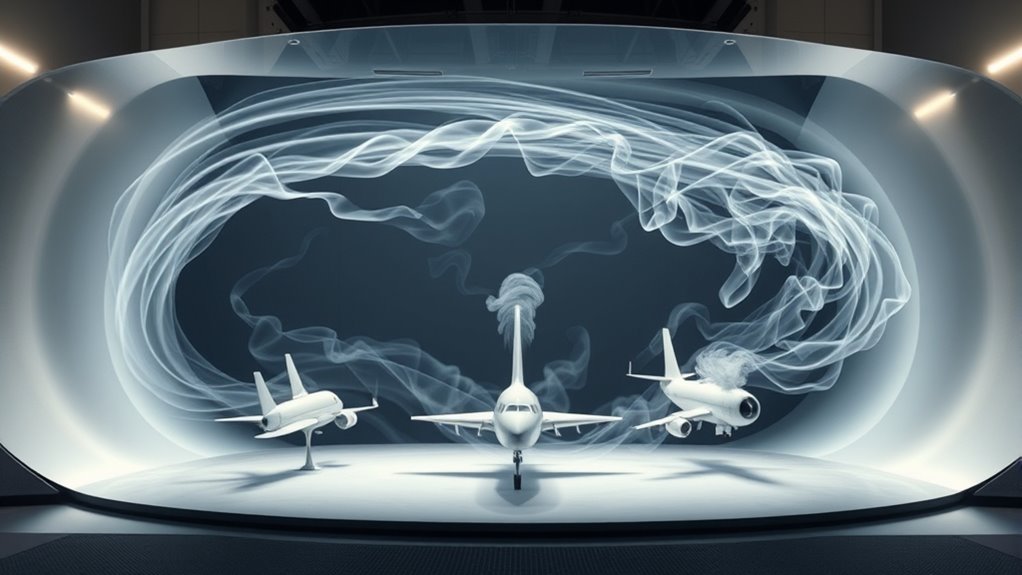
Ever wondered how air flows around obstacles? When air encounters an obstacle, it splits and moves around it, creating areas of varying pressure. Engineers use wind tunnels to study these interactions, simulating real-world conditions. Airfoil shapes are designed to manage airflow efficiently, minimizing drag and turbulence as air passes over them. As air hits an obstacle, it accelerates on the windward side, leading to lower pressure, while on the leeward side, flow separation can cause turbulence and drag. Sharp edges cause abrupt airflow changes, whereas smooth, rounded surfaces promote smoother flow. Understanding how air interacts with obstacles helps in designing everything from aircraft wings to buildings, ensuring they handle airflow effectively and reduce drag or wind resistance. Additionally, applying flow management techniques can optimize designs for better performance and safety, emphasizing the importance of aerodynamic principles in engineering. Recognizing the effects of pressure differences around objects allows engineers to develop more efficient and stable structures. Incorporating boundary layer control techniques can further improve airflow characteristics around complex shapes. Moreover, considering turbulence modeling is essential for accurate simulations and improved design accuracy.
Visualizing Streamlines and Flow Paths

Visualizing streamlines and flow paths provides a clear picture of how air moves around obstacles. This helps you understand airflow patterns critical for designing efficient airfoil shapes and ventilation systems. By examining streamlines, you can identify areas of smooth flow or potential turbulence, essential for optimizing performance. For example, smooth streamlines over an airfoil reduce drag, improving lift and fuel efficiency. In ventilation, clear flow paths ensure proper air distribution and indoor air quality. To better grasp these concepts, consider:
- Using streamline plots to visualize airflow around complex shapes
- Identifying zones of flow separation and recirculation
- Applying flow path analysis to optimize ventilation layouts
- Understanding thermal behavior helps you design systems that improve efficiency and comfort. Additionally, considering local climate conditions can further enhance ventilation effectiveness. Recognizing how airflow visualization techniques reveal flow patterns is key to optimizing system design and performance.
The Significance of Turbulence and Laminar Flow

Turbulence can increase drag and reduce efficiency in airflow systems, making it a challenge to optimize performance. On the other hand, laminar flow remains stable and predictable, helping maintain smooth operation. Understanding these differences is key to controlling airflow for better results.
Turbulence Effects on Efficiency
How does turbulence influence the efficiency of airflow systems? Turbulence can considerably impact performance, especially around an aircraft wing. It disrupts smooth airflow, increasing drag and reducing lift, which forces engines to work harder. Weather patterns often cause unpredictable turbulence, making it harder to maintain ideal efficiency. Understanding these effects helps you design better systems. Key points include:
- Increased drag from chaotic airflow lowers fuel efficiency.
- Turbulence causes uneven pressure distribution on wings, affecting lift.
- Frequent disturbances from weather patterns demand adaptive control systems.
Laminar Flow Stability
Maintaining laminar flow over surfaces like aircraft wings is essential for optimizing aerodynamic efficiency. Laminar flow offers less drag and smoother airflow, but it depends on flow stability. Small disturbances can trigger shift from laminar to turbulent flow, increasing drag and reducing performance. Understanding flow stability helps you predict when laminar flow will break down. Factors like surface roughness, angle of attack, and airspeed influence this transition. By controlling these variables, you can prolong laminar flow and keep turbulence at bay. Recognizing the importance of flow stability enables you to design surfaces that resist early transition, maximizing efficiency. Ultimately, maintaining stable laminar flow is key to reducing energy consumption and improving aerodynamic performance.
Applying the Diagram to Real-World Scenarios
To effectively apply airflow diagrams to real-world scenarios, you need to understand how the principles translate from theory to practice. This helps maximize ventilation systems and improve indoor air quality. By analyzing airflow patterns, you can identify areas with poor circulation or stagnation. Consider these key points:
- Adjust ventilation placements to ensure even airflow distribution.
- Use the diagram to predict how changes in room layout affect air movement.
- Monitor airflow rates to maintain ideal indoor air quality standards.
Applying these principles allows you to design more efficient systems, reduce energy costs, and create healthier indoor environments. Understanding how airflow behaves in real spaces empowers you to make informed decisions that enhance comfort and safety.
Common Mistakes When Interpreting Airflow Diagrams

Interpreting airflow diagrams can be tricky if you’re not careful, as small misreadings can lead to ineffective ventilation designs. A common mistake is misinterpreting airflow visualization, which can cause you to assume airflow directions or speeds incorrectly. Relying solely on visual cues without considering airflow measurement data can lead to errors, especially in complex systems. Another mistake is ignoring the scale or context of the diagram, causing you to overestimate or underestimate airflow rates. Additionally, failing to recognize the difference between airflow patterns and actual airflow quantities can result in faulty assumptions. Always cross-check airflow visualization with measurement data to guarantee accurate interpretation. Being precise and cautious helps you avoid these pitfalls and creates more reliable ventilation solutions.
Enhancing Efficiency Using Basic Airflow Principles

Applying basic airflow principles can substantially boost the efficiency of your ventilation system. By understanding airflow visualization, you can identify areas of turbulence, dead zones, or improper flow paths. Using airflow measurement tools helps you quantify airflow rates and verify system performance. To enhance efficiency, focus on:
- Optimizing duct layouts to promote smooth airflow and reduce resistance
- Using airflow visualization techniques to detect inefficient zones
- Regularly measuring airflow to ensure system remains balanced and effective
These steps help you pinpoint issues early, improve air distribution, and lower energy costs. Implementing simple adjustments based on airflow measurement and visualization guarantees your system operates at peak performance. Ultimately, mastering these basic principles saves energy, prolongs equipment life, and creates healthier indoor environments.
Expanding Your Knowledge Beyond the Basics

Once you’ve mastered the fundamental airflow principles, you can start exploring advanced techniques to optimize your ventilation system further. Airflow sensors play a pivotal role in this next step, providing real-time data to monitor and adjust airflow precisely. With accurate sensor readings, you can identify inefficiencies and fine-tune your setup for maximum performance. Additionally, airflow modeling allows you to simulate different scenarios, helping you predict how changes will impact airflow patterns. By integrating sensors and modeling into your design process, you gain a deeper understanding of airflow dynamics. This knowledge empowers you to create more efficient, balanced ventilation systems that improve air quality and energy efficiency, taking your expertise beyond basic principles and into precise, data-driven control.
Frequently Asked Questions
How Does Temperature Affect Airflow Patterns in the Diagram?
Temperature variation markedly impacts airflow patterns in the diagram. When warm air rises and cool air sinks, it alters the airflow direction, creating convection currents. You’ll notice that in areas with higher temperatures, airflow moves upward, while cooler zones draw air inward or downward. This movement influences ventilation efficiency and comfort, as understanding how temperature variation affects airflow direction helps you optimize airflow design for better climate control.
Can Airflow Diagrams Predict Turbulence Under All Conditions?
Airflow diagrams can’t predict turbulence under all conditions because computational modeling and airflow visualization have limitations. They help you understand and visualize airflow patterns, but turbulence is complex and influenced by many variables. You may see turbulent zones in diagrams, yet real-world conditions can differ. Consequently, while helpful, these tools don’t guarantee precise turbulence predictions in every scenario, especially under extreme or rapidly changing conditions.
What Software Tools Are Best for Creating Accurate Airflow Diagrams?
You need the right tools to create precise airflow diagrams, and computational modeling software like ANSYS Fluent or Autodesk CFD delivers remarkable accuracy. These programs excel at airflow visualization, helping you simulate complex conditions and predict turbulence with confidence. Don’t settle for less—by choosing advanced software, you access detailed insights into airflow behavior, ensuring your diagrams aren’t just visuals but powerful analytical tools that reveal what’s happening beneath the surface.
How Do Airflow Patterns Change in Different Environmental Settings?
You’ll notice airflow patterns change markedly across different environmental settings. In open outdoor spaces, airflow visualization shows wind disperses quickly, reducing pollutant buildup. In contrast, confined indoor environments direct airflow along surfaces and through vents, impacting ventilation efficiency. Understanding these variations helps you optimize airflow, minimize environmental impact, and improve air quality. Recognizing how environmental factors influence airflow enables better design and management of ventilation systems for healthier, safer spaces.
Are There Safety Considerations When Applying Airflow Principles Professionally?
Think of airflow principles like a safety net; ignoring them can lead to occupational hazards. You must prioritize ventilation safety by ensuring proper airflow to prevent buildup of harmful fumes or dust. In a factory, inadequate ventilation caused a worker’s respiratory issues—highlighting the importance of following airflow guidelines. Always assess environmental conditions and apply airflow principles carefully to protect yourself and others from potential health risks.
Conclusion
By mastering this simple airflow diagram, you’ll find it’s like discovering a secret language for understanding how air moves around us. It’s funny how a single diagram can reveal so much, making complex concepts feel like second nature. The next time you see airflow in action, you might just smile, knowing you’ve uncovered a little piece of the puzzle. After all, sometimes the simplest tools make the biggest difference in understanding the world around you.