📊 Full opportunity report: Micro-agency Proposal Scope Checker on IdeaNavigator AI — validation score, market gap, and execution plan.

Prime made for students and young adults
- Fast, free delivery for dorm and study essentials
- Prime Video and Amazon Music included
- Member-only deals
TL;DR
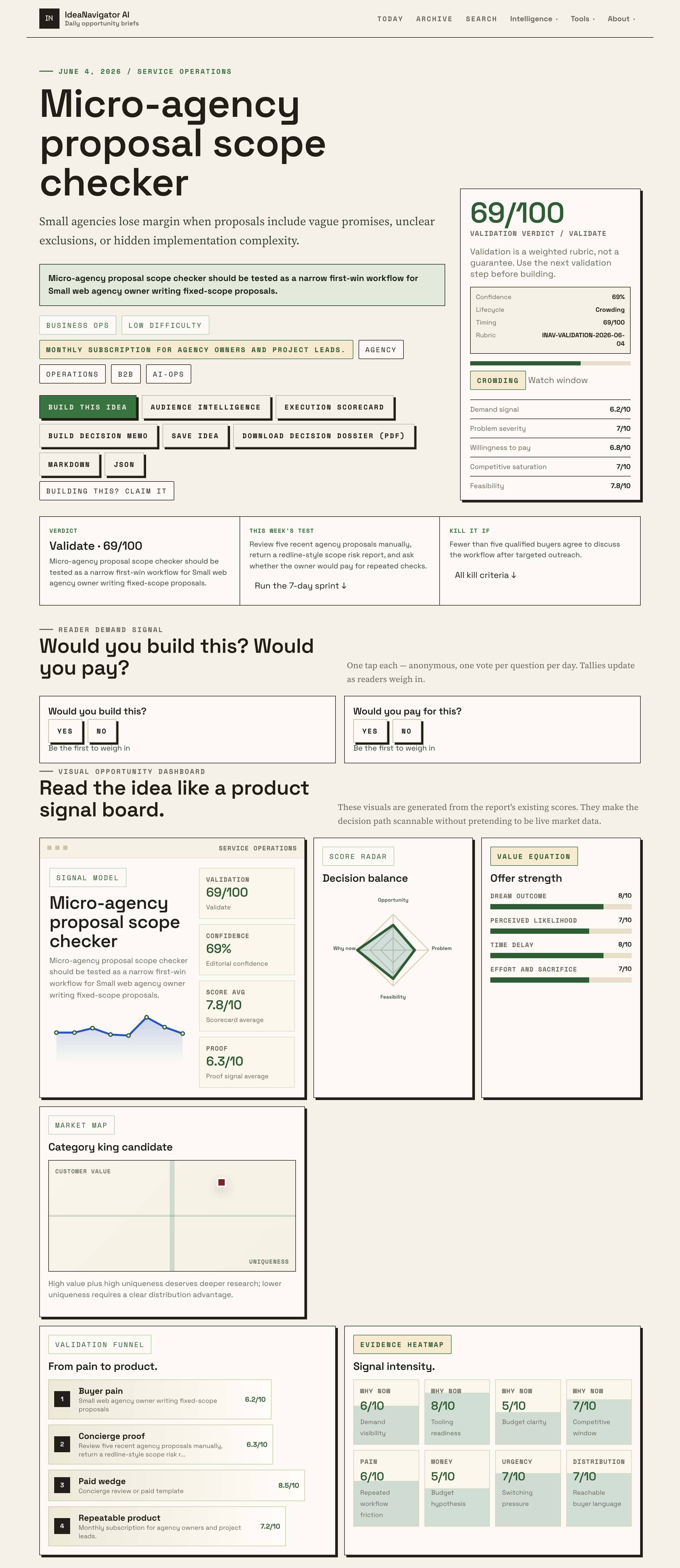
IdeaNavigator AI is testing a scope checker tool for small web agencies to flag vague deliverables and risky scope elements in proposals. This aims to reduce scope creep and improve margins.
IdeaNavigator AI is testing a new scope checker tool designed specifically for small web agencies to review fixed-scope proposals for scope risks before client submission. The tool aims to help agencies identify vague promises, missing assumptions, and risky integrations, potentially improving margins and reducing scope creep.
The proposed tool is a proposal upload system that analyzes draft proposals against reusable delivery checklists, highlighting areas of concern such as vague deliverables, missing assumptions, and risky technical components. It is intended as a first-win workflow for small agency owners who often struggle with unclear proposals that erode profit margins.
According to IdeaNavigator AI, the MVP (minimum viable product) will generate a redline-style scope risk report that pinpoints potential issues and suggests clearer exclusion language. The project is currently in a validation phase, where five recent agency proposals are being manually reviewed and analyzed to determine if the tool’s outputs would be valuable enough for agencies to pay a monthly subscription fee.
Market focus is on service operations, specifically small web agencies that frequently produce fixed-scope proposals. The goal is to offer a simple, scalable solution that helps agencies improve proposal clarity and manage scope more effectively, ultimately protecting margins.
Potential Impact on Small Web Agencies’ Profitability
This tool could significantly reduce scope creep and margin erosion for small web agencies, which often face challenges with vague proposals and hidden complexities. By providing early scope risk identification, agencies can improve proposal accuracy, set clearer client expectations, and avoid costly misunderstandings. The success of this pilot could lead to broader adoption and a new standard workflow for proposal review in the service industry.
As an affiliate, we earn on qualifying purchases.
Rise of AI Tools in Proposal Management for Small Agencies
Small agencies frequently struggle with scope management due to limited resources and expertise in detailed proposal drafting. While larger firms often have internal review processes, smaller outfits lack such infrastructure. Recent advances in AI have enabled tools to automate parts of project planning and scope analysis, but specific solutions targeting fixed-scope proposal risks are still emerging.
IdeaNavigator AI’s initiative aligns with broader trends toward automation and risk mitigation in service operations, aiming to provide accessible tools that improve proposal quality and profitability for small agencies. The current testing phase is a critical step toward validating the tool’s practical value and market fit.
“The scope checker aims to serve as a first-line defense against scope creep by highlighting potential issues before proposals are finalized.”
— an anonymous researcher
scope risk analysis tool for agencies
As an affiliate, we earn on qualifying purchases.
As an affiliate, we earn on qualifying purchases.
Unclear Effectiveness and Adoption Willingness
It is not yet confirmed how accurately the tool will identify scope risks or how willing small agencies will be to adopt a new automated review process. The pilot involves only five proposals, and broader market validation remains to be seen. Further testing and user feedback are needed to determine if the tool can deliver consistent value and justify subscription costs.
As an affiliate, we earn on qualifying purchases.
Next Steps in Validation and Market Rollout
The immediate next step is to complete the review of the five test proposals and assess the accuracy and usefulness of the scope risk reports generated. Based on feedback, IdeaNavigator AI plans to refine the tool’s features and consider a broader pilot involving more agencies. A commercial launch could follow if initial results demonstrate clear benefits.
As an affiliate, we earn on qualifying purchases.
Key Questions
How will the scope checker identify scope risks?
The tool compares draft proposals against reusable checklists to flag vague deliverables, missing assumptions, risky integrations, and suggest clearer exclusion language.
Who is the target user for this tool?
Small web agency owners and project leads who produce fixed-scope proposals and want to reduce scope-related issues and improve margins.
Is this tool available for use now?
No, it is currently in a testing phase with a limited number of proposals. A broader rollout will depend on validation results.
How does this compare to existing proposal review methods?
Unlike manual reviews, this AI-driven tool aims to automate scope risk detection and provide quick, actionable feedback, saving time and reducing human error.
What are the potential limitations of the scope checker?
Its effectiveness depends on the quality of the checklists and the complexity of proposals; it may not catch all nuanced scope issues or adapt perfectly to unique project contexts.
Source: IdeaNavigator AI
Halloween Picks
halloween
As an affiliate, we earn on qualifying purchases.