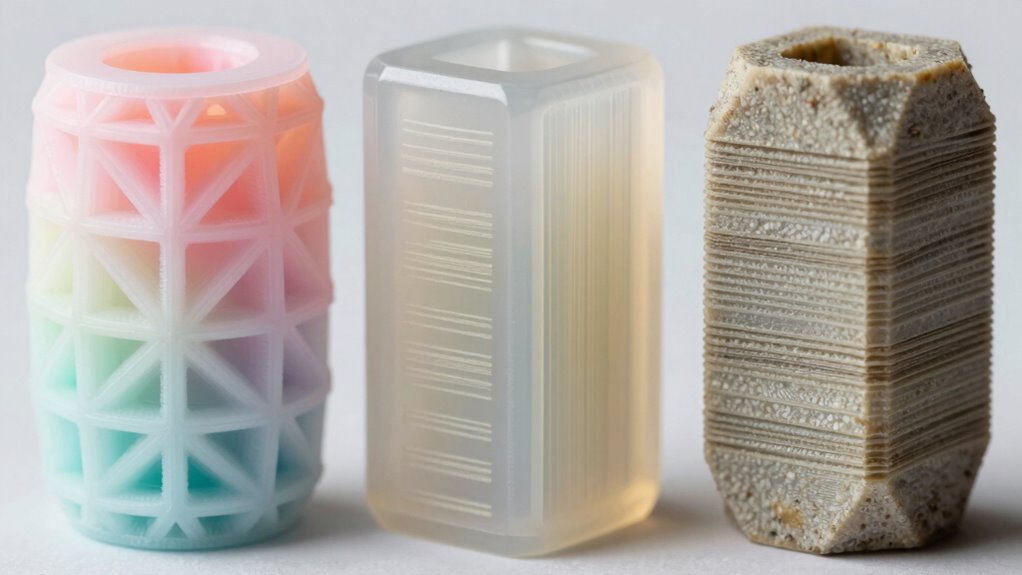

When choosing between PLA, PETG, and ABS for 3D printing, consider durability, surface finish, and application needs. PLA offers smooth surfaces but is less impact-resistant and heat-tolerant. PETG balances durability and a better finish, making it good for mechanical parts. ABS provides high impact resistance but can be tricky to print. Exploring these materials further will help you pick the best one for your projects and optimize your results.
Key Takeaways
- PLA offers high detail and smooth surfaces but has lower impact resistance and heat tolerance.
- PETG provides a good balance of durability, impact resistance, and surface finish, suitable for functional parts.
- ABS is impact-resistant and heat-stable but requires careful temperature control and has a rougher surface.
- PLA is biodegradable and easy to print, ideal for prototypes; PETG and ABS are better for durable, long-lasting objects.
- Surface quality and environmental factors influence the final appearance and performance of each filament type.
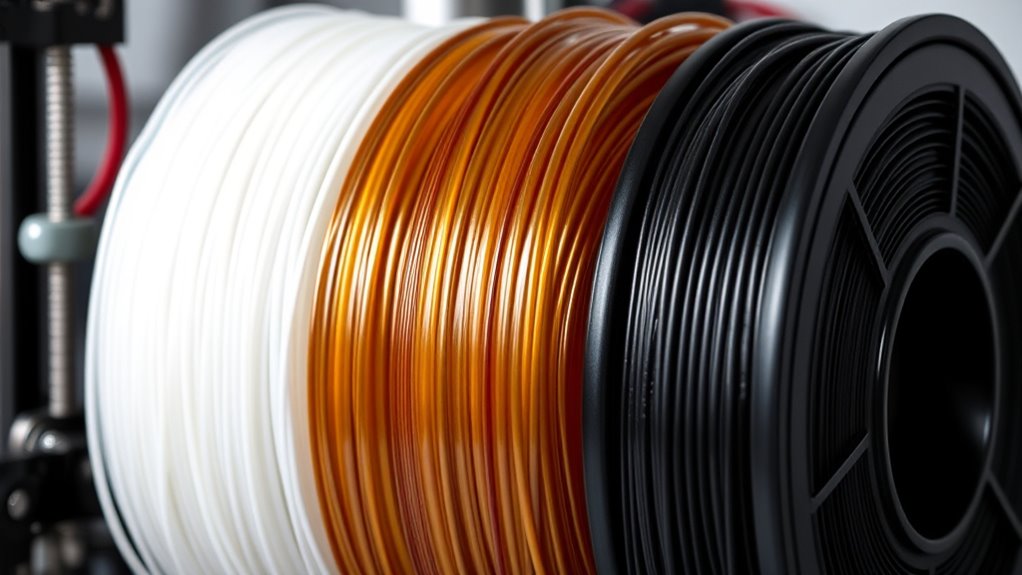
3D printing materials are the foundation of creating accurate, durable, and functional objects through additive manufacturing. When choosing the right filament, understanding factors like filament durability and print surface quality becomes vital. These qualities directly influence how well your prints turn out and how long they last. Filament durability determines how resistant your printed objects are to wear, impact, or environmental factors, while print surface quality affects the smoothness and detail of your finished piece. By grasping these aspects, you can select the best material for your specific needs and guarantee consistent, high-quality results.
If you’re considering PLA, you’ll find that it offers excellent print surface quality. It tends to produce smooth, clean surfaces with minimal warping, making it ideal for detailed models or prototypes. However, its filament durability isn’t as high as other materials, especially when exposed to heat or physical stress. PLA is biodegradable and less resistant to impact, which means that objects printed with PLA might crack or deform under rough handling or high temperatures. This makes PLA suitable for decorative items or temporary prototypes but less ideal for functional parts exposed to harsh conditions.
On the other hand, PETG strikes a good balance between filament durability and print surface quality. It’s known for its toughness and resistance to impact, which means your objects will stand up better over time. PETG also offers a smoother surface finish compared to some other filaments, though it may require more fine-tuning during printing to avoid issues like stringing or uneven layers. Its increased durability makes it a popular choice for mechanical parts, containers, or items that need to endure regular use. The material’s resistance to chemicals and moisture further enhances its suitability for functional applications.
ABS, meanwhile, provides high filament durability, especially when it comes to impact resistance and temperature stability. It’s a strong, tough filament that’s frequently used for engineering prototypes, automotive parts, or household objects. However, ABS’s print surface quality can be tricky; it often produces a rougher finish than PLA or PETG and is prone to warping if not printed with a heated bed and enclosed chamber. This requires you to fine-tune your settings and sometimes use adhesives or rafts to improve adhesion and surface smoothness. Additionally, using innovative European cloud solutions can help optimize printing environments for materials like ABS, reducing warping issues through better temperature control and monitoring.

250g PLA Filament 1.75mm Bundle, SUNLU 3D Printer Filament Neatly Wound, Individually Vacuum Packed, 250g Spool, 8 Rolls, White+Red+Orange+Yellow+Green+Blue+Cyan+Purple
【Beginner-Friendly Small Spool Filament Pack】Perfect for 3D printing beginners! This 250g × 8-color PLA filament bundle uses compact…
As an affiliate, we earn on qualifying purchases.
As an affiliate, we earn on qualifying purchases.
Frequently Asked Questions
Which Material Is Most Environmentally Friendly?
PLA is the most environmentally friendly option because it offers a better biodegradability comparison and recyclability potential than PETG and ABS. You can compost PLA in industrial facilities, reducing waste and environmental impact. PETG and ABS are less biodegradable, and recycling them is more challenging. By choosing PLA, you actively minimize your ecological footprint, making your 3D printing projects more sustainable and eco-conscious.
How Do Print Speeds Compare Among PLA, PETG, and ABS?
You might wonder which filament is fastest, and the answer varies. PLA generally offers the quickest print speeds thanks to its lower melting point and easier layer adhesion factors. PETG runs slightly slower but provides better layer bonding, while ABS tends to be the slowest due to its higher melting point, requiring careful temperature control. So, if speed matters most, PLA is your best bet, but consider your project’s specific layer adhesion needs.
Which Filament Offers the Best Chemical Resistance?
You should choose PETG for the best chemical resistance and durability. It withstands acids, alkalis, and most solvents better than PLA or ABS. PETG’s chemical resistance makes it ideal for functional parts exposed to harsh environments. While ABS also offers decent chemical resistance, PETG generally provides superior durability and resilience against chemicals, making it the top choice for applications requiring long-lasting, chemically resistant 3D printed components.
Are Post-Processing Techniques Different for Each Material?
Post-processing techniques vary for each material because they respond differently to finishing methods. You might sand PLA for a smooth finish, but PETG’s flexibility means you should use gentle polishing techniques. ABS responds well to acetone vapor smoothing, creating a glossy surface. Knowing these differences helps you choose the right finishing methods, ensuring your final print looks professional and meets your project needs.
How Do Costs Vary Between These 3D Printing Materials?
The cost comparison between PLA, PETG, and ABS can feel like a rollercoaster, but it’s manageable. Generally, PLA is the most budget-friendly, making it perfect for beginners, while PETG and ABS tend to be pricier due to their material properties. Your budget considerations matter—if you need durability, you might spend more on PETG or ABS. Choose wisely based on your project needs and financial limits.

OVERTURE PETG 3D Printer Filament 1.75mm, Neatly Wound Durable PETG 1kg Spool (2.2lbs), Strong Toughness Filament, Dimensional Accuracy +/- 0.02mm, Fit Most FDM Printers (White)
[High Speed Printing Up to 300mm/s] Engineered for high-speed printers like Bambu Lab, Creality K1, and Voron. While…
As an affiliate, we earn on qualifying purchases.
As an affiliate, we earn on qualifying purchases.
Conclusion
When choosing between PLA, PETG, and ABS, consider your project’s strength, flexibility, and ease of use. Did you know that PETG has seen a 35% increase in popularity over the past two years due to its durability and chemical resistance? By understanding these materials’ unique traits, you can make smarter choices and create better prints. So, pick the right filament for your needs and bring your ideas to life with confidence!

Siraya Tech Fibreheart ABS HT HF 3D Printer Filament – Premium Engineering-Grade ABS with 101°C Heat Resistance, High Flow for High-Speed Printing, Low Odor, for Functional Parts (1kg, Black)
PROFESSIONAL-GRADE HEAT RESISTANCE: Step up to a premium ABS engineered for demanding applications. With an industry-leading Heat Deflection…
As an affiliate, we earn on qualifying purchases.
As an affiliate, we earn on qualifying purchases.
250g PLA Filament 1.75mm Bundle, SUNLU 3D Printer Filament Neatly Wound, Individually Vacuum Packed, 250g Spool, 8 Rolls, White+Red+Orange+Yellow+Green+Blue+Cyan+Purple
【Beginner-Friendly Small Spool Filament Pack】Perfect for 3D printing beginners! This 250g × 8-color PLA filament bundle uses compact…
As an affiliate, we earn on qualifying purchases.
As an affiliate, we earn on qualifying purchases.