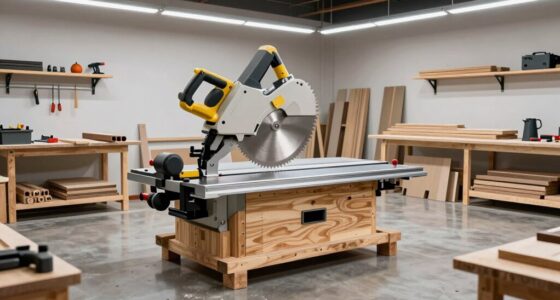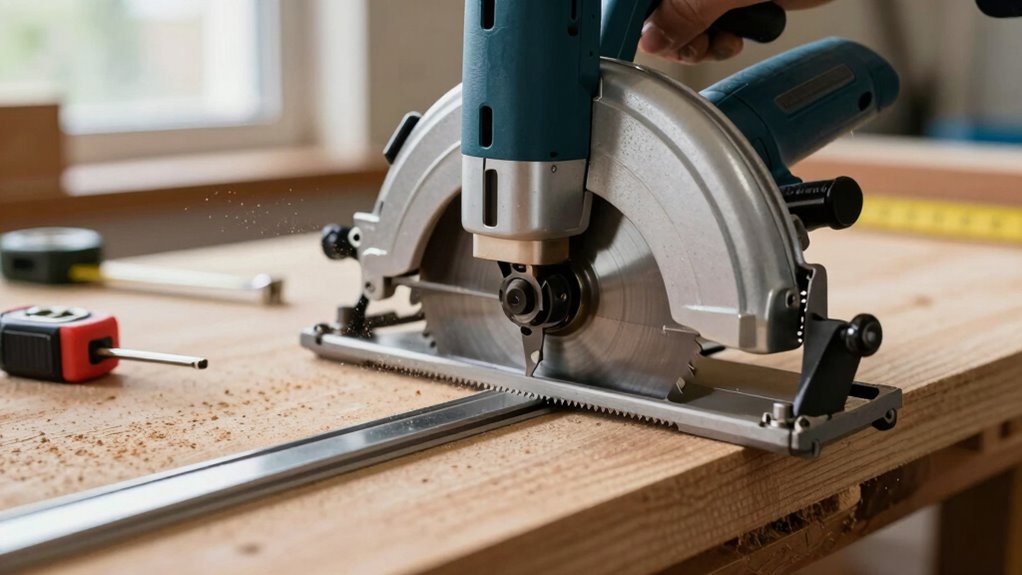
A track saw offers superior precision and control compared to a circular saw, thanks to its guide rail system. You can make straight, clean cuts effortlessly, especially on large panels or delicate projects. It reduces the risk of mistakes and offers safer operation. Proper blade maintenance and safety precautions enhance your results. Keep learning how to maximize these benefits to achieve professional-quality woodworking outcomes with your track saw.

Prime made for students and young adults
- Fast, free delivery for dorm and study essentials
- Prime Video and Amazon Music included
- Member-only deals
Key Takeaways
- Track saws run along guide rails, ensuring straight, accurate cuts that are difficult to achieve with circular saws.
- They provide greater control and stability, reducing the risk of crooked or uneven cuts.
- The precision of a track saw minimizes material waste and improves the quality of finished projects.
- Track saws are safer to operate, with features like safety guards and controlled cutting paths.
- Their ability to cut large panels smoothly makes them ideal for professional woodworking tasks requiring high accuracy.
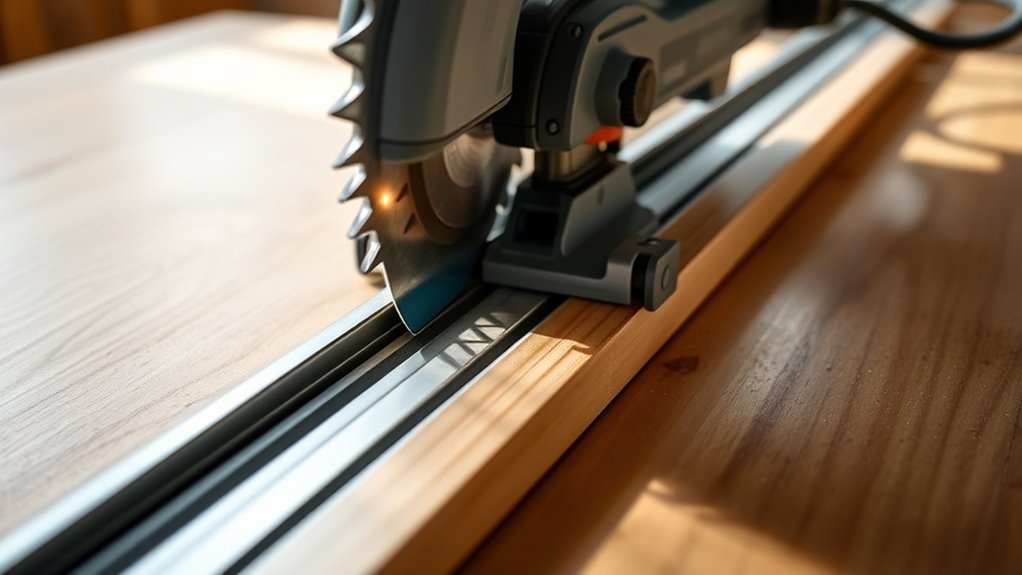
A track saw is a versatile tool that simplifies precise cutting for woodworking projects. When you’re working on large panels or delicate pieces, a track saw helps you achieve straight, clean cuts effortlessly. Unlike a traditional circular saw, it runs along a guide rail, giving you better control and accuracy. To keep your track saw performing at its best, paying attention to blade maintenance is essential. Regularly inspect the blade for dullness, chips, or damage, and replace or sharpen it as needed. A sharp blade not only produces cleaner cuts but also reduces strain on the motor, prolonging the tool’s lifespan. Cleaning the blade after each use prevents buildup of sawdust and debris, which can cause uneven cuts or overheating. Proper blade maintenance ensures your cuts stay precise and your safety remains a priority. Additionally, understanding sound vibrations can help you optimize cutting techniques by reducing noise and enhancing control during operation.
Speaking of safety, using a track saw involves a few precautions that you shouldn’t overlook. Always wear appropriate personal protective equipment—safety goggles to shield your eyes from flying debris, ear protection to guard against noise, and a dust mask if you’re working with materials that generate fine dust. Before starting, double-check that the blade guard is in place and functioning correctly. Never force the saw through the material; let the blade do the work at a steady, controlled pace. This minimizes kickback and reduces the risk of accidents. When making adjustments or changing blades, always unplug the saw to prevent accidental activation. Keep your hands clear of the blade path and maintain a stable stance to ensure control throughout the cut. Additionally, working in a clean, well-lit area helps prevent slips and miscalculations.
The importance of safety precautions extends beyond just personal protection. Maintaining your track saw’s safety features, like the anti-kickback mechanism and safety switch, is vital to prevent mishaps. Ensure your workspace is free of clutter that could interfere with your movement or cause accidental contact with the blade. If you’re new to using a track saw, familiarize yourself with the user manual and practice on scrap pieces until you’re comfortable with the process. Remember, a well-maintained blade combined with diligent safety precautions makes all the difference in achieving professional results safely. This approach not only enhances your craftsmanship but also keeps you protected during every cut.
Frequently Asked Questions
Can a Track Saw Cut Curved or Beveled Edges Effectively?
Yes, a track saw can cut curved and beveled edges effectively. You can guide it along a flexible or specially designed track to achieve smooth, accurate curved cuts. For beveled edges, simply adjust the saw’s bevel angle settings. This versatility allows you to make precise curved cuts and beveled edges, giving you clean, professional results on various woodworking projects.
How Does Dust Collection in Track Saws Compare to Circular Saws?
Think of dust collection in track saws as a finely-tuned vacuum, pulling sawdust away with higher efficiency than circular saws. You’ll find that the dust collection efficiency of a track saw is superior, thanks to its integrated systems and enclosed guides, which better contain sawdust. As a result, sawdust containment is more effective, keeping your workspace cleaner and reducing cleanup time. This makes your cutting experience smoother and safer.
Are Track Saws Suitable for Cutting Thick or Hardwood Materials?
Yes, track saws are suitable for cutting thick hardwoods, thanks to their impressive cutting capacity. You can handle dense materials with ease because the track guides the saw for straight, accurate cuts. Just guarantee your track saw has a motor strong enough to manage the thickness, and use proper blades designed for hardwoods. This way, you get clean, precise cuts even on the toughest materials.
What Safety Features Should I Look for in a Track Saw?
When choosing a track saw, you should look for safety features like a safety lock that prevents accidental starts and an anti-kickback mechanism to protect you from sudden jerks. These features guarantee safer operation, especially during precision cuts. A safety lock keeps the saw from turning on unexpectedly, while anti-kickback minimizes the risk of injury if the saw binds or kicks back during use.
How Portable Are Track Saws for On-Site Woodworking Projects?
Imagine carrying a sleek, lightweight tool that feels like an extension of your hand—this is a track saw’s portable design for on-site convenience. You can easily transport it, set it up swiftly, and work with precision right at your job site. Its compact size and minimal weight make it perfect for on-the-go projects, so you won’t be weighed down or slowed by bulky equipment.
Conclusion
In the end, choosing a track saw over a circular saw truly pays off when it comes to precision. It’s like hitting the bull’s-eye every time, giving you clean, straight cuts without the hassle. While it might seem like a small difference, your finished project will thank you for going the extra mile. So, don’t put things off—invest in a track saw and watch your woodworking skills soar. Sometimes, it’s the little things that make the biggest difference.
Fall Picks
fall essentials
As an affiliate, we earn on qualifying purchases.