
🔍 Read the full analysis: 10 Standout 3D Printers For Different Uses In 2027 on ThorstenMeyerAI.com

Prime made for students and young adults
- Fast, free delivery for dorm and study essentials
- Prime Video and Amazon Music included
- Member-only deals
TL;DR
A buyer’s guide from ThorstenMeyerAI.com compares 10 3D printers for different budgets and workflows, rather than reporting a product launch or independent test. It names the Bambu Lab P1S Combo its best overall fit for an enclosed printer with included multicolor capability, while emphasizing that build size, setup, materials and color-change methods should shape a buyer’s choice.
ThorstenMeyerAI.com’s 2027 buyer’s guide compares 10 3D printers for different needs, naming the Bambu Lab P1S Combo its best overall choice for buyers seeking an enclosed machine with an included multicolor system. The guide is an editorial comparison, not a report of a new product announcement or a disclosed independent performance test; its main point is that the right printer depends on projects, workspace and tolerance for setup and maintenance.
The guide’s recommendations span enclosed printers, multicolor workflows, faster CoreXY models and compact machines aimed at beginners. It distinguishes the P1S Combo, which includes an AMS multicolor system, from the standard Bambu Lab P1S, which retains the enclosed CoreXY platform without that bundle. The guide presents the standard P1S as a possible fit for buyers who want the enclosure but do not need the color system.
For buyers prioritizing a more accessible entry point, the guide points to the Bambu Lab A1. It describes the Snapmaker U1 as a standout for its four-toolhead approach, rather than treating all multicolor systems as equivalent. The FLASHFORGE AD5X is also included among the multicolor options. The article advises comparing loading, material handling, cleanup and color-change waste, not just the number of colors a printer can produce.
The remaining named picks are the HEPHI3D TINA2C, Entina Tina2C, Adventurer 5M, Centauri 2 Combo and P2S Combo. The supplied source gives these models a place in the comparison but does not provide a complete model-by-model specification table or detailed findings for each. It frames the TINA2C models as compact options for small projects and limited space, and the Adventurer 5M as a consideration for speed-focused buyers.
The 10 picks
- 1
 Bambu Lab P2S Combo 3D Printer with AMS 2 ProView on Amazon →
 - 2
 Snapmaker U1 3D Printer with Four ToolheadsView on Amazon →
 - 3
 Bambu Lab P1S Combo 3D Printer with AMSView on Amazon →
 - 4
 Bambu Lab P1S 3D Printer, Ready-to-Use FDM 3D PrinterView on Amazon →
 - 5
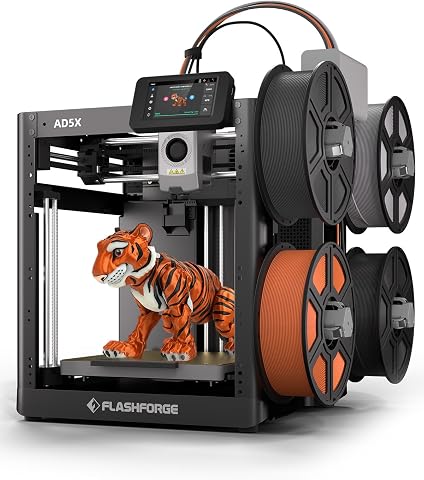 FLASHFORGE AD5X Multi-Color CoreXY 3D PrinterView on Amazon →
 - 6
 Bambu Lab A1 3D Printer, Ready-to-Use FDM 3D Printer for Beginners and KidsView on Amazon →
 - 7
 ELEGOO Centauri 2 Combo 3D PrinterView on Amazon →
 - 8
 FLASHFORGE Adventurer 5M High-Speed 3D PrinterView on Amazon →
 - 9
 HEPHI3D TINA2C Mini 3D PrinterView on Amazon →
 - 10
 Entina Tina2C Mini 3D Printer for BeginnersView on Amazon →
How the Workflow Shapes the Choice
The guide is useful because a printer’s headline feature does not settle whether it suits a buyer’s actual projects. Enclosure, build area, material support and color workflow affect what a person can print and how much time goes into preparation, monitoring and cleanup. An enclosed machine may better suit certain materials or a workspace with drafts, but the source cautions that an enclosure alone does not guarantee compatibility or eliminate noise and ventilation needs.
Multicolor capability also involves tradeoffs. Filament-swapping systems may produce purge waste as colors change, while a multi-toolhead system uses a different mechanical workflow and can bring its own setup demands. For mostly single-color functional parts, a color system may add complexity without much benefit. For signs, figures or labeled parts, the extra capability may be more relevant. These distinctions matter more than a simple color-count comparison.
Speed is similarly only one part of ownership. The guide says advertised maximum speeds do not establish how quickly a clean, usable object will print: geometry, material, cooling and settings also affect results. Buyers weighing the 10 options should consider typical jobs and available space, and budget for the wider setup rather than the printer alone.
The Guide’s Selection Criteria
ThorstenMeyerAI.com says it compared the models around setup and day-to-day usability, print format and enclosure, multicolor workflow, versatility and likely maintenance demands. It says the ranking favors broad usefulness first, followed by specialized strengths. The source does not describe a standardized test protocol, disclose side-by-side measured results or provide a publication date, so its rankings should be read as editorial recommendations.
The guide advises matching build area to objects a buyer regularly expects to make. Small machines can work for parts, toys and prototypes, but larger designs may need to be split and assembled. It also recommends checking manufacturer material guidance and leaving room around a printer for access and maintenance. Its broader advice is to buy features for a real project or workspace need, not simply because a model offers them.
“The P1S Combo is the strongest all-around match for buyers seeking an enclosed printer and multicolor capability in one package.”
— ThorstenMeyerAI.com buyer’s guide
What the Comparison Does Not Establish
The supplied source does not include prices, detailed specifications, test measurements or a full explanation of each model’s individual ranking. It also does not state when the guide was published or identify a common testing method for comparing print quality, speed, noise or reliability. Readers therefore cannot use the source alone to verify that one printer outperforms another on those measures.
Product capabilities, availability and pricing can change, and the guide’s recommendations do not establish that every printer is suitable for every filament or workspace. Buyers should check current manufacturer specifications, compatibility guidance and local pricing before making a purchase. The source does not quantify multicolor purge waste or compare typical print times across the 10 machines.
Checks Before Choosing a Printer
The guide points buyers toward a practical next step: list the objects they expect to print, decide whether multicolor or an enclosure is genuinely needed, and compare the required build area with the available workspace. Before purchasing, readers should verify current specifications and manufacturer material recommendations for their intended use.
There is no product launch or follow-up test announced in the supplied material. The immediate open questions are how the models compare under consistent testing and how their current prices and availability affect value. Those details would help readers judge whether the guide’s overall pick or a more specialized option fits their budget and workflow.
Key Questions
Which printer does the guide recommend overall?
The guide names the Bambu Lab P1S Combo as its best overall fit for buyers who want an enclosed printer with an included multicolor system. That is the source’s editorial recommendation, not a verified universal ranking.
How is the P1S Combo different from the standard P1S?
The guide says both use an enclosed CoreXY platform, while the Combo adds the AMS multicolor system. It presents the standard P1S as an option for buyers who do not need that bundle.
Which models are highlighted for multicolor printing?
The guide highlights the Snapmaker U1 for its four-toolhead approach and includes the Bambu Lab Combo models and FLASHFORGE AD5X among multicolor options. Their workflows differ, so the source recommends comparing setup and waste as well as color capacity.
Which picks suit small projects or limited space?
The guide describes the HEPHI3D TINA2C and Entina Tina2C as compact options for smaller projects and limited space. A smaller build area may be a drawback for large objects.
Does the guide prove which printer is fastest or best value?
No. The supplied source offers buyer guidance but does not provide standardized speed tests, prices or a complete specification comparison. Check current manufacturer information and independent testing before deciding.
Source: ThorstenMeyerAI.com
Fall Picks
fall essentials
As an affiliate, we earn on qualifying purchases.