The best robotics kit for kids balances hands-on building with genuine learning payoff, and my top pick, the Makeblock mBot, nails that balance better than anything else in this lineup with its metal frame, block-based coding, and room to grow across years rather than weeks. Two other standouts: the ELEGOO UNO R3 Smart Robot Car Kit V4 for families ready for real Arduino programming, and the Butterfly EduFields 40-in-1 kit for sheer experiment-per-dollar value. The main tradeoff you’ll face is between screen-free mechanical kits that build engineering intuition and app-and-code robots that teach programming — few kits do both well. Age range is the second sticking point, since kits aimed at 6-year-olds get abandoned by 10-year-olds, while teen-level kits frustrate younger builders. Keep reading for the full breakdown of all 15 kits and which one fits your child’s age, patience level, and interests.

Prime made for students and young adults
- Fast, free delivery for dorm and study essentials
- Prime Video and Amazon Music included
- Member-only deals
Key Takeaways
- The Makeblock mBot earned best overall because it is the only kit in the lineup that combines a durable metal chassis, structured coding progression, and expansion accessories — most competitors offer one or two of those traits, never all three.
- Kits with huge project counts (Butterfly EduFields 10-in-1 and 40-in-1) deliver the best value per experiment, but individual projects are shorter and less satisfying than single-focus kits like the Thames & Kosmos Mega Cyborg Hand.
- Screen-free mechanical kits (Smartivity, Klutz Gear Bots, Mega Cyborg Hand) proved best for younger builders and screen-time-limited households, while Arduino-based kits like the ELEGOO car demand a computer and sustained adult involvement.
- The ELEGOO UNO R3 V4 stands out as the clear upgrade path: it teaches real C++ coding on the same hardware platform used by hobbyists and engineers, unlike the block-coding kits that kids eventually outgrow.
- Battery logistics became a real differentiator — the Sillbird 12-in-1 solar kit needs no batteries at all, while the Sillbird 5-in-1 and EggTailz car both rely on frequent AA/AAA replacement or rechargeable cells parents must manage.
| Sillbird STEM 5-in-1 Robot Building Kit with Remote Control |  | Best Overall | Pieces: 488 | Models: 5-in-1 (robot, dinosaur, car, tank, and more) | Recommended Age: 8-13 years | VIEW LATEST PRICE | See Our Full Breakdown |
| EggTailz Smart Robot Car Kit – STEM Robotics Toy |  | Best for Autonomous Play | Recommended Age: 8-16 years | Drive: 2WD self-balancing | Battery: Built-in rechargeable (2-hour charge, 1-4 hours playtime) | VIEW LATEST PRICE | See Our Full Breakdown |
| Butterfly EduFields 10-in-1 STEM Electronics Robotics Kit |  | Best for Quick Wins | Recommended Age: 8-12 years | Projects: 10 in 1 | Components: 100+ (wires, switches, connectors, LED lights) | VIEW LATEST PRICE | See Our Full Breakdown |
| Butterfly EduFields 40-in-1 STEM Robotics Kit |  | Best Longevity | Recommended Age: 8-17 years | Projects: 40+ | Components: 100+ | VIEW LATEST PRICE | See Our Full Breakdown |
| Sillbird 12-in-1 Solar Robot Building Kit |  | Best Eco-Tech Pick | Pieces: 190 | Buildable Models: 12 | Power Source: Solar (or strong artificial light) | VIEW LATEST PRICE | See Our Full Breakdown |
| BeAndge 6-in-1 STEM Robotics Kit for Kids Ages 8–12 |  | Best for Project Variety | Project set: 6-in-1 STEM kit | Listed projects: Reptile robot, balance car, bubble machine, fiber lamp, and buzzer wire game | Recommended age: 8–12 years | VIEW LATEST PRICE | See Our Full Breakdown |
| ELEGOO UNO R3 Smart Robot Car Kit V4 with Camera |  | Best for Programmable Car Projects | Controller: UNO R3 | Camera and Wi-Fi module: ESP32-WROVER-based | Sensors: Line-tracking and ultrasonic | VIEW LATEST PRICE | See Our Full Breakdown |
| Thames & Kosmos My Robotic Pet: Coding Chameleon Kit |  | Best Screen-Free Coding Pick | Product type: Robotic building and coding kit | Length: 15 inches | Recommended age: 8+ with adult help; 12+ for independent play | VIEW LATEST PRICE | See Our Full Breakdown |
| Makeblock mBot STEM Coding Robot Kit for Kids Ages 8–12 | 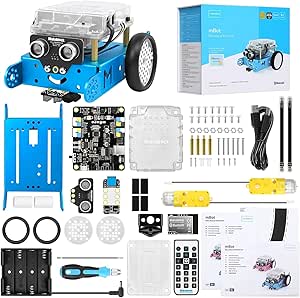 | Best for a First Coding Robot | Model: 90053 | Recommended age: 8 years and up | Programming platforms: Scratch and Arduino | VIEW LATEST PRICE | See Our Full Breakdown |
| Snap Circuits Jr. SC-100 Electronics Kit, 100+ Projects, Ages 8+ |  | Best for Circuit Basics | Model: SC-100 | Projects: 100+ | Recommended age: 8 years and up | VIEW LATEST PRICE | See Our Full Breakdown |
| Robot Arm Kit – STEM Robotics Building Set for Kids, Teens & Adults |  | Best for Learning Circuits | Age range: 8 years and up | Material: Wood | Power source: 6 AA batteries, not included | VIEW LATEST PRICE | See Our Full Breakdown |
| Smartivity Robotic Mechanical Hand STEM Building Toy for Kids Ages 8–14 |  | Best for Screen-Free Mechanical Play | Brand: Smartivity | Model: SMRT1135 | Age range: 8–14 years | VIEW LATEST PRICE | See Our Full Breakdown |
| BeAndge 5-in-1 STEM Science Kit for Kids Ages 6–14 |  | Best for Project Variety | Brand: BeAndge | Model: BA1011 | Age range: 6–14 years | VIEW LATEST PRICE | See Our Full Breakdown |
| Klutz LEGO Gear Bots Science/STEM Activity Kit |  | Best for Kinetic Building | Recommended age: 8–12 years | Number of models: 8 | Book length: 64 pages | VIEW LATEST PRICE | See Our Full Breakdown |
| Thames & Kosmos Mega Cyborg Hand STEM Experiment Kit |  | Best for Hydraulics and Wearable Robotics | Power source: Hydraulic and pneumatic; no batteries or motors | Configurations: Right hand, left hand, or claw-like design | Adjustability: Adjustable finger joint angles | VIEW LATEST PRICE | See Our Full Breakdown |
| robotics kits for kid | Recommended Age |
|---|---|
| Sillbird STEM 5-in-1 Robot Bui | 8-13 years |
| EggTailz Smart Robot Car Kit | 8-16 years |
| Butterfly EduFields 10-in-1 ST | 8-12 years |
| Butterfly EduFields 40-in-1 ST | 8-17 years |
| Sillbird 12-in-1 Solar Robot B | 8-13 years |
| BeAndge 6-in-1 STEM Robotics K | 8–12 years |
| ELEGOO UNO R3 Smart Robot Car | 12 years and up |
| Thames & Kosmos My Robotic Pet | 8+ with adult help; 12+ for independent play |
| Makeblock mBot STEM Coding Rob | 8 years and up |
| Snap Circuits Jr. SC-100 Elect | 8 years and up |
| Robot Arm Kit | — |
| Smartivity Robotic Mechanical | — |
| BeAndge 5-in-1 STEM Science Ki | — |
| Klutz LEGO Gear Bots Science/S | 8–12 years |
| Thames & Kosmos Mega Cyborg Ha | — |
More Details on Our Top Picks
Sillbird STEM 5-in-1 Robot Building Kit with Remote Control
This option stands out for balancing build depth and play value better than anything else in this lineup. With 488 pieces and five distinct models, it gives kids the satisfaction of a serious construction project, then extends the fun with app and remote control plus basic programming and path planning — features most sub-$50 kits skip entirely. Compared with the Sillbird 12-in-1 Solar Robot Kit, which is build-only, this model keeps kids engaged long after assembly ends. The tradeoff is stamina: 40 minutes of play per charge runs short for long sessions, and younger builders will likely need an adult to get through the full 488-piece assembly the first time.
Pros:- Five buildable models with progressive difficulty levels that reward rebuilding
- Dual control via Bluetooth app and remote, including basic programming and path planning
- Clear, colorful instructions that support independent building
- Rechargeable battery avoids constant battery replacements
Cons:- 40 minutes of play per charge feels short for extended sessions
- Full 488-piece assembly may be too challenging for younger kids without help
Best for: Kids ages 8-13 who want a real building challenge followed by ongoing remote-control and app play
Not ideal for: Impatient younger builders who will struggle with a 488-piece assembly or be frustrated by a 40-minute battery limit
- Pieces:488
- Models:5-in-1 (robot, dinosaur, car, tank, and more)
- Recommended Age:8-13 years
- Control Modes:Bluetooth app and remote control
- Programming Features:Basic programming and path planning
- Play Time:Up to 40 minutes per charge
- Battery:Rechargeable
Our verdict“The most complete package here — choose it if your child wants both the building experience and the toy that comes afterward.”
EggTailz Smart Robot Car Kit – STEM Robotics Toy
Where the Sillbird 5-in-1 kit is about building variety, this pick is about what the robot does on its own. The Auto-Go mode uses ultrasonic radar obstacle avoidance so the car cruises around the house without bumping into furniture, and the self-balancing 2WD drivetrain gives it a fluidity that simple remote cars lack. Playtime of 1-4 hours per charge also comfortably outlasts the Sillbird kit’s 40 minutes. The compromises: it’s a car, not a multi-model builder, so once it’s assembled there’s nothing else to construct, and first-time builders will likely need a parent nearby during assembly.
Pros:- Auto-Go autonomous cruising with ultrasonic obstacle avoidance
- Long 1-4 hour playtime per 2-hour charge
- Full remote control including 360-degree rotation and self-balancing movement
- Illustrated tutorial and video instructions make assembly approachable for beginners
Cons:- Assembly may require parental help for kids with no robotics experience
- Remote control requires separate AA batteries
Best for: Kids who want a robot that drives itself around the house with minimal supervision after the build
Not ideal for: Kids who love rebuilding repeatedly — once assembled, there’s only one model to enjoy
- Recommended Age:8-16 years
- Drive:2WD self-balancing
- Battery:Built-in rechargeable (2-hour charge, 1-4 hours playtime)
- Remote Batteries:2 AA (included)
- Modes:Auto-Go and Remote Control
- Features:Ultrasonic obstacle avoidance, headlights, taillights, ring-light
Our verdict“The right choice if self-driving action matters more than building variety — just plan on helping with the first build.”
Butterfly EduFields 10-in-1 STEM Electronics Robotics Kit
This kit solves a real parenting problem: kids who lose interest halfway through a marathon build. With 10 projects that each take around 15 minutes, it delivers fast, repeatable wins that build confidence before attention fades. Compared with the Butterfly EduFields 40-in-1 kit, it offers fewer projects but leans into sensor-based behavior like line-following and obstacle avoidance, which makes the builds feel more like real robotics than simple circuits. The tradeoff cuts both ways — older or experienced kids will find the projects finish too quickly, and the small wires and connectors mean younger children should have an adult supervising.
Pros:- 10 hands-on projects, each completing in roughly 15 minutes
- 100+ components including wires, switches, connectors, and LED lights
- Sensor features like line-following and obstacle avoidance make builds feel genuinely robotic
- Step-by-step illustrated manual supports mostly independent work
Cons:- Small components require adult supervision for younger kids
- Projects may be too simple for older or advanced builders
Best for: Kids ages 8-12 with shorter attention spans who thrive on finishing a project in one sitting
Not ideal for: Older or advanced builders who will outgrow the simple projects quickly
- Recommended Age:8-12 years
- Projects:10 in 1
- Components:100+ (wires, switches, connectors, LED lights)
- Features:Line-following, obstacle-avoidance, multi-function sensor control
- Assembly Time:Approximately 15 minutes per build
- Includes:Step-by-step illustrated instruction manual
Our verdict“Pick this for a child who needs quick, satisfying builds rather than a long-term engineering project.”
Butterfly EduFields 40-in-1 STEM Robotics Kit
This is the kit that keeps giving: more than 40 projects from over 100 reusable components, ranging from a line-following car to drawing robots and home automation gadgets. The plug-and-play, no-soldering, no-coding design makes it more approachable than kits like the ELEGOO UNO R3 Smart Robot Car, which demands real programming work — and the wide age range (8-17) means siblings of different ages can share it. The catch is a genuinely odd one: Duracell AA batteries are incompatible with the included battery holder, so check your battery drawer before buying, and stock up on a compatible brand since batteries aren’t included at all.
Pros:- 40+ projects spanning robotics and home automation
- Over 100 components with reusable sensors (IR, flame, touch, LDR)
- No soldering or coding required, keeping the entry barrier low
- Included instructions and concept manuals explain the science behind each build
Cons:- Requires separate AA batteries, and Duracell batteries are incompatible with the holder
- No coding component, so it won’t grow into real programming skills
Best for: Families wanting one kit with months of project variety across a wide 8-17 age range
Not ideal for: Households that only have Duracell batteries on hand or expect coding to be part of the learning
- Recommended Age:8-17 years
- Projects:40+
- Components:100+
- Sensors:IR, flame, touch, LDR, and others
- Assembly:Plug and play; no soldering or coding required
- Power:AA batteries (Duracell incompatible)
Our verdict“The best value over time — a strong pick for siblings who will work through dozens of projects together.”
Sillbird 12-in-1 Solar Robot Building Kit
Of everything in this roundup, this kit tells the most interesting story: 12 robots powered entirely by sunlight, with no batteries to charge or replace — a renewable-energy lesson built into every play session. The upgraded larger solar panel gives better output than earlier versions, and the 12 builds scale from beginner to advanced, so the kit grows with your child the way the Sillbird 5-in-1 kit does, at a lower piece count (190 vs 488) that keeps builds manageable. The real limitation is light dependence: indoor play requires a strong flashlight or lamp, which may not be included, so cloudy days and evening play need a workaround.
Pros:- 12 buildable models scaling from beginner to advanced difficulty
- Solar-powered operation with no batteries needed, teaching renewable energy concepts
- Upgraded larger solar panel delivers stronger power output
- Clear step-by-step instructions support independent or family assembly
Cons:- Indoor play requires a strong artificial light source, which may not be included
- Some builds may be challenging for younger children without adult help
Best for: Kids fascinated by renewable energy and parents who want a battery-free toy
Not ideal for: Households wanting reliable indoor or evening play, since operation depends on a strong light source
- Pieces:190
- Buildable Models:12
- Power Source:Solar (or strong artificial light)
- Recommended Age:8-13 years
- Difficulty Range:Beginner to advanced
- Instructions:Step-by-step illustrated manual
Our verdict“A smart buy for the eco-curious builder — just pair it with a bright flashlight for indoor fun.”
BeAndge 6-in-1 STEM Robotics Kit for Kids Ages 8–12
The BeAndge 6-in-1 suits kids who want to move between different kinds of hands-on projects rather than focus on one programmable robot. Its lineup includes a reptile robot, balance car, bubble machine, fiber lamp, and buzzer wire game, giving families a broader mix of motion, light, and circuit activities than the Makeblock mBot, which centers on a single robot platform. Step-by-step instructions and a mini screwdriver make the projects approachable for school-age builders. The tradeoff is that the kit’s range does not offer the mBot’s Scratch and Arduino programming path, so it may hold less appeal for children ready to write code. Families also need to supply AA batteries and bubble solution before all activities are ready.
Pros:- Offers a varied set of robot, vehicle, light, bubble, and circuit activities
- Step-by-step instructions support independent progress
- Includes a mini screwdriver for assembly
- Introduces circuits and science through practical projects
Cons:- AA batteries are not included
- Bubble solution must be supplied separately
- Does not list a programming platform for extending the projects into coding
Best for: Families with children ages 8–12 who want several different guided science and building activities in one kit.
Not ideal for: Kids eager to program a robot with Scratch or Arduino, since the listed projects focus on hands-on builds rather than a coding platform.
- Project set:6-in-1 STEM kit
- Listed projects:Reptile robot, balance car, bubble machine, fiber lamp, and buzzer wire game
- Recommended age:8–12 years
- Included tool:Mini screwdriver
- Power:AA batteries required; not included
- Additional supply:Bubble solution required; not included
Our verdict“Choose this kit for a child who enjoys switching among guided science projects more than programming one robot in depth.”
ELEGOO UNO R3 Smart Robot Car Kit V4 with Camera
For older kids who want a robot car they can build and program, the ELEGOO UNO R3 offers a more involved route than the Thames & Kosmos My Robotic Pet: Coding Chameleon Kit. Its UNO R3 controller, Arduino IDE support, and example programs give learners a foundation for changing how the car behaves; line tracking and ultrasonic obstacle avoidance make those changes visible on the floor. The camera with FPV video, plus app and IR remote control, adds ways to drive and observe the vehicle. That flexibility comes with more setup: assembly and programming can call for adult guidance, especially for first-time builders. The chameleon offers screen-free physical-card coding, while this car is better suited to kids ready for a screen-based coding workflow. It is recommended for ages 12 and up.
Pros:- Combines Arduino IDE programming with line-tracking and obstacle-avoidance sensors
- Camera and Wi-Fi module support FPV video
- Can be controlled through an app or IR remote
- Includes a rechargeable battery and guided example programs
Cons:- Assembly and programming can be challenging for beginners
- Recommended age is 12 years and up, limiting its fit for younger children
- The coding experience depends on using Arduino IDE rather than physical coding cards
Best for: Teens ages 12 and up who want to assemble a robot car, explore Arduino programming, and experiment with camera-based driving.
Not ideal for: Younger children or first-time builders seeking quick, screen-free play, since assembly and programming may need adult help.
- Controller:UNO R3
- Camera and Wi-Fi module:ESP32-WROVER-based
- Sensors:Line-tracking and ultrasonic
- Battery:2000 mAh rechargeable lithium-ion
- Control methods:App and IR remote
- Recommended age:12 years and up
- Programming:Arduino IDE
- Warranty:Half year
Our verdict“Pick this for a teen who wants a programmable, sensor-equipped car and is ready for assembly and Arduino work.”
Thames & Kosmos My Robotic Pet: Coding Chameleon Kit
The Coding Chameleon makes coding tangible: children arrange colored action cards to direct a 15-inch robotic pet, which responds with movement, color changes, and tongue action. That screen-free approach sets it apart from the ELEGOO UNO R3 Smart Robot Car, which uses Arduino IDE programming and suits older learners ready for a more technical project. Three modes—Coding, Wild, and Pet—let children alternate between planned actions and reactive play, while the 48-page guide introduces robotics and engineering. The tradeoff is a narrower focus than the BeAndge 6-in-1 kit’s assortment of projects: this is one character built around one style of play. Younger children may also need adult help with assembly; the product lists ages 8+ with help and 12+ for independent play.
Pros:- Physical colored action cards make programming screen-free
- Three modes combine coding with reactive and pet-style play
- Color and infrared sensors support responses to surroundings
- A 48-page guide introduces robotics and engineering
Cons:- Assembly may require adult help for younger children
- Offers one main robotic build rather than a range of different projects
- Independent play is recommended for ages 12 and up
Best for: Families seeking a screen-free coding introduction for a child who enjoys building and playing with an interactive robotic animal.
Not ideal for: Children wanting several different build projects or independent assembly at a younger age, since this kit centers on one chameleon and may need adult help.
- Product type:Robotic building and coding kit
- Length:15 inches
- Recommended age:8+ with adult help; 12+ for independent play
- Play modes:Coding, Wild, and Pet
- Sensors:Color and infrared
- Lighting:RGB LEDs
- Coding method:Physical colored action cards
- Guide:48-page manual
Our verdict“Choose this for a child who wants an interactive robotic pet and an approachable, screen-free first experience with coding.”
Makeblock mBot STEM Coding Robot Kit for Kids Ages 8–12
The Makeblock mBot is a strong match for children ready to connect a simple robot build with coding lessons. Its stated assembly time of about 15 minutes lowers the barrier to getting started, while Scratch and Arduino provide paths from visual programming toward text-based work. Remote control, line following, and obstacle avoidance give kids immediate ways to explore what the robot can do. Compared with the ELEGOO UNO R3 Smart Robot Car, the mBot’s shorter assembly and Scratch support make it more approachable for younger learners; the ELEGOO’s camera and FPV video suit older builders seeking a more involved car project. The mBot also supports a wide Makeblock parts ecosystem, though those listed compatibility figures do not mean the extra modules are included. Families need to provide batteries.
Pros:- Supports both Scratch and Arduino programming
- About 15 minutes of assembly helps beginners start promptly
- Remote control, line following, and obstacle avoidance offer varied activities
- Tutorials, coding cards, apps, and compatible Makeblock parts support continued projects
Cons:- Four AA batteries for the robot and one CR2025 battery for the remote are not included
- Does not list the camera or FPV video offered by the ELEGOO car
- Expanding into compatible modules and parts may require additional purchases
Best for: Families with children around age 8 or older who want a guided first robot build that can grow into Scratch and Arduino programming.
Not ideal for: Buyers seeking a camera-equipped robot car out of the box or a complete ready-to-power kit, since batteries are not included and no camera is listed.
- Model:90053
- Recommended age:8 years and up
- Programming platforms:Scratch and Arduino
- Assembly time:About 15 minutes
- Functions:Remote control, line following, and obstacle avoidance
- Power requirements:4 AA batteries for the robot and 1 CR2025 battery for the remote; not included
- Compatibility:100+ electronic modules and 500+ Makeblock platform parts
Our verdict“Pick the mBot for a child who wants an approachable build with a clear path from Scratch activities to Arduino.”
Snap Circuits Jr. SC-100 Electronics Kit, 100+ Projects, Ages 8+
Snap Circuits Jr. SC-100 belongs in a robotics roundup as a foundation pick for children who need to understand circuits before taking on a programmable robot. Color-coded, numbered parts snap onto a plastic grid, letting kids build more than 100 electronic projects without soldering or extra tools. That is a simpler and more direct introduction to electrical connections than the Makeblock mBot, which puts circuit concepts inside a robot that also involves coding and movement. The tradeoff is that the Snap Circuits set is an electronics activity kit, not a robot-building or programming platform. Its illustrated manual supports guided exploration, but batteries are required, and the product data gives conflicting component counts. Choose it for circuit practice; choose the mBot when a child is ready to make a robot move and respond.
Pros:- More than 100 projects offer repeated practice with basic circuits
- Color-coded, numbered components make connections easier to follow
- Snap-together assembly needs no soldering or extra tools
- Illustrated project instructions support guided building
Cons:- Batteries are required
- The product data gives inconsistent component counts
- Does not list a robot build or programming platform
Best for: Families with children age 8 or older who want to practice basic circuits with guided, tool-free projects before moving to programmable robotics.
Not ideal for: Kids specifically looking to build and code a mobile robot, since the listed projects focus on electronics rather than a robotics platform.
- Model:SC-100
- Projects:100+
- Recommended age:8 years and up
- Components:Descriptions vary: 28, 29, 32, and over 30 components
- Included items:Plastic snap-grid, electrical components, and project manual
- Assembly:Snap-together; no soldering or extra tools required
- Batteries:Required
Our verdict“Choose this as a hands-on circuit primer for a child who is more interested in understanding electronics than programming a robot right away.”
Robot Arm Kit – STEM Robotics Building Set for Kids, Teens & Adults
This wooden arm kit puts circuits and mechanical movement at the center of the build. Its motors, PCB board, and wires let kids see how electrical controls can move a mechanism, while the no-soldering setup keeps the electronics accessible. Compared with the Klutz LEGO Gear Bots, which explores cams and cranks through kinetic creatures, this kit offers a more direct introduction to powered motion. The tradeoff is a more demanding assembly process: children near the lower end of the stated age range may need adult help to follow the build and wiring steps. I’d also plan ahead for six AA batteries, which are required but not included. It suits patient builders who want to understand how a basic robotic arm works, rather than a kit focused on several quick projects.
Pros:- Connects motor movement with a PCB board and wiring
- No soldering required
- Wooden puzzle-style build develops problem-solving and patience
- Includes motors, wires, and an assembly tutorial
Cons:- Requires six AA batteries, which are not included
- Assembly and wiring may need adult help for younger builders
Best for: Patient builders aged 8 and up who want a hands-on introduction to motors, wiring, and mechanical movement
Not ideal for: Younger children who need a simple, independently assembled project or families who want a kit ready to use without sourcing batteries
- Age range:8 years and up
- Material:Wood
- Power source:6 AA batteries, not included
- Assembly:Required
- Soldering:Not required
- Electronics:Motors, PCB microcontroller board, and wires
- Instructions:Assembly tutorial included
Our verdict“Choose this kit for a hands-on lesson in circuits and powered movement if the builder is ready for a challenging assembly.”
Smartivity Robotic Mechanical Hand STEM Building Toy for Kids Ages 8–14
The Smartivity hand gives kids a clear, physical mechanism to assemble and operate, making it a screen-free way to explore how linked parts create movement. Its step-by-step instructions support the build, and the included lifetime supply of replacement parts is a practical advantage for a toy that may see repeated handling. Compared with the Thames & Kosmos Mega Cyborg Hand, this is a simpler mechanical-hand project; the latter uses air pressure and water to demonstrate hydraulic and pneumatic ideas. Smartivity’s narrower scope may suit children who want to build a hand without taking on that more involved system. The tradeoff is that it still requires assembly, and the product information does not specify a power source or electronic controls. I’d pick it for hands-on construction, not for programming or motorized robotics.
Pros:- Encourages hands-on, screen-free STEM learning
- Step-by-step building instructions are included
- Lifetime supply of replacement parts supports continued play
- Designed for children ages 8–14
Cons:- Requires assembly before play
- Does not offer the specified hydraulic and pneumatic features of the Thames & Kosmos Mega Cyborg Hand
- Product details do not specify electronic controls or a power source
Best for: Children ages 8–14 who enjoy building and manipulating a mechanical model without screens
Not ideal for: Families seeking a motorized or programmable robot, or children who want a ready-to-play toy with no assembly
- Brand:Smartivity
- Model:SMRT1135
- Age range:8–14 years
- Material:Engineered wood
- Educational focus:STEM
- Pack quantity:1
- Replacement parts:Lifetime supply included
Our verdict“Pick this for a screen-free mechanical-hand build, while choosing a different kit if powered or programmable robotics is the priority.”
BeAndge 5-in-1 STEM Science Kit for Kids Ages 6–14
Five different builds give this kit the broadest project mix among these picks: a solar car, wind-powered car, obstacle avoidance robot, transmission tank, and glider. That range lets families move between energy, motion, and basic robotics instead of repeating one mechanism. Compared with the Robot Arm Kit, which spends its effort on motors, wiring, and a single arm, BeAndge favors variety over depth in one build. Its obstacle avoidance robot adds a robotics project, but the listing does not specify coding controls, so I wouldn’t choose it as a programming-focused kit. The stated age range starts at six, though some projects may call for adult help at that end. AA batteries are also required and not included. This makes the most sense for shared project sessions where different build types matter more than a single advanced robot.
Pros:- Offers five distinct build projects
- Includes a mini screwdriver and step-by-step instructions
- Combines solar, wind, motion, and obstacle avoidance projects
- Designed for family, classroom, and science fair activities
Cons:- Requires AA batteries, which are not included
- Some builds may need adult help for children at the lower end of the age range
- The product details do not specify coding controls for the robot project
Best for: Families or classroom groups seeking several hands-on projects across energy, motion, and introductory robotics
Not ideal for: Kids seeking a focused coding course or younger builders who need every project to be manageable without adult support
- Brand:BeAndge
- Model:BA1011
- Age range:6–14 years
- Number of projects:5
- Projects:Solar car, wind-powered car, obstacle avoidance robot, transmission tank, and glider
- Batteries:AA batteries required, not included
- Educational objectives:Coding skills, concentration, motor skills, problem solving, and STEM
Our verdict“Choose this kit when project variety matters more than a deep focus on coding or one complex robot.”
Klutz LEGO Gear Bots Science/STEM Activity Kit
Eight physics-driven creatures make the Klutz kit a strong pick for kids who learn by building mechanisms and watching them move. The 64-page instruction book pairs each model with explanations of axles, cams, and cranks, connecting the build to mechanisms found in everyday machines. Unlike the Robot Arm Kit, which uses a PCB board and motors, Gear Bots focuses on LEGO Technic parts and papercraft rather than powered electronics. That keeps its projects centered on mechanical motion, but makes it a less direct fit for children seeking circuit work or a programmable robot. All LEGO elements are included; the paper components are the more delicate part and may wear with repeated use. Its stated ages of 8–12 also make it a more bounded choice than kits listed for a wider age range.
Pros:- Builds eight different kinetic creatures
- Includes LEGO Technic bricks and papercraft components
- 64-page book provides step-by-step instructions
- Explains cams, cranks, axles, and related physics
Cons:- Papercraft components may tear or wear with repeated use
- Does not focus on motors, circuits, or programming
- Stated age range may not suit builders outside ages 8–12
Best for: Children ages 8–12 who enjoy LEGO-style builds and want to understand cams, cranks, and axles
Not ideal for: Kids seeking electronics, coding, or a durable powered robot for extended play
- Recommended age:8–12 years
- Number of models:8
- Book length:64 pages
- Materials:LEGO Technic bricks and papercraft
- Included LEGO elements:All elements for the models
- Model number:9781338603453
Our verdict“Pick Gear Bots for mechanical motion and guided LEGO building; choose an electronics kit for powered or programmable robotics.”
Thames & Kosmos Mega Cyborg Hand STEM Experiment Kit
This wearable hand stands apart by using air pressure, water, and hydraulic pistons instead of motors or batteries. As builders assemble and operate it with their own fingers, the mechanism makes force and movement visible in a way a remote-controlled robot may not. It can be configured as a right hand, left hand, or claw, with adjustable finger joints for different movements. Compared with the Smartivity Robotic Mechanical Hand, this kit offers a more specified lesson in hydraulic and pneumatic systems, while Smartivity emphasizes screen-free mechanical construction and includes replacement parts. That extra mechanical complexity can require adult help for younger builders, and its grip strength is limited compared with motorized alternatives. I’d choose it for a tactile experiment in how pressure moves a mechanism, rather than for lifting heavier objects or powered robot play.
Pros:- Uses air pressure and water without batteries or motors
- Can be configured as a right hand, left hand, or claw
- Adjustable finger joints support different movements
- Demonstrates hydraulic and pneumatic principles through hands-on play
Cons:- Assembly may need adult help for younger builders
- Grip strength is limited compared with motorized alternatives
Best for: Curious builders who want a wearable, hands-on demonstration of hydraulic and pneumatic movement
Not ideal for: Children seeking a strong motorized gripper, or younger builders who need an uncomplicated assembly
- Power source:Hydraulic and pneumatic; no batteries or motors
- Configurations:Right hand, left hand, or claw-like design
- Adjustability:Adjustable finger joint angles
- Fit:Designed to fit virtually any human hand
- Mechanisms:Air pressure, water, and hydraulic pistons
- Award:2021 The Toy Association STEAM Toy of the Year
Our verdict“Choose this kit for a wearable lesson in pressure-powered movement, not for a strong motorized hand.”

How We Picked
I evaluated each kit against five buyer-relevant criteria. Age fit and skill floor came first: a kit that frustrates on day one gets shelved, so I weighed how much adult help each one realistically requires. Learning depth mattered next — does the kit teach transferable concepts like gears, circuits, or actual coding, or just snap-together assembly? Build quality and durability separated kits that survive sibling handling from ones that crack at the joints, and replay value distinguished multi-build kits kids return to from single-build models finished in an afternoon.
The ranking logic favors longevity of engagement over initial wow factor. The mBot ranks first because it grows with a child from remote-control play to Scratch coding to Arduino programming. Value picks like the Butterfly EduFields 40-in-1 rank high for breadth at low cost, while specialty kits — the Snap Circuits for electronics fundamentals, the Mega Cyborg Hand for pure mechanical engineering — earned spots for doing one thing exceptionally well rather than doing everything adequately. Kits requiring a computer and sustained setup rank lower for younger kids regardless of technical merit.
Factors to Consider When Choosing Robotics Kits For Kids
Before picking a specific kit, it helps to understand what actually drives satisfaction — and abandonment — in this category. These are the factors that shaped my ranking and the ones most buyers underestimate.Match the Kit to the Child’s Actual Attention Span
Age labels on robotics kits are notoriously optimistic, and this is the single most common buying mistake. A kit marked for ages 8+ may assume an eight-year-old who can focus for 90 minutes and follow a 40-page manual, which describes a minority of kids. Watch for the difference between guided-build kits (step-by-step instructions, one outcome) and open-ended kits (multiple projects, experimentation encouraged) — impatient kids do better with the first, creative kids with the second. Also consider whether you, the parent, have time to help: Arduino-based kits like the ELEGOO car are effectively parent-child projects for anyone under 13, and pretending otherwise leads to a half-built car in a closet by February.
Screen-Free Versus Screen-Required
This tradeoff gets less attention than it deserves. Coding-based robots require a tablet or computer for most of their value — without the app, an mBot is just a remote-control car. If your household limits screen time or you want building to feel distinct from gaming, mechanical kits like the Smartivity hand, Klutz Gear Bots, or the solar Sillbird deliver engineering learning with zero screens. The honest framing: screen-based kits teach programming, which is a distinct and valuable skill from mechanical assembly. Don’t buy a coding robot expecting engineering education, and don’t buy a wooden mechanical kit expecting coding exposure. The best approach for many families is one of each across a year, not one expensive hybrid.
Project Count Versus Project Depth
Marketing loves big numbers — 40-in-1, 100+ projects — but these figures describe breadth, not quality. A 40-in-1 kit typically means 40 small projects averaging 20-40 minutes each, while a single-build kit like the Robot Arm Kit means hours of focused construction with a more impressive end result. Neither is wrong; they serve different kids. Short projects suit builders who crave variety and quick wins, and they’re kinder to younger attention spans. Deep builds suit kids who want a showpiece they can display and explain. One warning: multi-project kits with tiny parts often lose pieces over time, and a 40-in-1 missing five components can drop to a 30-in-1 fast without careful storage habits.
Battery and Power Realities
Power supply is the hidden cost and hidden frustration of this category. Kits that run on AA batteries seem convenient until you’re replacing four AAs every week of heavy play — budget for rechargeable batteries and a charger from the start, roughly the cost of a mid-range kit accessory. Solar-powered kits like the Sillbird 12-in-1 avoid this entirely but depend on strong lamp or sunlight, which limits winter and indoor play. USB-rechargeable robots like the mBot sit in the middle and are the most parent-friendly long-term. Check what’s included, too: some kits ship without batteries and some without a charging cable, and discovering this on birthday morning is a rough start.
The Upgrade Path Question
The smartest purchase is the one that stays relevant for two or three years, and here the coding kits pull ahead decisively. A block-coding robot that later supports text-based Arduino programming — like the mBot — effectively contains two products at different skill levels. The ELEGOO car extends further still, since the UNO R3 board is the standard entry point for real hobbyist electronics, meaning the skills and components transfer directly to adult-level projects. Mechanical kits have a flatter trajectory: a wooden gear hand, however well made, is finished when it’s finished. If your child shows sustained interest in robotics specifically, spending more upfront on an expandable platform beats buying three throwaway kits in sequence.
Small Parts, Supervision, and Household Fit
Finally, think about who else lives in the house. Nearly every kit here contains small parts that are hazardous to toddlers and appealing to pets, and kits with dozens of tiny screws and connectors demand a dedicated storage bin or tackle box — ideally one you buy separately, because most kits’ packaging falls apart within weeks. Younger siblings also affect durability requirements: a wooden kit with glue joints won’t survive a two-year-old’s curiosity the way a metal-framed robot will. And if the kit will travel between households or to grandparents, prioritize self-contained sets like the Klutz Gear Bots whose book-format packaging doubles as storage, versus sprawling multi-tray kits that need a permanent shelf.
Frequently Asked Questions
What’s the best robotics kit for a child who has never built anything before?
For a true beginner, the Klutz LEGO Gear Bots kit is the gentlest entry point in this lineup because LEGO bricks eliminate the frustration of alignment and tiny screws — everything snaps together, and the included book teaches the physics along the way. The Smartivity Robotic Mechanical Hand is another strong first kit, with glue-and-wood construction that takes an afternoon rather than a weekend. Avoid Arduino kits like the ELEGOO car for first-timers under 12; they require software installation, driver troubleshooting, and code editing before anything moves. The goal of a first kit is a completed build and a feeling of competence, not maximum technical exposure — you can always upgrade to a coding robot for the next birthday.
Are the big multi-project kits like the 40-in-1 actually better value?
They offer more experiments per dollar, but value depends on how your child plays. The Butterfly EduFields 40-in-1 spreads its budget across many small projects, each teaching a real electronics concept but none producing an impressive standalone machine. A single-focus kit like the Mega Cyborg Hand produces one substantial, wearable build that generates far more pride and demonstrating-to-friends moments. Multi-project kits work best for kids who like variety and don’t mind modest outcomes; single-build kits suit kids motivated by showpieces. One practical note: multi-project kits live or die by parts organization, so if your child scatters components, expect the effective project count to shrink quickly.
At what age should a kid move from mechanical kits to real coding kits?
Most kids are ready for block-based coding around ages 8 to 10, provided they can read comfortably and follow multi-step on-screen instructions — that’s exactly why the mBot targets that range. The move to text-based coding, like the C++ used by the ELEGOO UNO kit, typically makes sense at 11 to 13, when a child has the typing fluency and patience for syntax errors. Readiness matters more than age, though: a seven-year-old who already tinkers with Scratch will outperform a twelve-year-old who’s never opened a programming environment. If you’re unsure, start with a kit like the mBot that supports both block and text coding, so the transition happens on familiar hardware rather than requiring a whole new purchase.
Do these kits require a smartphone, tablet, or computer?
Roughly half of them do for full functionality, and this splits the lineup cleanly. The mBot, ELEGOO car, Sillbird 5-in-1, and EggTailz car all need a device for coding or remote control features — the ELEGOO specifically requires a Windows or Mac computer, not just a tablet, because it runs the Arduino IDE. The mechanical and circuit kits — Snap Circuits, Smartivity, Klutz Gear Bots, both Thames & Kosmos kits, and the solar Sillbird — are fully screen-free. Before buying, check your device situation: an old laptop running a current OS works fine for Arduino, but a locked-down school Chromebook sometimes doesn’t support the required software. Screen-requiring kits also concentrate more of their value in an app, which means the experience changes if the app stops being updated.
How much parental involvement should I expect?
Plan on substantial help for kids under 10 with nearly every kit here, and near-equal partnership for the Arduino-based options regardless of age. The ELEGOO car tops the involvement list: assembly, wiring, code uploads, and troubleshooting genuinely require an adult or a very capable teen. Mid-range kits like the mBot and Butterfly EduFields sets need an adult for setup and the first build, then support independent play. The lowest-supervision options are the Klutz and Smartivity kits, which most eight-year-olds complete with occasional check-ins. Frame involvement as a feature, not a bug — robotics kits are among the best structured parent-child activities available — but if you’re buying for independent play while you work, choose a mechanical kit over a coding one.
Conclusion
After comparing all 15 kits, the right choice comes down to your child’s age and your household’s relationship with screens. For best overall, the Makeblock mBot is the clear winner: durable metal construction, a coding path that runs from block-based to real Arduino, and expansion accessories that keep it relevant for years. For best value, the Butterfly EduFields 40-in-1 delivers the most experiments per dollar and suits kids who crave variety over showpieces. For best premium, the ELEGOO UNO R3 Smart Robot Car Kit V4 earns it — the camera module and genuine Arduino platform make it a real engineering education, best for teens or committed parent-child teams.
For beginners, the Klutz LEGO Gear Bots kit removes every common first-build frustration thanks to familiar LEGO parts and book-guided instructions. For screen-free households, the Thames & Kosmos Mega Cyborg Hand offers the most impressive pure-mechanical build, while the Sillbird 12-in-1 solar kit wins for battery-free operation and renewable-energy learning. And for kids drawn to circuits rather than robots, the Snap Circuits SC-100 teaches electronics fundamentals more directly than any motorized kit can. Match the kit to the builder, not the box’s age label, and you’ll get months of engagement instead of a shelf ornament.
Fall Picks
fall essentials
As an affiliate, we earn on qualifying purchases.