Robotics kits for kids range from snap-together electronics starters to full programmable robot cars, and the right pick depends less on price and more on how your child learns. The Makeblock mBot stands out as my best overall pick because it blends approachable block coding with room to grow into real programming. For younger builders or tighter budgets, the Snap Circuits Jr. SC-100 delivers over 100 safe electronics projects, while the ELEGOO UNO R3 Smart Robot Car suits older kids ready for genuine Arduino coding. The main tradeoff in this category: screen-free mechanical kits teach engineering fundamentals but cap out quickly, whereas coding-based kits have a steeper start but far more replay value. Read on for the full breakdown of all 14 kits.

Prime made for students and young adults
- Fast, free delivery for dorm and study essentials
- Prime Video and Amazon Music included
- Member-only deals
Key Takeaways
- Kits split into two camps — mechanical/build kits (Sillbird, Smartivity, Klutz) and programmable kits (mBot, ELEGOO, EggTailz) — and picking the wrong camp is the most common buying mistake.
- The Makeblock mBot won best overall because it’s the only kit in this lineup that smoothly scales from drag-and-drop coding to Scratch and Python without buying new hardware.
- Multi-project kits like the Sillbird 12-in-1 and Butterfly EduFields 40-in-1 offer strong value on paper, but disassembly frustration means many kids only build two or three configurations.
- Solar-powered kits (Sillbird 12-in-1) are unreliable indoors under artificial light — a hidden drawback that matters more than the eco-friendly pitch suggests.
- The ELEGOO UNO R3 and Robot Arm Kit demand adult involvement and soldering-adjacent patience, making them better parent-child projects than solo gifts for kids under 12.
| Snap Circuits Jr. SC-100 Electronics Kit |  | Best for True Circuitry Beginners | Model: SC-100 | Projects: 100+ | Recommended age: 8 years and up | VIEW LATEST PRICE | See Our Full Breakdown |
| BeAndge 6-in-1 STEM Robotics Kit |  | Best Budget Variety Pack | Project count: 6-in-1 STEM kit | Included projects: Reptile robot, balance car, bubble machine, fiber lamp, buzzer wire game | Recommended age: 8–12 years | VIEW LATEST PRICE | See Our Full Breakdown |
| Smartivity Robotic Mechanical Hand STEM Building Toy |  | Best Screen-Free Wood Build | Brand: Smartivity | Model: SMRT1135 | Age range: 8–14 years | VIEW LATEST PRICE | See Our Full Breakdown |
| Thames & Kosmos My Robotic Pet: Coding Chameleon Kit |  | Best for Screen-Free Coding | Product type: Robotic building and coding kit | Length: 15 inches | Recommended age: 8+ with adult help; 12+ independent | VIEW LATEST PRICE | See Our Full Breakdown |
| Sillbird STEM 5-in-1 Robot Building Kit with Remote Control |  | Best Overall | Pieces: 488 | Models: 5-in-1 (robot, dinosaur, car, tank, and more) | Recommended age: 8–13 years | VIEW LATEST PRICE | See Our Full Breakdown |
| Klutz LEGO Gear Bots Science/STEM Activity Kit |  | Best LEGO-Based Intro to Mechanical Physics | Recommended Age: 8-12 years | Buildable Models: 8 kinetic creatures | Guide Book: 64 pages | VIEW LATEST PRICE | See Our Full Breakdown |
| Sillbird 12-in-1 Solar Robot Building Kit |  | Best Battery-Free Value | Brand: Sillbird | Number of Pieces: 190 | Buildable Models: 12 | VIEW LATEST PRICE | See Our Full Breakdown |
| Thames & Kosmos Mega Cyborg Hand STEM Experiment Kit |  | Best Wearable Robot | Power Source: Hydraulic/pneumatic — no batteries or motors | Configurations: Right hand, left hand, claw-like | Adjustability: Fits virtually any hand; adjustable finger joint angles | VIEW LATEST PRICE | See Our Full Breakdown |
| Butterfly EduFields 40-in-1 STEM Robotics Kit for Kids |  | Most Projects Per Kit | Brand: Butterfly EduFields | Age Range: 8-17 years | Projects: 40+ | VIEW LATEST PRICE | See Our Full Breakdown |
| EggTailz Smart Robot Car Kit |  | Best First Driving Robot | Brand: EggTailz | Recommended Age: 8+ years | Drive System: 2WD self-balancing | VIEW LATEST PRICE | See Our Full Breakdown |
| ELEGOO UNO R3 Smart Robot Car Kit V4 with Camera |  | Best for Teens Ready for Real Programming | Brand: ELEGOO | Model: US-EL-KIT-012 | Controller: UNO R3 | VIEW LATEST PRICE | See Our Full Breakdown |
| Robot Arm Kit – STEM Robotics Building Set for Kids, Teens & Adults |  | Best for Understanding Mechanical Movement | Age Range: 8 years and up | Power Source: 6 AA batteries (not included) | Materials: Wood | VIEW LATEST PRICE | See Our Full Breakdown |
| Makeblock mBot STEM Coding Robot Kit for Kids Ages 8–12 | 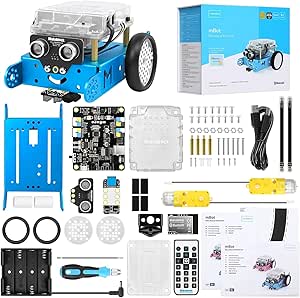 | Best Coding Starter | Brand: Makeblock | Model: 90053 | Recommended Age: 8 years and up | VIEW LATEST PRICE | See Our Full Breakdown |
| Butterfly EduFields 10-in-1 STEM Electronics Robotics Kit for Kids Ages 8-12 |  | Best Multi-Project Value | Recommended Age: 8–12 years | Number of Projects: 10 in 1 | Components: 100+ (wires, switches, connectors, LED lights) | VIEW LATEST PRICE | See Our Full Breakdown |
| robotics kits for kid | Recommended age | Brand |
|---|---|---|
| Snap Circuits Jr. SC-100 Elect | 8 years and up | — |
| BeAndge 6-in-1 STEM Robotics K | 8–12 years | — |
| Smartivity Robotic Mechanical | — | Smartivity |
| Thames & Kosmos My Robotic Pet | 8+ with adult help; 12+ independent | — |
| Sillbird STEM 5-in-1 Robot Bui | 8–13 years | — |
| Klutz LEGO Gear Bots Science/S | 8-12 years | — |
| Sillbird 12-in-1 Solar Robot B | 10 years and up | Sillbird |
| Thames & Kosmos Mega Cyborg Ha | — | Thames & Kosmos |
| Butterfly EduFields 40-in-1 ST | — | Butterfly EduFields |
| EggTailz Smart Robot Car Kit | 8+ years | EggTailz |
| ELEGOO UNO R3 Smart Robot Car | 12 years and up | ELEGOO |
| Robot Arm Kit | — | — |
| Makeblock mBot STEM Coding Rob | 8 years and up | Makeblock |
| Butterfly EduFields 10-in-1 ST | 8–12 years | — |
More Details on Our Top Picks
Snap Circuits Jr. SC-100 Electronics Kit
Unlike the build-a-robot kits in this lineup, Snap Circuits Jr. teaches kids how actual electricity flows through color-coded, snap-together components on a plastic grid—no soldering, no tools, no glue. With over 100 illustrated projects, this option stands out for sheer volume: compared with the Smartivity Robotic Hand, which produces one finished model, the SC-100 keeps rotating through fresh builds for months. The tradeoff is that the payoff is functional rather than toy-like—kids make fans spin and lights flash rather than pilot a remote-controlled dinosaur like the Sillbird 5-in-1 kit. This pick makes the most sense for families who want foundational electronics literacy before jumping into programmable robots.
Pros:- Over 100 hands-on electronics projects with illustrated instructions
- Color-coded, numbered parts make assembly forgiving for beginners
- No soldering or extra tools required
- Teaches genuine circuit concepts rather than just assembly
Cons:- Requires batteries that must be supplied separately
- Finished projects are functional demos rather than durable toys kids can play with long-term
Best for: Kids aged 8 and up who are brand new to electronics and parents who want a low-mess, tool-free introduction to circuits
Not ideal for: Children who expect a moving, playable robot at the end—this kit is about circuitry, not remote-controlled play
- Model:SC-100
- Projects:100+
- Recommended age:8 years and up
- Components:28–32 snap-together electrical parts
- Included items:Plastic snap-grid, electrical components, project manual
- Assembly:Snap-together; no soldering or tools
- Batteries:Required
Our verdict“The clearest on-ramp to real electronics for beginners, as long as your child values learning over a flashy robot to drive around.”
BeAndge 6-in-1 STEM Robotics Kit
Where most kits here deliver a single robot, BeAndge’s 6-in-1 set spreads its value across a reptile robot, balance car, bubble machine, fiber lamp, and buzzer wire game—six separate builds for the price of one. Compared with the Sillbird 5-in-1 kit, you lose app control and a rechargeable battery, but you gain genuinely different project types, including a buzzer game that plays more like a party activity than a build-and-shelf model. The catch is real friction: batteries and bubble solution are not included, so the first build session can stall if you haven’t stocked up. This option makes the most sense for gifting or sibling households where several kids can build different projects at once.
Pros:- Six genuinely different projects rather than variations on one robot
- Includes a mini screwdriver and step-by-step instructions
- Mixes robot builds with playable games like the buzzer wire challenge
- Affordable way to sample multiple STEM activities
Cons:- AA batteries and bubble solution must be purchased separately
- Build quality and longevity trail single-focus kits like the Sillbird 5-in-1
Best for: Budget-conscious gift-givers and multi-kid households wanting several distinct projects without buying multiple kits
Not ideal for: Parents who want everything in the box on day one—the missing batteries and bubble solution mean an extra store run
- Project count:6-in-1 STEM kit
- Included projects:Reptile robot, balance car, bubble machine, fiber lamp, buzzer wire game
- Recommended age:8–12 years
- Included tools:Mini screwdriver
- Power:AA batteries (not included)
- Additional supplies:Bubble solution (not included)
Our verdict“The best value-per-project pick in the roundup if you don’t mind supplying batteries and a bottle of bubble solution.”
Smartivity Robotic Mechanical Hand STEM Building Toy
This engineered-wood mechanical hand takes a different path from the electronics-heavy kits here: there are no batteries, apps, or remotes, just gears, linkages, and patience. Compared with the Thames & Kosmos Coding Chameleon, the Smartivity hand trades sensors and programmable reactions for pure mechanical understanding—kids see exactly how finger tendons work because they built the mechanism themselves. The standout feature is a lifetime supply of replacement parts, which no other kit in this roundup matches and which matters for a wooden build that can crack during reassembly. The tradeoff is a single finished model with a shorter play tail than the Sillbird 5-in-1’s five rebuildable robots, and assembly takes real time and care.
Pros:- Fully screen-free and battery-free STEM learning
- Lifetime supply of replacement parts for a wooden build
- Step-by-step instructions make an impressive, displayable finished model
- Wide 8–14 age range with genuine mechanical lessons
Cons:- Assembly is required and takes substantial time and fine motor skill
- Only one model—less replay value than multi-build kits like the BeAndge 6-in-1
Best for: Parents who want a completely screen-free, battery-free build that teaches mechanical engineering and anatomy
Not ideal for: Kids who want app control, lights, or multiple models—this is one wooden hand with no electronics at all
- Brand:Smartivity
- Model:SMRT1135
- Age range:8–14 years
- Material:Engineered wood
- Educational focus:STEM / mechanical engineering
- Power:None required
- Replacement parts:Lifetime supply included
Our verdict“A rewarding mechanical build for patient kids and screen-limiting households, provided one model is enough.”
Thames & Kosmos My Robotic Pet: Coding Chameleon Kit
This 15-inch robotic chameleon solves a problem most coding kits ignore: how to teach programming logic without parking a kid in front of a tablet. Instead of the Sillbird 5-in-1’s Bluetooth app, kids program behavior using physical colored action cards read by the chameleon’s color sensor, plus three play modes (Coding, Wild, and Pet) that keep the toy alive after the build. The gestures, color-changing RGB lighting, and snapping tongue give it more personality than anything else in this batch. Compared with the Snap Circuits Jr., it’s a far bigger conceptual jump—real sensors, real outputs, real sequencing—but the tradeoff is assembly complexity, with adult help recommended under age 12 and a single build rather than multiple projects.
Pros:- Screen-free coding via physical colored action cards
- Three distinct play modes extend life beyond the initial build
- Color and infrared sensors plus RGB lighting create real reactive behavior
- 48-page manual teaches genuine robotics and engineering concepts
Cons:- Assembly typically requires adult help for children under 12
- Single model with no rebuild variations, unlike multi-project kits
Best for: Kids 8+ (with a helping adult) or 12+ solo who want real coding logic without screen time
Not ideal for: Younger builders working alone—the build and card-sequencing logic may frustrate without adult help
- Product type:Robotic building and coding kit
- Length:15 inches
- Recommended age:8+ with adult help; 12+ independent
- Play modes:Coding, Wild, and Pet
- Sensors:Color and infrared
- Lighting:RGB LEDs
- Coding method:Physical colored action cards
- Guide:48-page manual
Our verdict“The best introduction to genuine coding concepts without a screen, best for families where an adult can assist the build.”
Sillbird STEM 5-in-1 Robot Building Kit with Remote Control
This is the pick that best balances build depth, replay value, and playability. With 488 pieces and five models—robot, dinosaur, car, tank, and more—the Sillbird kit offers progressive difficulty that younger kids can grow into, then keeps them engaged with remote and Bluetooth app control, basic programming, and path planning. Compared with the BeAndge 6-in-1, it trades project variety for a far more polished play experience: one motorized model kids actually drive and code, backed by a rechargeable battery that spares you the AA treadmill most kits here demand. The tradeoffs are honest ones—roughly 40 minutes of play per charge, and a 488-piece assembly that eight-year-olds will likely need help starting. If you’re buying one kit for a kid who wants to build and keep playing, this is it.
Pros:- Five buildable models with progressive difficulty levels
- Dual remote and app control with programming and path-planning features
- Rechargeable battery eliminates constant battery replacement
- Clear, colorful instructions support mostly independent building
Cons:- Up to 40 minutes of play per charge may feel short for long sessions
- 488-piece assembly is demanding for younger kids without adult help
Best for: Kids 8–13 who want to build a robot and then actually drive and program it, with room to grow across five models
Not ideal for: Impatient young builders—the 488-piece assembly can frustrate without an adult’s help early on
- Pieces:488
- Models:5-in-1 (robot, dinosaur, car, tank, and more)
- Recommended age:8–13 years
- Control modes:Bluetooth app and remote control
- Programming:Basic coding and path planning via app
- Play time:Up to 40 minutes per charge
- Battery:Rechargeable
Our verdict“The strongest all-around choice for a kid who wants serious building plus ongoing remote-controlled, programmable play.”
Klutz LEGO Gear Bots Science/STEM Activity Kit
This option stands out for blending a familiar building system with genuine engineering education. Kids construct 8 kinetic creatures from LEGO Technic bricks and papercraft, while a 64-page book explains cams, cranks, and axles alongside the builds. Compared with the Sillbird 12-in-1 Solar Robot Kit, which focuses on renewable energy, this kit digs into the mechanics behind everyday machines, making the physics feel more concrete. Since all LEGO elements are included, there’s no hunting for spare parts mid-build. The tradeoff is durability: the papercraft bodies will crease and tear with repeated play, so this is more a build-and-learn experience than a long-term toy.
Pros:- All LEGO elements included — nothing extra to buy
- 64-page instruction book weaves real physics concepts into each build
- Screen-free activity that works well for solo or parent-child time
- LEGO Technic familiarity lowers the barrier for first-time builders
Cons:- Papercraft components tear and degrade with handling
- Content skews narrow to the 8-12 range — younger kids will struggle, older kids may find it simple
Best for: Kids ages 8-12 who already love LEGO and want a screen-free, book-guided introduction to mechanical engineering
Not ideal for: Families seeking a durable, repeatedly playable robot — the papercraft parts wear out and the builds are mostly display pieces
- Recommended Age:8-12 years
- Buildable Models:8 kinetic creatures
- Guide Book:64 pages
- Materials:LEGO Technic bricks and papercraft
- Power Source:Hand-cranked mechanical motion
- Model Number:9781338603453
Our verdict“A smart pick for LEGO-loving kids who learn best by reading and building rather than coding or controlling.”
Sillbird 12-in-1 Solar Robot Building Kit
Twelve robots from 190 pieces at a modest price point makes this one of the strongest value plays in the roundup. The solar power system means no batteries to buy or recharge, and the upgraded larger panel generates enough torque to make builds genuinely move outdoors. Where the Klutz Gear Bots kit teaches mechanics through one style of build, Sillbird’s tiered difficulty lets a child start simple and work up to advanced robots as skills grow. The catch: the sun dependency cuts both ways. Indoors, a strong flashlight becomes mandatory equipment, and on cloudy days the robots simply sit still, which frustrates kids expecting instant results.
Pros:- 12 models across beginner-to-advanced difficulty extend replay value
- Solar operation teaches renewable energy with zero battery costs
- Larger upgraded panel delivers noticeably stronger power output
- Clear instructions support independent assembly for older kids
Cons:- Indoor use requires a strong artificial light source that isn’t included
- Younger children will likely need adult help on the advanced builds
Best for: Budget-minded parents who want a rebuild-heavy kit that teaches renewable energy and grows with a child’s ability
Not ideal for: Households with mostly indoor play time — without reliable direct sunlight or a strong lamp, the robots won’t run
- Brand:Sillbird
- Number of Pieces:190
- Buildable Models:12
- Power Source:Solar panel or strong artificial light
- Recommended Age:10 years and up
- Model Number:US-SB-SolarRobot
Our verdict“The best low-cost pick for patient kids who can take their robot outside to actually see it work.”
Thames & Kosmos Mega Cyborg Hand STEM Experiment Kit
Rather than building something a child watches move, this kit puts the robot on their own arm. The Mega Cyborg Hand runs on air pressure, water, and hydraulic pistons — no motors or batteries anywhere — and reconfigures into a right hand, left hand, or claw. Compared with the Smartivity Robotic Mechanical Hand, this model offers more adaptability, fitting virtually any hand size with adjustable finger joints. It’s a vivid demonstration of how industrial pneumatics actually work, which is rare in this price class. The realistic tradeoff: grip strength is limited compared with motorized kits like the EggTailz robot car, and younger kids will need an adult during the fiddly assembly.
Pros:- Completely battery- and motor-free operation via hydraulics and pneumatics
- Three configurations (right hand, left hand, claw) keep the build fresh
- Adjustable sizing fits nearly any hand, so siblings and parents can share it
- Award-winning design (2021 STEAM Toy of the Year) with real engineering depth
Cons:- Gripping power falls short of motorized robotic hands
- Assembly is complex enough that younger children need adult assistance
Best for: Kids fascinated by how machines mimic the human body who want a wearable, show-off-worthy STEM project
Not ideal for: Kids who want a robot that drives, races, or performs — this is a stationary gripping demonstration, not a vehicle
- Power Source:Hydraulic/pneumatic — no batteries or motors
- Configurations:Right hand, left hand, claw-like
- Adjustability:Fits virtually any hand; adjustable finger joint angles
- Recognition:2021 The Toy Association’s STEAM Toy of the Year
- Brand:Thames & Kosmos
Our verdict“A memorable, wearable engineering lesson best suited to kids who love biology-meets-machines projects.”
Butterfly EduFields 40-in-1 STEM Robotics Kit for Kids
With over 40 projects and 100+ components, this kit offers more experiments per dollar than anything else in the lineup. Kids build a line-following car, drawing robot, and home automation gadgets using reusable sensors — all with plug-and-play assembly that requires no soldering or coding. That last point is the key differentiator from the ELEGOO UNO R3 Smart Robot Car, which demands real programming; here, an 8-year-old can complete circuits independently. The quirky drawback is real, though: Duracell AA batteries are incompatible with the included holder, a frustrating fine print that catches many families off guard. Stock up on another brand before the box arrives.
Pros:- 40+ projects spanning robotics, sensors, and home automation
- Over 100 components with reusable sensors across builds
- No soldering or coding required, opening it to younger builders
- Includes instructions and concept manuals explaining the science
Cons:- Requires AA batteries that must be purchased separately
- Duracell batteries specifically don’t fit the included battery holder
Best for: Curious kids who want maximum variety — robotics, electronics, and smart-home projects — without needing to code
Not ideal for: Families already stocked with Duracell batteries, or kids ready to move into real programming — this kit stays at the no-code level
- Brand:Butterfly EduFields
- Age Range:8-17 years
- Projects:40+
- Components:100+
- Sensors:IR, flame, touch, LDR, and others
- Assembly:Plug and play; no soldering or coding
- Power:AA batteries (Duracell incompatible)
- Model Number:SKU504
Our verdict“The best choice for breadth — a child who wants to try many project types before committing to coding.”
EggTailz Smart Robot Car Kit
This kit splits the difference between pure building toy and programmable platform. After assembly, kids get a self-balancing 2WD car with ultrasonic obstacle avoidance, working headlights, and two play modes: autonomous Auto-Go cruising or full remote control with 360-degree rotation. Compared with the Butterfly EduFields 40-in-1 kit, there are fewer projects, but each one delivers a livelier payoff — a robot that drives itself around furniture. The built-in rechargeable battery (2-hour charge, up to 4 hours of play) also avoids the battery-buying friction that plagues several kits here. Be realistic about the build: the illustrated tutorial and videos help, but first-timers under 10 will need a parent alongside them.
Pros:- Self-balancing 2WD chassis with radar obstacle avoidance feels genuinely high-tech
- Dual modes: autonomous Auto-Go plus full remote control with 360-degree spins
- Built-in rechargeable battery avoids ongoing battery costs
- Illustrated tutorial and video instructions make first assembly approachable
Cons:- Kids with no robotics experience will need parental help during assembly
- Remote control requires separate AA batteries
Best for: Kids who want an end result they can actually drive and show off, with autonomous mode as the wow factor
Not ideal for: Families wanting multiple rebuilds or coding progression — this is one car, and the programming ceiling is low compared with the ELEGOO UNO kit
- Brand:EggTailz
- Recommended Age:8+ years
- Drive System:2WD self-balancing
- Play Modes:Auto-Go autonomous and Remote Control
- Obstacle Avoidance:Ultrasonic radar
- Lights:Headlights, taillights, top ring-light
- Battery:Built-in rechargeable — 2-hour charge, 1-4 hours playtime
- Remote Batteries:2 AA (included)
Our verdict“The pick for a kid whose motivation comes from watching their build drive itself across the living room floor.”
ELEGOO UNO R3 Smart Robot Car Kit V4 with Camera
This is the most technically ambitious kit in this batch, and it earns that distinction by teaching genuine Arduino programming rather than simplified drag-and-drop coding. The FPV camera driven by an ESP32-WROVER module lets a kid pilot the car from a phone while watching live video — a feature none of the other picks here offer. Compared with the Makeblock mBot, which assembles in about 15 minutes, this kit demands real assembly and writing code in the Arduino IDE, so the payoff is bigger but the ramp is steeper. Line-tracking and ultrasonic sensors give it projects beyond remote driving. The tradeoff: this is a commitment, not an afternoon toy, and most 12-year-olds will need an adult nearby for the first build.
Pros:- FPV camera streaming gives the car a genuinely exciting remote-piloting experience
- Teaches actual Arduino IDE programming, a real skill beyond toy-level coding
- Line-tracking and ultrasonic obstacle-avoidance sensors support many guided projects
- Rechargeable 2000 mAh battery included, unlike battery-hungry alternatives
Cons:- First-time builders will likely need adult help with assembly and setup
- Requires learning the Arduino IDE, which is a real hurdle for beginners
Best for: Teens 12 and up who already show interest in coding and want a bridge toward real electronics and Arduino development
Not ideal for: Younger kids or families looking for a quick build-and-play toy — the programming requirement makes it frustrating without adult guidance
- Brand:ELEGOO
- Model:US-EL-KIT-012
- Controller:UNO R3
- Camera and Wi-Fi Module:ESP32-WROVER-based
- Sensors:Line-tracking and ultrasonic
- Battery:2000 mAh rechargeable lithium-ion
- Control Methods:App and IR remote
- Recommended Age:12 years and up
- Warranty:Half year
Our verdict“Buy this for a motivated teen who wants authentic programming experience, not for a child expecting instant play out of the box.”
Robot Arm Kit – STEM Robotics Building Set for Kids, Teens & Adults
Most kits in this roundup put a kid behind a remote control; this one puts them inside the machine. Building a robotic arm from wooden parts forces an understanding of how motors translate into motion — a lesson wheeled robots like the ELEGOO Smart Robot Car never quite deliver. The solder-free design means the electrical work stays safe and approachable, while the PCB microcontroller board introduces circuit logic without specialized tools. Compared with the Smartivity Robotic Mechanical Hand, this kit goes further by adding real electrical engineering on top of mechanical assembly. The honest tradeoff: it is a focused, single-project build with no app, no sensors, and no programming, and the six AA batteries arrive separately.
Pros:- Teaches how circuits drive mechanical movement, a foundation most kits skip
- No soldering required, so the electrical side stays safe for beginners
- Challenging 3D-puzzle assembly builds patience and problem-solving skills
- Wide age appeal makes it a build a parent and child can tackle together
Cons:- Six AA batteries are not included
- Assembly can be complex for younger children without adult help
Best for: Kids 8 and up — and even adults — who learn best by understanding how motors, circuits, and joints physically work together
Not ideal for: Kids who want app control, sensors, or coding — this is a pure mechanics-and-circuits build with no programmable features
- Age Range:8 years and up
- Power Source:6 AA batteries (not included)
- Materials:Wood
- Assembly Required:Yes
- Soldering Required:No
- Includes:Motors, PCB microcontroller board, wires, assembly tutorial
Our verdict“This pick makes the most sense for families who value deep mechanical understanding over flashy app-driven features.”
Makeblock mBot STEM Coding Robot Kit for Kids Ages 8–12
The mBot nails the balance that most beginner kits miss: it builds fast, codes visually, and leaves room to grow. Scratch-based block programming lets an 8-year-old animate the robot within an hour, while Arduino support means the same kit still matters years later — a flexibility the Butterfly EduFields 10-in-1 kit can’t match with its fixed projects. Its 15-minute assembly time stands in sharp contrast to the ELEGOO car’s involved build, making it far better suited to younger kids working independently. Expansion into 100+ compatible electronic modules turns this from a toy into a platform. The main drawback is mundane but real: you’ll need to supply four AA batteries and a coin cell for the remote before anything moves.
Pros:- Scratch block coding is approachable for beginners, with Arduino as a growth path
- Assembles in about 15 minutes, so kids reach the fun quickly
- Line following, obstacle avoidance, and remote control provide immediate play value
- Expandable with 100+ Makeblock electronic modules and 500+ platform parts
Cons:- All required batteries are excluded from the box
- Base kit’s sensor set is basic compared with camera-equipped options like the ELEGOO car
Best for: Kids ages 8–12 new to coding who want a fast, friendly entry point that won’t be outgrown in a season
Not ideal for: Buyers wanting an all-inclusive box — batteries are not included, and tinkerers after advanced sensors may find the base kit limited
- Brand:Makeblock
- Model:90053
- Recommended Age:8 years and up
- Programming Platforms:Scratch and Arduino
- Assembly Time:About 15 minutes
- Functions:Remote control, line following, obstacle avoidance
- Power Requirements:4 AA batteries plus 1 CR2025 (not included)
- Compatibility:100+ electronic modules and 500+ Makeblock parts
Our verdict“For a first programmable robot that a child can build solo and grow into, the mBot is the strongest starting point in this lineup.”
Butterfly EduFields 10-in-1 STEM Electronics Robotics Kit for Kids Ages 8-12
Where the Makeblock mBot concentrates on one robot done well, this kit spreads its budget across ten separate builds from a shared pool of 100+ components. That variety is the whole point: a child who tires of one model can dismantle and rebuild it as something new, which keeps the kit alive through many weekends. The illustrated step-by-step manual and roughly 15-minute build times make it genuinely independent-play friendly for the 8–12 range, and sensor functions like line-following add unexpected capability at this level. Compared with the larger Butterfly EduFields 40-in-1 kit, this version is less overwhelming for first-time builders. The flip side of simplicity is a ceiling — older kids who’ve already mastered Scratch or Arduino will outgrow these projects quickly.
Pros:- Ten distinct projects from one 100+ piece component set keeps replay value high
- Clear illustrated instructions allow kids to build without constant adult help
- Quick 15-minute builds suit shorter attention spans
- Line-following and obstacle-avoidance features exceed typical entry-level kits
Cons:- Small components mean younger kids need adult supervision
- Project complexity caps out early for experienced builders
Best for: Families wanting maximum build variety per dollar for a child ages 8–12 who is new to electronics
Not ideal for: Older or advanced builders — the projects are designed for beginners and will feel too simple
- Recommended Age:8–12 years
- Number of Projects:10 in 1
- Components:100+ (wires, switches, connectors, LED lights)
- Features:Line-following, obstacle-avoidance, multi-function sensor control
- Assembly Time:Approximately 15 minutes per build
- Includes:Step-by-step illustrated instruction manual
Our verdict“This option stands out for variety-hungry beginners who would rather build ten simple models than master one complex robot.”

How We Picked
I evaluated each kit against four buyer-relevant criteria: age-appropriate usability (can an 8-year-old actually finish a build without constant adult rescue), learning depth (does it teach real concepts like circuits, gearing, or code, or just snap-together novelty), replay value (what happens after the first build), and build quality relative to cost. Programmable kits got extra scrutiny on software experience — clunky apps and fragile Bluetooth connections sink otherwise good hardware.
Ranking favors kits that grow with the child. A kit that teaches one satisfying lesson and then dies on a shelf ranked below kits with multi-project designs or code that scales in difficulty. I also weighed practical realities parents face: assembly time, small-part durability, battery appetite, and whether the instruction manual is genuinely clear or a translation headache. Products are ordered so the top picks balance all four criteria, while lower-ranked entries still earn a spot for specific situations where they outperform the leaders.
Factors to Consider When Choosing Robotics Kits For Kids
Before picking a specific kit, it helps to understand what actually separates a robotics kit that gets played with for months from one that lands in the closet after a weekend. These are the factors that shaped my ranking — and the mistakes I saw repeated across this category.Build-Only vs. Programmable: Match the Kit to the Kid
The single biggest decision is whether your child wants to build things or program things. Mechanical kits like the Smartivity hand or Klutz Gear Bots deliver the satisfaction of physical construction and teach gearing and levers, but once built, they’re done. Programmable kits flip this: initial assembly is simpler, but the learning curve extends through coding apps for months. A common mistake is buying a coding robot for a kid who just loves assembling LEGO — the code becomes a chore. The reverse also fails: a builder who craves interactivity will find a static model boring within an hour. Watch how your child plays before buying, not after.
Age Ratings Are Suggestions, Not Guarantees
Manufacturer age ranges in this category run optimistic, often by two years. An ‘8+’ coding kit frequently assumes reading fluency, fine motor precision, and frustration tolerance that many 8-year-olds don’t yet have. Kits with pre-cut or snap-fit parts (Snap Circuits, Klutz) genuinely match their age ratings, while wire-stripping and screw-terminal kits (ELEGOO, the Robot Arm Kit) realistically need a teen or an involved adult. My rule of thumb: for every ‘STEM engineering’ kit with tiny screws and wiring harnesses, add two years to the printed age. When in doubt, buy slightly below your child’s age range — confidence from finishing an easier build beats abandoning a hard one.
The Hidden Costs: Batteries, Apps, and Replacement Parts
Many kits in this price band ship without batteries, and motorized builds with remote controls can drain AAs fast — factor this into the true cost. App-based kits add another hidden dependency: if the companion app is buggy, abandoned by the developer, or incompatible with your tablet’s OS version, the robot becomes a paperweight. Before buying any Bluetooth or Wi-Fi kit, check the manufacturer’s app update history. Also consider parts availability: LEGO-based and Makeblock products have robust replacement ecosystems, while generic-brand kits with proprietary plastic parts don’t. One stripped gear can end a budget kit’s life permanently.
Instruction Quality Determines Success Rate
The difference between a kit that gets built and one that gets returned is almost always the manual. The best kits in this roundup use step-by-step visual instructions with numbered part bags and exploded diagrams. The worst use dense translated text with low-contrast photos, and parents end up reverse-engineering the build on YouTube at 10 p.m. This matters more for multi-project kits: a 12-in-1 or 40-in-1 kit means rebuilding from scratch each time, and if teardown isn’t well documented, most kids stop after the second configuration. If your household has no patient adult available during builds, prioritize brands known for clear documentation over raw project count.
Project Count Is a Marketing Number, Not a Value Number
A ’40-in-1′ kit sounds like four times the value of a 10-in-1, but the reality is that many configurations are minor variations — a different wheel arrangement or sensor placement counted as a ‘new robot.’ What actually predicts lasting value is depth per project: does one build teach a new mechanism or code concept? The Makeblock mBot is technically one robot, yet its coding platform generates effectively unlimited projects. When comparing kits, ask whether the projects teach escalating skills or just reshuffle the same parts. Fewer, better builds almost always beat more, shallower ones.
When to Spend More — and When It’s Wasted
Paying more makes sense when it buys real coding scalability (Scratch-to-Python pathways), durable metal or quality ABS construction, or an active manufacturer ecosystem. It’s wasted on a first kit for a child who hasn’t shown sustained interest in STEM — a sub-$40 mechanical kit tests the waters just as well. The premium tier in this lineup (ELEGOO, Robot Arm, mBot expansions) only pays off for kids who’ve already burned through a simpler kit and asked for more. A reasonable progression: start with Snap Circuits or a Sillbird build kit around age 8, move to mBot for coding around 9–10, then graduate to Arduino-based kits by middle school if the interest holds.
Frequently Asked Questions
What’s the best robotics kit for a child who has never built one before?
For a true beginner around age 8, snap-together kits remove the failure points that derail first projects. The Snap Circuits Jr. SC-100 is the safest starting point because parts click onto a board with no screws, no wiring errors, and no app setup — a child can complete the first project in under ten minutes, which builds the confidence to keep going. The Makeblock mBot is the best first coding robot, since assembly takes roughly 30 minutes and the block-based app works immediately after. I’d avoid Arduino-based kits like the ELEGOO car as first kits; wiring errors at that stage tend to end the hobby rather than teach resilience. Start simple, and let the child’s interest justify upgrading.
Are solar-powered robot kits actually good, or just a gimmick?
Solar kits like the Sillbird 12-in-1 teach a genuine renewable-energy lesson, but they come with a practical catch: the small panels need direct sunlight or a strong halogen bulb to generate enough power, and indoor lighting usually won’t move the robot at all. Cloudy winter weekends can mean the kit simply doesn’t work, which frustrates kids who expected a running robot. If you live somewhere sunny and plan to use it outdoors, the concept lands well. If most building will happen at a kitchen table in the evening, a battery-powered kit with a remote control will deliver far more consistent play. Treat solar as an educational bonus, not the primary power plan.
Do I need to know coding or electronics to help my child with these kits?
It depends entirely on the kit tier. Mechanical and snap-circuit kits require zero adult expertise — the manual does the teaching. Coding robots like the mBot use drag-and-drop blocks that most kids figure out faster than their parents, so your role is supervision, not instruction. The exception is Arduino-based kits (ELEGOO, Robot Arm): these involve wiring terminals, uploading code via USB, and troubleshooting when nothing powers on. A non-technical adult can still help by following the manual alongside the child, but expect the first build to take a full afternoon with some trial and error. If neither of you has any coding background, stay in the block-coding tier until it feels limiting.
What’s the difference between a STEM building kit and a true robotics kit?
The line comes down to whether the product senses, decides, or reacts. A mechanical hand or gear-bot is an engineering build — it teaches structures and mechanisms, but it does exactly what your hands make it do. A true robot (mBot, ELEGOO car) carries a controller and sensors, so it can follow a line, avoid obstacles, or respond to code the child writes. Both are valuable, and mechanical kits arguably teach physics more concretely. But if your goal is specifically to prepare a child for programming or robotics competitions, only the programmable tier counts. Marketing blurbs blur this distinction constantly, so check whether the kit includes a programmable brain before buying.
How much should I spend on a first robotics kit?
For a first kit, resist going premium. A child’s sustained interest is the unknown variable, and roughly half of STEM kits lose their appeal within a month regardless of quality — that’s about the child’s evolving interests, not the product. An entry-level mechanical or snap-circuit kit tests the waters cheaply. If the child finishes everything and asks for more, that’s your signal to invest in a programmable kit like the mBot. Spending big upfront on an Arduino kit for an untested interest is the most common regret I see in this category. The one exception: if an older sibling already codes or a parent will co-build, starting at the mBot level directly makes sense.
Conclusion
The right pick here depends almost entirely on who’s unwrapping it. For best overall, the Makeblock mBot is the clear choice — it’s the only kit that takes a child from first build to real Python coding on one platform. For best value, the Snap Circuits Jr. SC-100 delivers more projects per dollar than anything else in the lineup, with zero setup friction. The best premium pick is the ELEGOO UNO R3 Smart Robot Car, which offers genuine Arduino hardware and a camera module for kids serious about learning real electronics. For beginners and younger builders, the Klutz Gear Bots and Smartivity Robotic Hand provide screen-free wins that build confidence before any coding starts. For specific needs: the Thames & Kosmos Coding Chameleon suits kids who want cute over technical, the Sillbird solar kit fits outdoor-loving builders, and the Robot Arm Kit is the best parent-teen joint project. Whatever you choose, buy the tier that matches your child’s demonstrated interest today — the upgrade path will still be there when they’re ready.
Fall Picks
fall essentials
As an affiliate, we earn on qualifying purchases.