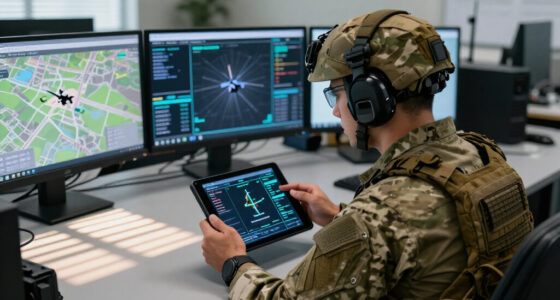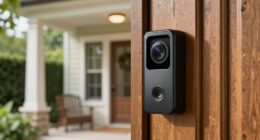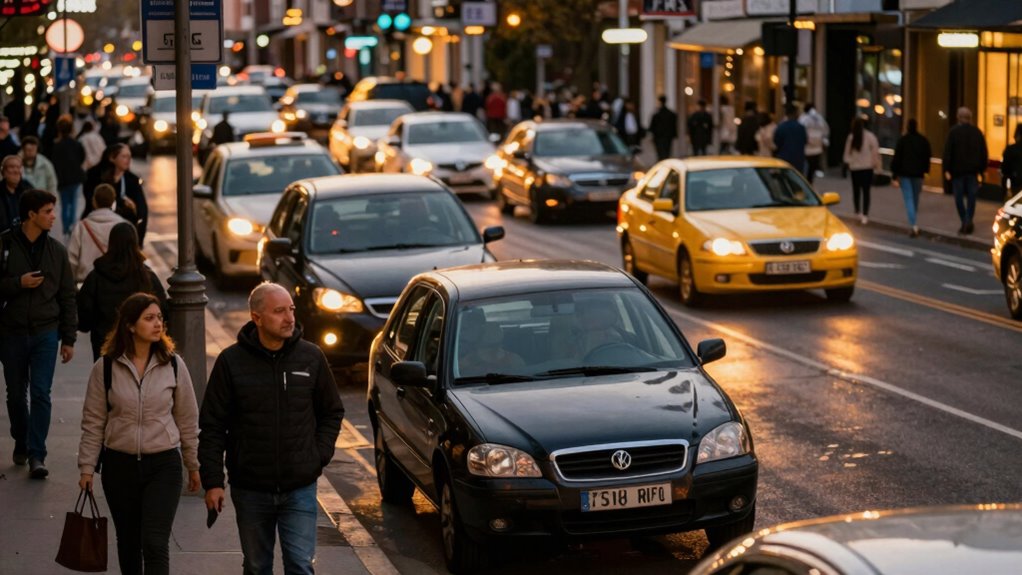

To improve real identification, position your camera at eye level or slightly above. This angle captures facial details clearly and avoids distortions caused by extreme angles. Avoid placing the camera too high or too low, as it can obscure features or create unhelpful shadows. Adjusting the camera angle based on lighting and environment will help you get sharper, more recognizable images. Keep exploring the best setup to maximize recognition accuracy in your specific space.

Prime made for students and young adults
- Fast, free delivery for dorm and study essentials
- Prime Video and Amazon Music included
- Member-only deals
Key Takeaways
- Position cameras at eye level or slightly above to capture natural facial features clearly.
- Avoid extreme angles; prefer angles facing or perpendicular to light sources for better clarity.
- Use slight elevation to prevent distortion and reduce shadows that obscure details.
- Test multiple angles under different lighting conditions to determine the most effective placement.
- Minimize background clutter and shadows by adjusting camera angles for optimal recognition.
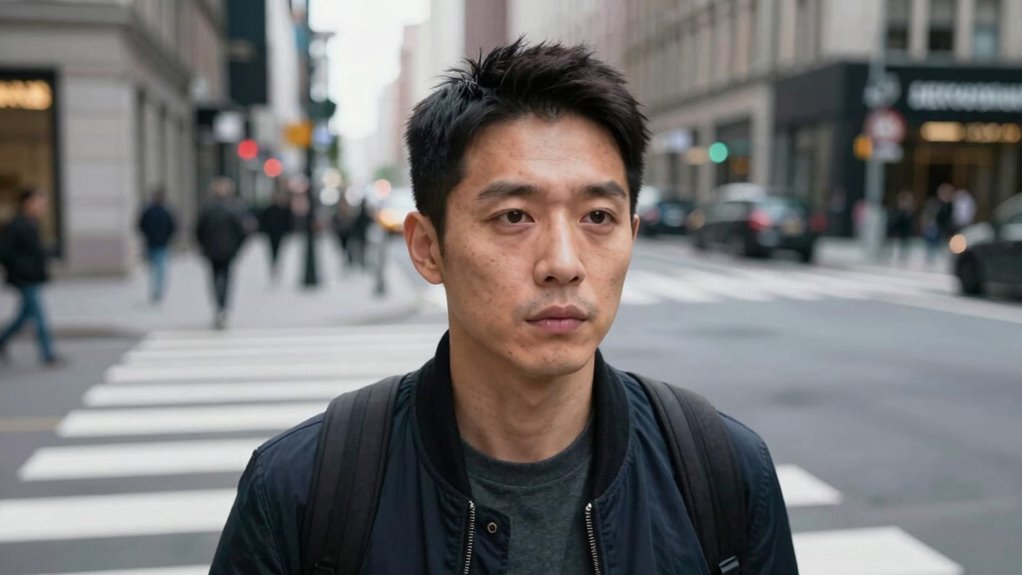
Choosing the right camera placement angle is vital for clear identification. When you’re setting up a security system or surveillance camera, your goal is to capture detailed, recognizable images of individuals or objects. To do that effectively, you need to consider the lighting conditions in the area and how your lens selection impacts image quality. Lighting plays an essential role because poor lighting can obscure facial features or details, making identification difficult even if the angle is perfect. If the light source is behind your subject, you’ll get silhouettes instead of clear images. To avoid this, position your camera so that it faces the light source or is at least perpendicular to it, guaranteeing the subject is well-lit and facial features are visible.
Lens selection also influences how well your camera can identify people. A lens with the right focal length helps you capture sharp images at the necessary distance. For close-up identification, a lens with a narrower field of view, like a telephoto lens, works better because it magnifies details of the face or object. Conversely, if you need to monitor a broad area, a wide-angle lens allows you to cover more ground but might sacrifice some detail. In choosing your angle, think about the lens’s capabilities and how they match the environment. You want to avoid placing the camera too high or too low, as extreme angles can distort facial features or obscure important details. A slightly elevated, eye-level or slightly above eye-level placement often provides the best perspective for recognition. Additionally, understanding how lighting conditions influence image clarity can help you make better placement decisions. Considering environmental factors, such as background clutter or weather, can further optimize your setup for consistent results.
Properly managing camera position in relation to the environment ensures consistent and clear images. It’s also helpful to consider lighting control measures like additional illumination or diffusers to reduce harsh shadows or glare. Remember that shadows cast by objects or people can hide important features, so adjusting the camera’s angle to reduce shadow interference is essential. Additionally, testing different angles during various lighting conditions can reveal how shadows and reflections affect image clarity. Ultimately, experimenting with camera placement helps identify the most effective position for optimal recognition. Overall, balancing ideal lighting, appropriate lens choice, and strategic placement ensures your camera captures the most accurate and identifiable images possible. With careful planning, your setup will markedly improve identification accuracy, making it easier to recognize individuals or objects when it matters most.
security camera with adjustable angle
As an affiliate, we earn on qualifying purchases.
As an affiliate, we earn on qualifying purchases.
Frequently Asked Questions
How Does Lighting Affect Camera Placement for Identification?
Lighting conditions greatly influence camera placement for identification. You should position the camera where it minimizes shadows that can obscure facial features, ensuring even illumination. Proper shadow management means avoiding placement where strong light sources create harsh shadows, which can hinder recognition. By adjusting angles to optimize natural and artificial light, you enhance image clarity, making it easier to identify individuals accurately and reliably.
What Equipment Enhances Camera Angle Effectiveness?
Did you know stable cameras can boost identification accuracy by up to 30%? To enhance camera angle effectiveness, focus on equipment like sturdy tripods for camera stability and choose the right lens—preferably a prime lens with a wide aperture—to improve clarity and focus. These tools guarantee your footage remains steady and sharp, making facial details more recognizable and increasing the chances of successful identification.
Can Camera Placement Prevent Identity Theft?
Camera placement alone can’t prevent identity theft, but it can enhance facial recognition accuracy, making unauthorized access more difficult. Position cameras to clearly capture faces without blind spots, helping systems differentiate individuals effectively. However, you should also address privacy concerns by safeguarding footage and limiting access. Proper placement improves real identification, but combining it with robust security measures is essential to protect against identity theft and guarantee privacy.
How to Adjust Angles for Moving Subjects?
Think of your camera as a skilled dancer adjusting to a moving partner. For moving subjects, use dynamic framing to keep them centered and sharp, while movement compensation technology smooths out jitters and blurs. Tilt or pan smoothly to follow the action, ensuring your footage stays steady and engaging. By actively adjusting angles with these techniques, you capture clear, professional shots that adapt seamlessly to motion, making your footage both compelling and accurate.
What Are Common Mistakes in Camera Positioning?
You often make mistakes in camera positioning by overlooking surveillance ethics and privacy concerns, like placing cameras where they infringe on people’s private spaces or capturing more than necessary. Avoid angles that could invade privacy or create bias, and guarantee your setup respects legal boundaries. Misplaced cameras can lead to ethical issues and legal trouble, so always balance security needs with respect for individual privacy when positioning your cameras.
high resolution outdoor surveillance camera
As an affiliate, we earn on qualifying purchases.
As an affiliate, we earn on qualifying purchases.
Conclusion
By choosing the right camera angle, you set the stage for clearer identification—like a spotlight on a performer. When you position your camera thoughtfully, you turn a blurry scene into a crisp, detailed story everyone can read easily. Think of it as tuning a radio to catch every word; a good angle tunes your camera to catch every detail. So, play around with your angles, and watch your footage become a masterclass in clarity.
As an affiliate, we earn on qualifying purchases.
camera mount for optimal placement
As an affiliate, we earn on qualifying purchases.
As an affiliate, we earn on qualifying purchases.
Fall Picks
fall essentials
As an affiliate, we earn on qualifying purchases.