📊 Full opportunity report: Postpartum Recovery Guides: Finding The Right Fit After Birth on IdeaNavigator AI — validation score, market gap, and execution plan.

Get school and study supplies delivered free — and shop member deals
- Fast, free delivery on millions of items
- Access to Prime Big Deal Days deals on October 6–7
- Prime Video, Amazon Music and more included
TL;DR
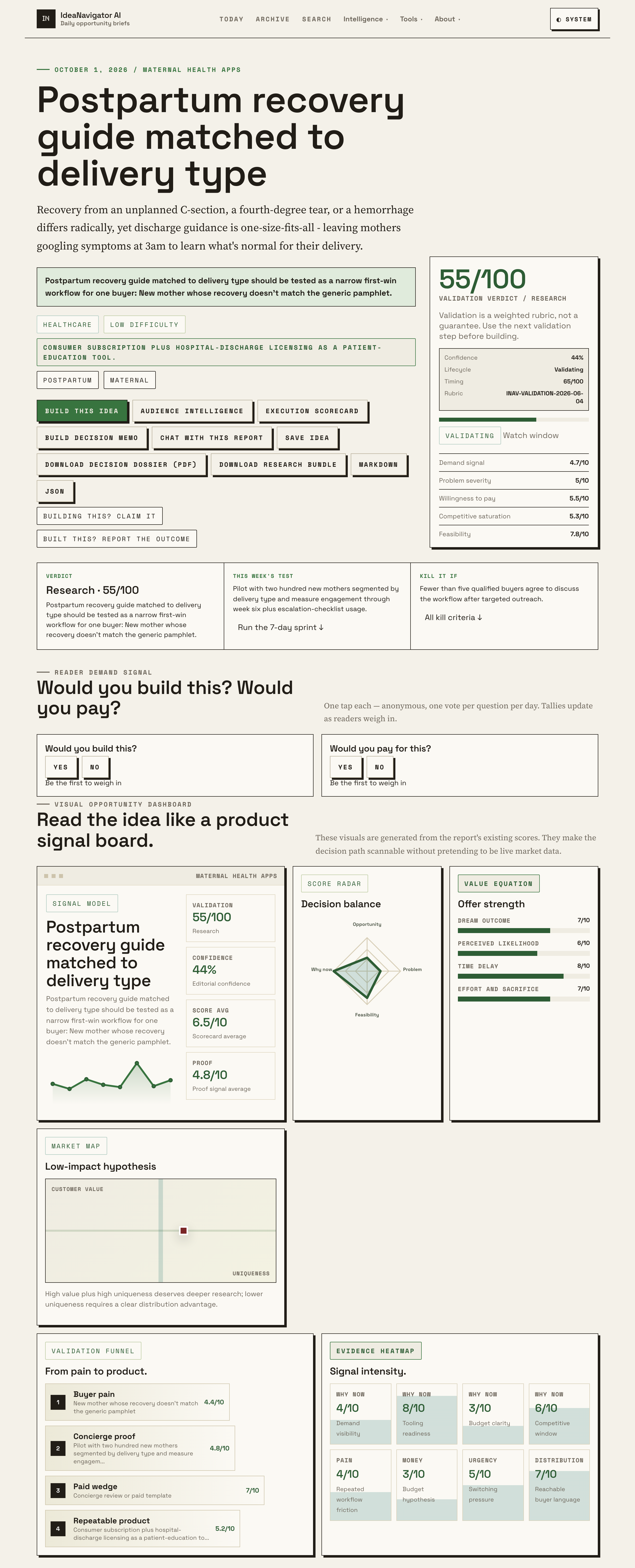
IdeaNavigator AI has proposed testing a postpartum recovery guide that tailors week-by-week information to a mother’s delivery, complications and feeding details. The proposal describes a 200-mother pilot, but provides no evidence that a pilot has begun or that a product is available.
IdeaNavigator AI has proposed a postpartum recovery guide tailored to delivery type and complications, aimed at mothers whose recovery needs may not fit generic discharge information. The concept includes week-by-week expectations, warning-sign checklists and preparation for a six-week visit; the proposal does not establish that a product or pilot is underway.
According to the IdeaNavigator AI proposal, the suggested guide would begin with an intake covering delivery mode, interventions, complications and feeding. It would then provide recovery information matched to that profile, including expected changes by week and checklists of symptoms that may warrant attention. A summary for the six-week appointment is also part of the proposed minimum viable product.
The proposal identifies mothers recovering from an unplanned C-section, a fourth-degree tear or a hemorrhage as examples of people whose circumstances may differ substantially from general guidance. It argues that a broad pamphlet can leave mothers uncertain about what is typical for their own delivery. The proposal does not provide clinical content, name a medical reviewer or specify how the guide would distinguish routine symptoms from urgent warning signs.
For validation, the proposal recommends a pilot with 200 new mothers, segmented by delivery type. Suggested measures are engagement through week six and use of escalation checklists. These are proposed study parameters, not reported results: the source provides no evidence of recruitment, study findings or participant feedback.
Matching Guidance to Recovery Needs
The concept addresses a practical gap between individual recovery experiences and information designed for a broad patient group. Delivery complications and procedures can shape what recovery involves, so a guide organized around a person’s reported circumstances could help her prepare questions and track information relevant to her care.
That potential depends on sound clinical review and clear boundaries. A digital checklist cannot diagnose a complication, and a guide that offers reassurance without suitable escalation advice could mislead users. The IdeaNavigator AI proposal names warning-sign checklists but does not explain their clinical basis, how urgent concerns would be handled or whether the material would be reviewed by clinicians.
The proposal outlines two commercial routes: a consumer subscription and licensing to hospitals as a discharge education tool. Those models would reach users in different ways. A hospital might provide the guide as part of discharge, while a subscription would require mothers to find and choose it themselves. The proposal supplies no pricing, hospital commitment or demand data, so commercial viability remains untested.
postpartum recovery guide for C-section
As an affiliate, we earn on qualifying purchases.
As an affiliate, we earn on qualifying purchases.
From Discharge Handout to Tailored Guide
The IdeaNavigator AI proposal describes postpartum care as receiving attention from clinical guidelines that call for individualized follow-up. It does not identify particular guidelines, publication dates or recommendations, so that characterization cannot be checked from the details provided. The proposal also asserts that maternal health apps still tend to treat delivery as a single event type, but supplies no market survey or examples to establish how widespread that approach is.
Its central product premise is narrower than a general postpartum information service: tailor recovery material to delivery details and complications. The proposed user is a new mother who finds that generic discharge material does not match her recovery. The workflow described in the proposal would collect personal details, return information over the first six weeks and help prepare for a follow-up appointment. No app interface, clinical protocol or completed user research is described.
As an affiliate, we earn on qualifying purchases.
Clinical Review and Pilot Status
The IdeaNavigator AI proposal provides no pilot results or launch date. It is not clear whether any mothers, hospitals or clinicians have tested the workflow, or whether the proposed 200-person study has funding or recruitment plans. The proposal also does not say how participants would be recruited, what comparison would be used, or how engagement and checklist use would be defined.
Key product and safety questions remain open. The intake would collect sensitive health information, but the proposal does not address privacy, data retention or access. It does not describe how the guide would be adapted for people with multiple complications, how it would handle incomplete answers, or when it would direct a user to emergency care. The cited guideline trend and market gap are also not supported with named references or independent market evidence in the proposal.
As an affiliate, we earn on qualifying purchases.
Testing the Six-Week Workflow
The next step outlined in the IdeaNavigator AI proposal is a 200-mother pilot that compares engagement and escalation-checklist use across delivery types through week six. Before such a test could establish usefulness, its organizers would need to define the guide’s clinical review process, participant safeguards, measures and handling of urgent symptoms. Those details are not yet specified in the proposal.
If testing proceeds, results could help determine whether mothers use delivery-specific guidance and whether hospitals see value in licensing it as patient education. At present, the proposal identifies a product hypothesis and a possible validation method; whether either commercial route will be pursued remains unknown.
postpartum recovery book for new mothers
As an affiliate, we earn on qualifying purchases.
As an affiliate, we earn on qualifying purchases.
Key Questions
Is the postpartum recovery guide available now?
No availability is reported. The IdeaNavigator AI proposal describes a product concept, and gives no release date.
What information would the guide use?
According to the proposal, the intake would collect delivery mode, interventions, complications and feeding details to tailor recovery expectations and checklists.
Has the proposed 200-mother pilot started?
The proposal does not say that it has started. It recommends a pilot and describes engagement through week six and checklist use as measures.
Would the guide replace medical advice?
The proposal presents it as a patient-education tool, but does not specify clinical oversight or how it would direct users with urgent symptoms. It does not establish that the guide can replace advice from a healthcare professional.
Source: IdeaNavigator AI
Halloween Picks
halloween
As an affiliate, we earn on qualifying purchases.