🔍 Read the full analysis: Running Local AI On A 32 GB Mac Mini: Uses And Limits on ThorstenMeyerAI.com

Prime made for students and young adults
- Fast, free delivery for dorm and study essentials
- Prime Video and Amazon Music included
- Member-only deals
TL;DR
Apple’s Mac mini lineup offers configurations with up to 64GB of unified memory, while the 32GB M6 model can accommodate some mid-sized models at reduced precision. Published memory requirements show that model weights are only part of the load: macOS, other apps and long context windows need additional memory. Local use can offer privacy and avoid per-token charges, but large models and faster generation remain better suited to more powerful hardware or cloud services.
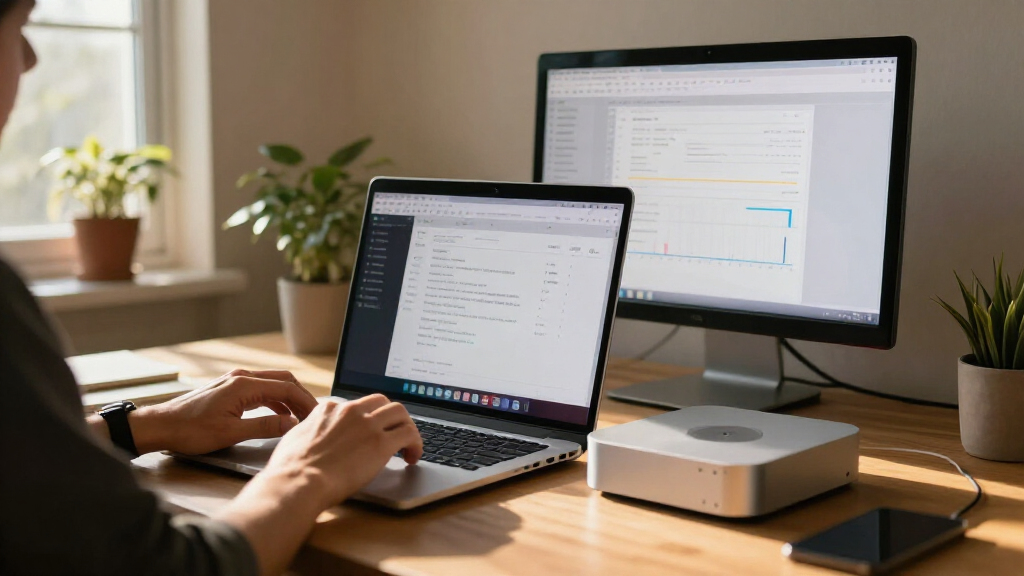
Apple is positioning its Mac mini as a desktop for always-on AI and agentic tools, but the 32GB M6 configuration can run only models that fit alongside macOS, applications and working context. Google’s published figures put its Gemma 4 31B model at 17.5GB at 4-bit precision, while OpenAI says gpt-oss-20b can run within 16GB of memory—evidence that useful local models fit, but not that every model or workload will run comfortably.
The Mac mini’s main advantage for local inference is unified memory: Apple says the CPU and GPU have direct access to the same memory pool. That allows the graphics processor to use more of the machine’s memory than a conventional setup where a GPU has a separate, smaller memory pool. It does not make all of that memory available to a model. The operating system and other applications also use it, and model weights are only part of the total requirement.
Google’s Gemma documentation gives a useful comparison. Its 31B model needs about 17.5GB at 4-bit precision and 34.9GB at 8-bit. The 26B A4B mixture-of-experts model needs 14.4GB at 4-bit, although only four billion parameters are active for each token: Google says all 26 billion parameters still have to be loaded. Lower-precision versions take less memory, with a possible quality trade-off.
Those figures do not include the full cost of a real session. Google says its estimates cover static model weights, and that longer context windows require significantly more memory. A 32GB machine may load a model that leaves less space for long documents, extended conversations or other open applications. OpenAI says gpt-oss-20b runs “within 16GB of memory,” while LM Studio recommends 16GB or more for local use; neither statement guarantees the same speed or headroom across every setup.
Privacy Without Cloud Dependence
Running a model on a desktop can appeal to people who want prompts and files to remain on their own machine, need to work offline, or want to avoid usage-based token charges. These are practical advantages, but they depend on using a local model and compatible software; they do not mean a Mac mini can match a cloud service’s model selection or performance.
Speed is a significant constraint. Apple lists memory bandwidth of 170GB/s for the 32GB M6, compared with 307GB/s for the top M5 Pro configuration. Nvidia lists 3.35TB/s for its H100 SXM data-center GPU. That is roughly 11 times the M5 Pro figure, based on the published specifications. Bandwidth is not a complete benchmark of generation speed, but it helps explain why fitting a model does not mean it will respond as quickly as a service running on data-center hardware.
Cost also varies sharply by configuration. Apple’s listed U.S. price for the 32GB M6 model with 1TB storage is $1,799, while the 64GB M5 Pro configuration with 1TB costs $3,199. Local use avoids a per-token bill, but buyers still pay for the computer, storage and electricity, and should weigh those costs against their expected workload.
Popular right now

Shark Pet Cordless Stick Vacuum, 40-Minute Runtime, Lightweight, IX141

TCL 55-Inch T7 Series 4K QLED Smart Google TV, 55T7

Bose QuietComfort Wireless Noise-Cancelling Headphones, Petal Pink
As an affiliate, we earn on qualifying purchases.
How Memory Shapes Model Choice
Apple announced the current Mac mini on August 25, 2026, describing it as “the leading desktop for always-on agentic computing.” On an April 30 earnings call, chief executive Tim Cook said customer recognition of the Mac mini and Mac Studio as platforms for AI and agentic tools was happening faster than Apple had predicted, according to MacRumors. The source article reports that Apple had also warned it could not build enough units, though the details of that supply warning are not included here.
As listed by Apple on November 16, the M6 Mac mini can be configured with 16GB, 24GB or 32GB of unified memory. The M5 Pro offers 24GB, 48GB or 64GB. The base M6 starts at $899 with 16GB, while the 32GB, 1TB configuration costs $1,799. These prices and configurations are specific to the U.S. list prices cited by the source and may change.
At 16GB, smaller quantized models are the more realistic choice: Google lists Gemma 4 12B at 6.7GB in 4-bit form. At 32GB, the 31B model at 4-bit or the 26B A4B at 4-bit may fit, subject to memory left for the system and context. At 64GB, Gemma 4 31B at 8-bit can fit with some headroom; its 16-bit version requires 69.9GB and exceeds even the largest listed Mac mini configuration.
““the leading desktop for always-on agentic computing””
— Apple, in its Mac mini announcement of August 25, 2026
Real-World Headroom and Speed
Published model-size estimates do not establish how quickly each model will generate responses on a particular Mac mini. Performance can depend on the model build, quantization, software, context length and other tasks using memory. The cited material does not provide standardized benchmarks comparing the 32GB M6 with cloud services or dedicated AI hardware.
It is also unclear how much memory a particular user’s prompts and agent workflow will require. Long documents and conversation histories add to the load, while macOS and other applications reduce the memory available for inference. Apple’s suggested option of connecting Mac minis to run larger models does not, in the cited material, specify expected performance, software requirements or total cost.
Choose Models Before Buying
Prospective buyers should compare the exact model’s memory requirements at the intended precision with the Mac mini’s available memory, then leave room for the operating system, applications and context. The next practical test is to run the intended workflow—not just load the model—and check response speed and memory use with the documents and tools it will actually handle.
Apple’s published specifications set the hardware limits, while model developers’ documentation can change as releases and recommended configurations evolve. Until comparable tests for specific model and software combinations are available, whether a 32GB Mac mini is a good fit depends on the user’s chosen models, desired context length and tolerance for slower responses.
Key Questions
Can a 32GB Mac mini run a 31B AI model?
Google lists Gemma 4 31B at about 17.5GB at 4-bit precision, so its weights can fit in a 32GB system. macOS, other applications and context also need memory, so the published figure does not guarantee comfortable operation for every workload.
Does a model that fits in memory run as fast as a cloud model?
Not necessarily. The cited specifications show substantially lower memory bandwidth for Mac mini chips than for an Nvidia H100 SXM. Bandwidth alone does not determine speed, and the source material provides no direct, standardized response-time comparison.
Why does a long prompt need extra memory?
The model must handle the context of a conversation or document as well as its weights. Google warns that larger context windows require additional memory, so longer inputs can reduce headroom on a 32GB machine.
Which Mac mini configuration offers the most memory?
Apple lists the M5 Pro Mac mini with up to 64GB of unified memory. The cited U.S. configuration with 64GB and 1TB of storage costs $3,199 as of November 16, 2026.
Source: ThorstenMeyerAI.com