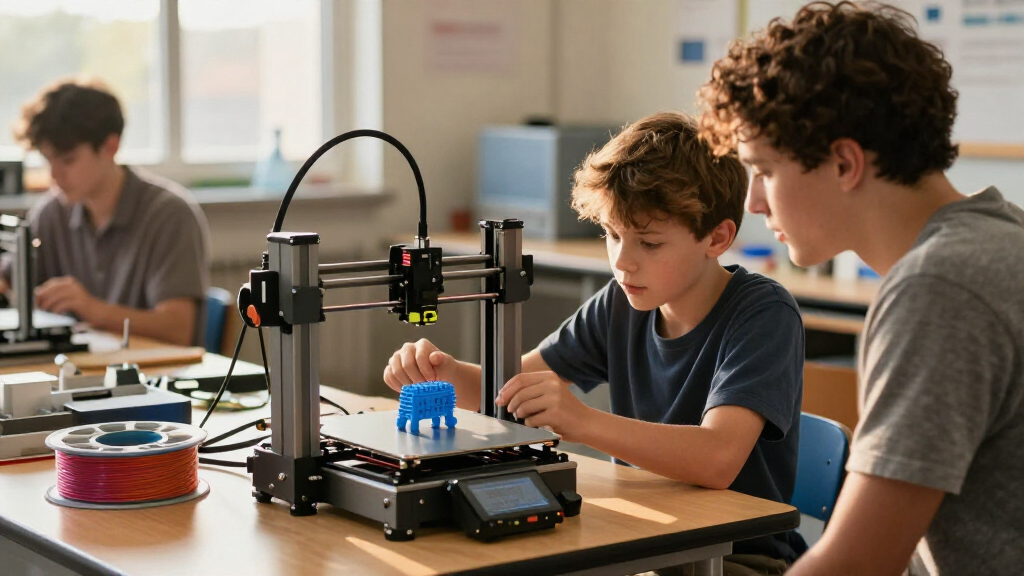
For most classrooms, I’d choose the Bambu Lab P1S Combo for its enclosed design and included multicolor system; the Flashforge Adventurer 5M is a compelling simpler option for quick single-color projects, while the Entina Tina2 Plus suits younger learners who need a compact, ready-to-use machine. Classroom buyers have to balance ease of supervision, student access, print speed, build volume, and the staff time required for upkeep. A feature-rich printer can support ambitious projects, but it may add setup and workflow complexity that a busy teacher doesn’t need. A small beginner model is easier to place and introduce, though it limits the size of student work. Read on for the full comparison and guidance on matching a printer to your students, space, and curriculum.

Prime made for students and young adults
- Fast, free delivery for dorm and study essentials
- Prime Video and Amazon Music included
- Member-only deals
Complete the kit


Key Takeaways
- The P1S Combo is the strongest all-around classroom fit in this lineup for schools that want an enclosure and multicolor printing in one system, while its more involved setup may not suit every beginner program.
- The Adventurer 5M favors straightforward single-color work; it avoids the extra material-management layer of multicolor models, making it a practical contrast to the P1S Combo and the AD5X.
- Several Tina2-family and mini printers prioritize approachability over capacity. Their compact, beginner-oriented designs can work well for demonstrations and younger learners, but are less suited to large class projects.
- Multicolor and multi-tool machines offer different teaching benefits. Color systems such as the Kobra X and AD5X support visual projects, while the Snapmaker U1’s four toolheads offer a different route to material changes but bring greater operational complexity.
- Classroom fit depends on supervision and workflow, not speed alone. Models with features such as an enclosure, AI camera monitoring, or kid-focused controls address different needs; schools should weigh those against maintenance, space, and who will manage the printer.
| Anycubic Kobra X Multicolor 3D Printer |  | Best for Classroom Multicolor Projects | Printer type: FDM 3D printer | Build volume: 260 × 260 × 260 mm | Standard color printing: 4 colors | VIEW LATEST PRICE | See Our Full Breakdown |
| Anycubic Kobra X Multicolor FDM 3D Printer |  | Best for Monitored Print Jobs | Printer type: FDM 3D printer | Build volume: 260 × 260 × 260 mm | Maximum print speed: 600 mm/s | VIEW LATEST PRICE | See Our Full Breakdown |
| Flashforge Adventurer 5M High-Speed 3D Printer |  | Best for Fast Single-Color Prototyping | Printer type and frame: CoreXY FDM printer with aluminum frame and dual linear rails | Build volume: 8.7 × 8.7 × 8.7 inches | Maximum print speed: 600 mm/s | VIEW LATEST PRICE | See Our Full Breakdown |
| Entina Tina2 Plus Fully Assembled 3D Printer |  | Best Compact Pick for Classroom Beginners | Assembly: Fully assembled | Maximum printing speed: 250 mm/s | Hotend: Ceramic; heats up in about 40 seconds | VIEW LATEST PRICE | See Our Full Breakdown |
| Bambu Lab P1S Combo 3D Printer with AMS |  | Best Premium Enclosed Multimaterial System | Model: P1S Combo | Printer design: Enclosed CoreXY | Maximum speed: 500 mm/s | VIEW LATEST PRICE | See Our Full Breakdown |
| Bambu Lab A1 mini 3D Printer with LED Lamp Kit |  | Best for Creative Classroom Projects | Product type: 3D printer with LED Lamp Kit | Dimensions: 15.21 × 16.77 × 17.94 inches | Weight: 12.1 pounds | VIEW LATEST PRICE | See Our Full Breakdown |
| Fully Assembled Mini 3D Printer for Kids and Beginners |  | Best for First-Time Student Operators | Printer type: Mini 3D printer | Assembly: Fully assembled | Maximum print speed: 250 mm/s | VIEW LATEST PRICE | See Our Full Breakdown |
| AOSEED X-MAKER JOY AI 3D Printer for Kids |  | Best for AI-Assisted Student Design | Printer type: Enclosed 3D printer | Printing speed: 220–250 mm/s; up to 400 mm/s | Precision: Up to 0.05 mm | VIEW LATEST PRICE | See Our Full Breakdown |
| Creality SPARKX i7 3D Printer with AI Camera Monitoring |  | Best for Larger Classroom Builds | Printer type: Desktop 3D printer | Build volume: 260 × 260 × 255 mm | Bed leveling: Automatic | VIEW LATEST PRICE | See Our Full Breakdown |
| Entina Tina2C Mini 3D Printer for Beginners |  | Best Compact Classroom Station | Printer type: FDM 3D printer | Print volume: 3.9 × 3.9 × 3.9 inches | Product dimensions: 8 × 6.5 × 10 inches | VIEW LATEST PRICE | See Our Full Breakdown |
| Flashforge AD5M Pro 3D Printer |  | Best Enclosed Printer for Material Range | Motion structure: CoreXY | Maximum print speed: 600 mm/s | Filtration: HEPA13 and activated carbon | VIEW LATEST PRICE | See Our Full Breakdown |
| Hephi3d TINA2C 3D Printer – Beginner Friendly, Ready to Print in 5 Minutes |  | Best for First-Time Classroom Users | Setup: Fully assembled | Auto-leveling: Yes | Connectivity: Wi-Fi, USB-C | VIEW LATEST PRICE | See Our Full Breakdown |
| FLASHFORGE AD5X Multi-Material 3D Printer with 4-Color Printing |  | Best for Four-Color Classroom Projects | Printer type: Multi-material 3D printer | Color printing: 4 colors | Maximum print speed: 600 mm/s | VIEW LATEST PRICE | See Our Full Breakdown |
| Bambu Lab A1 FDM 3D Printer |  | Best for Low-Fuss Everyday Printing | Printer type: FDM 3D printer | Acceleration: 10,000 mm/s² | Calibration: Automatic Z-offset and bed leveling | VIEW LATEST PRICE | See Our Full Breakdown |
| Snapmaker U1 3D Printer with 4 Toolheads and 5-Second Tool Changer |  | Best Premium Multi-Material Classroom Workhorse | Toolheads: 4 independent toolheads | Tool change time: 5 seconds | Maximum print speed: 500 mm/s | VIEW LATEST PRICE | See Our Full Breakdown |
| 3D printers for classroom | Printer type | Dimensions | Weight |
|---|---|---|---|
| Anycubic Kobra X Multicolor 3D | FDM 3D printer | — | — |
| Anycubic Kobra X Multicolor FD | FDM 3D printer | — | — |
| Flashforge Adventurer 5M High- | — | — | — |
| Entina Tina2 Plus Fully Assemb | — | — | — |
| Bambu Lab P1S Combo 3D Printer | — | 15.31 × 18.03 × 15.31 inches | 47.5 pounds |
| Bambu Lab A1 mini 3D Printer w | — | 15.21 × 16.77 × 17.94 inches | 12.1 pounds |
| Fully Assembled Mini 3D Printe | Mini 3D printer | 10.63 × 10.12 × 15.94 inches | 6.61 pounds |
| AOSEED X-MAKER JOY AI 3D Print | Enclosed 3D printer | — | — |
| Creality SPARKX i7 3D Printer | Desktop 3D printer | — | — |
| Entina Tina2C Mini 3D Printer | FDM 3D printer | — | — |
| Flashforge AD5M Pro 3D Printer | — | 15.75 × 17.83 × 14.96 inches | 33 pounds |
| Hephi3d TINA2C 3D Printer | — | 8.27 × 6.7 × 9.84 inches | 5.46 pounds |
| FLASHFORGE AD5X Multi-Material | Multi-material 3D printer | 14.8 × 16.26 × 14.29 inches | 22 pounds |
| Bambu Lab A1 FDM 3D Printer | FDM 3D printer | 21.76 × 20.83 × 12.87 inches | 22 pounds |
| Snapmaker U1 3D Printer with 4 | — | 22.6 × 13 × 14.2 inches | 57.9 pounds |
More Details on Our Top Picks
Anycubic Kobra X Multicolor 3D Printer
For teachers who want students to make color-coded models without changing filament by hand, the Kobra X offers four-color printing out of the box and a route to as many as 19 colors with four ACE 2 Pro units. Its 260 mm cubed build volume also gives classes room for larger prototypes than the compact Entina Tina2 Plus. Automatic 49-point leveling and app-based monitoring can reduce routine setup and help teachers keep an eye on prints between lessons. The tradeoff is a more involved materials workflow: filament is not included, and the 19-color expansion requires additional compatible hardware. The ACE 2 Pro is not compatible with ACE 2 Pro and ACE Pro units listed as alternatives in the product data. I’d choose this for color-rich design lessons, not for the simplest possible first printer.
Pros:- Four-color printing is supported out of the box for visual projects and labeled classroom models.
- 49-point automatic bed leveling reduces manual setup between print jobs.
- 260 × 260 × 260 mm build volume accommodates larger student prototypes.
- Supports PLA, PETG, TPU, PVA, and ASA, with a hardened steel nozzle.
Cons:- Filament is not included, so the school must source its own materials.
- Printing with up to 19 colors requires four ACE 2 Pro units, which add hardware and workflow complexity.
- ACE 2 Pro and ACE Pro units are not compatible, so accessory selection needs care.
Best for: Teachers planning recurring multicolor design projects who can manage filament supplies and classroom printer setup.
Not ideal for: Classrooms seeking a low-complexity first printer or unwilling to buy and maintain separate multicolor hardware for expanded color printing.
- Printer type:FDM 3D printer
- Build volume:260 × 260 × 260 mm
- Standard color printing:4 colors
- Maximum color printing:Up to 19 colors with four ACE 2 Pro units
- Maximum print speed:600 mm/s
- Nozzle:Hardened steel; maximum temperature 300°C
- Bed leveling:LeviQ 3.0, 49-point automatic calibration
- Connectivity and monitoring:Dual-band Wi-Fi and LAN; spaghetti and foreign object detection
Our verdict“Choose the Kobra X when multicolor classroom work and a generous build area matter more than keeping the setup simple.”
Anycubic Kobra X Multicolor FDM 3D Printer
This Kobra X suits classrooms where a teacher needs more visibility into prints running outside direct supervision. Its 720p camera pairs with object and spaghetti detection, while power-loss recovery and a filament run-out sensor can help a class resume work after common interruptions. The 49-point automatic leveling and 260 mm cubed build volume make it more capable for shared projects than the smaller Entina Tina2 Plus. It also supports four-color printing, with expansion to 19 colors through four ACE 2 Pro units. Those capabilities come with a more involved setup than a basic beginner machine, and the listed 600 mm/s is a maximum rather than a guarantee for every material or model. I’d pick it over the Flashforge Adventurer 5M when print-status alerts matter more than nozzle options and a simpler single-material workflow.
Pros:- 720p camera and AI detection help flag spaghetti failures and objects in the print area.
- Power-loss recovery and filament run-out sensing address common print interruptions.
- Four-color printing is supported, with an expansion path to up to 19 colors.
- Automatic leveling and a 260 × 260 × 260 mm build volume support shared classroom use.
Cons:- The 19-color configuration requires four ACE 2 Pro units.
- Maximum speed and nozzle temperature are stated limits; actual results depend on material and setup.
- Its multicolor and monitoring systems require more setup than a straightforward beginner printer.
Best for: Teachers managing several ongoing prints who want camera-based monitoring, interruption alerts, and room for larger student projects.
Not ideal for: Beginners who want the fewest setup decisions, or classrooms that do not need multicolor printing and monitoring features.
- Printer type:FDM 3D printer
- Build volume:260 × 260 × 260 mm
- Maximum print speed:600 mm/s
- Color printing:4 colors standard; up to 19 with four ACE 2 Pro units
- Supported materials:PLA, PETG, TPU, PVA, ASA
- Nozzle:Hardened steel; maximum temperature 300°C
- Camera and monitoring:720p camera with object and spaghetti detection
- Additional recovery features:Power-loss recovery and filament run-out sensor
- Noise level:≤48 dB
Our verdict“Pick this Kobra X if remote print oversight and interruption recovery are higher priorities than a stripped-down classroom workflow.”
Flashforge Adventurer 5M High-Speed 3D Printer
The Adventurer 5M makes the most sense when classroom projects call for quick, repeatable prototypes rather than color changes. Its CoreXY frame, high-flow nozzle, and stated speed of up to 600 mm/s are geared toward shortening print cycles, while automatic pressure-sensor bed compensation can reduce first-layer fuss. A removable PEI plate and quick-change nozzles give teachers useful flexibility for different lesson tasks. Compared with the multicolor Anycubic Kobra X, the 5M keeps the workflow focused on single-material prints; that means fewer color-system decisions, but no built-in multicolor capability. Its optional enclosure is another classroom tradeoff: it is not included and requires additional hardware and user-printed panels. The build volume is also smaller than the Kobra X’s, so it is better for fast classroom parts than oversized models.
Pros:- CoreXY design and high-flow nozzle support fast printing for prototype-heavy lessons.
- Automatic 25-point leveling with pressure-sensor compensation helps manage first-layer setup.
- Removable PEI plate and quick-change nozzles make print removal and nozzle changes more practical.
- Flashforge app supports remote monitoring, and a filament sensor can flag supply interruptions.
Cons:- The enclosure is an optional upgrade and requires extra hardware plus user-printed panels.
- Its 8.7-inch cubed build volume is smaller than the Anycubic Kobra X’s.
- It does not offer the Kobra X’s built-in four-color printing.
Best for: Teachers running frequent single-color prototyping lessons who value short print cycles, interchangeable nozzles, and app monitoring.
Not ideal for: Classes centered on multicolor projects or large models, and schools that need a fully enclosed printer without an added enclosure project.
- Printer type and frame:CoreXY FDM printer with aluminum frame and dual linear rails
- Build volume:8.7 × 8.7 × 8.7 inches
- Maximum print speed:600 mm/s
- Acceleration:20,000 mm/s²
- Extruder:Direct drive; up to 280°C
- Build plate:MagSwitch PEI
- Bed leveling:Automatic 25-point detection with pressure-sensor compensation
- Nozzle options:Quick-change nozzles from 0.25 to 0.8 mm
- Monitoring:Remote monitoring through the Flashforge app
Our verdict“Choose the Adventurer 5M for fast, mainly single-color classroom prototypes if its optional enclosure is acceptable.”
Entina Tina2 Plus Fully Assembled 3D Printer
For a teacher introducing 3D printing to younger students or a small group, the Tina2 Plus prioritizes a fully assembled, compact setup over the larger capacity and advanced materials of the Kobra X. Automatic leveling, a spring-steel PEI plate, and a hotend that heats in about 40 seconds help keep the path from lesson start to first print straightforward. Wi-Fi app control, TF card, and USB connections give teachers more than one way to send files, while Chromebook compatibility may fit school device fleets. The compromises matter in a classroom: the frame is only partially enclosed, so it does not isolate users from hot or moving parts, and the product data does not specify its build volume. Compared with the Flashforge Adventurer 5M, it is less suited to larger or speed-focused projects, but takes up less space and asks less of the initial setup.
Pros:- Fully assembled design reduces setup work before introductory classroom activities.
- Automatic leveling and a PEI spring-steel plate simplify routine print preparation and removal.
- Wi-Fi, TF card, and USB connections offer flexible ways to send student files.
- Compatible with Windows, macOS, Linux, and Chromebook.
Cons:- The partially enclosed frame does not fully separate students from hot or moving components.
- The product data does not state the maximum build volume, limiting planning for project size.
- Its compact beginner-oriented design is less suited to larger or more demanding projects than the Kobra X or Adventurer 5M.
Best for: Teachers seeking a small, ready-to-use printer for supervised introductory lessons, especially in classrooms using Chromebooks.
Not ideal for: Schools needing a fully enclosed machine, a documented large build area, or capacity for advanced materials and bigger projects.
- Assembly:Fully assembled
- Maximum printing speed:250 mm/s
- Hotend:Ceramic; heats up in about 40 seconds
- Build plate:PEI spring steel
- Leveling and Z-axis:Automatic leveling; dual Z-axis
- Connectivity:Wi-Fi, TF card, USB
- App and model library:Poloprint Cloud; access to a library of 3,500+ printable models
- Compatible operating systems:Windows, macOS, Linux, Chromebook
- Dimensions and weight:11.4 × 8.6 × 8.6 inches; 9.88 pounds
Our verdict“Choose the Tina2 Plus for supervised beginner lessons where compact size and easy setup matter more than enclosure or build-area certainty.”
Bambu Lab P1S Combo 3D Printer with AMS
The P1S Combo is the most capable enclosed option in this group for classrooms that want to teach multicolor and multimaterial printing on one system. Its AMS supports up to 16 colors, while the enclosed CoreXY design and broad listed material compatibility give teachers more scope than the single-color Flashforge Adventurer 5M. Setup is described as taking about 15 minutes, and automatic bed leveling helps keep routine preparation manageable. The tradeoffs are its 47.5-pound weight and reliance on the AMS for multicolor work, making it less convenient to move and more involved than the compact Entina Tina2 Plus. The listed supported filaments include advanced options, but the product data says it is not recommended for carbon- or glass-fiber-reinforced polymers. I’d reserve this for a well-equipped classroom that will use its broader material and color capabilities.
Pros:- AMS supports up to 16 colors for detailed visual and multimaterial classroom projects.
- Enclosed CoreXY design supports a broader range of listed materials than the open Adventurer 5M.
- Automatic bed leveling and a setup described as taking about 15 minutes reduce initial preparation.
- Supports PLA, PETG, TPU, PVA, PET, ABS, ASA, PA, and PC.
Cons:- The 47.5-pound weight makes relocation between classrooms difficult.
- Multicolor printing depends on connecting the AMS.
- It is not recommended for carbon- or glass-fiber-reinforced polymers.
Best for: Well-equipped school labs teaching multicolor design and a range of filament materials, with a stable place for a heavier enclosed machine.
Not ideal for: Small classrooms that need a portable beginner printer, or programs that require carbon- or glass-fiber-reinforced filament.
- Model:P1S Combo
- Printer design:Enclosed CoreXY
- Maximum speed:500 mm/s
- Maximum acceleration:20,000 mm/s²
- Color capability:Up to 16 colors with AMS
- Supported filaments:PLA, PETG, TPU, PVA, PET, ABS, ASA, PA, PC
- Dimensions:15.31 × 18.03 × 15.31 inches
- Weight:47.5 pounds
Our verdict“Choose the P1S Combo when an enclosed, higher-capability multicolor system is worth the added weight and AMS dependency.”
Bambu Lab A1 mini 3D Printer with LED Lamp Kit
The Bambu Lab A1 mini pairs beginner-friendly setup with a classroom-friendly creative hook: its included LED Lamp Kit can turn compatible printed models into decorative lights. Automatic calibration and active flow rate compensation reduce setup work, while MakerWorld and the Bambu Handy app give teachers ways to find models and manage prints. Compared with the Creality SPARKX i7, this is the smaller, lighter option, but it gives up the i7’s substantially larger build volume. Its ≤48 dB noise rating and compact footprint suit shared work areas, though the listed dimensions still call for a planned spot rather than casual storage. The lamp kit is useful for themed projects, but it only works with compatible models, so it is less versatile than a general-purpose classroom printer.
Pros:- Automatic calibration and active flow rate compensation reduce manual setup.
- Included LED Lamp Kit adds a guided decorative-project option.
- MakerWorld and the Bambu Handy app support model discovery and print management.
- Quiet operation and a compact form suit shared learning spaces.
Cons:- The LED Lamp Kit only supports compatible lamp models.
- The listed dimensions require a dedicated workspace despite the compact positioning.
- No build-volume figure is provided in the supplied product data.
Best for: Teachers seeking a beginner-accessible printer for small STEM, design, and lamp-making projects in a shared classroom or studio.
Not ideal for: Classes that routinely print large models or need a clearly specified build volume; the listing provides no print-volume figure, and the included lamp kit is limited to compatible designs.
- Product type:3D printer with LED Lamp Kit
- Dimensions:15.21 × 16.77 × 17.94 inches
- Weight:12.1 pounds
- Noise level:≤48 dB
- Calibration:Automatic calibration
- Printing features:Active flow rate compensation; high-speed printing
- Model access and management:MakerWorld and Bambu Handy app
- Model number:PF002-M-EU
Our verdict“Choose the A1 mini for quieter, approachable classroom printing with a distinctive lamp project, but pick the SPARKX i7 when larger documented build capacity matters more.”
Fully Assembled Mini 3D Printer for Kids and Beginners
This fully assembled mini printer is aimed at classrooms where students need a straightforward first encounter with 3D printing. One-button auto-leveling, one-touch filament loading, and automatic nozzle cleaning remove several setup chores, while the included SD card and test PLA roll offer a starting point without sourcing every accessory first. Its stated 250 mm/s maximum speed and PEI heated bed make it more feature-rich on paper than the compact Entina Tina2C, whose strengths are its small footprint and app-guided workflow. The tradeoff is that the test filament is only a starter supply, and using a standard 1 kg spool requires printing a compatible holder. At 6.61 pounds, it is easy to move between stations, but its mini format is better suited to small student models than larger class projects.
Pros:- Fully assembled design reduces initial setup for classroom use.
- One-button auto-leveling and one-touch filament loading simplify routine operation.
- Automatic nozzle cleaning and a PEI heated bed support a smoother print workflow.
- Includes test PLA filament, an SD card, and accessories.
Cons:- The included PLA is a test roll, not a full classroom supply.
- A compatible spool holder must be printed to use a 1 kg filament spool.
- Mini dimensions limit its suitability for larger student projects.
Best for: Teachers introducing younger students or beginners to basic printing who want an assembled machine with simple loading and leveling controls.
Not ideal for: Classes that need sustained printing from standard 1 kg spools or regularly produce larger models; the included filament is only a test roll and the printer is a mini format.
- Printer type:Mini 3D printer
- Assembly:Fully assembled
- Maximum print speed:250 mm/s
- Stated precision:0.01 mm
- Bed:PEI heated bed
- Filament loading:One-touch loading and unloading
- Dimensions:10.63 × 10.12 × 15.94 inches
- Weight:6.61 pounds
- Included items:Test PLA filament roll, SD card, and accessories
Our verdict“Pick this printer for a simple first machine with student-friendly controls, provided small build projects and a separate filament plan fit your class.”
AOSEED X-MAKER JOY AI 3D Printer for Kids
The AOSEED X-MAKER JOY AI puts student idea generation at the center of its classroom appeal: learners can create models from voice, text, or image prompts, then choose from a library of more than 20,000 tested models. Its enclosure, leveling-free platform, app and voice controls, and built-in camera make it a guided, monitorable option for supervised projects. Compared with the Fully Assembled Mini 3D Printer for Kids and Beginners, the AOSEED brings a much broader model library and a substantial starter kit of eight PLA rolls, but its single-color output limits finished designs. Multicolor work means printing separate parts and assembling them, adding time and planning to group projects. The stated 400 mm/s is a peak; typical listed speeds are 220–250 mm/s, so I would choose it for accessible design exploration rather than assuming the headline speed will define classroom throughput.
Pros:- AI-assisted tools generate models from voice, text, and image prompts.
- Access to more than 20,000 tested models supports varied classroom assignments.
- Enclosure, leveling-free platform, and built-in camera support guided operation and monitoring.
- Starter kit includes eight PLA rolls, tools, and a magnetic build plate.
Cons:- Single-color printing means multicolor designs need separate parts and assembly.
- The 400 mm/s figure is a peak; typical speed is listed as 220–250 mm/s.
- Build volume is not specified in the supplied product data.
Best for: Teachers running supervised design and creativity activities where students benefit from prompt-based model creation, a large model library, and app-based monitoring.
Not ideal for: Classes focused on ready-made multicolor prints or predictable high-volume production; it prints one color at a time, and its typical speed is below the stated peak.
- Printer type:Enclosed 3D printer
- Printing speed:220–250 mm/s; up to 400 mm/s
- Precision:Up to 0.05 mm
- Printing colors:Single color
- Connectivity:Wi-Fi
- Compatible platforms:iOS, Android, Windows
- Controls:App and voice control
- Model library:More than 20,000 models
- Included accessories:Eight PLA rolls, tools, magnetic build plate, and DIY stickers
Our verdict“Choose the AOSEED for app-led, AI-supported student design sessions, but skip it if your class needs one-piece multicolor prints or a documented build volume.”
Creality SPARKX i7 3D Printer with AI Camera Monitoring
The Creality SPARKX i7 earns its place for classrooms that need room to move beyond small demonstration models: its 260 × 260 × 255 mm build volume is the clearest capacity advantage in this group. Automatic bed leveling and a built-in camera help teachers check progress without relying on students to manage every adjustment, while the flexible PEI plate can make finished prints easier to remove. Compared with the Bambu Lab A1 mini, the i7 is far larger and heavier, making it better suited to a fixed classroom station than a shared portable setup. A direct-drive extruder and tool-free quick-swap hotend support practical maintenance, but the product data does not state a print speed, so I can’t rank it confidently for lesson-to-lesson throughput. Multicolor printing also requires the separately sold CFS Lite system.
Pros:- Large 260 × 260 × 255 mm build volume accommodates bigger classroom projects.
- Automatic bed leveling reduces manual calibration work.
- Built-in camera supports remote monitoring and time-lapse recording.
- Flexible PEI plate and tool-free quick-swap hotend simplify print removal and maintenance.
Cons:- Multi-color printing requires the optional CFS Lite system, sold separately.
- The product data does not specify printing speed.
- At 29.5 pounds, it is less convenient to move between classroom stations.
Best for: Schools that want a fixed desktop printer for larger student prototypes, with remote camera monitoring and accessible hotend maintenance.
Not ideal for: Teachers who need a lightweight printer to move between rooms, require documented speed figures, or expect multicolor printing without buying an additional system.
- Printer type:Desktop 3D printer
- Build volume:260 × 260 × 255 mm
- Bed leveling:Automatic
- Camera:Built-in monitoring camera
- Connectivity:Wi-Fi
- Extruder:Direct drive
- Build plate:Flexible PEI
- Hotend:Tool-free quick-swap
- Dimensions and weight:16.6 × 17.9 × 18.5 inches; 29.5 pounds
Our verdict“Choose the SPARKX i7 when larger build capacity and monitoring matter most, but look at the A1 mini for a lighter, quieter option or elsewhere for stated speed details.”
Entina Tina2C Mini 3D Printer for Beginners
The Entina Tina2C is the most space-conscious choice here: at 8 × 6.5 × 10 inches and 5.28 pounds, it can fit on a crowded classroom counter or move between small-group stations. Its 3.9-inch cubed print volume makes the limit plain, though: this is for small models and demonstrations, not oversized prototypes. Guided setup in Poloprint Cloud, automatic leveling, and printing over Wi-Fi or TF card keep the entry process approachable, while power-loss recovery can save a print after an interruption. Compared with the Fully Assembled Mini 3D Printer for Kids and Beginners, the Tina2C is smaller and adds app-based STEM modules and recovery features, but the other mini printer lists a higher maximum speed and a PEI heated bed. The Tina2C’s 2.4 GHz Wi-Fi requirement may also complicate use on school networks.
Pros:- Small footprint and low weight suit compact classrooms and shared stations.
- Fully assembled setup with automatic leveling supports beginner use.
- Power-loss recovery can help preserve longer classroom print jobs.
- Wi-Fi and TF card options provide two ways to send prints.
Cons:- The 3.9-inch cubed print volume restricts project size.
- Wi-Fi printing is limited to 2.4 GHz.
- The supplied product data does not state print speed.
Best for: Teachers with limited counter space who want a lightweight printer for small STEM models, app-guided lessons, and rotating student groups.
Not ideal for: Classes printing larger prototypes or using Wi-Fi networks that only support 5 GHz; its build volume is small and wireless printing requires 2.4 GHz.
- Printer type:FDM 3D printer
- Print volume:3.9 × 3.9 × 3.9 inches
- Product dimensions:8 × 6.5 × 10 inches
- Item weight:5.28 pounds
- Connectivity:2.4 GHz Wi-Fi and TF card
- Leveling:Automatic
- Build plate:Flexible magnetic
- Software compatibility:Cura and Simplify3D
- Additional features:Power-loss recovery, LED lighting, and quick-swap printhead
Our verdict“Pick the Tina2C when workspace and portability outweigh build size, but choose a larger printer for class projects that need more than a small model footprint.”
Flashforge AD5M Pro 3D Printer
For classrooms that need an enclosed machine for varied projects, the Flashforge AD5M Pro pairs a CoreXY frame with HEPA13 and activated carbon filtration. Its enclosure and listed operating noise of ≤50 dB make it a more classroom-conscious fit than open-frame choices such as the Bambu Lab A1, though filtration does not replace room ventilation or school safety procedures. Auto calibration can reduce routine bed setup, while support for PLA, PETG, TPU, ABS, ASA, and carbon-fiber blends gives teachers more material options than a basic PLA-focused workflow. The tradeoff is a substantial 33-pound weight and a footprint that needs a dedicated spot. I’d choose it over the A1 when enclosure and material breadth matter more than easy relocation; its maximum speed is a specification, not a guarantee of classroom-ready print quality at that rate.
Pros:- Enclosed design includes HEPA13 and activated carbon filtration.
- Automatic calibration reduces manual bed-adjustment work.
- Supports a broad range of listed materials, including TPU, ABS, ASA, and carbon-fiber blends.
- CoreXY system is specified for speeds up to 600 mm/s.
Cons:- At 33 pounds, it is less convenient to move between classrooms.
- Its dimensions require a dedicated, roomy work surface.
- Fast printing and specialty materials may call for more setup and supervision than introductory PLA projects.
Best for: Teachers with a dedicated, ventilated printer area who want an enclosure, filtration, and options beyond PLA for supervised material demonstrations.
Not ideal for: Classrooms that need to move the printer between rooms or have limited desk space; the 33-pound body and sizable footprint make relocation and placement harder.
- Motion structure:CoreXY
- Maximum print speed:600 mm/s
- Filtration:HEPA13 and activated carbon
- Noise level:≤50 dB
- Supported materials:TPU, ASA, PLA, ABS, PETG, PLA-CF, PETG-CF
- Nozzle sizes:0.25, 0.4, 0.6, 0.8 mm
- Extruder temperature:280°C
- Dimensions:15.75 × 17.83 × 14.96 inches
- Weight:33 pounds
Our verdict“Choose the AD5M Pro for a fixed classroom workstation where enclosure and material flexibility matter more than portability.”
Hephi3d TINA2C 3D Printer – Beginner Friendly, Ready to Print in 5 Minutes
The Hephi3d TINA2C is the simplest entry point in this group for a teacher who wants students to reach a first print without assembling a larger machine. It arrives fully assembled, offers auto-leveling, and supports app printing over Wi-Fi, with USB-C and Cura compatibility for a more computer-based workflow. The included PLA and sample models can help a class get started, while the stated library of more than 3,500 designs gives beginners ready-made projects to explore. Compared with the faster, more material-flexible Flashforge AD5M Pro, this is a small, learning-focused option rather than a production workhorse. The main limitation is that the product data does not state its build volume, making it difficult to plan project sizes. I’d skip it if several students need large or demanding prints.
Pros:- Fully assembled setup lowers the barrier for first-time classroom use.
- Auto-leveling reduces a common source of beginner setup trouble.
- Wi-Fi and app control support straightforward print starts.
- Supports Wiibuilder and Cura for app-based or computer-based workflows.
Cons:- Build volume is not specified, so project-size suitability is unclear.
- The listed product details do not establish enclosure or filtration for classroom air management.
- Its beginner-oriented feature set is less suited to material exploration than the AD5M Pro.
Best for: Teachers introducing 3D printing to beginners who value a fully assembled machine, app-based starts, and simple PLA projects.
Not ideal for: Classes planning larger models, sustained production, or a clear build-volume requirement; the supplied specifications do not state the printable area.
- Setup:Fully assembled
- Auto-leveling:Yes
- Connectivity:Wi-Fi, USB-C
- Supported software:Wiibuilder, Cura
- Dimensions:8.27 × 6.7 × 9.84 inches
- Weight:5.46 pounds
Our verdict“Pick the TINA2C for introductory, small-scale classroom activities where setup simplicity matters more than documented capacity or advanced materials.”
FLASHFORGE AD5X Multi-Material 3D Printer with 4-Color Printing
When color is part of the lesson, the FLASHFORGE AD5X makes a stronger case than single-material picks such as the Bambu Lab A1, which needs the separately sold or included AMS lite for multi-color printing. The AD5X’s four-color capability and Intelligent Filament System can support visual models, labeled parts, and projects that combine listed materials such as PLA, TPU, and PETG. Automatic bed leveling and vibration compensation are designed to help keep prints consistent, while the CoreXY system is specified for speeds up to 600 mm/s. That speed may call for careful setup rather than being a classroom default. The listed data also omits build volume, so I can’t recommend it confidently for classes with size-specific projects. It is best when color work is the priority and the school can accommodate a more involved multi-filament workflow.
Pros:- Four-color printing supports more legible and visually differentiated classroom models.
- Intelligent Filament System supports a multi-filament workflow.
- Automatic bed leveling reduces manual setup between prints.
- CoreXY structure and vibration compensation are designed for precise movement.
Cons:- The supplied product data does not specify build volume.
- High listed speed and acceleration may need tuning to balance speed with print quality.
- Multi-color printing adds filament handling and supervision compared with simpler machines such as the TINA2C.
Best for: Teachers whose curriculum benefits from multi-color models and who can supervise filament setup and plan projects around an unspecified build volume.
Not ideal for: Classrooms focused on simple single-color starter prints or projects requiring a known minimum build area; the extra color capability adds workflow complexity, and capacity is not listed.
- Printer type:Multi-material 3D printer
- Color printing:4 colors
- Maximum print speed:600 mm/s
- Maximum acceleration:20,000 mm/s²
- Filament system:Intelligent Filament System (IFS)
- Supported materials:PLA, TPU, PETG, SILK, PLA-CF, PETG-CF
- Frame structure:CoreXY, all-metal motion structure
- Dimensions:14.8 × 16.26 × 14.29 inches
- Weight:22 pounds
Our verdict“Choose the AD5X when four-color output is central to lessons and you can work around its unspecified build area and more involved filament setup.”
Bambu Lab A1 FDM 3D Printer
The Bambu Lab A1 is a practical fit for classrooms that want automated setup and routine printing without making four-color output the starting point. Automatic Z-offset and bed leveling can reduce teacher intervention, while active flow-rate compensation is designed to support consistent extrusion across a print. A touchscreen and quick-swap nozzle also make common operation and maintenance tasks more approachable. Compared with the FLASHFORGE AD5X, the A1 is a simpler single-color choice as supplied: multi-color printing requires an AMS lite, which may be sold separately. Its ≤48 dB noise specification and motor noise cancellation may help in shared spaces, though the listed dimensions still call for a substantial work area. I’d favor it over the AD5X when ease of everyday operation matters more than built-in four-color capability.
Pros:- Automatic Z-offset and bed leveling simplify setup.
- Active flow-rate compensation is designed to support consistent extrusion.
- Quick-swap nozzle makes nozzle changes more convenient.
- Active motor noise cancellation and a listed ≤48 dB noise level suit shared work areas.
Cons:- Multi-color printing requires an AMS lite, which may not be included.
- The listed dimensions require a sizeable, stable surface.
- Compared with the enclosed AD5M Pro, the supplied description does not list an enclosure or filtration.
Best for: Teachers seeking an automated, accessible FDM printer for regular single-color class projects and straightforward maintenance.
Not ideal for: Programs that need multi-color printing without an additional system, or classrooms with little room for a full-size printer.
- Printer type:FDM 3D printer
- Acceleration:10,000 mm/s²
- Calibration:Automatic Z-offset and bed leveling
- Multi-color printing:Requires AMS lite
- Nozzle:1-Clip quick-swap
- Noise level:≤48 dB
- Dimensions:21.76 × 20.83 × 12.87 inches
- Weight:22 pounds
Our verdict“Choose the A1 for automated everyday single-color printing, but select a multi-material option if four-color lessons are a core requirement.”
Snapmaker U1 3D Printer with 4 Toolheads and 5-Second Tool Changer
The Snapmaker U1 is the most capable choice here for classes that need to combine colors, flexible filament, and support material in one machine. Its four independent toolheads change in a stated five seconds, which avoids the manual swaps of simpler workflows and is designed to reduce filament purging and waste. A 270 × 270 × 270 mm build volume gives teachers a documented project area, unlike the FLASHFORGE AD5X, whose supplied data does not specify one. Auto calibration, AI print monitoring, and remote app control can also help with oversight. The tradeoff is substantial: at 57.9 pounds, it is far less movable than the 22-pound AD5X or A1, and the cubic build area still sets a firm size limit. I’d reserve it for a dedicated lab with regular multi-material assignments.
Pros:- Four independent toolheads support multi-color and multi-material prints without manual filament swaps.
- Five-second tool changes are designed to reduce waiting and filament waste.
- Specified 270 × 270 × 270 mm build volume helps teachers plan project dimensions.
- Automatic calibration, AI print monitoring, and remote app control support classroom oversight.
Cons:- At 57.9 pounds, it is difficult to move between rooms.
- The 270 mm cubed build volume limits larger classroom models.
- Four toolheads and broad material support create a more complex setup than the A1.
Best for: A dedicated school makerspace that regularly teaches multi-color or multi-material design and can keep a heavy printer in one location.
Not ideal for: Teachers needing a portable machine, a compact desk setup, or only occasional basic PLA printing; its weight and advanced toolhead system may be more than those needs justify.
- Toolheads:4 independent toolheads
- Tool change time:5 seconds
- Maximum print speed:500 mm/s
- Build volume:270 × 270 × 270 mm
- Motion system:CoreXY
- Supported materials:PLA, PVA, TPU, PETG, PCTG, ABS, ASA, PA, PC, and more
- Display:3.5-inch touchscreen
- Dimensions:22.6 × 13 × 14.2 inches
- Weight:57.9 pounds
Our verdict“Choose the U1 for a fixed makerspace that will make regular use of its multi-material toolheads, not for occasional beginner printing.”
How We Picked
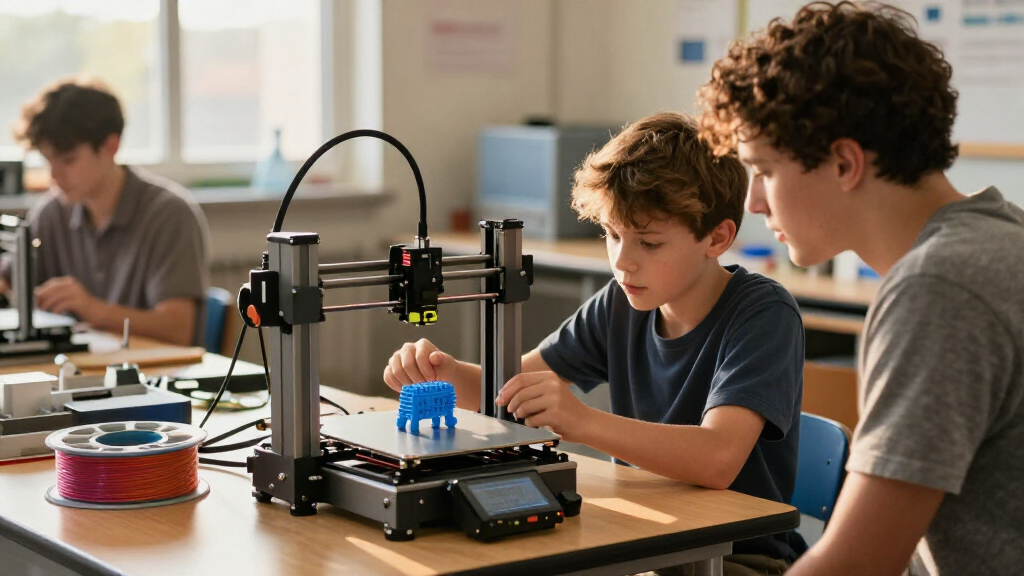
I ranked these 3D printers for classrooms around the needs of teachers and students rather than headline specifications alone. My criteria included how approachable the machine is for a first-time operator, how its design fits supervised shared use, how much flexibility it offers for lessons, and whether its size and workflow are practical in a school setting. I also weighed the likely staff burden of setup, material changes, maintenance, and troubleshooting against the learning benefit of added features.
The order reflects classroom usefulness across a range of ages and programs, not a claim that one printer is best for every school. The P1S Combo ranks first for its balance of enclosure and multicolor capability; simpler and compact models earn a place for accessible entry points, while advanced multi-material options appeal to programs able to support more complex workflows. The two Kobra X listings are treated as separate products in this roundup, but their similar names make checking the exact model and included configuration especially important before choosing.
| 3D printers for classroom | Printer type |
|---|---|
| Anycubic Kobra X Multicolor 3D | FDM 3D printer |
| Anycubic Kobra X Multicolor FD | FDM 3D printer |
| Flashforge Adventurer 5M High- | — |
| Entina Tina2 Plus Fully Assemb | — |
| Bambu Lab P1S Combo 3D Printer | — |
| Bambu Lab A1 mini 3D Printer w | — |
| Fully Assembled Mini 3D Printe | Mini 3D printer |
| AOSEED X-MAKER JOY AI 3D Print | Enclosed 3D printer |
| Creality SPARKX i7 3D Printer | Desktop 3D printer |
| Entina Tina2C Mini 3D Printer | FDM 3D printer |
| Flashforge AD5M Pro 3D Printer | — |
| Hephi3d TINA2C 3D Printer | — |
| FLASHFORGE AD5X Multi-Material | Multi-material 3D printer |
| Bambu Lab A1 FDM 3D Printer | FDM 3D printer |
| Snapmaker U1 3D Printer with 4 | — |
Factors to Consider When Choosing 3D Printers For Classrooms
Before choosing a classroom printer, I’d start with how students will use it and who will be responsible for it between lessons. The right machine is the one that fits your teaching plan and the time your school can give to printing, not simply the one with the longest feature list.
Match the Printer to Student Age and Supervision
Decide whether students will operate the printer themselves, prepare files with a teacher, or watch demonstrations while an adult handles setup. Younger groups may benefit more from a compact, ready-to-use design than from advanced controls they cannot yet manage. Older students can gain useful experience from material changes and print preparation, but only if the class has time for instruction and supervision. A common mistake is choosing a kid-oriented machine based on its name without checking whether its workflow fits the actual age group. Plan who can pause a job, remove a finished print, and respond if a print fails. Shared classroom access calls for clear operating routines regardless of the printer model.
Treat Safety as a Room and Routine Decision
An enclosure can help separate students from moving and heated parts, but it does not replace adult oversight or school safety procedures. Think about where the printer will sit, who can reach it, and whether the room has appropriate ventilation for the materials you plan to use. A compact open printer may be easy to place, yet it can require more care around student access. Check the school’s rules for electrical equipment, ventilation, and after-hours operation before purchase. Avoid assuming that a camera or remote monitoring feature makes unattended printing suitable for your setting. The safest choice depends on both the machine and the classroom routine around it.
Choose Capacity Around Lesson Design
Build volume matters most when student projects need to print as one piece; many lessons can work just as well with smaller parts assembled afterward. A larger printer can support prototypes and group projects, but it also takes more room and may make longer jobs easier to disrupt. Small machines can be a better fit for short demonstrations, repeated exercises, or a limited work surface. Before prioritizing size, estimate the largest object students will actually make and how often it needs to be printed. Consider whether one shared machine or several smaller units would better serve a class. Don’t pay for capacity your curriculum rarely uses.
Decide Whether Multicolor Printing Serves a Learning Goal
Color can help students distinguish parts, present models, and explore design choices, but it may add material handling and planning to each job. Ask whether color is central to the lesson or mainly an attractive extra. Single-color printing can keep early projects and classroom routines simpler, with students adding color by hand when appropriate. Multicolor and multi-tool systems also differ: a color-feeding setup and a printer with multiple toolheads do not create the same workflow. Schools should check how students will prepare files, change materials, and manage scraps or leftovers. If only a few projects need multiple colors, a simpler printer may serve the class better.
Budget Time for Maintenance and Failed Prints
A classroom printer needs time for setup, bed preparation, material loading, cleaning, and occasional troubleshooting. Those tasks can turn into useful lessons for advanced students, but they can also interrupt teaching if no one owns them. Ask who will be trained to maintain the printer and when that work can happen. Keep the first projects short and repeatable so students can learn the workflow before attempting lengthy designs. Schools often underestimate the effect of a failed long print on a lesson plan. A model with more capabilities is only an advantage when the staff can support its added workflow.
Check the Whole Classroom Workflow Before Buying
Printer choice is only one part of the setup: file preparation, device access, storage, and access to replacement materials all shape how reliably a class can use it. Confirm that the printer’s software and connection options work with school devices and network policies. Decide whether students will submit files to a teacher or send jobs themselves, and make that process clear before the first lesson. Consider where filament and finished prints will be stored so supplies do not crowd teaching space. A printer that is easy for one teacher to run may be awkward for rotating classes without shared procedures. Test a sample lesson workflow on paper before committing to a more complex system.
Frequently Asked Questions
Should I choose an enclosed 3D printer for a classroom?
An enclosure can reduce direct access to hot and moving components, which may help in a room with younger students or frequent foot traffic. It does not remove the need for supervision, safe placement, or attention to ventilation. Consider whether students will operate the printer or mainly observe it, and follow school guidance for equipment and materials. An enclosed model such as the Bambu Lab P1S Combo may suit programs that value a more contained setup, while a simpler open model may fit a supervised workspace with controlled access. Choose based on the classroom routine, not the enclosure alone.
Is a multicolor 3D printer worth the added classroom complexity?
It can be worthwhile when color is part of the learning objective, such as labeling model components or producing presentation-ready prototypes. For basic shape design and engineering exercises, single-color printing may teach the same core concepts with fewer material decisions. Multicolor workflows can require extra preparation and attention to material use, so account for teacher time as well as the visual result. The Kobra X and Flashforge AD5X options suit programs interested in color, while the Adventurer 5M is a simpler single-color direction in this lineup. Start with the curriculum’s needs rather than treating color as a default requirement.
How many 3D printers does a classroom need?
That depends on how often students need hands-on access and how long typical prints take. One printer can work for teacher-led demonstrations or projects scheduled in rotations, but a large class may spend too much time waiting if every student needs a separate print. Several smaller machines can spread access across groups, though they also create more devices to supervise and maintain. Begin by estimating the number of student projects per week, the average print duration, and who will manage the queue. A pilot with one machine can reveal whether your class needs more capacity before the school expands its setup.
Are compact beginner printers suitable for a full class?
Compact beginner models can be a good teaching tool for introductions, short exercises, and small prototypes. Their limited footprint may also make storage and supervised placement easier. They are less suitable when projects require larger parts or when many students need prints on a tight schedule. Check the expected project size and print throughput against your lesson plan instead of assuming a beginner label means the printer can serve every classroom task. A compact unit may work best as a first machine or as one part of a broader school setup.
What should a school check before allowing students to print independently?
Set rules for who may prepare and submit files, start jobs, handle finished prints, and report problems. Confirm that students understand the printer’s hot and moving parts, material-handling rules, and the limits of any monitoring features. The school should also review its equipment, supervision, ventilation, and network policies before student access begins. Start with short, teacher-approved projects and assign an adult to oversee the routine until students show they can follow it consistently. Independent access should be a planned teaching step, not an assumption based on a printer’s beginner-friendly controls.
Conclusion
For the best overall classroom balance, I’d pick the Bambu Lab P1S Combo when an enclosure and multicolor capability fit the school’s workflow. For a more straightforward single-color choice, the Flashforge Adventurer 5M is my best value-style pick in this lineup, while the Anycubic Kobra X is worth considering for classrooms that specifically want multicolor projects. Beginners and younger learners may be better served by the Entina Tina2 Plus or another compact Tina2-family option, provided its smaller scale matches the lesson plan. For schools seeking a premium, advanced setup, the Snapmaker U1 stands apart with four toolheads, though I’d reserve it for programs prepared to manage a more involved workflow. Choose by teaching goal: approachable basics, streamlined single-color use, classroom multicolor work, or advanced material exploration.