
🔍 Read the full analysis: Design An AI NLC Watch With This Twilight Dial As Your Guide on ThorstenMeyerAI.com

Prime made for students and young adults
- Fast, free delivery for dorm and study essentials
- Prime Video and Amazon Music included
- Member-only deals
TL;DR
ThorstenMeyerAI.com describes “Noctilucent — NLC Watch at 83 km,” an AI-built exhibition about real high-altitude clouds, framed as a fictional observing project rather than a live scientific service. Its interactive dial changes the page’s simulated twilight lighting, making the relationship between darkness at ground level and sunlight on clouds easier to explore.
ThorstenMeyerAI.com has presented “Noctilucent — NLC Watch at 83 km,” an AI-built exhibition piece described in the original analysis that uses an interactive twilight dial to explain how real noctilucent clouds can remain sunlit after the ground is dark. The site describes its observing project and field journal as fictional, not as a real company or a live scientific service.
The dial represents the Sun’s position from 6 to 16 degrees below the horizon. As visitors adjust it, the page changes a linked set of visual elements, including sky brightness, shadow depth, cloud glow, ambient color, grain and the flare along the horizon. The design description identifies about 11 degrees below the horizon as the most expressive setting. The page also updates related diagrams and explanatory text, making the dial part of the exhibit’s explanation rather than a standalone visual effect.
The exhibition moves through the horizon, cloud forms, ice crystals, seasonal observing and a field-log section. Its cloud imagery distinguishes among billows, whirls and bands, giving each a different pattern of motion. In an interaction exercise, visitors hold a control while ground-level haze recedes and the cloud band at 83 kilometres becomes clearer. The sighting fades if the visitor releases the control early. The described interaction supports pointer, keyboard and touch-like input.
According to the project description, the visuals are generated in the browser: Canvas draws the sky and clouds, while inline SVG provides diagrams and an altitude illustration. CSS creates other visual details, and the project says it uses no image assets. The account also describes animation that pauses when the page is hidden and a simplified still state for visitors who prefer reduced motion.
Interactive exhibit · Room 162 of 175
Design an AI NLC Watch With This Twilight Dial as Your Guide
A fictional observing project uses one adjustable twilight dial to reveal how real noctilucent clouds can glow above a darkened ground. Explore the design idea, the visual system, and what the project does—and does not—claim.
01 / The twilight dial
One setting changes the scene
Visitors adjust the simulated position of the Sun below the horizon. The exhibit links that single control to several visual responses, turning the dial into an explanation rather than a standalone effect.
Dark below. Sunlit above.
As the ground enters shadow, sunlight can still reach ice clouds high in the atmosphere. The exhibit uses that geometry to make the central contrast visible.
Brightness & color
Sky brightness and ambient color shift with the dial to suggest changing twilight.
Glow & shadow
Cloud glow, ground shadow depth, and horizon flare respond together.
Diagrams & text
Related diagrams and explanatory copy update alongside the visual state.
02 / The exhibit journey
From horizon to field log
The exhibition guides visitors through the setting, the cloud forms, and a fictional observing routine. A hold-to-reveal moment adds a small experience of waiting.
Horizon
Meet the twilight geometry.
Cloud forms
Billows, whirls, and bands.
Ice crystals
Explore the high-altitude subject.
Season
Solstice and nearby weeks.
Field log
Read invented station entries.
Hold to reveal
In the described interaction, visitors hold a control while ground-level haze recedes and the band at 83 km becomes clearer. Releasing early fades the sighting. The account describes pointer, keyboard, and touch-like input.
Cloud motion vocabulary
Billows, whirls, and bands each receive a distinct motion pattern. This gives the forms visual character within the exhibit’s story; it does not document actual observed cloud motion.
03 / How the experience is built
Procedural visuals, thoughtful states
The project account describes a browser-based implementation assembled from code-drawn elements, with attention to visibility and motion preferences.
Sky & clouds
Canvas draws the sky and cloud forms as procedural graphics.
Diagrams
Inline SVG supplies diagrams and an illustration of altitude.
Visual details
CSS creates additional effects. The account says the project uses no image assets.
Pause when hidden
Animation pauses when the page is hidden, according to the project account.
Simplified still
A still state is described for visitors who prefer reduced motion.
Clarity & art direction
The account describes reviewing the room for clarity and interaction, followed by an art-direction review.
04 / Real phenomenon, fictional watch
Keep the claims in view
Noctilucent clouds are real. The exhibition’s network, stations, and field journal are invented parts of the presentation.
What the concept depicts
The supplied description places the clouds at roughly 83 kilometres. High-altitude ice can catch sunlight after the surface below has entered darkness. The brief proposes a summer observing calendar focused on latitudes of 55° to 65°.
What is fictional or unverified
Station logs near Kiruna and the Shetland Islands are described as invented. The supplied material does not establish active observation sites, actual sightings, scientific validation of the lighting model, visitor research, or independent usability testing.
05 / Reader guide
Key questions, clear answers
Is NLC Watch a real monitoring service?
No. ThorstenMeyerAI.com describes a fictional observing project presented through an AI-built exhibition. The clouds are real; the site is not presented as a live scientific service.
What does the dial control?
It represents the Sun from 6° to 16° below the horizon and changes simulated sky, shadows, cloud glow, colors, diagrams, and explanatory text.
Are the station logs real sightings?
No. The brief describes invented stations near Kiruna and the Shetland Islands. The supplied source does not present their logs as actual records.
Where are the build details?
ThorstenMeyerAI.com points readers to a live room and construction guide. The supplied account does not confirm current availability or provide independent technical review.
How the Twilight Dial Teaches
The project’s design significance is its use of a single adjustable variable to connect an explanation with the look and behavior of the page. Instead of presenting noctilucent clouds only as text or a fixed illustration, the exhibition lets visitors change the simulated solar depression and see several visual elements respond together. That approach can help visitors grasp the central contrast: the lower atmosphere is in shadow while ice clouds high above it can still catch sunlight.
The exhibit also turns waiting into an interaction. Holding a control for the cloud band to emerge gives visitors a simple way to experience the patience associated with observation. That is a design choice, not evidence about how long real sightings take or a substitute for scientific observation. The distinction matters because the project is an educational and visual prototype, not a forecasting or monitoring tool.
For readers interested in AI-assisted design, the page’s account offers a specific example of how a generated web experience can combine scientific subject matter, procedural graphics and interaction. The supplied material describes the concept and implementation, but does not provide independent testing, visitor research or performance measurements.
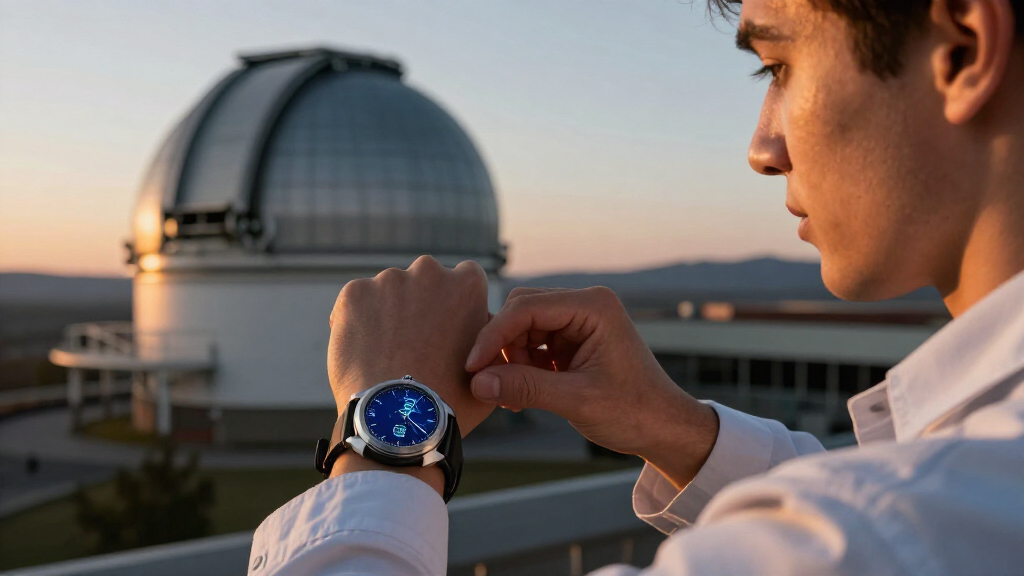
interactive watch with twilight dial
As an affiliate, we earn on qualifying purchases.
As an affiliate, we earn on qualifying purchases.
A Fictional Watch, Real Clouds
Noctilucent clouds are a real atmospheric phenomenon, while the exhibition’s network, stations and field journal are invented. The supplied description places the clouds at roughly 83 kilometres in altitude and explains their appearance through sunlight reaching high-altitude ice after the surface below has entered darkness. The project uses that geometry as the basis for its visual story.
The design brief calls for an observing calendar linked to the summer solstice and nearby weeks, with attention to latitudes of 55 to 65 degrees. It also proposes invented station logs with locations described as near Kiruna and the Shetland Islands. These are elements of the exhibition concept; the source does not establish them as active observation sites or report actual cloud sightings.
ThorstenMeyerAI.com labels the piece room 162 of 175 and points readers to a live version of the site and a construction guide. Its account describes a process of building the room, reviewing it for clarity and interaction, and then conducting an art-direction review. The supplied material does not give a publication date or independent confirmation of the review process.
““an AI-built exhibition piece: a fictional field journal for a fictional observing project, not a real company or live scientific service””
— ThorstenMeyerAI.com’s project description
noctilucent cloud observation watch
As an affiliate, we earn on qualifying purchases.
As an affiliate, we earn on qualifying purchases.
What the Project Does Not Verify
The supplied material does not provide a publication date, visitor numbers, independent usability testing or a third-party technical review. It also does not document scientific validation of the exhibit’s lighting model or provide measurements showing how accurately its simulated sky represents real observing conditions. The dial should be understood as an interactive illustration, not a scientific instrument.
Although the source refers readers to a live site and a design guide, the material provided here does not confirm current site availability or independently verify every implementation detail. The fictional stations and observation logs should not be mistaken for records of real sightings.
As an affiliate, we earn on qualifying purchases.
Where to Find the Build Details
ThorstenMeyerAI.com directs readers to the exhibition’s live room and a construction guide describing its lighting model, procedural graphics, visibility-aware animation and reduced-motion behavior. Those pages are the next places to check for the full interactive experience and implementation notes. No launch schedule, later update or external evaluation is given in the supplied material.
As an affiliate, we earn on qualifying purchases.
Key Questions
Is NLC Watch a real cloud-monitoring service?
No. ThorstenMeyerAI.com describes it as a fictional observing project presented through an AI-built exhibition. The clouds themselves are real, but the site is not described as a live scientific service.
What does the twilight dial control?
It represents the Sun’s position from 6 to 16 degrees below the horizon and changes the exhibit’s simulated sky, shadows, cloud glow, colors and related diagrams as visitors adjust it.
Are the station logs records of real observations?
No. The project brief describes invented stations near Kiruna and the Shetland Islands. The supplied source does not present their logs as actual sighting records.
How are the visuals made?
The project account says the sky and cloud forms are drawn with Canvas, diagrams use inline SVG, and CSS supplies additional effects. It says the experience uses no image assets.
Where can readers learn more about the implementation?
ThorstenMeyerAI.com points to a live version of the room and a construction guide. The supplied account does not confirm whether those pages remain available at the time of reading.
Source: ThorstenMeyerAI.com
Halloween Picks
halloween
As an affiliate, we earn on qualifying purchases.