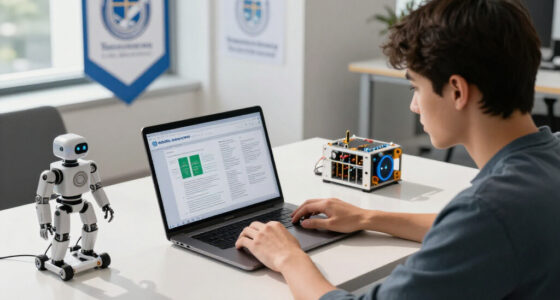

📊 Full opportunity report: World Model Readiness: Are You Ready for AI That Acts? on ThorstenMeyerAI.com — validation score, market gap, and execution plan.

Get school and study supplies delivered free — and shop member deals
- Fast, free delivery on millions of items
- Access to Prime Big Deal Days deals on October 6–7
- Prime Video, Amazon Music and more included
TL;DR
A new diagnostic tool evaluates whether organizations are prepared for AI that predicts and acts, marking a shift from traditional language models. Major AI labs are developing world models, but readiness varies widely.
A new diagnostic tool called ‘World Model Readiness’ has been introduced to evaluate how prepared organizations are for AI systems that can predict and act, rather than just describe. Developed amid rapid advances in AI research, this tool aims to identify operational gaps as the field moves toward autonomous, environment-aware systems, a shift that could redefine AI deployment and risk management.
The concept of world models — AI systems that internally represent how environments work and predict future states — has gained significant momentum since late 2024. Major players like Meta, Google DeepMind, Nvidia, and Waymo are actively developing such models, with capabilities including real-time 3D environment generation and robotics applications. These systems aim to move beyond language prediction to understanding and acting within complex environments.
The ‘World Model Readiness’ diagnostic evaluates whether organizations possess the necessary data, processes, and oversight structures to integrate these models safely and effectively. It asks critical questions: Do you have comprehensive environment telemetry? Can your processes be represented as states and dynamics? Are your oversight mechanisms sufficient for autonomous actions? The diagnostic is designed not to sell a specific system but to provide an honest assessment of gaps and preparedness, emphasizing calibration against real-world complexity.
While the momentum is undeniable, experts caution that current world models remain immature. Benchmark studies reveal limitations in physical reasoning and the ‘reality gap’ between simulation and real-world deployment. The diagnostic aims to prevent panic by clarifying which aspects of this technological shift are imminent and which are still experimental.
World Model Readiness — are you ready for AI that acts?
LLMs describe. World models predict and act. The next AI shift isn’t “have we adopted a chatbot” — it’s whether you’d know what to do with a model that anticipates consequences.
Independent commentary, produced with AI assistance under human editorial oversight. The views are the author’s own and may change. World Model Readiness is an early, positioning-stage diagnostic — an assessment framework, not a prediction, guarantee, or technical advice; its conclusions depend on the framework’s assumptions. “World models” are an emerging, rapidly-evolving area of AI; statements about the field reflect publicly reported developments as of mid-2026 and may quickly date. References to companies, labs, and products describe public reporting and imply no affiliation, endorsement, or verification. Product, model, and company names are trademarks of their respective owners.
Implications of Transitioning to Predictive, Action-Oriented AI
This development marks a fundamental shift in AI deployment. Moving from models that suggest to those that predict and act introduces new risks and operational considerations. Organizations must evaluate their data infrastructure, process representability, oversight capabilities, and risk calibration to avoid unintended consequences. The diagnostic helps distinguish between readiness for near-term applications and long-term research challenges, enabling more informed decision-making in AI adoption.
AI environment telemetry monitoring tools
As an affiliate, we earn on qualifying purchases.
As an affiliate, we earn on qualifying purchases.
Rapid Advances in World Model Research and Development
Since late 2024, the AI field has seen a surge in world model research, with notable projects like Meta’s V-JEPA 2, DeepMind’s Genie 3, and initiatives from Nvidia and Waymo. These models demonstrate capabilities such as real-time environment simulation and physical reasoning, pushing the boundary from theoretical research to practical application. The shift in trade press from ‘interesting’ to ‘the next frontier’ underscores the growing importance of these systems. However, current models are data- and compute-intensive, with significant limitations in real-world physical reasoning, highlighting the need for careful assessment of readiness.
“The move from describe to act changes what organizations need to be ready for, because action without prediction is dangerous.”
— Thorsten Meyer, AI researcher
autonomous system oversight software
As an affiliate, we earn on qualifying purchases.
As an affiliate, we earn on qualifying purchases.
Current Limitations and Challenges in Real-World Deployment
While research progresses rapidly, current world models face significant limitations. Benchmark tests show inconsistent physical reasoning, and the ‘reality gap’ between simulation and real-world environments remains substantial. It is not yet clear when these models will be reliable enough for widespread autonomous deployment, and the calibration of systems against messy, unpredictable environments is still an open challenge.
real-time 3D environment generation hardware
As an affiliate, we earn on qualifying purchases.
As an affiliate, we earn on qualifying purchases.
Next Steps for Organizations and AI Developers
Organizations should begin assessing their data infrastructure, oversight processes, and operational models to determine their readiness for integrating predictive, action-capable AI. Developers are likely to release more mature versions of world models, but cautious adoption and thorough calibration will be essential. The upcoming months will see increased focus on safety, validation, and real-world testing to bridge the gap between research and deployment.
AI risk management diagnostic tools
As an affiliate, we earn on qualifying purchases.
As an affiliate, we earn on qualifying purchases.
Key Questions
What is a world model in AI?
A world model is an AI system that internally represents how an environment works, allowing it to predict future states and understand the consequences of actions.
Why is readiness for AI that acts important now?
Because moving from descriptive models to predictive, action-oriented systems introduces new risks, operational requirements, and safety considerations that organizations need to prepare for.
What are the main challenges in deploying world models?
Current challenges include limited physical reasoning capabilities, the ‘reality gap’ between simulation and real environments, and the need for robust oversight and calibration mechanisms.
How can organizations evaluate their preparedness?
Using tools like the ‘World Model Readiness’ diagnostic, organizations can assess their data quality, process representability, oversight structures, and risk management practices.
When can we expect widespread deployment of reliable world models?
While research is advancing, experts caution that reliable, fully autonomous deployment is still several years away, with significant technical and safety hurdles to overcome.
Source: ThorstenMeyerAI.com
Halloween Picks
halloween
As an affiliate, we earn on qualifying purchases.