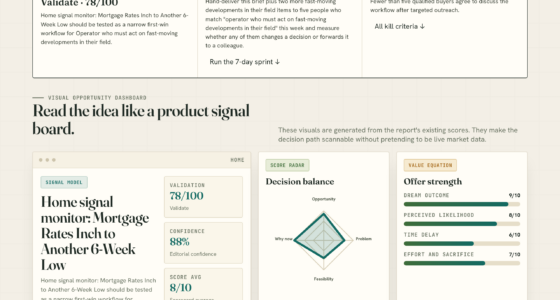

📊 Full opportunity report: Anthropic’s Claude Watermark And The Future Of Responsible AI Use on ThorstenMeyerAI.com — validation score, market gap, and execution plan.

Get school and study supplies delivered free — and shop member deals
- Fast, free delivery on millions of items
- Access to Prime Big Deal Days deals on October 6–7
- Prime Video, Amazon Music and more included
TL;DR
A recent report indicates that Anthropic might be working on a watermark for Claude-generated text. However, technical details and deployment status remain unconfirmed, raising questions about AI attribution and responsible use.
A recent report suggests that Anthropic is developing or may have developed a watermark for its AI model, Claude, which could help identify AI-generated text. The report does not confirm whether the watermark has been deployed or how it functions, but the development raises important questions about AI transparency and responsible use.
The report, published by Thorsten Meyer AI, indicates that there is a possibility of a new method for marking Claude’s output, but no official technical details or confirmation from Anthropic have been provided. For more details, see the original analysis. It remains unclear whether the proposed watermark is active, which models it applies to, or if it can be detected reliably. This uncertainty highlights the importance of transparent and reproducible testing of AI watermarking methods. The report emphasizes that a visible or embedded signal in text is technically challenging, as modifications like paraphrasing or editing can weaken or eliminate such markers.
Furthermore, there is no evidence that major search engines or publishers currently recognize or utilize any such watermark for ranking or content verification. The report also highlights that, without documented testing, claims about the watermark’s effectiveness or scope are speculative. It is important to distinguish between observed output patterns and confirmed, intentional marking systems, as the latter would require transparent documentation and reproducible testing.
Potential Impact on AI Transparency and Content Identification
If proven effective and widely deployed, a watermark in Claude’s output could significantly aid publishers, platforms, and researchers in tracing AI-generated content. It could support efforts to enforce disclosure rules and combat misuse such as spam or impersonation. However, experts caution that without official confirmation and technical validation, the presence of a watermark remains uncertain. The development highlights ongoing challenges in establishing reliable, tamper-resistant attribution methods for AI-generated text, which is vital for responsible AI deployment and public trust.
AI content watermark detection tools
As an affiliate, we earn on qualifying purchases.
As an affiliate, we earn on qualifying purchases.
Background on AI Watermarking and Responsible Use
Watermarking AI-generated content has long been a goal for developers and regulators aiming to improve transparency and accountability. Past efforts have focused on embedding signals within text, but technical hurdles remain due to the ease of editing and paraphrasing. Major AI developers, including OpenAI and others, are exploring various methods to mark or verify AI output, but no standardized or universally accepted solution exists yet. The recent report about Anthropic’s Claude adds to this ongoing debate, emphasizing the importance of independent testing and clear documentation before such features can be relied upon for attribution or regulation.
“The report suggests a possibility of a watermark in Claude’s output, but without official confirmation or technical details, it remains speculative.”
— Thorsten Meyer, AI researcher
AI-generated text attribution software
As an affiliate, we earn on qualifying purchases.
As an affiliate, we earn on qualifying purchases.
Unconfirmed Aspects of the Claimed Watermark
Several key facts remain unresolved: there is no confirmed information on when the watermark was introduced, which models or interfaces might use it, whether it can be removed, or if a detection tool exists. The technical mechanism—whether linguistic patterns, hidden data, or metadata—is also unspecified. Its effectiveness against paraphrased or edited text is unknown, and no independent testing has been published to verify its reliability. As a result, the current status of the watermark remains speculative.
AI transparency verification tools
As an affiliate, we earn on qualifying purchases.
As an affiliate, we earn on qualifying purchases.
Next Steps for Verification and Deployment
Developers and researchers should await official documentation from Anthropic or independent studies that detail the watermark’s technical approach, scope, and error rates. Reproducible tests are necessary to determine whether the signal can survive common text modifications and whether it can reliably attribute content to Claude. Meanwhile, publishers and search engines should treat the report as an indication of ongoing efforts rather than a confirmed feature, avoiding changes to workflows until more evidence becomes available.
As an affiliate, we earn on qualifying purchases.
Key Questions
Has Anthropic confirmed that all Claude outputs are watermarked?
No. There is no official confirmation that every response from Claude contains a watermark or that the feature has been deployed across all models.
How does the proposed Claude watermark work?
The exact mechanism has not been publicly disclosed. It could involve linguistic patterns, hidden characters, or metadata, but these are only possibilities, not confirmed features.
Can search engines detect the watermark?
There is no confirmed evidence that major search engines can recognize or utilize any such watermark at this time.
Would a watermark definitively prove a text was generated by Claude?
Not necessarily. Detection accuracy depends on the method used and the extent of text editing. Without documented validation, attribution remains probabilistic rather than definitive.
Source: ThorstenMeyerAI.com
Fall Picks
fall essentials
As an affiliate, we earn on qualifying purchases.