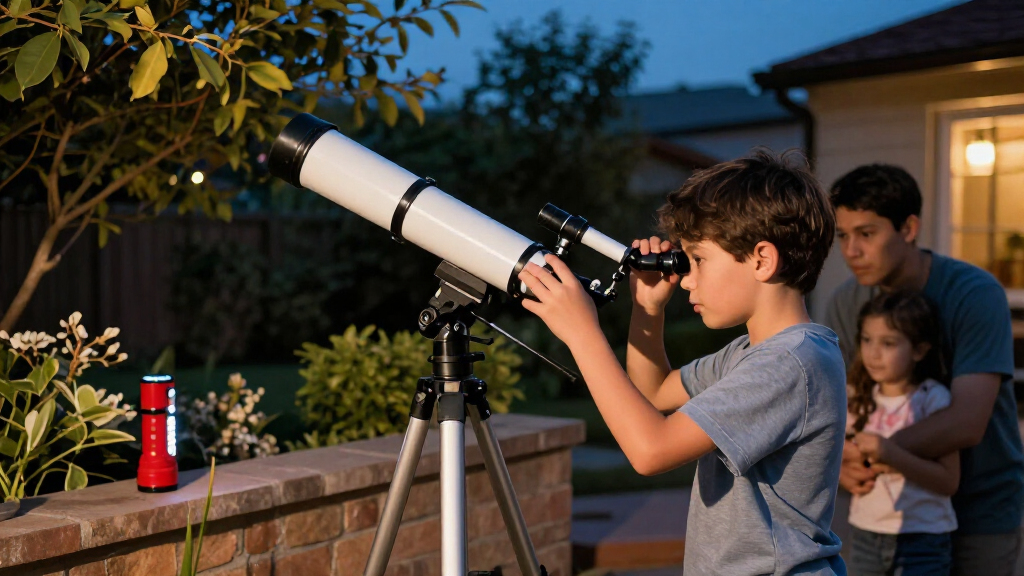

For most first-time stargazers, I’d start with the Celestron Travel Scope 70DX: its 70mm aperture and included backpack make it a practical balance of views and portability. The Gskyer 70mm Refractor stands out for its phone adapter and wireless remote, while the Hawkko 80mm, 500mm Refractor offers more light-gathering area for buyers willing to carry a larger setup. The main tradeoff across beginner telescope kits is simple: compact, easy-to-use scopes are convenient, but larger apertures can show more detail and may take more effort to transport and set up. Included extras such as phone adapters, star wheels, and screens can help, but they do not replace steady support and useful optics. Read on for the full comparison and advice on matching a starter telescope to your observing plans.

Prime made for students and young adults
- Fast, free delivery for dorm and study essentials
- Prime Video and Amazon Music included
- Member-only deals
Key Takeaways
- The Celestron Travel Scope 70DX leads on balance: it pairs a portable 70mm telescope with a backpack, while the smaller 50mm kits prioritize simplicity over light gathering.
- An 80mm aperture is the clearest step up in this group: the Hawkko 80mm models gather more light than the 70mm options, but their larger optical tube is less travel-friendly.
- Phone accessories serve different purposes: the Gskyer combines a phone adapter with a wireless remote, while several 70mm models include adapters without offering the same remote-control convenience.
- Kids’ kits vary in how they teach: the astronomy kit with a star wheel and audio content adds guided learning, while the NASA Lunar kit focuses attention on the Moon with a finder scope.
- Small apertures and high magnification claims are not interchangeable: the 50mm scopes are simple introductory choices, while claims such as 15x–150x do not by themselves tell buyers how sharp or steady a view will be.




| beginner telescope kit | Focal length | Eyepieces | Focus type | Included accessories |
|---|---|---|---|---|
| Luzsco 50mm Beginner Telescope | 400–600 mm | 6 mm and 20 mm | Manual | Tripod, finderscope, two eyepieces, Barlow lens |
| Kids’ Telescope & Astronomy Ki | — | — | Manual | — |
| 70mm Aperture Refractor Telesc | 300 mm | — | Manual | Phone adapter, wireless remote, tripod, 1.5× erecting eyepiece, 3× Barlow lens |
| ToyerBee 70mm Refractor Telesc | 300 mm | 20 mm and 6 mm | — | Tripod, phone adapter, wireless camera remote, star chart, 3× Barlow lens |
| Hawkko 80mm Aperture | 500 mm | 10 mm and 25 mm | — | Tripod, finderscope, two eyepieces, 3× Barlow lens, smartphone adapter |
| Hawkko 80mm Refractor Telescop | 500 mm | 25 mm and 10 mm | — | Adjustable aluminum tripod, phone adapter, backpack, telescope guide, and Moon and space learning guide |
| Luzsco 50mm Beginner Telescope | — | 6 mm and 20 mm | Manual | Tripod, finderscope, two eyepieces, Barlow lens, and Moon observation guide |
| ToyerBee Kids’ Telescope with | — | — | Manual | — |
| 70mm Aperture 300mm Refracting | 300 mm | — | Manual | — |
| Gskyer 70mm Refractor Telescop | 400 mm (f/5.7) | 25 mm (16×) and 10 mm (40×) | — | Carry bag, smartphone adapter, wireless camera remote, and 48° erecting BAK4 prism |
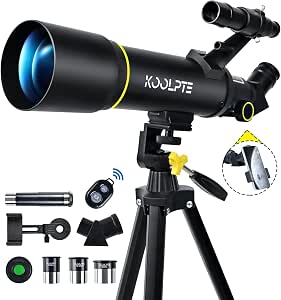
| Koolpte 70mm Travel Refractor | 400 mm | K6mm, K10mm, K25mm | — | — |
| NASA Lunar Telescope for Kids | — | Low-power and high-power | Manual | — |
| 70mm Refractor Telescope with | 400 mm | — | — | — |
| Celestron Travel Scope 70DX Re | 175 mm | 20 mm and 10 mm | Manual | — |
| Celestron Travel Scope 70 Port | 400 mm | 20 mm and 10 mm | Manual | Tripod, backpack, finderscope, star diagonal |
More Details on Our Top Picks
Luzsco 50mm Beginner Telescope for Kids with Tripod
For a child who is ready to try finding and focusing on objects independently, the Luzsco 50mm keeps the kit portable and straightforward. It weighs 600 g and includes a tripod, finderscope, two eyepieces, and a Barlow lens, giving a beginner several ways to learn how magnification changes a view. Its manual focus and screen-free setup make the activity hands-on rather than app-led. Compared with the 70mm ToyerBee, though, its smaller aperture is a less capable choice for gathering light, and it is framed more clearly for children than for adults seeking a shared all-purpose telescope. The short focal-length range is listed as 400–600 mm, so buyers may want to confirm which configuration applies. This is a sensible first kit for supervised backyard exploration, not a route to detailed faint-object viewing.
Pros:- Light 600 g design is easier to carry than larger 70mm kits.
- Includes a tripod, finderscope, two eyepieces, and a Barlow lens.
- Manual operation encourages children to learn basic focusing and viewing.
- Requires no power source.
Cons:- Its 50mm objective is smaller than the 70mm ToyerBee and 80mm Hawkko, limiting its light-gathering capability.
- Manual focusing and aiming may need adult help for younger children.
- The listed focal-length range of 400–600 mm leaves the exact configuration unclear.
Best for: Families introducing children around ages 6–12 to hands-on, screen-free backyard observing.
Not ideal for: Adults or families seeking brighter views from a larger aperture, or children who need an adult to handle manual aiming and focusing.
- Objective lens diameter:50 mm
- Focal length:400–600 mm
- Optical tube length:40 cm
- Eyepieces:6 mm and 20 mm
- Focus type:Manual
- Weight:600 g
- Included accessories:Tripod, finderscope, two eyepieces, Barlow lens
Our verdict“Choose the Luzsco for a lightweight, hands-on first telescope for a young child, but pick a larger-aperture kit for more ambitious viewing.”
Kids’ Telescope & Astronomy Kit – 25x & 50x Magnification, Adjustable 48” Tripod, Star Wheel, Audio Content – Intro to Astronomy for Ages 6+
This kit makes the strongest case for learning the sky, rather than collecting telescope accessories. Its star wheel, illustrated guide, and audio content give children several ways to connect what they see with basic astronomy. The two eyepieces offer 25× and 50× magnification, while the aluminum tripod adjusts up to 48 inches, making the setup usable as a child grows or an adult helps. Unlike the Luzsco 50mm, this package foregrounds guided learning instead of a particularly light, compact build. The tradeoff is that the tripod may be cumbersome for a young child to carry and set up alone, and there is no phone adapter for capturing observations. I’d choose it for a family that wants activities and context alongside viewing, not for buyers prioritizing portability or simple astrophotography.
Pros:- Star wheel and illustrated guide support learning how to identify and discuss objects.
- Audio content adds an educational format beyond the printed materials.
- Two eyepieces provide 25× and 50× options.
- Adjustable aluminum tripod extends up to 48 inches.
Cons:- The tripod may be bulky for younger children to transport and set up independently.
- No smartphone adapter or digital imaging accessory is included.
- Manual focusing and aiming still require practice.
Best for: Families with children aged six and up who want a guided introduction to astronomy, including activities beyond looking through the eyepiece.
Not ideal for: Young children who need a very lightweight setup to carry alone, or beginners who specifically want smartphone photos of their observations.
- Magnification:25× and 50×
- Eyepieces included:2
- Tripod height:Adjustable up to 48 inches
- Mount type:Altazimuth
- Focus type:Manual
- Lens design:Kellner
- Included learning accessories:Star wheel, 8-page illustrated guide, audio content
Our verdict“Pick this kit when astronomy activities and guided learning matter more than a compact setup or phone photography.”
70mm Aperture Refractor Telescope with FMC Optics, 300mm Focal Length and Phone Adapter – Ideal for Kids and Adults
The phone adapter and wireless remote give this 70mm refractor a clear beginner-friendly purpose: observing and trying to record what appears in the eyepiece. Fully multi-coated optics and a 70mm aperture are a step up in light-gathering area from the Luzsco 50mm, while the two eyepieces, Barlow lens, and erecting eyepiece support different kinds of viewing. The stated 15×–150× range sounds broad, but the highest magnification should not be treated as a promise of consistently sharp views; conditions and the telescope’s short 300mm focal length shape what is useful. Compared with the ToyerBee 70mm, this model offers a similar phone-oriented accessory mix, so the choice may come down to the exact kit and setup details. Its manual operation and inverted finder image can add friction for first-timers.
Pros:- 70mm aperture and fully multi-coated optics are a step up in light gathering from the Luzsco 50mm.
- Phone adapter and wireless remote support basic smartphone capture.
- Two eyepieces, a Barlow lens, and an erecting eyepiece offer viewing flexibility.
- Tool-free assembly is intended to simplify setup.
Cons:- Manual mount and focus require the user to locate, aim, and refocus objects.
- The inverted finderscope image may confuse beginners.
- A 70mm aperture is limited for showing fine detail in faint deep-sky objects.
Best for: Beginners who want a 70mm telescope kit with phone-mounting accessories for casual photos and shared observing.
Not ideal for: Buyers who want automated sky tracking, a simple upright finder view, or detailed views of faint deep-sky objects.
- Aperture:70 mm
- Focal length:300 mm
- Magnification range:15×–150×
- Finderscope:5×24
- Focus type:Manual
- Included eyepieces:20 mm and 6 mm
- Included accessories:Phone adapter, wireless remote, tripod, 1.5× erecting eyepiece, 3× Barlow lens
Our verdict“Choose this over the Luzsco if a larger aperture and phone-capture accessories matter more than a child-sized, screen-free first kit.”
ToyerBee 70mm Refractor Telescope with Phone Adapter and Tripod
The ToyerBee pairs a 70mm aperture with a phone adapter, wireless remote, and star chart, making it a flexible kit for beginners who want to alternate between skywatching and terrestrial views. Its 20mm and 6mm eyepieces plus 3× Barlow give several magnification combinations, though the stated 15×–150× range does not mean the upper end will be useful in every viewing condition. Compared with the similar 70mm, 300mm refractor from the same roundup, the ToyerBee’s listing spells out a star chart and a 3.5 lb weight, while the other kit lists an erecting eyepiece. That makes this a practical accessory-rich alternative, not an obvious optical upgrade. Manual focusing and aiming remain part of the learning curve, and the supplied data does not describe automated tracking.
Pros:- 70mm aperture offers more light-gathering area than the 50mm Luzsco.
- Phone adapter and wireless remote support basic smartphone capture.
- Includes a star chart, two eyepieces, and a 3× Barlow lens.
- Listed for both celestial and landscape viewing.
Cons:- Manual focus and aiming take practice, especially for users new to telescopes.
- The 3× Barlow and high stated maximum magnification may not produce useful views in all conditions.
- At 3.5 lb, it is heavier than the 600 g Luzsco for a child to carry.
Best for: Beginners and families who want a 70mm telescope with a star chart and phone-photo accessories for backyard or daytime use.
Not ideal for: Buyers seeking automated tracking, a lighter child-carried setup, or reliably detailed views at the advertised maximum magnification.
- Telescope type:Refractor
- Aperture:70 mm
- Focal length:300 mm
- Magnification range:15×–150×
- Eyepieces:20 mm and 6 mm
- Finderscope:5×24
- Weight:3.5 lb
- Included accessories:Tripod, phone adapter, wireless camera remote, star chart, 3× Barlow lens
Our verdict“Choose the ToyerBee for a 70mm beginner kit with a star chart and phone accessories, but not if easy independent handling by a young child is the priority.”
Hawkko 80mm Aperture, 500mm Focal Length Refractor Telescope Kit
Among these five kits, the Hawkko has the largest listed objective: its 80mm aperture gathers more light than the 50mm Luzsco and the two 70mm options, giving a beginner more room for observing brighter celestial and terrestrial targets. The 500mm focal length also distinguishes it from the shorter 300mm ToyerBee, while its 10mm and 25mm eyepieces, 3× Barlow, and smartphone adapter keep the package versatile. That larger optical tube is a tradeoff: at 50cm, it is less compact than the short-tube kits, and its altazimuth mount and manual focus still call for hands-on aiming. The product data does not list automated tracking, so locating objects remains the user’s job. I’d choose this as the more capable starter package when aperture matters more than a child’s easiest carry.
Pros:- 80mm objective is larger than the apertures of the Luzsco and both 70mm kits in this group.
- 500mm focal length sets it apart from the shorter 300mm ToyerBee.
- Includes two eyepieces, a 3× Barlow lens, and a smartphone adapter.
- Aluminum alloy tripod is adjustable.
Cons:- The 50cm optical tube is less compact than the 30cm tube listed for the 70mm refractors.
- Manual focus and an altazimuth mount require hands-on aiming and adjustment.
- No motorized tracking or automated sky navigation is listed.
Best for: Beginners who want a larger-aperture refractor for brighter views of the Moon, planets, and daytime subjects, with a phone adapter included.
Not ideal for: Families prioritizing the lightest kit for a young child to carry, or users who want motorized tracking and automated object finding.
- Telescope type:Refractor
- Objective lens diameter:80 mm
- Focal length:500 mm
- Magnification range:20×–150×
- Eyepieces:10 mm and 25 mm
- Mount:Altazimuth
- Optical tube length:50 cm
- Included accessories:Tripod, finderscope, two eyepieces, 3× Barlow lens, smartphone adapter
Our verdict“Choose the Hawkko if you want the largest aperture in this group and accept a longer, manual setup over a compact child-focused kit.”
Hawkko 80mm Refractor Telescope Kit for Beginners
The 80mm aperture gives this kit a stronger starting point for Moon and daytime viewing than the smaller Luzsco 50mm, while its 500mm focal length offers a more forgiving fit for lunar observation than the shorter 300mm Fuoibl. Two eyepieces and a 3× Barlow provide options as beginners learn how magnification changes a view, and the phone adapter, backpack, and learning guides make the package useful beyond the telescope itself. I’d rank it highest for families who want room to explore without moving into a more involved setup. The tradeoff is fully manual use: locating and focusing targets takes practice, and the listing gives no tripod height or adjustment range. Its stickers and activity materials suit younger learners, but won’t add much for adults seeking a more technical kit.
Pros:- 80mm aperture offers a larger light-gathering opening than the Luzsco 50mm.
- 500mm focal length is well suited to Moon and nature observation.
- Includes two eyepieces, a 3× Barlow, phone adapter, and backpack.
- Learning guides and an observation log support structured practice.
Cons:- Manual aiming and focusing require hands-on adjustment.
- Tripod height and adjustment range are not specified.
- The themed stickers and kid-focused extras may be less useful to adult learners.
Best for: Families seeking a larger-aperture starter kit for Moon viewing, nature observation, and guided activities together.
Not ideal for: Beginners who want clear tripod height details or a motorized mount to track targets without constant manual adjustment.
- Telescope type:Refractor
- Objective lens diameter:80 mm
- Focal length:500 mm
- Magnification range:20×–150×
- Eyepieces:25 mm and 10 mm
- Mount:Altazimuth
- Item weight:2.8 kg
- Included accessories:Adjustable aluminum tripod, phone adapter, backpack, telescope guide, and Moon and space learning guide
Our verdict“Choose the Hawkko if you want a relatively capable 80mm starter kit with learning materials and carry gear, and are comfortable operating it manually.”
Luzsco 50mm Beginner Telescope for Kids
For a child’s first hands-on introduction to the Moon, the age-specific guide and simple manual setup are the main reasons to pick the Luzsco. Its 50mm objective is a smaller starting point than the Hawkko 80mm, so I’d treat it as a learning instrument rather than a kit for growing into more demanding observing. The two eyepieces and Barlow lens give kids a chance to compare views, while the finderscope and tripod make target-finding part of the activity. At 1.3 pounds, it is also easier for a child or parent to carry than the Hawkko. The tradeoff is limited aperture and a toy-oriented design; the ToyerBee, with its reflex finder and compass, offers more built-in orientation aids. Manual focusing also calls for adult help with younger users.
Pros:- Moon observation guide gives young beginners a clear activity to start with.
- Light 1.3-pound listed weight is easier to handle than the Hawkko 80mm.
- Includes a tripod, finderscope, two eyepieces, and a Barlow lens.
- Manual operation gives children a hands-on introduction to focusing.
Cons:- 50mm objective is a modest aperture for observing beyond basic beginner targets.
- Manual focus can require adult help, especially for younger children.
- The child-oriented design is less suited to adults seeking a telescope to grow with.
Best for: Children ages 6–12 who want a lightweight first telescope for Moon observation and guided parent-child STEM activities.
Not ideal for: Adults or older beginners seeking a more capable telescope for detailed observing; its 50mm aperture and child-focused design are limiting.
- Objective lens diameter:50 mm
- Magnification range:20×–100×
- Eyepieces:6 mm and 20 mm
- Mount:Altazimuth
- Focus type:Manual
- Optical tube length:27.5 inches
- Item weight:1.3 pounds
- Recommended age:6–12 years
- Included accessories:Tripod, finderscope, two eyepieces, Barlow lens, and Moon observation guide
Our verdict“Pick the Luzsco for a child’s first Moon-viewing activities, but choose the Hawkko 80mm if stronger optics and longer-term use matter more.”
ToyerBee Kids’ Telescope with Compass and Three Eyepieces
The ToyerBee puts the emphasis on easy setup and basic orientation: it assembles without tools and pairs a reflex finderscope with a compass, features that can make a child’s first attempts at locating a target less fiddly. Its three eyepieces offer 20×, 30×, and 40× choices, a simpler set of steps than the Hawkko’s eyepieces plus 3× Barlow. That simplicity comes with a clear limit: the listed 32mm objective is far smaller than the Hawkko’s 80mm or the Fuoibl’s 70mm, so this is best treated as a child-focused introduction to the Moon and nearby nature, not a kit for detailed observing. The 360° rotating tripod supports broad movement, but manual focus remains part of the learning process. Buyers wanting a guide or carry bag should look at the other kits.
Pros:- Tool-free setup suits children and families who want to start quickly.
- Reflex finderscope and compass provide basic target-orientation aids.
- Three fixed eyepiece magnifications offer straightforward choices.
- 360° tripod rotation supports movement across a broad field.
Cons:- 32mm objective is substantially smaller than the 70mm Fuoibl and 80mm Hawkko apertures.
- Manual focusing still requires user adjustment.
- The listed kit does not include a learning guide or phone adapter.
Best for: Children and families who value tool-free assembly, simple eyepiece choices, and basic help finding targets.
Not ideal for: Beginners who want a larger aperture, a learning booklet, or a kit with a phone adapter for image capture.
- Objective lens diameter:32 mm
- Magnifications:20×, 30×, and 40×
- Mount type:Altazimuth
- Focus type:Manual
- Finderscope:Reflex
- Tripod:360° rotation
- Setup:Tool-free
- Item weight:1.4 lb
Our verdict“Choose the ToyerBee for a straightforward child-focused first telescope, not for buyers prioritizing aperture or extra learning and imaging accessories.”
70mm Aperture 300mm Refracting Telescope with Phone Adapter – 15x‑150x Magnification for Kids and Adults
The Fuoibl’s standout is its phone adapter and wireless remote, giving beginners a simple way to try capturing a view without touching the phone during a shot. Its 70mm aperture and fully multi-coated optics make it a more substantial optical starting point than the 32mm ToyerBee, while the short 300mm focal length keeps the tube compact and supports wide-field use. Two eyepieces and a 3× Barlow are listed for a broad 15×–150× range, though the highest setting is not a promise of equally useful views across that range. Compared with the Gskyer 70mm, the Fuoibl has a shorter focal length and includes a remote, but its finderscope image may feel confusing to beginners. There is no motorized tracking, so targets need manual adjustment.
Pros:- 70mm aperture is larger than the ToyerBee’s listed 32mm objective.
- Fully multi-coated optics are specified for the objective.
- Phone adapter and wireless remote support hands-off image capture.
- Tool-free assembly and adjustable tripod suit family use.
Cons:- Manual mount has no motorized tracking, so targets require ongoing adjustment.
- The finderscope image may be confusing for beginners.
- The 15×–150× range does not mean the top magnification will be useful in all conditions.
Best for: Beginners who want a 70mm starter telescope with a phone holder and remote for casual Moon and scenery photos.
Not ideal for: Users who want automatic tracking or a beginner-friendly finderscope orientation, or who expect clear views at the maximum listed magnification.
- Brand and model:Fuoibl BY-001
- Telescope type:Refractor
- Objective lens diameter:70 mm
- Focal length:300 mm
- Magnification range:15×–150×
- Mount:Altazimuth
- Focus type:Manual
- Additional features:Fully multi-coated optics, phone adapter, and wireless remote
Our verdict“Pick the Fuoibl if phone-assisted viewing is a priority, but choose the Gskyer if you prefer its longer 400mm focal length and specified erecting prism.”
Gskyer 70mm Refractor Telescope with Tripod, Carry Bag, Smartphone Adapter and Wireless Remote
The Gskyer is the most clearly specified travel-ready kit in this group: its 65cm adjustable aluminum tripod, carry bag, and 70mm optical tube give buyers a concrete sense of what comes along. The 400mm focal length sits between the Hawkko’s 500mm and Fuoibl’s 300mm, making this a middle-ground option for lunar and terrestrial viewing rather than the shortest, widest-field design. Two eyepieces and a 3× Barlow are included, with a listed maximum magnification of 120×. A 5×24 crosshair finder and 48° erecting BAK4 prism also make the setup more explicit than the Fuoibl’s less detailed finder listing. It still relies on manual focus and a manually moved altazimuth mount, so locating and following targets takes practice.
Pros:- 70mm aperture offers a larger objective than the Luzsco and ToyerBee kits.
- 400mm focal length provides a middle ground between the Fuoibl 300mm and Hawkko 500mm.
- 65cm adjustable aluminum tripod and carry bag support portable use.
- Phone adapter and wireless remote enable basic phone-based image capture.
Cons:- Manual focusing and aiming require ongoing hands-on adjustment.
- Listed maximum magnification is 120×, below the Fuoibl’s stated 150× ceiling.
- The kit does not offer motorized tracking for keeping objects centered.
Best for: Beginners who want a portable 70mm refractor with a specified adjustable tripod, carry bag, and phone photography accessories.
Not ideal for: Observers who want motorized tracking or a higher listed maximum magnification than 120×.
- Telescope type:Refractor
- Objective lens diameter:70 mm
- Focal length:400 mm (f/5.7)
- Eyepieces:25 mm (16×) and 10 mm (40×)
- Barlow lens:3×
- Maximum magnification:120×
- Finderscope:5×24 with crosshair lines
- Tripod:Adjustable aluminum, 65 cm height
- Included accessories:Carry bag, smartphone adapter, wireless camera remote, and 48° erecting BAK4 prism
Our verdict“Choose the Gskyer for a portable 70mm kit with clearly specified tripod and carry accessories, while accepting manual operation and a 120× listed limit.”
Koolpte 70mm Travel Refractor Telescope Kit for Kids and Beginners
The Koolpte stands out among these beginner kits for the number of ways it supports a first observing session: it pairs a 70mm refractor with three eyepieces, a 3× Barlow, a finder scope, and phone-adapter accessories. Its stated 20×–200× range gives beginners options to experiment with, though the upper end of a magnification range does not guarantee a sharp view. Compared with the Celestron Travel Scope 70, this kit emphasizes eyepiece variety and a wireless remote, while the Celestron offers a backpack and Moon filter for travel and lunar viewing. The Koolpte’s 400mm focal length and 40cm tube suit a compact setup, but manual focusing takes practice and the listed battery-powered operation adds a power detail buyers should clarify before use.
Pros:- 70mm aperture and coated optics are designed for lunar and daytime viewing.
- Three eyepieces and a 3× Barlow provide several magnification combinations.
- Includes a phone adapter and wireless remote for attempting hands-free image capture.
- Compact 40cm optical tube and adjustable aluminum tripod suit portable use.
Cons:- Manual focusing requires practice, especially when changing eyepieces or magnification.
- The listed battery-powered operation is not clearly explained in the supplied product details.
- The stated 200× maximum may promise more magnification than practical viewing conditions can support.
Best for: Beginners who want multiple eyepiece choices and phone-adapter accessories in one compact 70mm kit.
Not ideal for: Buyers seeking the simplest possible setup or a clearly specified power arrangement; manual focus and the battery-powered listing may add questions for a first-time user.
- Optical design:Refractor
- Aperture:70 mm
- Focal length:400 mm
- Focal ratio:f/5.7
- Stated magnification range:20×–200×
- Eyepieces:K6mm, K10mm, K25mm
- Barlow lens:3×
- Mount:Altazimuth
- Finder scope:5×24 with cross-hair lines
Our verdict“Choose the Koolpte if you want a compact beginner kit with more included viewing and phone accessories than the simpler Celestron Travel Scope 70.”
NASA Lunar Telescope for Kids with Tripod and Finder Scope
This Blue Marble kit makes the most sense for a child whose first goal is finding and studying the Moon, rather than building a flexible observing setup. Its learning guide, straight-through finder, and low- and high-power eyepieces give a beginner a clear starting routine: locate a target, then switch views. Compared with the Koolpte 70mm Travel Refractor, it is more focused on guided lunar learning and less on accessories such as phone capture or a wide selection of eyepieces. The tabletop tripod and smooth mount help keep the telescope manageable for younger users, but the setup needs a stable table or similar surface. Manual focus still calls for adult help or patience, and the supplied details do not state an aperture, limiting direct optical comparisons.
Pros:- Educational guide gives children a structured introduction to lunar observing.
- Finder scope and two eyepieces support locating the Moon and changing viewing power.
- Tabletop tripod and smooth mount offer a compact setup for a stable surface.
- Designed for beginner assembly and use.
Cons:- Tabletop tripod limits where the telescope can be used and requires a steady surface.
- Manual focus may need adult assistance for younger children.
- The supplied specifications do not list aperture or focal length.
Best for: Children aged 8 and up who want guided Moon viewing at a table, with an educational guide and a small number of straightforward eyepiece choices.
Not ideal for: Families who need a full-height tripod for standing observations, or buyers wanting stated aperture and focal-length specifications for comparing optical capability.
- Brand:Blue Marble
- Recommended age:8 years and up
- Stated magnification:90×
- Eyepieces:Low-power and high-power
- Finder scope:Straight-through
- Mount:Equatorial
- Focus type:Manual
- Field of view:0.85 degrees
- Tripod:Tabletop
Our verdict“Pick this kit for a child’s guided Moon-focused introduction, but choose a full-height tripod model such as the Celestron Travel Scope 70 for more flexible placement.”
70mm Refractor Telescope with 4.5-Inch LCD Display
This telescope takes a different approach to beginner viewing: alongside a conventional eyepiece, it has a built-in 4.5-inch LCD for watching the image without placing an eye at the scope. The screen, rechargeable battery, and remote also support capturing photos and video, making this a better fit for families who want a shared display than for learners focused on traditional eyepiece practice. Compared with the Celestron Travel Scope 70DX, it has a screen and stated video capture, while the Celestron kit provides a backpack and Moon filter. Its 70mm aperture and 400mm focal length put it in familiar beginner territory, but manual focus remains part of setup, and expandable storage requires a separately supplied memory card.
Pros:- Built-in 4.5-inch LCD allows screen viewing without a smartphone or computer.
- Includes a 25mm optical eyepiece for conventional viewing as well as digital use.
- Rechargeable 2000mAh battery is specified for up to 4.5 hours of use.
- Wireless remote can capture photos and video without touching the telescope.
Cons:- Manual focusing still requires user adjustment.
- A memory card for expanded storage is sold separately.
- The digital display and recording features add complexity compared with simpler beginner kits such as the Celestron Travel Scope 70.
Best for: Families who want several people to view a digital screen together and save lunar photos or video without relying on a phone or computer.
Not ideal for: Traditional observers who prefer a simple eyepiece-only kit, or buyers who do not want to source a memory card for expanded recording storage.
- Optical design:Refractor
- Aperture:70 mm
- Focal length:400 mm
- Focal ratio:f/5.6
- Display:4.5-inch LCD
- Photo and video:Up to 48 MP photos; 1080p video
- Optical eyepiece:25 mm; 16× stated magnification
- Battery:2000mAh rechargeable; up to 4.5 hours
- Tripod:Adjustable metal tripod, up to 1.3 m
Our verdict“Choose this model if shared screen viewing and recording matter more than the lighter, simpler setup of a conventional travel refractor.”
Celestron Travel Scope 70DX Refractor Telescope Kit with Backpack
The 70DX earns its place as the most travel-ready kit here because it combines a padded backpack with a full-height tripod and a useful set of lunar and phone-viewing accessories. The Moon filter and 2× Barlow add options the standard Celestron Travel Scope 70 does not list, while the included Bluetooth remote supports smartphone image capture. That makes the DX package more complete for a beginner who expects to carry the scope outdoors and try several types of observing. The tradeoff is a stated 175mm focal length, shorter than the standard model’s 400mm, so buyers comparing specifications should not assume the two versions offer the same optical setup. Both require manual focusing, and the remote uses a nonstandard battery according to the supplied product details.
Pros:- Padded backpack makes storage and transport easier.
- Full-height tripod supports standing-height use rather than requiring a tabletop.
- Moon filter, 2× Barlow, smartphone adapter, and Bluetooth remote broaden the kit’s uses.
- Tool-free setup and a two-year warranty are specified.
Cons:- Manual focus requires adjustment by the user.
- The included remote requires a nonstandard battery.
- Its listed 175mm focal length differs substantially from the standard Travel Scope 70’s 400mm specification, so buyers should compare the versions carefully.
Best for: Beginners who plan to carry a telescope between home and observing spots and want a backpack, full-height tripod, Moon filter, and phone accessories included.
Not ideal for: Buyers who want the longer focal length listed for the standard Travel Scope 70, or who prefer to avoid the remote’s nonstandard battery requirement.
- Aperture:70 mm
- Focal length:175 mm
- Field of view:1.67 degrees
- Mount:Altazimuth
- Focus type:Manual
- Eyepieces:20 mm and 10 mm
- Included optical accessories:2× Barlow lens, Moon filter, star diagonal, finderscope
- Tripod and carrying case:Full-height tripod and padded backpack
- Warranty:2 years
Our verdict“Choose the 70DX for a ready-to-carry accessory bundle, but compare its listed 175mm focal length with the standard Travel Scope 70 before deciding.”
Celestron Travel Scope 70 Portable Refractor Telescope with Backpack
The standard Travel Scope 70 is the more straightforward choice for beginners who want a portable, conventional refractor without the screen or recording features of the digital 70mm model. It pairs a 70mm aperture and 400mm focal length with two eyepieces, a star diagonal, finder, full-height tripod, and padded backpack. Compared with the 70DX version, this kit lists the longer 400mm focal length but does not include the DX’s Moon filter, 2× Barlow, or Bluetooth remote. That simpler package can suit someone who values a familiar optical setup over extra accessories. The compromises are real: manual focusing takes practice, and the beginner-oriented design is less suited to observers who want a more advanced scope or many included add-ons.
Pros:- 70mm aperture and fully coated optics suit beginner lunar and daytime observing.
- 400mm focal length is specified, unlike the 70DX listing’s 175mm focal length.
- Includes two eyepieces, a finder, star diagonal, tripod, and padded backpack.
- Tool-free setup lowers the barrier for a first observing session.
Cons:- Manual focus requires adjustment by the user.
- Does not list the 70DX’s Moon filter, 2× Barlow, or Bluetooth remote.
- Beginner-focused design may not satisfy observers looking for more advanced equipment.
Best for: First-time observers who want a portable 70mm refractor with a full-height tripod and backpack, and who prefer ordinary eyepiece viewing over digital features.
Not ideal for: Buyers seeking a screen, remote image capture, or the extra Moon filter and Barlow listed with the 70DX; advanced observers may also want more capability.
- Optical design:Refractor
- Aperture:70 mm
- Focal length:400 mm
- Field of view:1.43 degrees
- Mount:Altazimuth
- Focus type:Manual
- Eyepieces:20 mm and 10 mm
- Included accessories:Tripod, backpack, finderscope, star diagonal
- Warranty:2 years
Our verdict“Pick the standard Travel Scope 70 for portable, traditional observing and the stated 400mm focal length; choose the 70DX if its extra accessories matter more.”
How We Picked
I compared these beginner telescope kits by the factors that shape a first night under the sky: aperture, optical design, setup demands, included accessories, portability, and how clearly each kit supports a novice. I treated a stable, manageable scope as more useful than a long list of accessories or a high advertised magnification figure. I also looked at whether the kit’s extras serve a real beginner need, such as helping locate targets, making transport easier, or introducing children to astronomy.
The ranking favors balanced, usable packages over models with a single standout feature. The Celestron Travel Scope 70DX ranks highly for its portable 70mm design and included backpack; the Gskyer earns attention for its imaging accessories; and the Hawkko 80mm models offer a larger aperture with a portability tradeoff. Smaller 50mm scopes and feature-led kits can still suit specific buyers, but they rank lower for general-purpose stargazing when their aperture, intended audience, or accessory emphasis narrows their usefulness.
| beginner telescope kit | Mount |
|---|---|
| Luzsco 50mm Beginner Telescope | — |
| Kids’ Telescope & Astronomy Ki | — |
| 70mm Aperture Refractor Telesc | — |
| ToyerBee 70mm Refractor Telesc | — |
| Hawkko 80mm Aperture | Altazimuth |
| Hawkko 80mm Refractor Telescop | Altazimuth |
| Luzsco 50mm Beginner Telescope | Altazimuth |
| ToyerBee Kids’ Telescope with | — |
| 70mm Aperture 300mm Refracting | Altazimuth |
| Gskyer 70mm Refractor Telescop | — |
| Koolpte 70mm Travel Refractor | Altazimuth |
| NASA Lunar Telescope for Kids | Equatorial |
| 70mm Refractor Telescope with | — |
| Celestron Travel Scope 70DX Re | Altazimuth |
| Celestron Travel Scope 70 Port | Altazimuth |
Factors to Consider When Choosing Beginner Telescope Kits
Choosing a first telescope is less about chasing the biggest number on the box and more about choosing a setup you will actually take outside and use. I’d start with your observing location, who will handle the scope, and whether learning the sky or capturing phone images matters most. These factors can prevent common mismatches before you pick a kit.
Match Aperture to the Views You Want
Aperture controls how much light the telescope collects, which affects how much detail it can show, especially on dimmer targets. In this roundup, the 50mm models emphasize compactness and a straightforward introduction, while 70mm scopes offer a middle ground and the 80mm Hawkko models collect more light. A larger aperture is not a promise of a crisp view: poor focus, shaky support, and atmospheric conditions can limit what you see. Beginners often make the mistake of comparing magnification claims instead of aperture and optical quality. Choose the largest scope you can comfortably carry and support, rather than buying more aperture than your setup can handle.
Treat Magnification Claims as a Starting Point
Magnification depends on the eyepiece and telescope focal length, but a higher number does not automatically mean a better image. At excessive magnification, targets can look dimmer and blurrier, and small movements become more obvious. A short-focal-length scope advertised with a wide magnification range may be more useful at modest powers than at the top of that range. For a first telescope, the ability to focus cleanly and keep a target in view matters more than reaching a headline figure. Check whether the kit includes multiple eyepieces, but do not assume each one will be equally useful.
Prioritize a Steady, Manageable Setup
A telescope that shakes is hard to focus, even when its optics are capable. Tripod height, leg stiffness, and the way the mount moves all affect the viewing experience, particularly when a child is adjusting the telescope. A tall tripod can be convenient, but height alone does not guarantee stability. Consider where the scope will be used: a patio setup has different needs from a kit carried to a park or campsite. If you expect frequent trips, portability matters; if the scope will stay in one spot, a compact travel design may not be your main priority.
Choose Accessories for a Purpose
Useful accessories solve specific beginner problems, while a crowded accessory list can distract from the scope itself. A finder scope or star wheel can help with locating objects, and a backpack makes storage and transport easier. Phone adapters support casual imaging, but holding a phone in alignment with an eyepiece can take patience and will not turn a starter telescope into a dedicated astrophotography setup. A wireless remote can reduce phone shake when taking a picture. Before paying more for extras, ask which ones match your routine and whether you would use them after the first few observing sessions.
Think About Who Will Learn With the Telescope
A child-friendly kit should make participation easier, not just carry an age label. A star wheel and audio content can give a young observer a guided activity, while a Moon-focused kit can make it easier to begin with a familiar target. Adults buying a scope to share with children may prefer a kit that remains useful as their interest grows, rather than one selected only for its presentation. Check how much setup and alignment an adult may need to handle, since a child may not be able to manage every adjustment alone. Match the kit to the user’s patience, reach, and interest in learning the sky.
Set Realistic Expectations for Viewing and Photography
Most starter refractors are best treated as visual observing tools, with phone photos as an occasional extra. The Moon is a rewarding first target because it is bright and easy to locate; planets and other objects can demand more careful focusing, steadiness, and sky conditions. City lights and nearby buildings also limit what is visible, regardless of the telescope’s advertised capabilities. Beginners sometimes expect a small telescope to reproduce detailed images seen in astronomy books or professional photos, which use different equipment and processing. Decide whether your main goal is learning to observe, sharing lunar views, or experimenting with phone pictures, then choose accessories accordingly.
Frequently Asked Questions
Is a 50mm telescope enough for a first-time stargazer?
A 50mm scope can be enough for a simple introduction, especially for a child or someone who values a small, easy-to-handle kit. It gathers less light than the 70mm and 80mm options in this roundup, so it is a narrower choice for exploring a variety of targets. For a family expecting to keep using the telescope as interest grows, I’d compare it with the 70mm models before deciding. Also check whether the tripod and included accessories suit the intended user. The best fit depends on whether convenience or broader observing potential matters more.
Should I choose an 80mm telescope over a 70mm model?
An 80mm aperture gathers more light than a 70mm aperture, which can make it appealing for buyers hoping to see more than the brightest, easiest targets. In this lineup, the Hawkko 80mm scopes trade some portability for that larger aperture. A 70mm travel kit may be the better choice if you will carry the telescope often or want a more compact package. The difference in aperture matters less if the tripod is unstable or the scope is difficult to use. Choose 80mm when you can manage the size and want the extra light collection; choose 70mm when transport and convenience lead.
Do phone adapters make these kits suitable for astrophotography?
A phone adapter is best viewed as a way to try basic imaging, not as a guarantee of detailed astrophotography. Keeping a phone camera aligned with an eyepiece can take adjustment, and a telescope’s mount may move when touched. The Gskyer’s wireless remote can help reduce camera shake when taking a photo, but it does not change the scope’s aperture or turn the kit into a tracking system. Start with bright targets such as the Moon and keep expectations modest. If photography is the main goal, compare the complete imaging setup rather than choosing by phone adapter alone.
Which kit makes the most sense for a child who is new to astronomy?
The child’s age, patience, and interest in learning should guide the choice. The Kids’ Telescope & Astronomy Kit adds a star wheel and audio content, which can make sky learning part of the activity, while the NASA Lunar kit gives a beginner a clear first target with its finder scope. A simpler 50mm model may suit a younger child who needs a lightweight, basic introduction. An adult should expect to help with setup, aiming, and focus rather than assuming the child can manage every step. Pick the kit that supports how the child likes to learn, not just the one with the most accessories.
Is the Travel Scope 70DX worth choosing over the standard Travel Scope 70?
Both Celestron options belong to the portable 70mm travel category, so your decision should focus on the package differences and what you will actually use. The 70DX is listed with a backpack and may appeal if carrying and storing the telescope are part of your routine. The standard Travel Scope 70 also includes a backpack, so check the exact kit contents before treating the DX name as proof of a major optical difference. Compare the included accessories, finder arrangement, and any stated kit variations rather than relying on the model name alone. If those details do not change how you plan to observe, choose the package that best fits your needs.
Conclusion
For an all-around first scope, I’d choose the Celestron Travel Scope 70DX for its portable 70mm format and backpack. My best value direction is a straightforward 70mm refractor that includes only the accessories you will use, rather than paying for extras you do not need; compare the ToyerBee and other 70mm kits by their exact bundle contents. For a more capable aperture-led option, the Hawkko 80mm, 500mm Refractor is the premium-style pick in this lineup, provided you accept a less compact setup. For a child’s first introduction, the Kids’ Telescope & Astronomy Kit stands out for its star wheel and audio content; choose the NASA Lunar kit if a Moon-centered start and finder scope fit better. If phone snapshots matter most, consider the Gskyer 70mm, while frequent travelers may prefer one of the Celestron backpack kits. The right choice comes down to whether you value ease of use, a larger aperture, guided learning, or portability most.