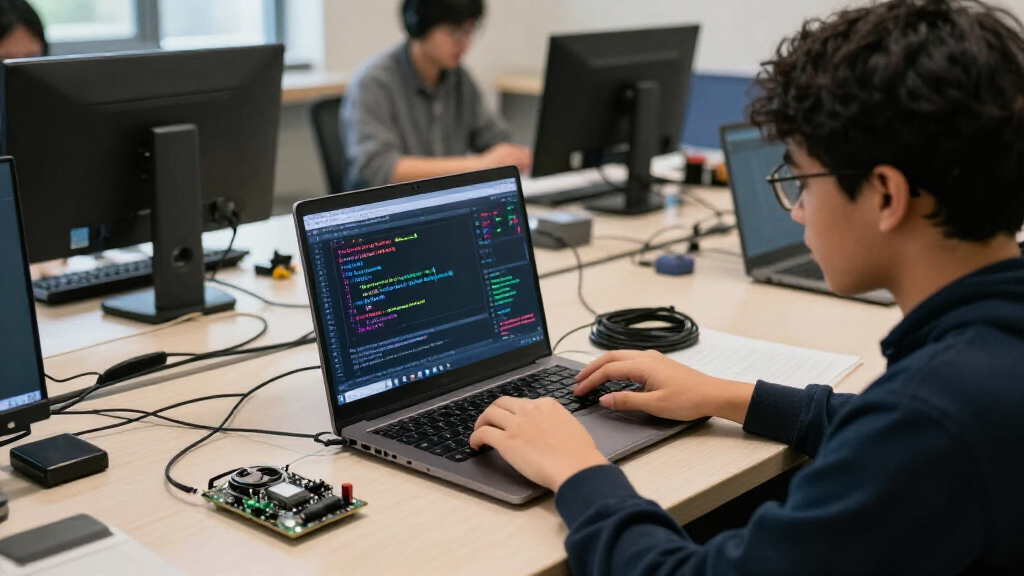

🔍 Read the full analysis: The Building Blocks Of PyTorch: Tensors, Autograd, And Training on ThorstenMeyerAI.com

Prime made for students and young adults
- Fast, free delivery for dorm and study essentials
- Prime Video and Amazon Music included
- Member-only deals
TL;DR
A November 22 explainer from ThorstenMeyerAI.com breaks PyTorch down into tensors, autograd, accelerators, training loops and compilation. It also examines new native PyTorch backends announced for Google’s TPUs and AWS Trainium, while noting that moving workloads between chips can still require changes.
ThorstenMeyerAI.com published a PyTorch explainer on November 22, describing how tensors, automatic differentiation and training loops fit together as Google and Meta promote PyTorch support for Google’s TPUs and AWS introduces a native PyTorch backend for its Trainium chips. The account says these projects aim to make it easier to use PyTorch across different accelerators, but does not establish that moving a model between chips requires only a one-line change.
The explainer presents PyTorch as an open-source Python library for building and training neural networks. It describes five building blocks: tensors that store numerical data, autograd that calculates gradients, accelerators such as GPUs, training code built with modules and loops, and torch.compile, which can compile code for faster execution. The article says its small code examples were tested with PyTorch 2.12.
At the center is the tensor, a multidimensional data structure with a shape, data type and device. PyTorch operations can combine tensors, including matrix multiplication. When a model is trained, autograd tracks relevant calculations and computes gradients that help update the model’s parameters. The explainer characterizes PyTorch’s default approach as “eager”: Python executes operations as it reaches them, building the calculation graph during execution.
The article reports that TorchTPU was presented by Google and Meta on October 20, with the stated aim of running PyTorch natively on Google’s TPU chips. It also says TorchNeuron, a native PyTorch backend for AWS Trainium, entered public beta that day. The source describes the goal as making a TPU port as simple as changing a device name, but cautions that the authors say peak performance can still require code changes.
How PyTorch Shapes Chip Choices
AI frameworks sit between a team’s model code and the hardware that runs it. Native PyTorch backends could make alternative accelerators easier to evaluate for organizations whose staff and existing projects already use the framework. That may broaden hardware choices and affect infrastructure planning, hiring and the effort involved in moving workloads.
It does not follow that hardware can be swapped without engineering work. The source specifically says peak performance on TPU hardware may call for changes. Performance, compatibility and migration costs depend on the model and workload; the explainer provides no comparative benchmarks or cost figures. Its practical point is narrower: broader support can lower some barriers to switching, not eliminate them.
Popular right now

Roborock Qrevo 2 Pro Robot Vacuum and Mop with 20,000 Pa Suction

Apple AirPods Pro (1st Generation) with MagSafe Charging Case

Roborock F25 XT Cordless Wet-Dry Vacuum Mop
As an affiliate, we earn on qualifying purchases.
From PyTorch to Native Backends
PyTorch began in 2016 and had its first public release in January 2017, according to the 2019 research paper cited by the source. That paper describes the library’s imperative style and says most of its implementation is written in C++ for performance. The project moved to the PyTorch Foundation, under the Linux Foundation, in September 2022; the source says technical decisions remain with individual maintainers.
The source reports that PyTorch 2.15 was released on October 28, 2026, with 3,117 commits from 583 contributors since version 2.14, and support for Python 3.11 through 3.15. It places PyTorch alongside JAX and TensorFlow as an open-source framework that can use accelerators, while distinguishing their programming styles: PyTorch is eager by default with optional compilation, JAX uses function transformations, and TensorFlow 2 can turn functions into graphs with tf.function. These are differences in approach, not a ranking.
What Backend Portability Can Deliver
The source does not provide independent performance tests, migration case studies or cost comparisons for TorchTPU and TorchNeuron. It is therefore unclear how much work a typical organization would save, which models can move with minimal changes, or how results vary across hardware and software versions. The one-line device change is presented as a goal, while the source also notes that peak performance may require modifications.
The explainer’s technical examples were tested with PyTorch 2.12, while its account says version 2.15 was released later, on October 28, 2026. The source does not specify whether every example was retested against that release. The backend announcements are described as a presentation and a public beta; the supplied material does not give adoption figures or a schedule for wider availability.
Testing the New PyTorch Backends
The next useful evidence will come from testing TorchTPU and TorchNeuron on real workloads: whether existing PyTorch models run, what changes are needed for tuning, and how performance and operating costs compare with other accelerators. TorchNeuron is identified as being in public beta, but the source gives no further release timetable. It also does not report a general availability date for TorchTPU.
For teams choosing infrastructure, the immediate takeaway is to treat native backend support as a reason to evaluate hardware options, not as proof that a workload will transfer unchanged. The article is part three of a six-part explainer series; its focus here is how the framework works and why its role as a bridge between code and chips matters.
Key Questions
What is PyTorch?
PyTorch is an open-source Python library used to build and train neural networks. It provides data structures and tools for calculations, differentiation and model training.
What does autograd do?
Autograd calculates gradients by tracking operations involved in a computation. Those gradients help a training process adjust a model’s parameters.
What are TorchTPU and TorchNeuron?
As described in the source, TorchTPU is a project for native PyTorch use on Google TPUs, presented by Google and Meta. TorchNeuron is a native PyTorch backend for AWS Trainium that entered public beta on October 20, 2026.
Can a PyTorch model move between chips with one code change?
That is the stated usability goal for porting to a TPU, not a confirmed rule for every model. The source says peak performance may still require changes, and supplies no migration tests or benchmark data.
Source: ThorstenMeyerAI.com