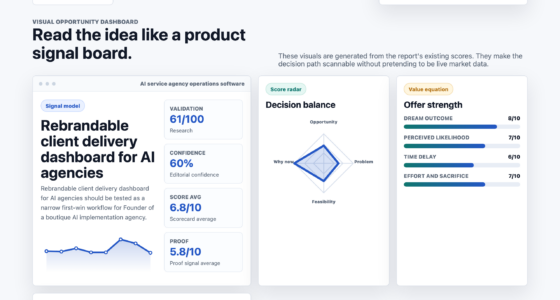

📊 Full opportunity report: How Internal Dynamics Influence AI Outcomes on ThorstenMeyerAI.com — validation score, market gap, and execution plan.
TL;DR
Despite widespread AI adoption in 2026, most enterprise pilots fail to deliver measurable ROI due to internal organizational challenges. Success hinges on addressing internal resistance, data silos, and organizational change, not just technology.
Despite near-universal adoption of AI across Fortune 500 companies, most enterprise AI pilots fail to produce measurable ROI. The key barrier is not the technology itself but internal organizational dynamics, including resistance, data silos, and cultural challenges, which prevent successful deployment and scaling.
Recent studies, including a comprehensive MIT analysis, show that 95% of AI pilots in enterprises do not generate immediate profit and loss impact within six months. However, this figure largely reflects the difficulty of scaling pilots beyond initial demos, not the failure of AI technology. The core issue lies in organizational dysfunctions such as unclear ownership, lack of success criteria, and workflows that are never redesigned for AI integration.
Furthermore, 80% of the work needed to move AI from pilot to production involves data engineering, governance, and workflow integration—tasks that are organizational rather than technical. Less than 1% of enterprise data is currently incorporated into AI models, not due to technological limitations but because of resistance rooted in data silos, governance disputes, and political obstacles. Additionally, many employees fear job losses or actively sabotage AI initiatives, complicating deployment efforts.
Near-universal adoption, near-total value failure. The gap between spend and proof is the defining tension of enterprise AI in 2026.
Why Internal Resistance Hampers AI Success
This analysis underscores that organizational readiness is the critical factor in AI success. Companies investing billions in AI are often thwarted not by the models but by internal resistance, cultural barriers, and data management issues. Addressing these factors is essential for realizing AI's potential and avoiding wasted expenditure.

Project Management with AI For Dummies
As an affiliate, we earn on qualifying purchases.
As an affiliate, we earn on qualifying purchases.
Organizational Challenges in Enterprise AI Deployment
Since 2020, enterprise AI adoption has surged, with over 80% of Fortune 500 companies deploying AI tools. Despite this, reports indicate that most initiatives do not deliver ROI. The MIT study highlights that the bottleneck is organizational—failure to adapt workflows, unclear ownership, and resistance from employees. Surveys in 2026 reveal widespread fear of job loss and sabotage, which further impedes progress.
Historically, technical limitations have been less of a barrier than organizational and cultural factors. Successful AI projects tend to involve partnerships with external vendors and cross-functional teams that focus on change management and workflow redesign, rather than solely relying on internal teams or technical prowess.
"Most AI failures are organizational, not technical. The technology works; the organization doesn’t."
— Thorsten Meyer
As an affiliate, we earn on qualifying purchases.
Unclear Factors in Long-Term AI Adoption
It is not yet clear how organizations will effectively overcome deep-rooted cultural resistance and data silos at scale. The success of new change management strategies remains to be seen, and long-term impacts of internal sabotage or fear are still developing.
organizational change management tools
As an affiliate, we earn on qualifying purchases.
As an affiliate, we earn on qualifying purchases.
Next Steps for Improving AI Integration Success
Organizations are likely to focus on comprehensive change management, cross-functional teams, and external partnerships to address internal barriers. Future research will evaluate the effectiveness of these strategies, and companies may adopt new governance models to better align incentives and reduce resistance. Monitoring how organizations adapt their internal processes will be key in determining future success rates.
enterprise data silos integration solutions
As an affiliate, we earn on qualifying purchases.
As an affiliate, we earn on qualifying purchases.
Key Questions
Why do most enterprise AI pilots fail to deliver ROI?
Most failures are due to organizational issues such as resistance, data silos, unclear ownership, and workflows that are not redesigned for AI integration, rather than technical limitations.
What role does employee resistance play in AI deployment?
Employee resistance, driven by fear of job loss and sabotage, significantly hampers AI adoption. Addressing cultural and emotional factors is crucial for success.
Is the failure of AI projects mainly due to technology?
No, studies show that the technology itself works; the main barriers are organizational, including governance, workflow integration, and change management.
What strategies improve AI implementation success?
Successful organizations partner with external vendors, redesign workflows, and focus on change management to win internal support and overcome resistance.
Will internal resistance diminish over time?
It remains uncertain; success depends on how organizations address cultural fears, data governance, and workflow adaptation in the coming years.
Source: ThorstenMeyerAI.com