📊 Full opportunity report: How Digital Platforms Help Fill Small-Town Retail Spaces on IdeaNavigator AI — validation score, market gap, and execution plan.

Get school and study supplies delivered free — and shop member deals
- Fast, free delivery on millions of items
- Access to Prime Big Deal Days deals on October 6–7
- Prime Video, Amazon Music and more included
TL;DR
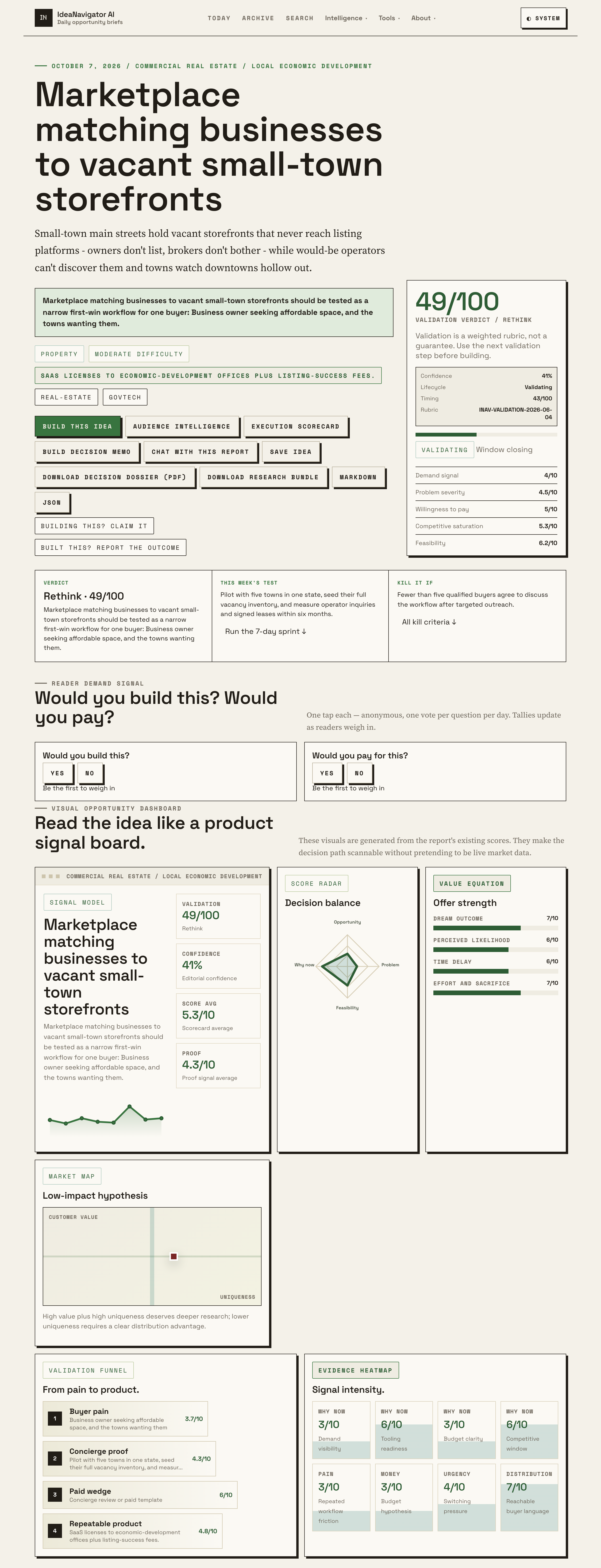
IdeaNavigator AI’s proposal outlines a marketplace that would list vacant small-town storefronts and match them with business operators, routing inquiries to local development offices with relevant incentives. It recommends testing the idea in five towns in one state and tracking inquiries and signed leases over six months; no operating platform or pilot results are confirmed.
IdeaNavigator AI’s proposal describes a digital marketplace to connect prospective business tenants with vacant storefronts in small towns, pairing property listings with local incentives and referrals to economic-development offices. The proposal recommends a pilot in five towns in one state. It does not confirm that a platform has been built, towns have signed on, or a pilot is underway.
In its proposal, IdeaNavigator AI frames the problem as a discovery gap: some owners of empty main-street commercial properties may not list them on conventional platforms, while brokers may not pursue listings in smaller markets. The proposal says operators looking for affordable space may therefore not know which properties are available. It characterizes the effect as downtowns losing activity but provides no vacancy figures or measurement of that impact.
For a minimum product, IdeaNavigator AI says property owners and towns would submit photos, floor area, rent and available incentive programs. Prospective operators could browse by town profile and foot-traffic information. When an operator expresses interest, the platform would direct the match to the local development office, including relevant grants or other incentives where available.
IdeaNavigator AI suggests a business model combining software subscriptions for economic-development offices with fees tied to successful listings. To test demand, its proposal recommends collecting a complete vacancy inventory in five towns and measuring operator inquiries and signed leases over six months. These are proposed features and measures, not reported results from an existing service.
Connecting Vacancies With Local Support
If implemented, a shared marketplace could make storefronts easier to discover for small-business operators who lack access to local broker networks. Bringing property details and incentives into one search could also help towns direct prospects to grants or other support sooner, rather than leaving operators to find separate contacts and programs themselves.
The proposed pilot would test whether the matching process leads to more than online interest. Inquiries and signed leases could offer an initial indication of whether operators can be brought into vacant spaces, although those measures alone would not establish lasting business success or prove that the platform caused a lease. For towns, the approach could offer a structured way to inventory empty properties and track prospective tenants; for owners, it could provide another route to reach them.
The proposal also points to a practical question for local governments: whether a subscription service and success fees are affordable compared with existing economic-development work. No pricing, implementation costs, expected revenue or evidence of willingness to pay is provided.
digital storefront listing platform
As an affiliate, we earn on qualifying purchases.
As an affiliate, we earn on qualifying purchases.
The Proposed Matching Model
IdeaNavigator AI describes the concept as a focused marketplace for two groups: business owners seeking affordable commercial space and towns seeking new tenants for vacant storefronts. Its central premise is that some available properties remain difficult to find because they are not listed through channels prospective operators typically use.
The proposal cites renewed interest in small towns linked to remote-work migration, along with grant funding for economic-development offices, as reasons to explore the service. It does not cite migration statistics, identify specific grant programs, or establish how widely those conditions apply. These are presented as reasons to consider the idea, not as evidence of demand.
IdeaNavigator AI recommends an initial test in five towns in one state: compile their available storefronts and observe activity over six months. That scope could help test whether towns will supply accurate listings and whether operators use them before a larger rollout is considered.
small town commercial property listings
As an affiliate, we earn on qualifying purchases.
As an affiliate, we earn on qualifying purchases.
Demand, Costs and Lease Outcomes
IdeaNavigator AI’s proposal reports no launch, participating towns or completed leases. It does not name a platform operator, give a launch date, specify participating communities or show that owners and development offices have agreed to provide listings.
The proposal does not explain how the service would verify rent, space measurements, availability or incentive eligibility, or how often listings would be updated. It also does not describe how foot-traffic data would be gathered or define a town profile. These details could affect whether operators trust the listings and whether local offices can respond to referrals.
Other unanswered questions include subscription and success-fee prices, the definition of a successful listing, and how a pilot would distinguish platform-driven leases from deals that would have happened anyway. The suggested six-month window is a proposed measurement period, not a guarantee that leases will be signed in that time.
As an affiliate, we earn on qualifying purchases.
Testing the Five-Town Pilot
IdeaNavigator AI proposes recruiting five towns in one state and assembling a full inventory of their vacant storefronts. Before a test begins, organizers would need to define who can list properties, how listing information and incentives will be checked, and how operator inquiries will be routed to development offices.
For the proposed six-month pilot, the stated measures are operator inquiries and signed leases. Reporting those results alongside listing completeness, response times and costs could help towns judge whether the marketplace merits continued use. Until a pilot is confirmed and results are published, the concept remains a proposed approach rather than a demonstrated solution.
Source: IdeaNavigator AI proposal
As an affiliate, we earn on qualifying purchases.
Key Questions
Has the storefront marketplace launched?
No launch is confirmed. IdeaNavigator AI presents the platform as a proposal; its recommended five-town pilot is not reported as underway.
Who would use the proposed platform?
According to IdeaNavigator AI’s proposal, it is intended to connect business operators seeking space with owners and towns that have vacant storefronts, while giving local development offices a role in handling matches.
What information would storefront listings include?
The proposal calls for listings with photos, size, rent and incentive programs. Operators would also be able to browse by town profile and foot-traffic data.
How would the pilot be evaluated?
IdeaNavigator AI recommends testing in five towns in one state and tracking operator inquiries and signed leases over six months. No pilot results or baseline figures are reported.
How might the marketplace make money?
The proposed model combines software subscriptions for economic-development offices with fees linked to successful listings. The proposal does not specify prices or define success.
Source: IdeaNavigator AI
Halloween Picks
halloween
As an affiliate, we earn on qualifying purchases.