
TL;DR

Prime made for students and young adults
- Fast, free delivery for dorm and study essentials
- Prime Video and Amazon Music included
- Member-only deals
Archaeologists have uncovered a previously unknown ancient city beneath Egypt’s desert, including a well-preserved church dating back thousands of years. The discovery offers new insights into Egypt’s history, but many details remain unclear.
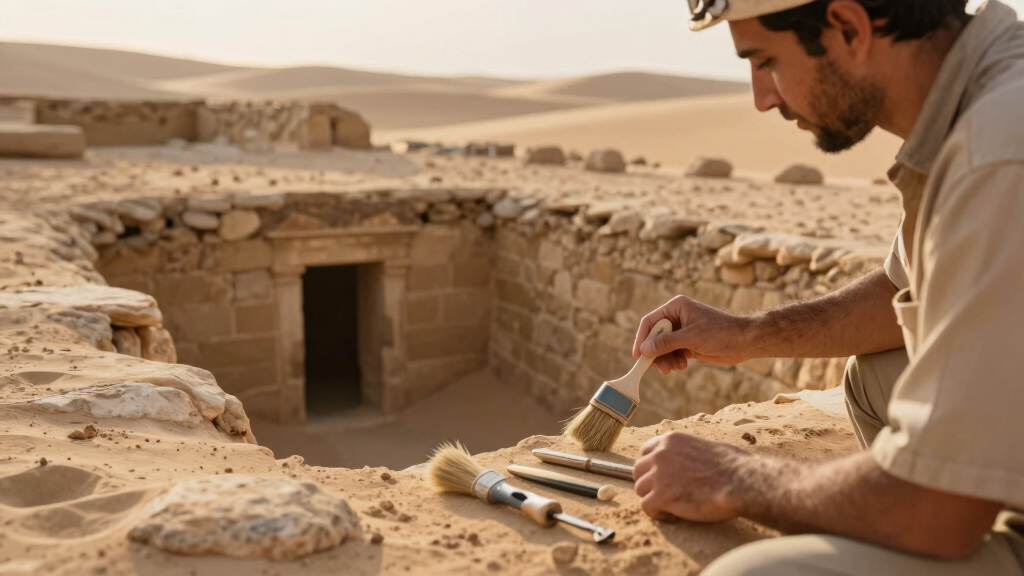
Archaeologists have uncovered a lost city beneath Egypt’s desert, including a well-preserved ancient church dating back thousands of years. This discovery provides new insights into Egypt’s historical landscape and religious practices, making it a significant breakthrough in archaeology.
The discovery was announced by Egypt’s Ministry of Antiquities on March 2024. The site was uncovered during recent excavations in the Western Desert, where a team led by Dr. Sarah Ahmed identified extensive ruins. The city appears to date from the New Kingdom period, approximately 1550–1070 BCE, based on preliminary dating methods.
Among the findings is a remarkably intact church with Christian-era artifacts, suggesting the site was a religious center during late antiquity. The church’s architecture includes a basilica-style layout, with stone walls and remnants of frescoes, according to the ministry’s statement. The site also contains pottery, tools, and inscriptions, which are now being analyzed.
Officials confirmed that the city covers an area of approximately 20 square kilometers, indicating it was a significant settlement in its time. The discovery was made possible through advanced ground-penetrating radar and excavation techniques, which revealed the extensive underground structures.
Implications for Egypt’s Ancient History and Religious Evolution
This discovery is important because it sheds light on Egypt’s urban development and religious history during a previously under-documented period. The presence of a Christian church suggests the area was inhabited during late antiquity, possibly indicating a Christian community thriving in the region.
It challenges existing narratives about the desert’s role in Egypt’s ancient civilization, showing that significant settlements existed far from the Nile River. The find could lead to revisions of historical timelines and cultural interactions during the transition from pagan to Christian societies.
ground penetrating radar archaeological equipment
As an affiliate, we earn on qualifying purchases.
As an affiliate, we earn on qualifying purchases.
Recent Archaeological Discoveries in Egypt’s Western Desert
Egypt has seen a surge in archaeological activity in recent years, with discoveries of tombs, temples, and settlements. Notably, in 2022, a large necropolis was uncovered near Luxor, and in 2023, a well-preserved temple complex was found in the Sinai Peninsula.
The current discovery builds on these efforts, utilizing new technologies like ground-penetrating radar to identify buried structures without extensive excavation. Historically, the Western Desert has been less explored than the Nile Valley, making this find particularly significant.
Experts believe the site may be part of a broader network of settlements that facilitated trade and religious exchange during the late ancient period.
“This is one of the most significant discoveries of our careers. The well-preserved church and the extensive city ruins open new windows into Egypt’s past, especially during the late antique period.”
— Dr. Sarah Ahmed, Lead Archaeologist
ancient Egyptian church replica model
As an affiliate, we earn on qualifying purchases.
As an affiliate, we earn on qualifying purchases.
Details on the Site’s Exact Age and Cultural Context Still Unclear
While preliminary dating suggests the city dates to the New Kingdom period and the church to late antiquity, precise chronological details are still being established through ongoing analysis. The full extent of the city’s historical significance and its relationship with other known settlements remains to be clarified.
Researchers are also investigating whether the site was continuously inhabited or had periods of abandonment, and how it fits into broader regional networks.
As an affiliate, we earn on qualifying purchases.
Further Excavations and Scientific Analysis Planned
Scientists and archaeologists will continue excavating the site to uncover more structures and artifacts. Radiocarbon dating, artifact analysis, and detailed mapping are expected to provide clearer timelines and cultural insights.
The team plans to publish detailed findings in academic journals over the coming months and organize public exhibitions to showcase the discoveries. International collaboration is also anticipated to deepen understanding of the site’s significance.
As an affiliate, we earn on qualifying purchases.
Key Questions
How old is the city and the church?
Preliminary estimates suggest the city dates back to approximately 1550–1070 BCE, during Egypt’s New Kingdom, while the church appears to be from the late antique period, around the 4th to 7th centuries CE. Exact dates are still being confirmed through ongoing analysis.
What makes this discovery so important?
The site offers new insights into Egypt’s urban and religious history, especially during late antiquity. It challenges previous assumptions about desert settlements and religious communities outside the Nile River Valley.
Are there any threats to the site?
As with many archaeological sites, natural erosion and human activity pose risks. The authorities are working to preserve the site and prevent looting or damage during ongoing excavations.
Will the public be able to visit the site?
Access will depend on ongoing excavation progress and preservation efforts. Official plans for public viewing or museum displays are expected to be announced after further research is completed.
Source: hn
Fall Picks
fall essentials
As an affiliate, we earn on qualifying purchases.