Educational board games for families work best when learning feels like part of the play, not a separate lesson. I’d put Race Across the USA first for its blend of geography and family competition, while Scrabble Junior is a more approachable pick for early readers and Paycheck to Billionaire brings money decisions into play. The main tradeoff is depth versus accessibility: trivia and strategy games can offer more challenge, while simpler word, number, and guessing games are easier to bring out with mixed ages. Age guidance, reading demands, and how much direct teaching a game needs can matter as much as its subject. Read on for the full breakdown and help matching a game to your family.

Prime made for students and young adults
- Fast, free delivery for dorm and study essentials
- Prime Video and Amazon Music included
- Member-only deals
Key Takeaways
- Race Across the USA stands apart for teaching geography through a shared route-and-destination challenge, rather than relying on isolated facts.
- Scrabble Junior and Number Hunter offer clearer practice with early literacy and arithmetic, but their narrower learning focus may call for variety across game nights.
- Paycheck to Billionaire is the strongest fit for money-related decision-making, while families seeking a broad range of knowledge may prefer a trivia game.
- Hedbanz, Tapple, and Do You Really Know Your Family? lean on conversation, recall, or quick word play; they feel more social than curriculum-driven.
- The lineup ranges from preschool-friendly turn-taking in Chutes and Ladders to reading-heavy or knowledge-based play, so matching player ages and skills matters more than choosing the game with the broadest theme.
| Bananagrams Classic Word Game with 144 Tiles and Banana-Shaped Pouch |  | Best for Fast-Paced Word Practice | Game type: Word, spelling, and anagram game | Players: 1–8 | Recommended age: 7 years and up | VIEW LATEST PRICE | See Our Full Breakdown |
| Scholastic Race Across the USA Geography Board Game for Kids, Ages 8+ |  | Best for Mixed-Grade Geography Practice | Brand: University Games | Players: 2–4 | Recommended age: 8+ | VIEW LATEST PRICE | See Our Full Breakdown |
| Hasbro Gaming Scrabble Junior Board Game, 2–4 Players, Ages 5+ |  | Best for Early Readers | Players: 2–4 | Age range: 5 years and up | Playing time: 15 minutes | VIEW LATEST PRICE | See Our Full Breakdown |
| Spin Master Games Hedbanz Picture Guessing Game, 2nd Edition |  | Best for Deductive Questioning | Players: 2–6 | Recommended age: 6 years and up | Edition: 2nd Edition | VIEW LATEST PRICE | See Our Full Breakdown |
| I Should Have Known That! Trivia Game, Green |  | Best for Teen-and-Adult Trivia Groups | Brand: Hygge Games | Model: 21026 | Age range: 14 years and up | VIEW LATEST PRICE | See Our Full Breakdown |
| Hasbro Gaming Trivial Pursuit Family Edition Board Game | 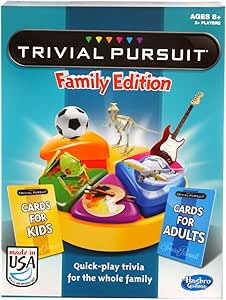 | Best for Mixed-Age Trivia | Brand: Hasbro Gaming | Edition: Family Edition | Players: 2 or more | VIEW LATEST PRICE | See Our Full Breakdown |
| Hasbro Gaming Operation Electronic Board Game |  | Best for Fine-Motor Practice | Brand: Hasbro Gaming | Edition: Standard Edition | Players: 1 or more | VIEW LATEST PRICE | See Our Full Breakdown |
| Number Hunter Addition and Subtraction Board Game for Kids |  | Best for Early Math Practice | Brand: Clever Fox Play | Game type: Math board game | Players: 2 or more | VIEW LATEST PRICE | See Our Full Breakdown |
| Do You Really Know Your Family? Family Card Game |  | Best for Family Conversation | Game type: Trivia and conversation card game | Players: 3–8 | Recommended age: 8 years and up | VIEW LATEST PRICE | See Our Full Breakdown |
| Paycheck to Billionaire Financial Strategy Board Game, Ages 8+ |  | Best for Financial Concepts | Brand: VENTURE CATCHER | Players: 2–6 | Recommended age: 8 years and up | VIEW LATEST PRICE | See Our Full Breakdown |
| Hasbro Gaming Chutes and Ladders Board Game for 2–4 Players, Ages 3+ |  | Best for Preschool Number Practice | Brand: Hasbro Gaming | Players: 2–4 | Recommended age: 3 years and up | VIEW LATEST PRICE | See Our Full Breakdown |
| The Original Tapple Family Word Game |  | Best for Fast-Paced Vocabulary Play | Brand: USAOPOLY | Age range: 8 years and up | Players: 2–8 | VIEW LATEST PRICE | See Our Full Breakdown |
| educational board games for familie | Players | Included components | Recommended age | Brand |
|---|---|---|---|---|
| Bananagrams Classic Word Game | 1–8 | Letter tiles, banana-shaped pouch, instructions | 7 years and up | — |
| Scholastic Race Across the USA | 2–4 | Game board, cards, airplane pawns | 8+ | University Games |
| Hasbro Gaming Scrabble Junior | 2–4 | Double-sided gameboard, 4 tokens, 105 letter tiles, game guide | — | — |
| Spin Master Games Hedbanz Pict | 2–6 | 6 headbands, 6 headplates, 16 scoring badges, 1 timer, 69 picture cards, 3 sample question cards, instructions | 6 years and up | — |
| I Should Have Known That! Triv | — | — | — | Hygge Games |
| Hasbro Gaming Trivial Pursuit | 2 or more | Gameboard, 100 blue adult cards, 100 yellow kids’ cards, 2 cardholders, 6 scoring tokens, 36 scoring wedges, die, and instructions | 8 years and up | Hasbro Gaming |
| Hasbro Gaming Operation Electr | 1 or more | Gameboard with Cavity Sam, tweezers, 26 cards, 12 Funatomy parts, play money, rubber band, and instructions | — | Hasbro Gaming |
| Number Hunter Addition and Sub | 2 or more | Game board, 5 game pieces, 2 number dice, 1 operation die, 50 challenge cards, and game rules | 5 years and up | Clever Fox Play |
| Do You Really Know Your Family | 3–8 | Cards | 8 years and up | — |
| Paycheck to Billionaire Financ | 2–6 | 100 play cards, 240 banknotes, 5 stop signs, 1 game map, 2 dice, 40 upgrade arrows, 6 Eye of Providence pieces, 1 user manual, and 1 card organizer | 8 years and up | VENTURE CATCHER |
| Hasbro Gaming Chutes and Ladde | 2–4 | Game board, cardboard playing pieces, and spinner | 3 years and up | Hasbro Gaming |
| The Original Tapple Family Wor | 2–8 | Portable Tapple wheel with built-in timer, 36 cards, and instructions | — | USAOPOLY |
More Details on Our Top Picks
Bananagrams Classic Word Game with 144 Tiles and Banana-Shaped Pouch
Bananagrams suits families whose children can already recognize letters and want spelling practice without waiting through turns. Everyone builds a crossword grid at once, so the game stays active; unlike Scrabble Junior, it does not offer a picture-matching side to help younger beginners. Its 144 letter tiles and banana-shaped pouch also make it an easy option to pack for travel, with no board, pencils, or paper to carry.
The tradeoff is that players must independently form words into connected grids, which may frustrate children who need more guidance or are still learning basic spelling. It supports one to eight players, but the supplied details do not describe graded difficulty or a structured teaching path. I’d choose it for flexible, lively word practice, not as the gentlest first literacy game.
Pros:- Simultaneous play keeps everyone involved rather than waiting for turns.
- 144 letter tiles support repeated word-building play.
- Banana-shaped pouch makes the set easy to carry.
- Requires no board, pencils, or paper.
Cons:- Players need enough spelling confidence to build crossword grids independently.
- Small parts make it unsuitable for children under 3.
Best for: Families with school-age children who can spell simple words and want a portable, simultaneous-play word game for home or travel.
Not ideal for: Families with early readers who need picture cues, guided letter matching, or turn-by-turn support; Scrabble Junior offers a more scaffolded starting point.
- Game type:Word, spelling, and anagram game
- Players:1–8
- Recommended age:7 years and up
- Tiles:144
- Included components:Letter tiles, banana-shaped pouch, instructions
- Materials:Rubber, wood
- Model number:1295
Our verdict“Choose Bananagrams for portable, lively spelling practice with children ready to build words independently.”
Scholastic Race Across the USA Geography Board Game for Kids, Ages 8+
Race Across the USA gives geography a clear family-game structure: players visit six states, answer questions, and race back home. Its strongest distinction is grade-level questions, which can let children at different school stages play together without every question landing at the same difficulty. Compared with I Should Have Known That!
The race gives answers a purpose beyond recalling facts, but this is still a question-driven game: players who dislike geography quizzes may not enjoy the central task. The two-to-four-player limit also makes it a tighter fit for larger households than Hedbanz, which accommodates up to six. I’d pick this for families who want a focused, school-friendly learning theme rather than an all-subject quiz.
Pros:- Grade-level questions help children at different school stages play together.
- Combines U.S. geography recall with a race across the board.
- Includes a board, cards, and airplane pawns for a complete tabletop setup.
Cons:- Limited to two to four players, so some larger families may need to sit out.
- Question-answering is central to play and may not suit children who dislike quizzes.
Best for: Families with two to four children in different grades who want a structured U.S. geography game for family nights or classroom groups.
Not ideal for: Larger families or players who would rather learn through word play or deduction than answer geography questions.
- Brand:University Games
- Players:2–4
- Recommended age:8+
- Estimated playing time:20 minutes
- Genre:Educational
- Included components:Game board, cards, airplane pawns
- Language:English
- Edition:Standard Edition
Our verdict“Choose this game when your family wants U.S. geography practice with questions adjusted for different grade levels.”
Hasbro Gaming Scrabble Junior Board Game, 2–4 Players, Ages 5+
Scrabble Junior is the most scaffolded word-learning choice in this group. One side lets children match letters to words and pictures; flipping the double-sided board introduces a more open word-building level as their skills grow. That progression gives it an advantage over Bananagrams for early readers, who may find Bananagrams’ independent crossword-building too demanding at first.
The tradeoff is a narrower group size: it supports two to four players, while Bananagrams can include a much larger family and keeps everyone playing at once. Its stated play time is 15 minutes, which can suit short sessions but may feel brief for families hoping for a longer game night. I’d choose it for young learners who benefit from visible prompts and a gradual shift toward creating words, rather than for older children seeking a faster, less guided challenge.
Pros:- Two-sided board moves from letter matching to creating words.
- Picture and word prompts give beginning readers extra support.
- Includes 105 letter tiles and four character tokens.
- No batteries are required.
Cons:- Supports only two to four players.
- The 15-minute listed play time may be short for families wanting a longer session.
Best for: Families with children around age five who are learning letter recognition and spelling and would benefit from a guided-to-independent progression.
Not ideal for: Larger families or confident readers looking for simultaneous, open-ended word play; Bananagrams supports more players and moves at a faster pace.
- Players:2–4
- Age range:5 years and up
- Playing time:15 minutes
- Game type:Word-building
- Game levels:Letter matching and advanced word creation
- Included components:Double-sided gameboard, 4 tokens, 105 letter tiles, game guide
- Battery requirement:No batteries required
- Language:English
Our verdict“Choose Scrabble Junior for young readers who need picture-supported practice before moving into independent word building.”
Spin Master Games Hedbanz Picture Guessing Game, 2nd Edition
Hedbanz turns learning into a shared guessing exercise: players wear a picture card and ask yes-or-no questions to work out what it shows. This makes it a more conversational choice than Scrabble Junior, where learning centers on letters and word formation. The picture prompts and simple question format can give children practice with categorizing clues and refining guesses, while the six headbands allow a larger group than Race Across the USA.
Its learning value depends on players actively asking useful questions, and the timed rounds may put pressure on children who need longer to think or speak. Unlike Bananagrams, it requires at least two players and relies on group interaction rather than quiet solo practice. I’d choose Hedbanz for families who want an accessible reasoning game with plenty of conversation, not for a household seeking a focused spelling or geography lesson.
Pros:- Yes-or-no questions make the basic play structure easy to grasp.
- Picture cards give players concrete clues to reason from.
- Six headbands support family groups of up to six players.
- Encourages deduction through asking and refining questions.
Cons:- Requires at least two players.
- Timed rounds may pressure players who need more time to ask or answer questions.
Best for: Families with children ages six and up who enjoy verbal clues, group interaction, and practicing deductive reasoning together.
Not ideal for: Solo players or children who feel rushed by timed rounds or need more time to form questions; Bananagrams can be played alone and has no described timer.
- Players:2–6
- Recommended age:6 years and up
- Edition:2nd Edition
- Included components:6 headbands, 6 headplates, 16 scoring badges, 1 timer, 69 picture cards, 3 sample question cards, instructions
- Model year:2023
- Winning condition:First player to collect 3 scoring badges
Our verdict“Choose Hedbanz for families who want a social, picture-based reasoning game rather than direct spelling or geography practice.”
I Should Have Known That! Trivia Game, Green
I Should Have Known That! is the oldest-skewing pick here, aimed at players ages 14 and up who enjoy quick questions about everyday facts. Its distinctive rule—losing points for wrong answers—makes guessing feel riskier than in Race Across the USA, where geography questions serve a broader race across the board. With more than 400 questions on 110 cards, it offers a substantial question pool for family gatherings, but the supplied information does not specify a precise player maximum or a learning progression.
This is better suited to older teens and adults than to a family with younger children; Scrabble Junior and Hedbanz welcome much younger players. The penalty scoring can also turn a light quiz into a frustrating experience for anyone who dislikes being marked down for mistakes. I’d choose it for a group that enjoys lively trivia banter, not as the most inclusive educational game for mixed-age households.
Pros:- More than 400 questions provide a broad pool for repeat group play.
- Questions focus on everyday facts and topics.
- Penalty scoring gives wrong answers a distinct consequence.
- Card-based format suits indoor gatherings.
Cons:- Recommended for ages 14 and up, excluding younger children from much of the family audience.
- Losing points for incorrect answers may frustrate players who prefer low-pressure learning.
- The supplied player information says more than two but does not give a maximum.
Best for: Families with teens aged 14 and up who enjoy everyday-fact trivia and do not mind losing points for incorrect answers.
Not ideal for: Households with younger children or players who find penalty-based scoring discouraging; Hedbanz and Scrabble Junior are designed for younger age groups.
- Brand:Hygge Games
- Model:21026
- Age range:14 years and up
- Number of players:More than 2
- Question count:More than 400
- Card count:110
- Material:Paper
- Language:English
Our verdict“Choose this trivia game for teen-and-adult gatherings where players enjoy everyday questions and accept point deductions for mistakes.”
Hasbro Gaming Trivial Pursuit Family Edition Board Game
Separate adult and kids’ question decks make this the strongest trivia pick here for families who want adults and children to play on more even footing. Its 1,200 questions span six categories, and players can compete individually or in teams, so younger players can get help without making every turn a group answer. Compared with I Should Have Known That!, this edition puts more emphasis on category-based knowledge and collecting wedges; it is less suited to quick, casual question bursts. Quick-play spaces let players earn a wedge on any colored space, which can keep a family game moving, but winning still depends on answering the final question. It is best for families with children ages 8 and up who enjoy trivia, not households seeking a broad mix of learning activities.
Pros:- Separate adult and kids’ card decks help balance questions across ages.
- Six categories and 1,200 questions offer variety for repeat play.
- Players can compete individually or in teams.
- Quick-play spaces allow wedge collection on any colored space.
Cons:- The trivia format favors players who enjoy recalling general knowledge.
- Recommended for ages 8 and up, so younger children may need to sit out or rely on a teammate.
- Designed for indoor play.
Best for: Families with children ages 8 and up who enjoy trivia and want age-separated questions with the option to play in teams.
Not ideal for: Families seeking hands-on math, word, or physical play, or those with children younger than 8 who need simpler questions.
- Brand:Hasbro Gaming
- Edition:Family Edition
- Players:2 or more
- Recommended age:8 years and up
- Questions:1,200 across 6 categories
- Included components:Gameboard, 100 blue adult cards, 100 yellow kids’ cards, 2 cardholders, 6 scoring tokens, 36 scoring wedges, die, and instructions
- Language:English
- Dimensions:10.51 x 7.87 x 2.24 inches
Our verdict“Choose this for age-adjusted family trivia and team play; pick Number Hunter if practicing a specific school skill matters more.”
Hasbro Gaming Operation Electronic Board Game
Steady-hand play gives Operation a different educational angle from the lineup’s quiz and number games: players practice fine motor control while trying to lift 12 pieces without touching the metal cavity edges. The buzzer and light-up nose provide immediate feedback, making each attempt easy for children to understand. Unlike Number Hunter, it does not teach a defined academic skill such as arithmetic; its learning value comes from coordination, careful movement, and turn-taking. Solo play is an advantage for a child who wants to practice alone, while group play adds a competitive layer through the money tally. The tradeoffs are the need for batteries and the hand control the game demands. I’d choose it for children who enjoy precision challenges, not for families looking for a calm, low-pressure game.
Pros:- Tweezers play gives children practice with careful hand movements.
- Buzzer and light-up nose provide clear, immediate feedback.
- Solo or group play supports different play styles.
- Includes 12 removable ailments and 26 cards.
Cons:- Requires batteries, and the listed battery types are inconsistent.
- Touching the cavity edges can frustrate players who have difficulty with steady hand control.
- Its educational focus is coordination rather than a specific school subject.
Best for: Families with children ages 6 and up who enjoy hands-on precision challenges and want an option that can also be played solo.
Not ideal for: Players who find fine-motor challenges frustrating, or families who want a game centered on direct academic practice rather than coordination.
- Brand:Hasbro Gaming
- Edition:Standard Edition
- Players:1 or more
- Age range:6 years and up
- Skills:Fine motor coordination and strategy
- Included components:Gameboard with Cavity Sam, tweezers, 26 cards, 12 Funatomy parts, play money, rubber band, and instructions
- Batteries:Required; listed as 2 AA batteries, with another description listing 2 D batteries
- Instruction languages:English and Spanish
Our verdict“Pick Operation for tactile fine-motor practice and playful competition, rather than the direct math learning offered by Number Hunter.”
Number Hunter Addition and Subtraction Board Game for Kids
Focused arithmetic practice is Number Hunter’s clearest advantage: players roll number and operation dice, solve problems, and tackle challenge cards while moving around the board. The even-and-odd-number content adds another early math concept without requiring a screen or worksheet. Compared with Scholastic Race Across the USA, this game targets number skills rather than geography, so it suits families who want practice with a particular school subject. Its 20-minute estimated playtime also makes it a more contained activity than Paycheck to Billionaire, which is listed at 45 minutes. That focus is a tradeoff: the activity is mainly about early math, and at least two players are required. I’d choose it for young learners who benefit from repeated problems woven into a shared game.
Pros:- Practices addition, subtraction, and even-and-odd numbers during play.
- Fifty challenge cards add structured problem-solving beyond dice rolls.
- Screen-free format supports shared play and social interaction.
- Designed for family, classroom, and homeschool settings.
Cons:- Requires at least two players, so it does not work as a solo activity.
- Its learning focus is primarily early math rather than multiple subjects.
- Children who already find the covered arithmetic easy may outgrow the challenge.
Best for: Families, homeschoolers, and classrooms with children ages 5 and up who want screen-free addition, subtraction, and even-or-odd practice.
Not ideal for: Families seeking solo play or a broad mix of educational subjects; this game requires at least two players and centers on early math.
- Brand:Clever Fox Play
- Game type:Math board game
- Players:2 or more
- Recommended age:5 years and up
- Estimated playing time:20 minutes
- Included components:Game board, 5 game pieces, 2 number dice, 1 operation die, 50 challenge cards, and game rules
- Language:English
- Materials:Non-toxic, child-safe materials
Our verdict“Choose Number Hunter for guided early-math practice in a short family game; choose Race Across the USA for geography instead.”
Do You Really Know Your Family? Family Card Game
Conversation and shared jokes, rather than school-subject practice, are the point of this family card game. Questions and silly challenges give relatives a reason to talk and learn small things about one another, with simple play that should be approachable for children, teens, and adults. Compared with Trivial Pursuit Family Edition, it is less about testing stored knowledge and more about family interaction; it also needs at least three players, while Trivial Pursuit can start with two. Its compact card format is easier to bring along than a board-and-piece game such as Number Hunter. The listed playing time is only three minutes, so buyers should not expect a long game session from a single round. I’d treat it as a light social activity, not a substitute for a game built around academic learning.
Pros:- Questions and silly challenges encourage family conversation.
- Designed for children, teens, and adults to play together.
- Simple format is easy to learn.
- Portable card-only format needs no batteries.
Cons:- Requires at least three players, excluding smaller households.
- The listed playing time is only 3 minutes, so it may feel brief as a standalone activity.
- Its educational value is social and conversational rather than tied to a school subject.
Best for: Families with at least three players, including children ages 8 and up, who want easy conversation prompts for shared time or travel.
Not ideal for: Two-player households or families looking for structured practice in math, vocabulary, geography, or trivia knowledge.
- Game type:Trivia and conversation card game
- Players:3–8
- Recommended age:8 years and up
- Listed playing time:3 minutes
- Included components:Cards
- Material:Cardstock
- Special feature:Portable
- Dimensions:2 x 4.7 x 6.7 inches
Our verdict“Choose this for quick family conversation with three or more players, not for the subject-based learning in Number Hunter or Trivial Pursuit.”
Paycheck to Billionaire Financial Strategy Board Game, Ages 8+
Investing, cost management, and business-building set this game apart from family picks that teach through trivia, conversation, or arithmetic drills. Its cards, banknotes, dice, and upgrade pieces give players components to work with as they make strategic choices, while support for two to six players fits many family tables. Compared with Number Hunter, Paycheck to Billionaire reaches into economics rather than practicing elementary operations, making it a better fit for families ready to discuss money decisions during play. That wider strategic scope comes with a longer estimated session of 45 minutes, so it may be harder to fit into a brief weeknight window. It is recommended for ages 8 and up, which also puts it beyond the youngest learners in the roundup. I’d select it when financial themes matter more than a short, simple game.
Pros:- Introduces investing, cost management, and economic ideas through business-building play.
- Supports 2–6 players for family or classroom settings.
- Includes a substantial assortment of cards, banknotes, and game pieces.
- Strategy creates opportunities to discuss money choices during play.
Cons:- The estimated 45-minute playing time may be lengthy for some families.
- Recommended for ages 8 and up, so it is not aimed at younger children.
- Its business and investing focus is less direct for buyers seeking basic math practice.
Best for: Families with children ages 8 and up who want a longer strategy game built around investing, business decisions, and cost management.
Not ideal for: Families with younger children, limited game-night time, or a preference for short games focused on basic academic skills.
- Brand:VENTURE CATCHER
- Players:2–6
- Recommended age:8 years and up
- Estimated playing time:45 minutes
- Edition:US Edition
- Included components:100 play cards, 240 banknotes, 5 stop signs, 1 game map, 2 dice, 40 upgrade arrows, 6 Eye of Providence pieces, 1 user manual, and 1 card organizer
- Package type:Standard Board Game Package
- Unit count:1
Our verdict“Choose Paycheck to Billionaire for an older child’s longer game about financial choices; pick Number Hunter for quicker early-math practice.”
Hasbro Gaming Chutes and Ladders Board Game for 2–4 Players, Ages 3+
Chutes and Ladders is a gentle starting point for families who want a game that gives preschoolers practice with counting and number recognition without asking them to read. Its spinner-and-move rules are simpler than Scrabble Junior, which asks children to build words, so younger players can join in with less adult explanation. The tradeoff is that turns offer little decision-making: players mainly spin, count, and follow the board, making this better for early number exposure than for developing strategy. At up to 30 minutes, a game may also feel long for some young children, especially when chutes send them backward. I’d choose it for a first family board-game routine, but families seeking richer learning choices may prefer a game with more active problem-solving.
Pros:- No reading is required, so preschoolers can participate before they know their letters.
- Counting spaces supports number recognition during play.
- Simple spinner-and-move rules are easy for young children to follow.
- Includes the board, playing pieces, and spinner needed to play.
Cons:- Gameplay offers little strategy or choice beyond spinning and moving.
- The 2–4 player limit excludes larger groups.
- A listed playing time of 30 minutes may be lengthy for some preschoolers.
Best for: Families with children age 3 and up who want a reading-free first board game and casual counting practice.
Not ideal for: Families looking for strategic choices, varied educational challenges, or a game that accommodates more than four players.
- Brand:Hasbro Gaming
- Players:2–4
- Recommended age:3 years and up
- Playing time:30 minutes
- Skills:Counting and number recognition
- Game mechanics:Race and roll-and-move
- Included components:Game board, cardboard playing pieces, and spinner
- Battery required:No
- Instructions:English and Spanish
Our verdict“Choose Chutes and Ladders for a straightforward, reading-free way to introduce preschoolers to counting, but skip it if your family wants strategic play.”
The Original Tapple Family Word Game
Tapple turns vocabulary practice into a timed group challenge: players name a word that fits the category and starts with a letter still available on the wheel. That pressure makes it livelier than Scrabble Junior, where players have more time to place letters, while the 2–8 player range suits gatherings that outgrow smaller games such as Chutes and Ladders. Its 144 categories offer variety, and the wheel stores the cards for easier carrying and cleanup. The pace is also its main drawback: the 10-second timer can frustrate players who need more time to think, and English-language categories limit its usefulness for families seeking multilingual play. I’d pick it for school-age players who enjoy quick verbal challenges, not for early readers or relaxed, untimed word practice.
Pros:- Categories and available letters prompt vocabulary recall and word association.
- The 10-second timer keeps turns brisk and gives the game an energetic group pace.
- Includes 36 cards with 144 categories for a range of prompts.
- The wheel stores the cards and is portable for gatherings.
Cons:- The short timer can pressure players who need longer to find a word.
- English-language play limits accessibility for multilingual groups.
- An age recommendation of 8 and up makes it less suitable for younger children.
Best for: Families with children age 8 and up who enjoy quick vocabulary challenges and need a word game for groups of up to eight.
Not ideal for: Families with younger children, players who prefer untimed word games, or groups seeking play in a language other than English.
- Brand:USAOPOLY
- Age range:8 years and up
- Players:2–8
- Playing time:15 minutes
- Educational objective:Vocabulary and word association
- Included components:Portable Tapple wheel with built-in timer, 36 cards, and instructions
- Categories:144
- Language:English
- Material:Paper and plastic
Our verdict“Choose Tapple for school-age families who want energetic vocabulary practice in a larger group, and pass if a timer would make word play stressful.”
How We Picked
I compared the 12 games by how directly their play supports learning, how easily a family can get started, and whether the age and reading demands fit the stated audience. I also weighed the kind of learning each game offers—such as geography, arithmetic, vocabulary, financial choices, general knowledge, or social communication—against how naturally that learning is woven into the activity.
The ranking favors games that combine a clear educational purpose with accessible family play and a distinct reason to choose them. Games with a narrower skill focus can still be the right pick for a specific need, but they rank below more versatile options for households wanting one shared game. I also account for tradeoffs: trivia can challenge older players but leave younger ones behind, while very simple games welcome beginners yet offer less room for growing skills.
| educational board games for familie | Brand |
|---|---|
| Bananagrams Classic Word Game | — |
| Scholastic Race Across the USA | University Games |
| Hasbro Gaming Scrabble Junior | — |
| Spin Master Games Hedbanz Pict | — |
| I Should Have Known That! Triv | Hygge Games |
| Hasbro Gaming Trivial Pursuit | Hasbro Gaming |
| Hasbro Gaming Operation Electr | Hasbro Gaming |
| Number Hunter Addition and Sub | Clever Fox Play |
| Do You Really Know Your Family | — |
| Paycheck to Billionaire Financ | VENTURE CATCHER |
| Hasbro Gaming Chutes and Ladde | Hasbro Gaming |
| The Original Tapple Family Wor | USAOPOLY |
Factors to Consider When Choosing Educational Board Games For Families
Before choosing a game, I’d start with the family’s actual play habits, not the broadest educational claim on the box. A good fit should be easy to bring out, fair enough for different ages, and focused on a skill your family wants to practice.
Match the Learning Goal to the Kind of Play
Decide whether you want direct practice, such as spelling or arithmetic, or learning that happens through decisions and conversation. A focused game can help reinforce one skill, but it may feel repetitive if it is the only educational game in the cupboard. Social guessing and discussion games can develop communication and recall without resembling a classroom exercise. A common mistake is buying by subject alone—for example, choosing a geography game without checking whether players enjoy route-based challenges. I’d favor the format your family will willingly play more than once, then treat the subject as the tie-breaker.
Check the Real Age and Reading Gap
Printed age guidance is a useful starting point, but it does not tell the whole story for a household with siblings several years apart. Reading fluency, number confidence, and comfort answering questions in front of others can affect whether a child can join in independently. Look for ways younger players can participate without needing an adult to translate every turn or give them the answers. Games that rely on fast recall or broad trivia can favor older family members, even when everyone is technically within the suggested age range. If ages differ widely, prioritize shared decisions, visual clues, or flexible team play over a contest based only on individual knowledge.
Decide How Much Competition Your Family Enjoys
Some families want a clear winner; others prefer games where laughter and teamwork matter more than the score. Competitive formats can motivate practice, though a large skill gap may make younger players feel they never had a chance. Cooperative or team-based play can soften that gap, but may give individual players less control. Consider how your household reacts to timed turns, wrong answers, and setbacks before choosing a game built around them. If game night often ends in frustration, a quick, low-pressure format may be a better learning tool than a more demanding challenge.
Balance Replayability Against a Narrow Skill Focus
A game designed around a specific academic skill may be useful for targeted practice, but repeated rounds can feel like extra homework if the activity does not change much. Broader word and trivia games can vary with the players’ knowledge, yet their educational value may be less structured. Think about whether your family wants a regular practice aid or a game that stays fresh across different groups and occasions. Expansions or reusable prompts can help some formats, but they add setup and storage considerations. I’d choose a narrow-focus game when there is a clear learning need and a more flexible game when one box needs to serve many kinds of family nights.
Account for Setup, Pace, and Attention Span
The best game on paper may sit unused if it takes too long to explain or has a pace that does not suit your players. Younger children often benefit from short turns and visible actions, while older players may enjoy longer decisions or more involved questions. Check whether the game needs an adult to lead every round, keep score, or explain unfamiliar concepts. That support can be a plus when a parent wants to teach alongside play, but a drawback when children need to play independently. For busy evenings, a fast setup and a round that can end cleanly may matter more than a large number of components or rules.
Pay for Fit, Not for the Broadest Learning Claim
A higher-cost game is not automatically more educational, and a simple format can still give children worthwhile practice. Spend more when a game offers a specific experience your family will use repeatedly, such as meaningful strategy or adaptable play across ages. For a first purchase, a straightforward game with a clear skill focus can be a lower-risk way to learn what your family enjoys. Avoid choosing a game solely because it claims to teach many subjects; broad claims may not translate into focused practice. Compare the learning activity, ease of play, and likely audience before treating extra components or a more elaborate theme as added value.
Frequently Asked Questions
Which game is the best starting point for a family with both young children and older players?
I’d begin with a game whose turns do not depend on advanced reading or specialized knowledge, then use teams or informal help to close the age gap. Scrabble Junior is a more literacy-focused option for younger players, while visual or conversational games can make it easier for different skill levels to take part together. Trivia games may be less suitable if older players already know far more answers. Check whether adults can support younger children without effectively playing their turns for them. The right starting point is the game that lets everyone contribute, even if each player contributes differently.
Are trivia games a good way to teach children, or do they mostly reward what children already know?
Trivia can prompt curiosity and recall, but a correct-answer format often rewards prior knowledge more than it teaches a new subject. It tends to work better when players can discuss answers, learn from missed questions, or play in mixed-age teams. A child who repeatedly misses questions may disengage if the game offers no way to catch up. For focused skill-building, a game built around vocabulary, arithmetic, or geography practice may be a better match. Choose trivia when your family enjoys sharing knowledge and treating unfamiliar answers as conversation starters.
Should I choose a game that teaches one subject or one that covers several kinds of learning?
Choose a focused game when your family has a clear goal, such as building confidence with addition or early spelling. A broader game can suit households that want variety and are less concerned with structured practice. The tradeoff is depth: a game with a single learning focus may provide more repeated practice, while a wider format can touch on skills without developing any one of them as much. Think about whether the game will supplement another activity or serve as your main family game. One focused option plus a social or word-based game can offer a better balance than expecting one box to teach everything.
How can I tell whether a game will work for a child who is still learning to read?
Look beyond the age label and check how much text a child must read during each turn, including cards, instructions, and answer choices. Picture clues, spoken prompts, and short words can make independent participation easier. If an adult must read every prompt, the game can still work, but it may require more ongoing attention than your family wants to give. A child may also enjoy playing on a team with a confident reader, provided they still get meaningful choices. When possible, choose a format that lets reading practice support the play rather than stop it.
Is a family board game a good way to teach money skills?
A money-themed game can give children a low-stakes way to discuss choices, tradeoffs, and the consequences of decisions. It cannot replace practical lessons about real budgets, saving, or household finances, so I’d treat it as an introduction rather than a full financial education. Check whether the game asks players to make meaningful choices or mainly moves them through a themed sequence. Children may learn more when adults pause to talk about why a decision worked or did not work. It is a stronger fit for families ready to discuss money concepts than for very young players who are still learning basic number skills.
Conclusion
For the broadest mix of family-friendly play and learning, I’d choose Race Across the USA as the best overall pick. Number Hunter is my value-oriented choice for families seeking hands-on arithmetic practice, while Paycheck to Billionaire is the best premium-style choice for households interested in financial decisions and strategy. For beginners or families with younger children, Chutes and Ladders offers a simple entry point, though it provides less focused learning than the word and number games. For specific needs, choose Scrabble Junior for early literacy, Hedbanz or Tapple for lively verbal play, and Trivial Pursuit Family Edition for broad knowledge challenges. I’d make the final choice by matching the game’s pace and skill demands to the people who will actually play it.