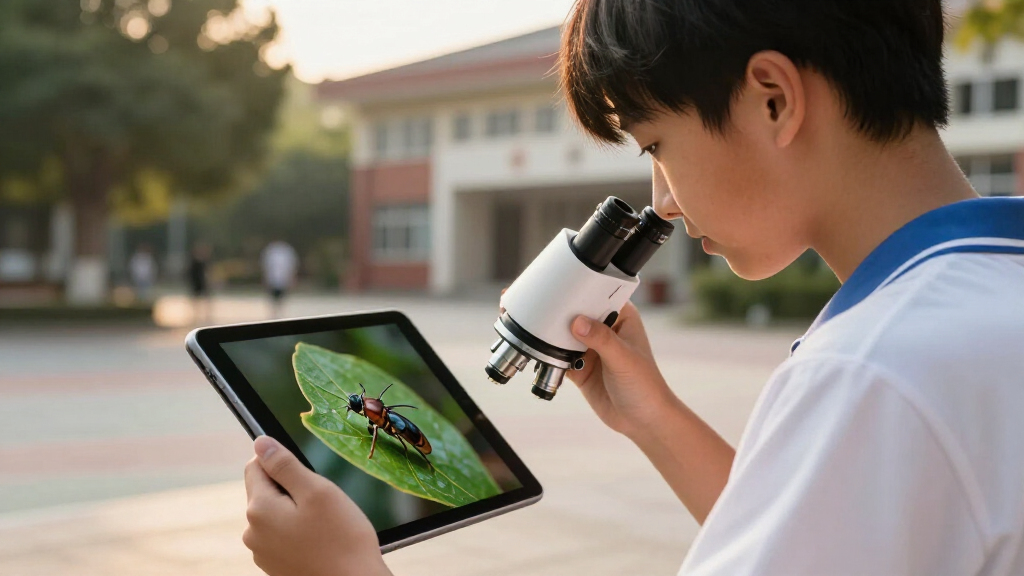

Digital microscopes for students split into two camps: screen-based models that make viewing effortless for beginners, and compound microscopes that deliver the magnification needed for serious biology coursework. The Celestron TetraView stands out as the best overall pick for students because its rotating LCD screen and specimen-friendly stage bridge both worlds. The AmScope B120 with digital camera is the stronger choice for high school and college biology, while the TOMLOV DM301 Pro makes the most sense for younger students who need a big, easy-to-view screen. The main tradeoff you’ll face is portability and ease of use versus true optical magnification — most cheap handheld models can’t show cell detail. Keep reading for the full breakdown of all 13 models and which student each one actually suits.

Get school and study supplies delivered free — and shop member deals
- Fast, free delivery on millions of items
- Access to Prime Big Deal Days deals on October 6–7
- Prime Video, Amazon Music and more included
Key Takeaways
- Screen size made a bigger practical difference than raw magnification claims — the 7-inch TOMLOV DM301 Pro and DM301 Max were far easier for beginners to use than the 4.3-inch models, because focusing is simpler when you can see clearly.
- Magnification numbers are heavily inflated in this category: the handheld ‘1000x’ wireless models magnify digitally, not optically, so they’re fine for coins and fabric but can’t resolve cells the way the AmScope B120 or PalliPartners 2000x compound scopes can.
- PC compatibility (Elikliv, AmScope B120) adds real value for students who need to capture images for lab reports, while built-in scales (TOMLOV DM4W) matter for measuring specimens rather than just viewing them.
- A mechanical stage is the hidden differentiator between student and lab-grade compound microscopes — without one, scanning a slide at high magnification becomes frustrating, which is why the AmScope B120 ranks above the cheaper PalliPartners monocular options.
- Built-in cameras on compound scopes are only as good as the optics feeding them — the budget 40X-2500X models with 5MP cameras produced softer images than the Celestron TetraView despite similar spec sheets.
| Elikliv LCD Digital Coin Microscope 1000x with 8 LED Lights, 4.3-Inch Screen, PC Compatibility |  | Best Digital Screen for Everyday Student Use | Magnification: Up to 1000x | Display: 4.3-inch LCD | Resolution: 720P HD | VIEW LATEST PRICE | See Our Full Breakdown |
| Wireless Digital Microscope 50X-1000X Magnification WiFi Portable Handheld Microscope with Adjustable Stand |  | Best Budget Portable Pick | Magnification: 50X-1000X | Resolution: 1920×1080 | Sensor: 2MP HD CMOS | VIEW LATEST PRICE | See Our Full Breakdown |
| PalliPartners 40x-2000x Biological Compound Trinocular Microscope |  | Best for Documenting Lab Work | Magnification Range: 40x to 2000x | Head Type: Trinocular | Illumination: Dual LED | VIEW LATEST PRICE | See Our Full Breakdown |
| AmScope B120 Series LED Binocular Compound Microscope with Digital Camera |  | Best Premium Lab-Grade Choice | Magnification: 40X-2500X | Head Type: Binocular | Camera: 5MP USB digital camera | VIEW LATEST PRICE | See Our Full Breakdown |
| Compound Microscope 40X-2500X with Dual LED Lighting and Mechanical Stage |  | Best Value Compound Microscope | Magnification: 40x-2500x | Eyepieces: WF10x and WF25x ultra-wide-angle | Lighting: Dual LED (top and bottom) | VIEW LATEST PRICE | See Our Full Breakdown |
| TOMLOV DM4W Digital Coin Microscope with Built-in Scale and 4.3″ Screen |  | Best for Interdisciplinary Science Projects | Display: 4.3-inch HD IPS screen | Magnification: 10X–200X | Weight Measurement: 0.1g resolution, ±0.5g accuracy | VIEW LATEST PRICE | See Our Full Breakdown |
| PalliPartners Compound Microscope for Adults & Students, White |  | Best Complete Starter Kit | Magnification: 100X to 2000X | Objective Lenses: 4X, 10X, 40X | Eyepiece: WF25X | VIEW LATEST PRICE | See Our Full Breakdown |
| AmScope Rotating Monocular Compound Microscope, 40X-1000X Magnification |  | Best Traditional Lab Scope with Digital Capture | Magnification: 40X-1000X | Head: Rotating monocular | Lens Type: Optical glass lenses | VIEW LATEST PRICE | See Our Full Breakdown |
| 1600X Microscope for Kids with 4.0-Inch Screen and HD Camera |  | Best for Young Explorers | Magnification: 100x to 1600x | Screen Size: 4.0 inches | Camera Resolution: 48MP 1080P | VIEW LATEST PRICE | See Our Full Breakdown |
| TOMLOV DM301 Pro Microscope for Kids and Adults, 7″ Screen Science Kit |  | Best Big-Screen Learning Experience | Display: 7-inch IPS screen | Magnification: 1200X | Camera Resolution: 8MP photos, 1080P videos | VIEW LATEST PRICE | See Our Full Breakdown |
| Celestron TetraView LCD Digital Microscope with 180° Swivel Screen |  | Best Classroom-Ready Kit | Camera: 5MP digital camera | Magnification: 40x to 1600x | Display: 4.3-inch swiveling TFT LCD | VIEW LATEST PRICE | See Our Full Breakdown |
| TOMLOV DM301 Max Microscope for Kids, Students, Adults |  | Best for Shared Viewing and Sharing Work | Display: 7-inch IPS LCD | Magnification: Up to 1200X | Camera: 8MP, 1080P video | VIEW LATEST PRICE | See Our Full Breakdown |
| Microscope 40X-2500X Magnification with 4.3-inch Display, Built-in 5MP Camera |  | Best Magnification Range for the Money | Magnification: 40X–2500X | Display: 4.3-inch HD screen | Camera: 5MP built-in | VIEW LATEST PRICE | See Our Full Breakdown |
| digital microscopes for student | Magnification |
|---|---|
| Elikliv LCD Digital Coin Micro | Up to 1000x |
| Wireless Digital Microscope 50 | 50X-1000X |
| PalliPartners 40x-2000x Biolog | — |
| AmScope B120 Series LED Binocu | 40X-2500X |
| Compound Microscope 40X-2500X | 40x-2500x |
| TOMLOV DM4W Digital Coin Micro | 10X–200X |
| PalliPartners Compound Microsc | 100X to 2000X |
| AmScope Rotating Monocular Com | 40X-1000X |
| 1600X Microscope for Kids with | 100x to 1600x |
| TOMLOV DM301 Pro Microscope fo | 1200X |
| Celestron TetraView LCD Digita | 40x to 1600x |
| TOMLOV DM301 Max Microscope fo | Up to 1200X |
| Microscope 40X-2500X Magnifica | 40X–2500X |
More Details on Our Top Picks
Elikliv LCD Digital Coin Microscope 1000x with 8 LED Lights, 4.3-Inch Screen, PC Compatibility
This model stands out for putting a screen first: the 4.3-inch LCD means students can observe without hunching over an eyepiece, which makes it far better suited to younger learners and classroom sharing than the PalliPartners 40x-2000x compound, which demands eyepiece technique. The 8 adjustable LEDs and height-adjustable stand make coins, leaves, and prepared slides easy to light and frame, and PC compatibility lets images move onto a laptop for reports. Compared with the Wireless Handheld model, the built-in screen trades portability for stability and comfort. The tradeoffs are real: magnification is digital, not true optical, and a memory card is a separate purchase.
Pros:- 4.3-inch LCD screen allows group viewing without eye strain
- 8 adjustable LEDs give control over illumination
- Connects to Windows and MacBook for saving and sharing images
- Rechargeable battery and adjustable stand make setup flexible
Cons:- Memory card not included, so saving images requires an extra purchase
- Battery tops out around 3 hours per charge
Best for: Middle and high school students who need a shareable screen and simple operation for hobby and classroom observation
Not ideal for: Biology students who need true optical magnification of cell-level detail — digital zoom won’t resolve it
- Magnification:Up to 1000x
- Display:4.3-inch LCD
- Resolution:720P HD
- Lighting:8 adjustable LED lights
- Compatibility:Windows, MacBook
- Battery Life:Up to 3 hours
- Stand:Height-adjustable
Our verdict“This pick makes the most sense for students who need a screen-based, low-friction microscope for everyday exploration rather than serious biology work.”
Wireless Digital Microscope 50X-1000X Magnification WiFi Portable Handheld Microscope with Adjustable Stand
Where the Elikliv LCD model anchors itself to a desk with its built-in screen, this handheld unit flips the equation: it beams 1080p video over WiFi straight to a phone or tablet, which students already own. That makes it the cheapest way for a class or family to get magnified views on a big display, and the 3-60mm focal range handles everything from fabric weave to insect wings. The adjustable stand helps with stability, though handheld shooting at higher magnifications demands a steady grip. Fixed focus is the main limitation — this is a discovery tool, not a lab instrument, and it falls short of the PalliPartners trinocular for any structured biology coursework.
Pros:- WiFi and USB connectivity works with phones, tablets, Windows, and Mac
- Genuinely pocketable design suits field trips and outdoor use
- 1080p image and video capture is easy to share
- 8 adjustable LEDs improve detail on reflective surfaces
Cons:- Fixed focus prevents fine focusing at high magnification
- Connectivity sometimes needs software updates to work smoothly
- No power adapter included
Best for: Budget-conscious students and families who want to explore outdoors using a phone as the display
Not ideal for: Students doing graded lab work — fixed focus and a 2MP sensor limit precision and detail
- Magnification:50X-1000X
- Resolution:1920×1080
- Sensor:2MP HD CMOS
- LED Lights:8 adjustable
- Focal Length Range:3-60 mm
- Connectivity:WiFi, USB
- Compatibility:iPhone, Android, iPad, Windows, Mac
Our verdict“This option is best for curious students on a budget who value portability and phone-based viewing over lab-grade precision.”
PalliPartners 40x-2000x Biological Compound Trinocular Microscope
The trinocular head is what separates this model from the similarly specced Compound Microscope 40X-2500X (B0CCNZFJ61): a third optical port lets a camera capture images without anyone leaving the eyepiece, which matters for students building lab portfolios or teachers demonstrating live to a screen. The 40x-2000x range, dual LED illumination, and double-layer stage cover the full arc of secondary and early college biology. Coarse and fine focus knobs make precise work achievable, though a complete beginner will face a learning curve that a screen-first model like the Elikliv avoids entirely. Build details are thin, so long-term durability is an open question compared with the established AmScope B120.
Pros:- Trinocular head enables camera attachment without interrupting viewing
- Wide 40x-2000x range handles education through basic research
- Dual LED illumination delivers even lighting top and bottom
- Coarse and fine dual focus knobs allow precise specimen work
Cons:- Steeper learning curve than screen-based digital models
- Heavy and not intended to move between rooms or locations
- Published build-quality details are limited
Best for: Biology students and teaching assistants who need to photograph or project specimens while observing
Not ideal for: Younger or first-time users — the trinocular design and focus system assume some prior microscope training
- Magnification Range:40x to 2000x
- Head Type:Trinocular
- Illumination:Dual LED
- Stage Type:Double-layer stage
- Focus Adjustment:Coarse and fine
Our verdict“This model is better suited to serious biology students who need imaging capability than to casual explorers or young kids.”
AmScope B120 Series LED Binocular Compound Microscope with Digital Camera
For students heading into advanced coursework, the AmScope B120 is the most professional package here: a 40X-2500X binocular body with a 5MP USB camera included, versus the PalliPartners trinocular, which leaves the camera as your own add-on. The binocular eyepieces are noticeably more comfortable during long dissection and slide sessions than monocular student scopes, and the LED illumination with fly-eye lens delivers even, glare-free lighting across the field of view. The included software turns captured images into measurable, annotatable files for lab reports. The costs are money and complexity — beginners will spend real time learning coaxial focus, stage control, and camera setup before getting good results, and the camera falls short of publication-grade imaging.
Pros:- 5MP USB camera and software included for capture and analysis
- 40X-2500X range spans intro through advanced coursework
- Binocular viewing is comfortable for extended sessions
- LED illumination with fly-eye lens produces uniform brightness
Cons:- Complex operation demands patience from first-time users
- Included camera quality is adequate, not professional-grade
Best for: College-bound and advanced high school students who need a durable, camera-equipped microscope for multi-year use
Not ideal for: Casual young hobbyists — the price and setup complexity go far beyond what curiosity-driven exploration requires
- Magnification:40X-2500X
- Head Type:Binocular
- Camera:5MP USB digital camera
- Lighting:LED with fly-eye lens
- Stage:3D stage
Our verdict“This is the pick for students committed to biology long-term, where a lab-grade instrument with built-in imaging justifies the investment.”
Compound Microscope 40X-2500X with Dual LED Lighting and Mechanical Stage
This model delivers the headline specs of the AmScope B120 — a 40x-2500x range, dual LED lighting, and a two-layer mechanical stage — at a friendlier price, making it the value play for a first serious compound microscope. The WF10x and WF25x wide-angle eyepieces give a generous field of view that reduces the squinting common with cheaper student scopes, and the large mechanical stage with spiral moving scale makes scanning slides methodical rather than fiddly. The obvious gap versus both the PalliPartners trinocular and the AmScope B120 is imaging: there’s no camera path, so documentation means holding a phone to the eyepiece. Setup also takes patience the first time, and the body is bulky to store.
Pros:- 40x-2500x magnification rivals more expensive models
- Dual top-and-bottom LED lighting handles both slides and solid specimens
- Ultra-wide-angle binocular eyepieces are comfortable for long sessions
- Large two-layer mechanical stage enables precise slide navigation
Cons:- No digital imaging or camera compatibility
- Initial setup can frustrate absolute beginners
- Bulky footprint requires dedicated storage space
Best for: High school and early college students who want full compound capability and maximum magnification per dollar
Not ideal for: Students who need to save or share images digitally — there’s no camera compatibility
- Magnification:40x-2500x
- Eyepieces:WF10x and WF25x ultra-wide-angle
- Lighting:Dual LED (top and bottom)
- Focus:Coaxial coarse and fine
- Stage:Two-layer mechanical stage
- Additional Features:Telescopic lens, spiral moving scale
Our verdict“The smart choice for students who want serious optical performance without paying for a built-in camera they may not need.”
TOMLOV DM4W Digital Coin Microscope with Built-in Scale and 4.3″ Screen
What sets the TOMLOV DM4W apart from every other scope in this lineup is its built-in 0.1g precision scale — no competitor, including the Elikliv LCD coin microscope, combines weighing and magnification in one device. For a student designing a science fair project that involves measuring specimens while observing them, that dual capability turns two tools into one. The 4.3-inch IPS screen is bright with wide viewing angles, and the 10X–200X zoom range suits coins, gems, insects, and circuit boards. Compared with the PalliPartners compound microscope, it sacrifices high biological magnification, so cells and bacteria are off the table. The 8-inch stand also limits taller objects. This option makes the most sense for older students who need quantitative data alongside imagery rather than pure biology work.
Pros:- Unique built-in scale adds measurable data to visual observation
- Vivid IPS screen with wide viewing angles for group work
- Rechargeable battery enables field and portable use
- USB connectivity to Windows and Mac for shared classroom viewing
Cons:- Magnification tops out at 200X, far below compound microscopes for biology
- Battery may need frequent charging during long lab sessions
Best for: Middle and high school students doing science fair projects or collections research that benefit from weighing specimens during inspection
Not ideal for: Biology students who need to view cells or microorganisms — the 200X ceiling and top-lit design can’t compete with compound scopes like the PalliPartners
- Display:4.3-inch HD IPS screen
- Magnification:10X–200X
- Weight Measurement:0.1g resolution, ±0.5g accuracy
- Lighting:Built-in LED
- Connectivity:USB to Windows/Mac
- Stand Height:8 inches
- Power:Built-in rechargeable battery
Our verdict“A smart pick for students who need to weigh and inspect small specimens at once, but the wrong tool for cell-level biology.”
PalliPartners Compound Microscope for Adults & Students, White
This PalliPartners model earns its place through sheer completeness: 28 prepared slides, a phone adapter, Bluetooth remote, and dual LED illumination arrive in the box, so a curious student can start exploring within minutes of unboxing. With 100X to 2000X magnification, it reaches beyond the AmScope monocular’s 1000X ceiling, opening up protist and cell observation that screen-based scopes like the 4-inch kids’ microscope simply can’t match optically. The tradeoff is that this is a traditional optical design — the phone clip is a workaround, not a native digital display, so image capture is clunkier than on the TOMLOV DM301 Pro. It also demands some assembly and a basic understanding of focusing technique. This pick makes the most sense for families prioritizing real laboratory skills over instant screen gratification.
Pros:- 2000X magnification range covers serious biological study
- 28-slide starter kit removes the barrier of buying specimens separately
- Top and bottom dual LED illumination handles both solid and translucent samples
- SGS safety certification offers peace of mind for teen users
Cons:- Phone-clip photography is less convenient than a built-in digital screen
- Setup and focusing technique require adult guidance for younger students
Best for: Families and classrooms wanting a full biology-ready package with slides included so a motivated student can begin immediately
Not ideal for: Very young children or anyone who wants a screen-first experience — operation requires supervision and the phone-mount workflow is awkward
- Magnification:100X to 2000X
- Objective Lenses:4X, 10X, 40X
- Eyepiece:WF25X
- Additional Lens:2X magnification
- Lighting:Top and bottom LED illumination
- Includes:28 slides, phone clip, Bluetooth remote, power adapter
- Safety Certification:SGS
Our verdict“The best-equipped launchpad for a student getting serious about biology, provided someone is willing to teach proper microscope technique.”
AmScope Rotating Monocular Compound Microscope, 40X-1000X Magnification
The AmScope monocular stands out for its all-metal frame and genuine optical glass lenses, a level of build seriousness that plastic-bodied kid models like the 1600X screen microscope can’t approach. Its 40X–1000X range handles the classic biology curriculum, and the included USB camera means students can capture evidence for lab reports. The 360-degree rotating head is genuinely useful in shared or multi-student settings — one person can swing the eyepiece without moving the whole instrument. Compared with the PalliPartners kit, you give up the slide bundle and top illumination, and the 640×480 camera resolution looks dated next to the 8MP output of the TOMLOV DM301 Pro. Note that the camera software is Windows-only, which matters for Mac households. This model is better suited to a student who needs a durable workhorse over gadget-friendly features.
Pros:- All-metal construction survives years of classroom-style handling
- True optical glass lenses deliver sharper images than plastic-lens kids’ models
- Rotating head makes shared viewing easier without repositioning the scope
- Runs on outlet power or batteries for flexible placement
Cons:- 640×480 camera resolution is low by current digital standards
- Camera software works only on Windows
- No prepared slides or starter accessories included
Best for: Students in structured science courses who need a durable, school-style compound scope that can also capture images for lab documentation
Not ideal for: Mac users and younger kids — the camera software is Windows-only and operation assumes some lab familiarity
- Magnification:40X-1000X
- Head:Rotating monocular
- Lens Type:Optical glass lenses
- Illumination:LED
- Camera:640×480 USB 2.0 digital camera
- Power Source:Outlet and/or batteries
- Framework:All-metal
Our verdict“A dependable, lab-grade foundation for coursework-first students, if you can live with dated digital capture and a Windows requirement.”
1600X Microscope for Kids with 4.0-Inch Screen and HD Camera
Built for ages 3 to 14, this scope’s real strength is its three-mode flexibility — desktop, handheld, and portable — which lets a curious kid carry it into the backyard rather than being tethered to a desk. The 4.0-inch IPS screen and 48MP camera mean immediate, shareable results with no eyepiece frustration, a gentler on-ramp than the AmScope monocular, which demands real focusing technique. Six adjustable LEDs help in dim outdoor light. The honest caveat: that 1600X claim outpaces what a screen-based handheld can genuinely resolve at this quality level, and the magnification experience won’t match a proper compound scope like the PalliPartners for biology. The non-removable battery is another practical limitation — when it degrades, the whole device is done. This pick makes the most sense for engagement and discovery, not rigorous coursework.
Pros:- Three usage modes (desktop, handheld, portable) encourage outdoor exploration
- Large 4-inch IPS screen removes eyepiece difficulty for young users
- 48MP camera captures shareable photos and video without extra accessories
- Adjustable 6-LED lighting handles dim conditions
Cons:- Non-removable battery means no easy replacement when it wears out
- Stated 1600X magnification outperforms what the optics can genuinely resolve
Best for: Parents of elementary and middle-school kids who want a screen-based, grab-and-go scope that makes exploration fun indoors and out
Not ideal for: High school students or hobbyists needing accurate high magnification — the optics and non-removable battery limit serious and long-term use
- Magnification:100x to 1600x
- Screen Size:4.0 inches
- Camera Resolution:48MP 1080P
- Modes:Desktop, handheld, portable
- LED Lights:6 LED with 3 brightness levels
- Battery:Built-in non-removable lithium polymer battery
Our verdict“A low-friction way to get younger kids excited about microscopy, as long as parents treat it as a toy-adjacent tool rather than a lab instrument.”
TOMLOV DM301 Pro Microscope for Kids and Adults, 7″ Screen Science Kit
The TOMLOV DM301 Pro delivers the most presentation-friendly package here: a 7-inch adjustable-angle IPS display that a whole study group can gather around, plus 8MP photo capture that embarrasses the AmScope’s 640×480 camera. Wireless app control lets a student view, zoom, and snap images from a phone, which is a step beyond the DM4W’s USB-only sharing. The bundled STEM kit, slides, SD card, and carrying case make it classroom- or road-trip-ready out of the box. Tradeoffs are real: the 3-hour battery won’t survive a full school day, and app features depend on a WiFi connection that may not exist in every classroom. Like other screen-based scopes here, its magnification favors surfaces — coins, leaves, insects — over the cell-level work compound models handle. This option stands out for collaborative, screen-first learning at home.
Pros:- 7-inch adjustable IPS screen supports group viewing without crowding
- 8MP photos and 1080P video clearly outclass entry-level USB cameras
- WiFi app control enables remote viewing and capture from a phone
- Complete accessory bundle includes slides, SD card, and carrying case
Cons:- Up to 3 hours of battery life limits extended sessions
- App features require a WiFi connection not always available in classrooms
Best for: Families and small study groups who want a large shared display, app control, and a bundled STEM kit for guided science learning
Not ideal for: Students needing all-day unplugged use or serious biological magnification — battery life and surface-focused optics fall short of compound scopes
- Display:7-inch IPS screen
- Magnification:1200X
- Camera Resolution:8MP photos, 1080P videos
- Lighting:Dual LED lights with adjustable brightness
- Connectivity:WiFi, USB/HD output
- Battery Life:Up to 3 hours
- Included Accessories:Slides, STEM kit, carrying case, SD card, cables
Our verdict“The strongest choice for shared, screen-based science learning at home, provided WiFi is available and sessions stay under a few hours.”
Celestron TetraView LCD Digital Microscope with 180° Swivel Screen
The Celestron TetraView stands out as the most complete out-of-the-box package here. While the generic 40X-2500X model offers higher magnification on paper, Celestron backs its 40x–1600x range with a genuine optical system, prepared slides, a carrying case, and a two-year warranty — support no other pick in this batch matches. The 180° swiveling 4.3-inch LCD makes group viewing in a classroom far easier than fixed screens, and the 5MP camera produces images sharp enough for lab reports.
The tradeoff is bulk and storage: the 2GB micro SD card fills quickly if a student records video, and the body is heavier than handheld options like the TOMLOV DM301 Max. This is a microscope built to live on a lab bench, not to travel light.
Pros:- 5MP camera captures detailed, report-ready images
- 180° rotating 4.3-inch LCD makes group viewing easy
- Complete accessory kit: slides, case, SD card, AC adapter
- Two-year warranty from an established optics brand
Cons:- 2GB included storage fills fast and needs expansion
- Bulkier and heavier than screen-equipped portable models
Best for: Science classrooms and homeschool families who want a complete, warrantied kit with slides and accessories included
Not ideal for: Students who need portability or wireless sharing — it’s bulky and tethered to AC power for long sessions
- Camera:5MP digital camera
- Magnification:40x to 1600x
- Display:4.3-inch swiveling TFT LCD
- Storage:2GB micro SD card (included)
- Accessories:Dust cover, carrying case, 7 slides, AV cable, AC adapter
- Warranty:2 years
Our verdict“Buy this if you want a classroom-grade digital microscope with real warranty backing and everything included in one box.”
TOMLOV DM301 Max Microscope for Kids, Students, Adults
Where the Celestron TetraView keeps viewing private behind a small 4.3-inch panel, the TOMLOV DM301 Max goes big with a 7-inch IPS screen — the largest in this batch — so several students can watch a specimen at once without crowding. Its real differentiator is connectivity: WiFi and app control let a student beam the live feed to a phone or tablet, which is far more practical for presentations and group projects than the TetraView’s AV-out cable.
The X-Y metal stage with a 1.0mm scale also gives it precision the TOMLOV DM4W coin microscope lacks, making slide work genuinely feasible. The costs are modest but real: WiFi features depend on a stable connection, and the roughly 3-hour battery won’t survive a full school day unplugged.
Pros:- Large 7-inch IPS display ideal for group viewing
- WiFi and app control stream to phones and tablets
- 8MP camera with 1080P video for assignments
- Precision X-Y metal stage with measurement scale
Cons:- WiFi-dependent features can frustrate in weak-signal classrooms
- Battery life caps out around 3 hours
Best for: Middle and high school students who present or share findings, and families doing science together around one screen
Not ideal for: Younger kids who need dead-simple operation — app pairing and WiFi setup add friction a basic LCD model avoids
- Display:7-inch IPS LCD
- Magnification:Up to 1200X
- Camera:8MP, 1080P video
- Connectivity:WiFi, USB, HD output
- Control:App control for Android and iOS
- Stage:X-Y metal stage with 1.0mm scale
- Power:Up to 3 hours battery
- Accessories:Prepared slides, blank slides, SD card, carrying case
Our verdict“This is the pick when the screen itself is the classroom — big display, wireless sharing, and a real mechanical stage for under-a-tree-to-lab versatility.”
Microscope 40X-2500X Magnification with 4.3-inch Display, Built-in 5MP Camera
For students heading toward serious biology — cell structures, microorganisms, pond water — this unnamed 40X-2500X model offers the widest magnification ceiling in this batch, doubling the TOMLOV DM301 Max at the top end. The 25X wide-angle eyepiece paired with three objective lenses gives genuine compound-microscope flexibility, and the dual power options (batteries plus USB) make fieldwork possible where the AC-dependent Celestron TetraView can’t go.
But that range comes with a learning curve. Swapping eyepieces and objectives to hit 2000x+ magnification demands patience that younger children won’t have — this is better suited to a motivated high schooler than an elementary student. Build quality also sits below branded options like Celestron, and no warranty terms are stated, so buyers take on more risk for the extra reach.
Pros:- Widest magnification range in this batch (up to 2500X)
- Dual eyepieces (10X/25X) with three objective lenses
- Battery and USB power for field and lab use
- Complete accessory set for slide-based biology work
Cons:- Multi-lens setup is genuinely complex for young users
- Unbranded build with no stated warranty
- Cumbersome size compared to portable digital models
Best for: Ambitious high school and college-bound students who need 2000x-plus magnification for biology coursework
Not ideal for: Elementary-age kids — eyepiece swapping and setup complexity will frustrate them and likely go unused
- Magnification:40X–2500X
- Display:4.3-inch HD screen
- Camera:5MP built-in
- Eyepieces:10X and 25X wide-angle
- Objective Lenses:4x, 10x, 40x
- Magnification Settings:100/250/1000x, 200/500/2000x
- Power Supply:Batteries and data cable
Our verdict“Choose this when maximum magnification matters more than brand support — it’s the serious-biology workhorse of the group, provided the user is old enough to operate it.”

How We Picked
I evaluated each microscope through a student’s actual workflow: setting it up at a desk, preparing and viewing slides, capturing images for assignments, and packing it away between sessions. The criteria that separated the winners were ease of focusing, image clarity at the magnifications students actually use (40x–400x covers most schoolwork), build quality of the stage and focus mechanism, and whether the digital features genuinely helped or just inflated the spec sheet. Screen size, lighting flexibility, and PC connectivity were weighted heavily because they determine whether a student can work independently or needs constant adult help.
The ranking reflects a simple principle: match the tool to the coursework. Compound microscopes with proven optics and mechanical stages rank higher for middle school and up, while screen-based digital models rank based on display quality and usability for younger or more casual users. Handheld wireless models sit lower for academic use because their digital zoom can’t replace real optical magnification — but I’ve flagged where they still make sense.
Factors to Consider When Choosing Digital Microscopes For Students
Before picking a specific model, it helps to understand what actually separates a useful student microscope from a frustrating one. These are the factors that shaped my ranking — and the mistakes I see buyers make most often.Optical vs. Digital Magnification
This is the single most misunderstood distinction in the category. Optical magnification comes from glass lenses and determines how much detail you can genuinely resolve — cells, tissue structure, microorganisms. Digital magnification just enlarges the sensor image on screen, which looks impressive in specs but produces blur rather than detail past a certain point. A true 400x compound microscope will show far more than a handheld device claiming 1000x digital zoom. If the student’s coursework involves cells, bacteria, or slide preparation, optical magnification is non-negotiable. Digital-only magnification is fine for inspecting coins, circuit boards, leaves, and insects — a different but legitimate use case.
Screen Size and Standalone Use
A built-in screen changes who can actually use the microscope. Younger students and classroom groups benefit from 4.3-inch and larger displays because focusing is dramatically easier when you can see the image in real time rather than squinting through an eyepiece. The jump from 4.3 to 7 inches matters more than most buyers expect — it turns solo viewing into group viewing. However, screens add cost and can fail, so a traditional eyepiece scope with a removable camera (like the AmScope B120) offers more longevity for a student who will grow into more advanced work. A common mistake is buying the smallest screen to save money, then finding the student loses interest because everything looks tiny and hard to focus.
Stage Quality and Mechanical Controls
Microscope stages are where cheap models quietly cut corners, and it’s the feature buyers least often check. A mechanical stage lets you move a slide smoothly in fractions of a millimeter with control knobs — at 400x and above, hand-moving a slide is nearly impossible without losing your specimen. Simple clip stages are acceptable at low magnification for younger kids but become a real limitation by high school biology. Focus mechanism quality matters too: coarse and fine focus knobs make the difference between a sharp image and a frustrating hunt. If the student will spend more than a semester with the microscope, a mechanical stage is worth paying extra for.
Lighting Configuration
Lighting determines what you can actually look at. Bottom (transmitted) lighting shines through thin specimens on slides — essential for cells, pond water, and tissue sections. Top (reflected) lighting bounces off opaque objects like coins, insects, and plants. Many student microscopes offer only one or the other, which silently limits half of what the student can explore. Dual-LED models and coin-style microscopes with adjustable ring lights handle both specimen types. Adjustable brightness is also worth checking: a fixed-bright LED washes out translucent specimens that need gentler illumination to show detail.
Image Capture and Report Writing
Once students reach the grade level where lab reports require documentation, image capture stops being a gimmick and becomes a requirement. Built-in cameras and PC connectivity let students photograph specimens at exact magnifications, annotate them, and paste them into assignments. The quality gap here is real — a 5MP sensor behind sharp optics beats a higher-rated sensor behind mediocre lenses, which is why spec sheets alone can’t guide this decision. Memory card support and file transfer ease matter too; a microscope that only displays images but can’t export them loses value quickly. For elementary students this feature is optional; for middle school and beyond, I’d treat it as near-mandatory.
Durability and Room to Grow
Student microscopes live hard lives — desk knocks, backpack transport, curious siblings. All-metal bodies with glass optics survive this; plastic-bodied models often don’t, and their focus mechanisms loosen within a year of regular use. The other durability question is whether the microscope will still fit next year. A scope a fifth grader loves may be maxed out by eighth grade, while a binocular compound model feels intimidating at ten but lasts through college. Buying one step above the student’s current level usually costs less than replacing a too-basic scope in two years. The mistake to avoid is the reverse: buying a professional trinocular scope for a curious nine-year-old who will rarely use its capabilities.
Frequently Asked Questions
Can a handheld digital microscope handle school biology homework?
Usually not. Handheld wireless models rely on digital zoom rather than glass objective lenses, so they excel at surfaces — coins, fabric weave, insect legs, leaf veins — but cannot resolve cells, nuclei, or microorganisms on prepared slides. If the coursework includes looking at onion cells, pond water, or blood smears, a compound microscope with real objective lenses (40x, 100x, 400x optical) is required. The handheld models still earn a place for younger students doing exploratory science at home, or as a supplement to a compound scope. A reasonable rule: if the assignment says ‘prepare a slide,’ a handheld won’t cut it.
Is a monocular or binocular compound microscope better for a student?
Monocular scopes (like the AmScope 40X-1000X) are cheaper, lighter, and simpler for younger students who haven’t developed the eye alignment needed for two eyepieces. Binocular models (like the AmScope B120) reduce eye strain during longer sessions and feel more natural for teens and adults, but they require adjusting the interpupillary distance before every new user. For a middle schooler, monocular is usually the smarter buy; by high school, binocular comfort starts to justify the price difference. If the scope will be shared between family members of different ages, factor in that a binocular scope needs readjusting each time it changes hands.
How much magnification does a student actually need?
Far less than the box suggests. Most school biology work happens between 40x and 400x — that range covers cells, plant tissue, and protozoa clearly. The 1000x–2500x settings on many models require oil immersion techniques or heavy digital enlargement, and images often look dim or blurry in student hands anyway. A scope with excellent 400x performance beats one with mediocre 2000x claims. When comparing models, look at how many quality objective lenses it has and whether the stage can hold a slide steady at high power, rather than chasing the biggest magnification number printed on the box.
Are the cheap 4.3-inch screen microscopes good enough for elementary students?
For exploration, yes — for sustained interest, the screen size can be a limiting factor. A 4.3-inch display shows the image clearly enough for one child at a time, and models like the Elikliv and TOMLOV DM4W make focusing intuitive for small hands. The tradeoff appears with sharing and patience: younger kids crowd around, lose the viewing angle, and disengage faster than they would with a 7-inch screen like the TOMLOV DM301 Pro. If the microscope is for one child doing short sessions, 4.3 inches is a sensible budget choice. If siblings or classmates will share it, or sessions run long, the bigger screen is worth the extra cost.
Is it better to buy a digital screen microscope or a traditional scope with a camera attachment?
It depends on where the student is headed. Screen-based models win on immediacy — turn on, focus, view, with no software or computer needed — which suits beginners and casual learners. Traditional compound scopes with digital cameras (like the AmScope B120) deliver better optics, upgrade flexibility, and images suitable for graded lab reports, but require a computer connection and more setup patience. Some families solve this by starting with a screen model around age 8–11, then moving to a compound scope when real biology coursework begins. If you only want to buy one microscope for the next five years, the compound scope with camera is the safer investment.
Conclusion
For most students, the Celestron TetraView is the best overall choice — its swivel screen, solid stage, and genuine optical performance make it work from middle school science through early high school without outgrowing its capabilities. The Elikliv LCD Coin Microscope takes best value for younger or casual users who want a capable screen-based scope without a big spend. On the premium end, the AmScope B120 with digital camera is the pick for serious biology students and anyone heading toward college-level lab work, thanks to its binocular optics and mechanical stage.
For beginners, the TOMLOV DM301 Pro with its 7-inch screen makes first experiences frustration-free, while the wireless handheld model serves a specific niche: portable exploration of coins, plants, and surfaces — just don’t expect it to handle slide work. Students on a tight budget who still need real optics should look at the AmScope monocular compound, which covers the essentials of biology coursework reliably. Match the microscope to the student’s age and coursework rather than the spec sheet, and any of these picks will serve them well.
Halloween Picks
halloween
As an affiliate, we earn on qualifying purchases.





![The Legend Of Von Neumann (1973) [Pdf]](https://micronomicon.com/wp-content/uploads/2026/10/the-legend-of-von-neumann-1973-pdf-featured-260x140.jpg)