
Your table saw’s accuracy hinges on proper setup before making any cuts. When you align the blade correctly and calibrate the fence, you create a solid foundation for precise work. Misaligned blades or fences lead to crooked cuts and mismatched joints, regardless of your technique. Regular checks and adjustments prevent errors and extend blade life. Keep in mind, focusing on setup first makes all your cuts better—so explore what it takes to get it right.
Key Takeaways
- Proper setup ensures the blade and fence are aligned, forming the foundation for accurate cuts.
- Accurate blade perpendicularity and fence calibration prevent drift and uneven cuts.
- Routine maintenance of setup components maintains consistent precision over time.
- Inaccurate setup causes crooked cuts and mismatched joints, regardless of cutting technique.
- A well-calibrated setup minimizes material waste and extends blade life, promoting overall accuracy.
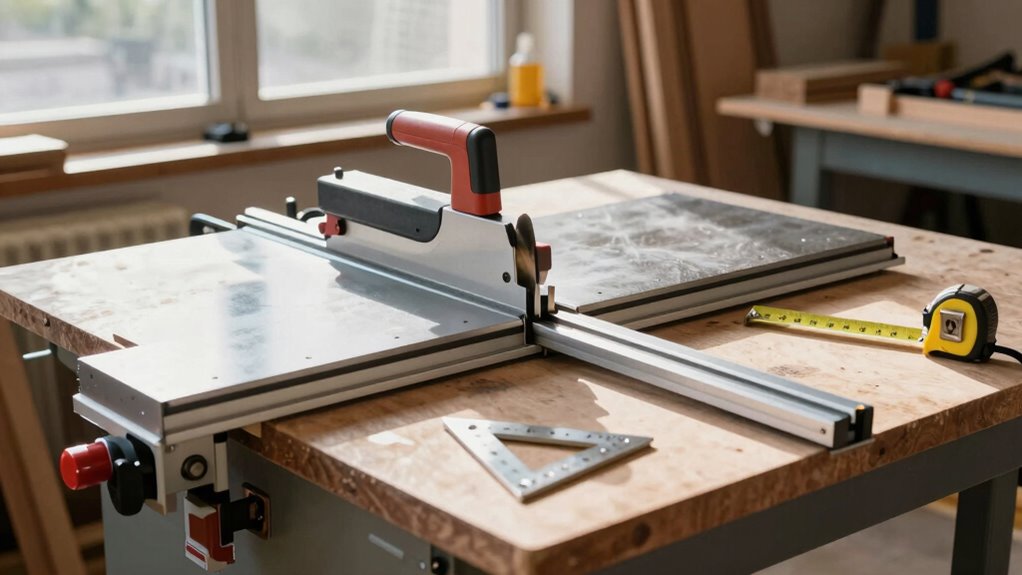
Are you confident your table saw delivers precise cuts every time? Many woodworkers assume that a clean cut depends solely on the act of cutting itself. In reality, the foundation of accurate work lies in proper setup before you even make your first cut. The key elements that influence precision are blade alignment and fence calibration. If these aren’t spot-on, your cuts will be inconsistent, no matter how skilled you are with the saw.
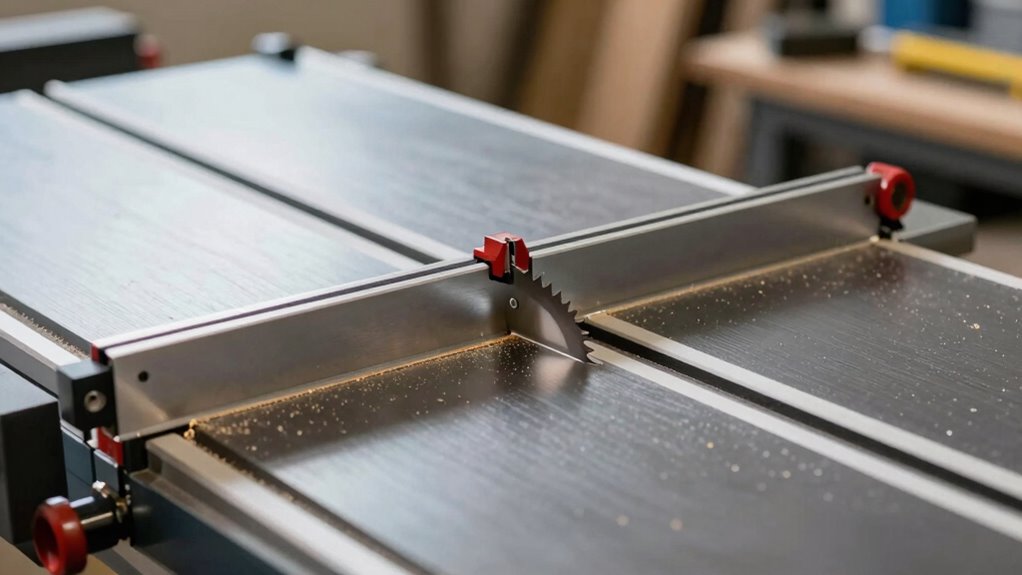
Blade alignment is critical. When your blade isn’t perfectly perpendicular to the table or not aligned with the miter slot, your cuts will drift or become uneven. Take the time to check and adjust the blade’s position regularly. Use a combination square or a dial indicator to ensure the blade’s teeth are exactly 90 degrees to the table surface. This small step prevents miscuts and ensures that rip cuts, crosscuts, and bevels are consistent. Ignoring blade alignment might save time initially, but it quickly leads to inaccuracies that compromise your project’s quality. Regularly inspecting blade alignment helps maintain your saw’s precision over time. Additionally, understanding the importance of proper setup can significantly improve your overall results.
Ensuring blade perpendicularity prevents miscuts and guarantees consistent rip cuts, crosscuts, and bevels.
Fence calibration is equally important. Your fence guides the workpiece during cuts, so any misalignment directly affects the precision of your work. To calibrate it, measure from the fence to the blade at several points along its length, ensuring that these measurements are equal. Adjust the fence accordingly until it runs parallel with the blade. Doing this guarantees that each cut is straight and that your pieces fit together perfectly. If your fence isn’t correctly calibrated, even a perfectly aligned blade won’t save you from crooked cuts or mismatched joints.
Many woodworkers overlook these setup details, believing that adjustments can wait or that their saw is “close enough.” But in reality, taking the time to properly align the blade and calibrate the fence before each project pays off in the long run. It not only improves accuracy but also extends the life of your blades and minimizes material waste. Remember, the quality of your cuts depends more on how well your saw is set up than on the cutting technique itself. Developing a routine to check these elements regularly can make a noticeable difference in your craftsmanship.
Ultimately, your ability to produce precise cuts hinges on setting up your table saw correctly. By focusing on blade alignment and fence calibration, you create a solid foundation for accurate work. When these elements are properly maintained, you’ll find that your projects come together more smoothly, with fewer errors and less frustration. Precision starts with a careful setup—so invest the time upfront, and your cuts will follow suit. Proper saw setup is essential for achieving the best results.
table saw blade alignment tool
As an affiliate, we earn on qualifying purchases.
As an affiliate, we earn on qualifying purchases.
Frequently Asked Questions
How Often Should I Recalibrate My Table Saw?
You should recalibrate your table saw whenever you notice inaccuracies or after making significant adjustments. Regularly check blade alignment and motor calibration—at least once every few months or after heavy use—to guarantee precision. Proper calibration helps maintain cutting accuracy, so don’t skip these steps. Frequent checks keep your saw performing at its best, preventing errors and ensuring safe, clean cuts every time.
What Are Common Signs of a Misaligned Saw?
You’ll notice a misaligned saw through signs like blade wobble, which causes uneven cuts, and fence misalignment, leading to inconsistent measurements. If your cuts aren’t straight or your workpieces don’t fit properly, these are clear indicators. Regularly check the blade for wobble and confirm the fence is square and tight. Addressing these issues promptly helps maintain accuracy and guarantees safe, precise cuts every time.
Does Blade Type Affect Cutting Accuracy?
Yes, blade type affects cutting accuracy. Blade materials determine durability and sharpness, influencing precision. For example, carbide blades cut smoother and stay sharp longer, enhancing accuracy. Cutting angles also matter; a proper bevel or tilt ensures cleaner cuts and reduces errors. Selecting the right blade material and setting correct cutting angles help you attain consistent, precise results, making your projects look professional and reducing the need for rework.
How Does Environmental Temperature Impact Saw Precision?
Environmental temperature impacts saw precision because temperature fluctuations cause material expansion and contraction, affecting cut accuracy. When temperatures rise, materials expand slightly, which can lead to wider cuts or misalignments. Conversely, cooler temperatures cause contraction, making cuts tighter or skewed. To maintain precision, you should monitor temperature changes and allow your materials and saw to stabilize in consistent environments, ensuring accurate measurements and cuts every time.
Can Improper Dust Collection Affect Cut Quality?
Improper dust collection can seriously impact cut quality. Did you know that 30% of saw inaccuracies are caused by dust buildup? When dust accumulates, it disrupts airflow, which can affect the saw’s motor and blade stability. This instability leads to less precise cuts and rougher edges. To maintain accuracy, you need to guarantee proper dust collection, keeping airflow clear and preventing dust buildup, which helps your saw perform at its best.
fence calibration gauge for table saw
As an affiliate, we earn on qualifying purchases.
As an affiliate, we earn on qualifying purchases.
Conclusion
Remember, nailing the setup is the secret to true accuracy—you can’t expect to hit the mark if your tools aren’t properly aligned. It’s like building a house on shaky ground; everything else will be off. Take the time to double-check your settings before making cuts, and you’ll see your project come together just right. After all, a stitch in time saves nine, so don’t cut corners at the start. Your precision will thank you!
dial indicator for saw blade perpendicularity
As an affiliate, we earn on qualifying purchases.
As an affiliate, we earn on qualifying purchases.
combination square for woodworking
As an affiliate, we earn on qualifying purchases.
As an affiliate, we earn on qualifying purchases.