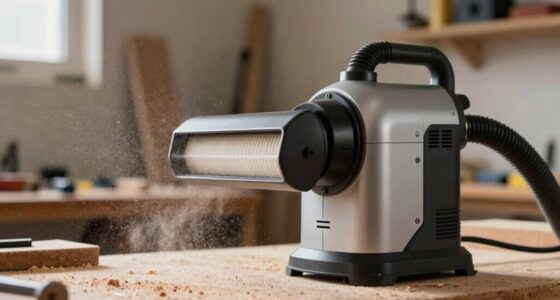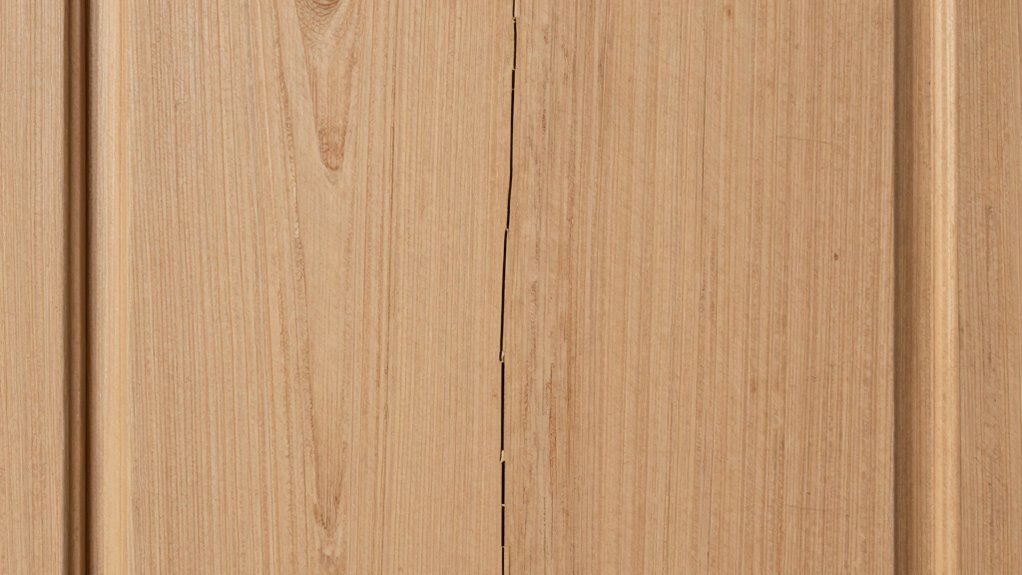

Wood movement after planing reveals the limitations of your planer, especially its inability to handle irregular grain patterns and moisture variations. If the wood wasn’t properly conditioned or acclimated, movement can cause warping, twisting, or surface imperfections that weren’t visible before. This movement exposes weaknesses in your planer’s capacity to produce stable, smooth surfaces over time. Keep exploring to learn how proper preparation and environmental control can help minimize these issues.
Key Takeaways
- Wood movement can reveal initial surface imperfections not visible before planing.
- Warping or twisting caused by moisture changes exposes planer limitations in handling irregular surfaces.
- Post-planing shrinkage or swelling may create uneven surfaces or gaps, highlighting planer constraints.
- Environmental fluctuations can cause additional movement, revealing weaknesses in planer blade alignment.
- Proper acclimation and moisture control prevent movement that exposes planer limitations later.

Have you ever wondered why your planer sometimes struggles to produce perfectly smooth, consistent boards? The answer often lies in the subtle, yet impactful, way wood responds to its environment and internal structure. One key factor is grain orientation. When you feed wood into a planer, it’s vital to consider how the grain runs through the board. If the grain is uneven or runs in different directions, the planer may catch or tear at certain spots, leading to rough surfaces or inconsistent thickness. Grain orientation affects how smoothly the planer can cut, since the tool’s blades are more effective when aligned with the grain. When the grain runs against the blades or is irregular, the cutting becomes uneven, resulting in a less polished finish. That’s why understanding the natural grain pattern is essential for achieving a perfectly smooth surface.
Another critical factor is moisture content. Wood is hygroscopic, meaning it absorbs and releases moisture depending on the environment. If your boards have high moisture content, they tend to be more elastic and prone to movement. When you run these wet or damp boards through the planer, the uneven moisture distribution can cause the wood to warp or cup as it dries. This movement can lead to an uneven cut, chipping, or even damage to your planer blades. Conversely, overly dry wood can become brittle and more susceptible to splitting or tearing during the planing process. Maintaining a consistent moisture content helps guarantee the wood feeds smoothly through the planer, producing a uniform surface. Additionally, wood movement can reveal the planer’s limitations, especially when the wood warps or twists after initial processing. Even if you start with perfectly conditioned wood, wood movement can still expose the limitations of your planer over time. As the board dries or absorbs moisture after planing, it may warp, twist, or shrink, revealing the initial imperfections that weren’t visible before. These movements are especially pronounced along the grain, which is why grain orientation and moisture content are so intertwined. If your boards are not properly acclimated or if you ignore their grain direction, the finished product will not be as smooth or as consistent as you’d like. Recognizing these limitations allows you to better prepare your wood—by selecting the right grain orientation and controlling moisture levels—so that your planer can do its job without exposing its weaknesses later on. Proper wood conditioning and understanding how wood reacts to environmental changes can significantly extend the life of your planer and improve the quality of your work. Additionally, being mindful of environmental factors like temperature and humidity can help mitigate wood movement, further preserving the integrity of your finished projects. Understanding the effects of environmental conditions on wood can help you anticipate and prevent issues that might compromise the planing process.

General Tools MMD4E Moisture Meter for Wood, Walls & Water Leak Detection
- Humidity Sensor: Detects moisture levels for mold prevention
- Water Leak Detection: Identifies moisture in wood and drywall
- Moisture Reader: Backlit LCD with large digits for easy reading
As an affiliate, we earn on qualifying purchases.
As an affiliate, we earn on qualifying purchases.
Frequently Asked Questions
How Can I Prevent Wood Movement From Affecting My Projects?
To prevent wood movement from affecting your projects, you need to focus on grain orientation and moisture control. Always cut and plane your wood with the grain to minimize warping. Keep your wood’s moisture content stable by storing it properly and acclimating it to your environment before working. This reduces expansion and contraction, ensuring your project stays stable and looking great over time.
Are There Specific Wood Types More Prone to Movement?
Some wood types are more prone to movement due to their grain and moisture content. Softwoods like pine and cedar tend to expand and contract more with humidity changes, making them less stable. Hardwoods such as oak and maple are generally more stable because of their dense grain and lower moisture content. To minimize movement, choose species with tight grain and control moisture content during storage and use.
What Tools Can Help Detect Wood Movement Early?
You can use moisture meters and grain gauges to detect wood movement early. Moisture meters measure the moisture content, helping you anticipate grain expansion or contraction. Grain gauges provide insight into how the grain may react to moisture changes. Regularly monitoring these tools allows you to identify potential movement before it causes issues, enabling you to adjust your woodworking process and prevent warping or cracking caused by moisture fluctuations.
How Does Climate Change Impact Wood Stability Over Time?
Did you know that climate change causes a 20-25% increase in environmental fluctuations? It considerably impacts wood stability over time by accelerating wood expansion and contraction. As temperatures and humidity levels shift unpredictably, wood responds with increased movement, risking warping, cracking, or splitting. You need to monitor environmental conditions closely, as these fluctuations directly influence your wood’s long-term durability and appearance, especially in outdoor or climate-sensitive projects.
Can Finishing Techniques Mitigate the Effects of Wood Movement?
Finishing techniques can help mitigate the effects of wood movement by creating finishing barriers and surface sealing. When you apply a proper finish, it forms a protective layer that reduces moisture exchange, minimizing expansion and contraction. This barrier helps stabilize the wood’s surface, preventing cracks, warping, and other issues. Regularly maintaining and reapplying surface sealing enhances this protection, ensuring your wood projects stay stable and beautiful over time.

Planer Blade Jig, Magnetic Planer Blade Setting Jig 2 Pack of Set Planer Blade Setter Jig Gauge Setter Wood Jointer Woodworking Tool
- Accurate Blade Adjustment: Micro-adjustable magnets for precise alignment
- Durable Construction: Two magnetic gauges for secure attachment
- Easy Knife Setting: Simplifies adjusting and stabilizing blades
As an affiliate, we earn on qualifying purchases.
As an affiliate, we earn on qualifying purchases.
Conclusion
So, next time you crank up that planer, just remember—wood’s sneaky dance of expansion and contraction will outsmart your machine’s limits every time. It’s like trying to tame a wild stallion with a feather. Your perfectly planed board? It’s just a fleeting illusion, doomed to warp and twist, leaving you pondering if your tools are better suited for sculpture than precision. Welcome to the hilarious world of woodworking’s greatest prank: wood movement.

Forest Products and Wood Science: An Introduction
As an affiliate, we earn on qualifying purchases.
As an affiliate, we earn on qualifying purchases.
wood acclimation and moisture control kit
As an affiliate, we earn on qualifying purchases.
As an affiliate, we earn on qualifying purchases.