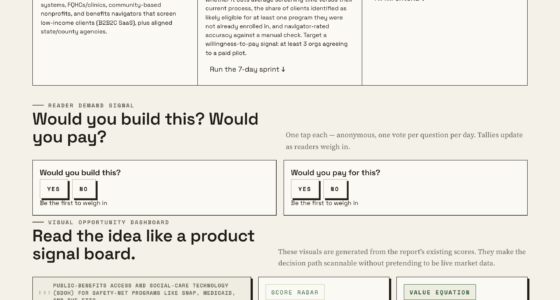
📊 Full opportunity report: What Men Should Know About Skincare Measurement Apps on IdeaNavigator AI — validation score, market gap, and execution plan.

Prime made for students and young adults
- Fast, free delivery for dorm and study essentials
- Prime Video and Amazon Music included
- Member-only deals
TL;DR

IdeaNavigator AI has outlined a concept for a men’s skincare app built around weekly selfie-based progress tracking, routine logs and streaks. The proposal describes a product opportunity, not a launched app or proven market finding; demand, scoring accuracy and subscription potential have not been established.
IdeaNavigator AI’s concept page proposes a skincare-tracking app aimed at men who want to measure whether a new routine is working, with weekly guided selfies, skin scores and routine logs as its core features. The page presents a product concept rather than evidence of a launched service or validated demand, and it reports no results showing that selfie scores can reliably measure skin changes.
IdeaNavigator AI identifies men newly investing in skincare as the suggested first audience. Its concept argues that some existing beauty apps may feel unwelcoming to this group because of their design, tone or marketing. The page does not cite user research or comparisons establishing how many men have rejected those apps for those reasons.
The proposed minimum product would prompt users to take weekly guided selfies and track skin clarity, texture and dark circles. IdeaNavigator AI would pair those measures with routine logging, streaks and progress cards framed as training-style metrics rather than beauty-oriented language. The concept also suggests subscriptions and affiliate product recommendations linked to perceived skincare needs, but provides no pricing, financial projections or evidence that users would pay or buy recommended products.
For validation, IdeaNavigator AI proposes testing the same selfie-capture technology with men’s-training branding and neutral branding, then comparing conversion and retention by audience segment. The concept page reports no test, sample size, timing, success criteria or results. Its claims about market growth and men’s interest in metrics are presented as rationale for exploring the idea, not supported by market figures or independent research on the page.
The Test Is Trustworthy Skin Tracking
The concept page focuses on a practical question for people starting a routine: is anything changing? A regular record could help users compare their appearance over time and remember what products or habits they have used. That may be more useful than relying on memory, though IdeaNavigator AI provides no evidence that its proposed scores would improve adherence or outcomes.
The distinction between a progress tool and a reliable measurement tool matters. Selfies can vary with lighting, camera angle, facial expression and image quality. Without consistent capture conditions and a method tested against appropriate standards, a score for texture or dark circles could reflect the photograph rather than a real skin change. IdeaNavigator AI’s proposal does not explain how it would handle those sources of variation or whether scoring would be automated, reviewed by people, or both.
There is also a commercial tension in linking scores to affiliate recommendations. If an app earns commissions when users buy products, users would need clear disclosure and a way to distinguish measured observations from sales suggestions. The concept page does not describe recommendation safeguards, privacy practices or how sensitive face images would be handled. Those questions would affect whether users trust a product that stores repeated selfies.
men's skincare progress tracking app
As an affiliate, we earn on qualifying purchases.
As an affiliate, we earn on qualifying purchases.
A Concept, Not a Product Launch
IdeaNavigator AI frames the opportunity within men’s grooming technology and describes men’s skincare as a fast-growing segment influenced by looksmaxxing culture and interest in metrics. Its concept page offers no market-size figures, growth rate, cited research or consumer survey, so those statements should be treated as the proposal’s rationale rather than independently established findings.
The recommended approach is deliberately narrow: target one kind of customer, offer a simple routine-and-progress workflow, and test whether positioning changes sign-ups and continued use. That is different from announcing a developed app. The IdeaNavigator AI material names no product, developer or launch schedule and reports no completed branding experiment, user trial or technical validation. The proposed features and business model remain ideas to test.
guided selfie skin measurement device
As an affiliate, we earn on qualifying purchases.
As an affiliate, we earn on qualifying purchases.
Accuracy, Demand and Privacy Remain Open
IdeaNavigator AI reports no evidence that men who are new to skincare want a numerical scoreboard, or that training-style branding would make them more likely to install or keep using an app. Its proposal does not establish that existing beauty apps turn men away, nor does it provide segment-level conversion or retention data. The market rationale is therefore unverified in the material provided.
The concept page does not explain how the app would generate its skin scores, whether scores would be consistent across devices and settings, or what threshold would count as meaningful progress. It gives no details on image storage, deletion, consent or data protection. Nor does it describe clinical review or present evidence that the app could diagnose skin conditions; a tracking score should not be treated as medical advice.
As an affiliate, we earn on qualifying purchases.
Brand Tests Would Be the First Step
IdeaNavigator AI proposes comparing men’s-training branding with neutral branding while keeping the selfie-capture technology the same. A useful report would need to identify the audience, test period and measures used, including whether users return after signing up rather than merely clicking through an advertisement. The concept page reports no such test or schedule.
If early testing supports continued development, the concept would still need to show that weekly images produce consistent and understandable progress information. Further work would also be needed on privacy, image handling, recommendation disclosures and whether people find the routine useful enough to pay for. IdeaNavigator AI reports no confirmed launch or next milestone, so the idea’s commercial and technical prospects remain unsettled.
Source: IdeaNavigator AI
dark circles treatment products for men
As an affiliate, we earn on qualifying purchases.
As an affiliate, we earn on qualifying purchases.
Key Questions
Has a men’s skincare measurement app launched?
No launch is reported. IdeaNavigator AI’s page describes a product concept, with proposed features and a suggested validation test.
What would the proposed app track?
According to IdeaNavigator AI’s concept, it would use weekly guided selfies to track skin clarity, texture and dark circles, alongside routine logs, streaks and progress cards. The proposal does not explain how those scores would be calculated or validated.
Can selfie scores prove that a skincare routine works?
Not on the evidence provided. Lighting, angle and other photo conditions can affect comparisons, and IdeaNavigator AI reports no testing showing that the proposed scores reliably reflect skin changes.
How might the app make money?
IdeaNavigator AI’s concept suggests a subscription and affiliate product recommendations tied to measured gaps. It gives no pricing, revenue data or details about how recommendations would be separated from commercial interests.
What is the proposed first validation test?
IdeaNavigator AI suggests comparing men’s-training branding with neutral branding using the same capture technology, then measuring conversion and retention by audience segment. Its page provides no results or test timetable.
Source: IdeaNavigator AI
Fall Picks
fall essentials
As an affiliate, we earn on qualifying purchases.