📊 Full opportunity report: Revolutionizing Eligibility Checks With Benefit Check Bots on IdeaNavigator AI — validation score, market gap, and execution plan.
Open a free Amazon Business account
Business pricing, bulk buying and tax-exempt orders.
Create a free accountAs an affiliate, we earn on qualifying purchases.
TL;DR
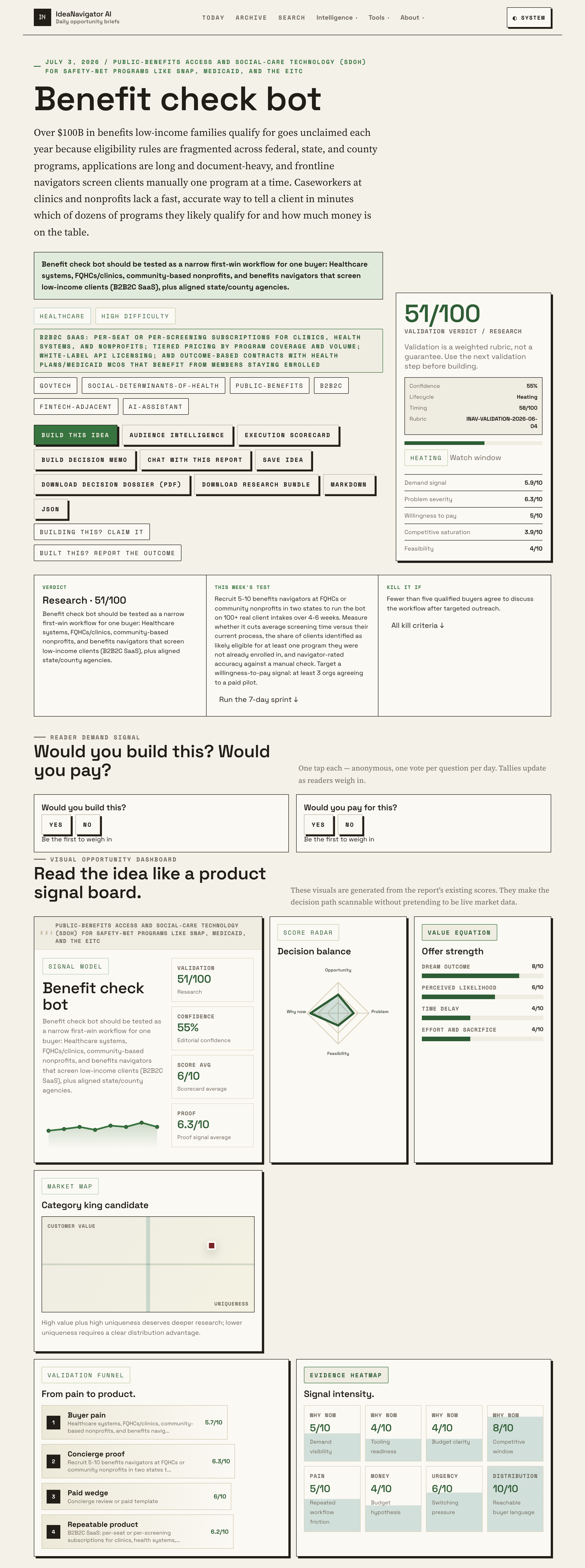
A new conversational AI benefit check bot is being tested to automate eligibility screening for public assistance programs. It aims to reduce manual effort, improve accuracy, and increase access to benefits for low-income families. The initiative responds to recent gaps in benefits access caused by nonprofit closures and pandemic-related redeterminations.
A new AI-powered benefit check bot is entering pilot testing with healthcare providers and community nonprofits to automate eligibility screening for multiple social programs, including SNAP, Medicaid, and energy assistance. This development aims to address the longstanding challenge of low-income families missing out on over $100 billion in benefits each year due to fragmented eligibility rules and manual screening processes. The initiative responds to recent gaps caused by the closure of Benefits Data Trust and the surge in eligibility redeterminations following the pandemic, which have overwhelmed traditional screening methods.
The benefit check bot is a white-label conversational tool designed for integration into websites or SMS channels used by clinics, health systems, and nonprofits. It employs a short, branching set of yes/no and multiple-choice questions to quickly assess a client’s likely eligibility for programs such as SNAP, Medicaid, EITC/CTC, WIC, and LIHEAP. The tool then provides an estimated benefit amount, next-step application links, and document checklists. Initially, the pilot will focus on two to three states, with the goal of logging anonymized screening outcomes to evaluate accuracy, efficiency, and potential benefits over manual methods.
The system is built to be cost-effective, leveraging conversational AI to deliver near-zero marginal costs for multilingual, multi-program screening. It is intended for use by frontline navigators, who can embed the bot on their organization’s site or use it via SMS, streamlining the process of identifying eligible clients and reducing the time spent per screening. The platform also offers a dashboard for organizations to monitor outcomes and export summaries to support client applications.
This development could significantly improve access to public benefits for low-income families by reducing the time and complexity involved in eligibility screening. It addresses a critical gap left by the closure of Benefits Data Trust, which previously provided outsourced benefits enrollment services across seven states. By automating screening, health systems and nonprofits can better identify eligible clients, potentially increasing benefit uptake and reducing unclaimed aid, which totals over $100 billion annually. Moreover, the AI-driven approach could lower operational costs, enable multilingual support, and improve accuracy compared to manual screening, which is often time-consuming and prone to errors.
For policymakers and social service providers, the tool offers a scalable solution to manage large volumes of redeterminations, especially in the post-pandemic context where millions face eligibility changes. If successful, the model could be expanded to broader states and programs, transforming how social benefits are accessed and administered at the frontline level.
As an affiliate, we earn on qualifying purchases.
Background: Fragmented Benefits and Manual Screening Challenges
Over the past decade, low-income families have faced increasingly complex eligibility rules across federal, state, and local programs. Despite the availability of over $100 billion in unclaimed benefits annually, many eligible individuals do not access aid due to lengthy, document-heavy application processes and the need for manual screening by caseworkers or navigators. The closure of Benefits Data Trust in 2024, a nonprofit that previously handled benefits enrollment across seven states, has left a significant gap in outsourced benefits access capacity. Meanwhile, the post-pandemic period has seen a surge in Medicaid redeterminations, as millions of beneficiaries are required to re-verify eligibility, often overwhelming existing manual systems.
Advances in conversational AI and natural language processing now make it feasible to deliver accurate, multilingual screening at near-zero marginal cost, offering a promising solution to these longstanding challenges. Pilot programs are emerging to test this approach, aiming to streamline eligibility assessments and increase benefits uptake among vulnerable populations.
social program eligibility screening tool
As an affiliate, we earn on qualifying purchases.
As an affiliate, we earn on qualifying purchases.
Uncertainties Around Pilot Outcomes and Scalability
While initial pilots are promising, it is still unclear how accurately the benefit check bot will perform across diverse populations and complex eligibility rules. The effectiveness depends on the quality of the underlying data, the ability to adapt to different state and local rules, and user acceptance by frontline navigators. Additionally, the long-term scalability and integration with existing benefits management systems remain to be tested. Results from the pilot phase over the next 4-6 weeks will be critical to determine whether this approach can be adopted more broadly.
AI-powered benefits application assistant
As an affiliate, we earn on qualifying purchases.
As an affiliate, we earn on qualifying purchases.
Next Steps: Pilot Evaluation and Broader Deployment Plans
Over the coming weeks, participating organizations will run the benefit check bot with over 100 real client intakes, measuring screening time reductions, accuracy, and client outcomes. Success metrics include increased identification of eligible benefits, improved navigator efficiency, and positive feedback from users. Pending favorable results, plans include expanding the pilot to additional states, refining the AI’s accuracy, and developing integrations with more benefit programs. Stakeholders will also explore potential funding models and partnerships to scale deployment at the state and national levels.
multilingual benefits screening software
As an affiliate, we earn on qualifying purchases.
As an affiliate, we earn on qualifying purchases.
Key Questions
How does the benefit check bot work?
The bot uses a short set of yes/no and multiple-choice questions to assess eligibility for multiple programs simultaneously, then provides estimated benefits, next steps, and required documents.
Who can use this benefit check bot?
It is designed for use by healthcare providers, community nonprofits, and social service agencies that serve low-income clients, either embedded on their websites or accessed via SMS.
What programs can the bot evaluate eligibility for?
The initial focus is on programs like SNAP, Medicaid, EITC/CTC, WIC, and LIHEAP, with plans to expand to additional benefits as the system matures.
When will the pilot results be available?
Results from the pilot are expected within the next 4-6 weeks, which will determine the next phase of deployment and potential scaling.
What are the main challenges ahead?
The main challenges include ensuring accuracy across diverse populations, integrating with existing systems, and securing funding for broader rollout.
Source: IdeaNavigator AI
Flea & tick season Picks
flea and tick prevention
As an affiliate, we earn on qualifying purchases.