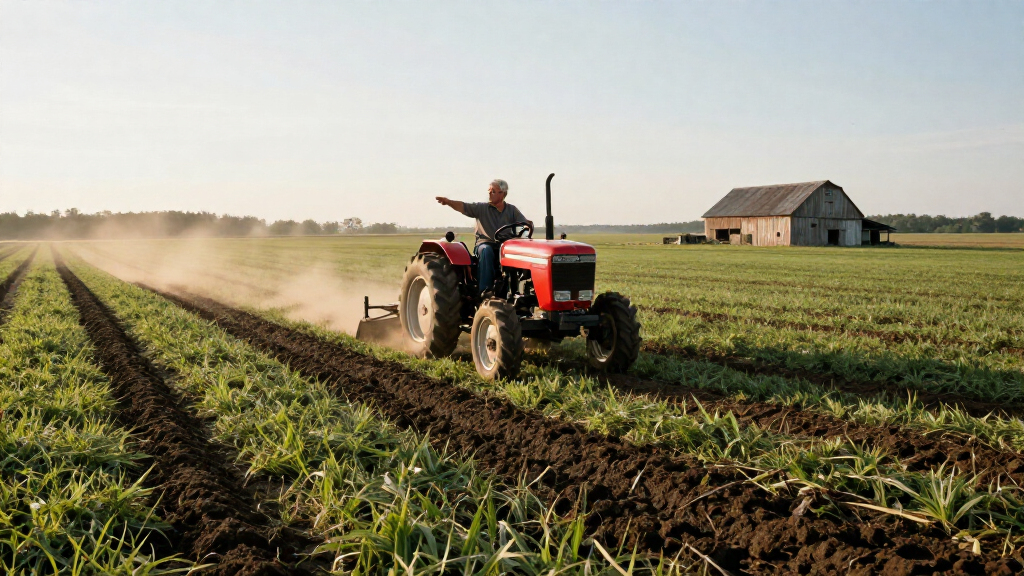

🔍 Read the full analysis: How The Tractor Transformed Farming And Its Workforce on ThorstenMeyerAI.com

Prime made for students and young adults
- Fast, free delivery for dorm and study essentials
- Prime Video and Amazon Music included
- Member-only deals
TL;DR
Tractors and other farm machinery replaced much of the animal power used on U.S. farms during the first half of the 20th century. The shift freed land previously used to grow animal feed and helped raise farm output, while farm employment declined and workers moved toward nonfarm jobs.
A November 4 report from ThorstenMeyerAI.com describes how tractors and related machinery transformed U.S. farming, with the number of tractors rising from about 1,000 in 1910 to 4.69 million in 1960 as farm horses and mules fell from their 1918 peak of 26.7 million to 3.1 million. The change increased the amount of work farms could do with fewer workers, while helping drive a long decline in agricultural employment.
The report draws on historical estimates reprinted by the U.S. Census Bureau and figures from the Department of Agriculture. Horses and mules supplied much of the power for ploughing, planting, harvesting and hauling. They also required feed: in 1915, an estimated 93 million acres of harvested cropland grew feed for the animals, out of 340 million acres harvested overall. That was more than a quarter of the total, according to the cited historical statistics.
Tractor adoption accelerated after the Fordson entered the market in 1917. The Henry Ford museum describes it as a mass-produced, relatively inexpensive lightweight tractor intended for smaller farmers. The report’s figures put the U.S. tractor count at 246,000 in 1920 and 920,000 in 1930. Around 1955, tractors outnumbered farm horses and mules for the first time; by 1960 the counts were 4.69 million tractors and 3.1 million animals.
The tractor was part of a broader mechanization of agriculture. Combine harvesters, which cut and processed grain in one pass, increased from about 4,000 on U.S. farms in 1920 to 1.04 million in 1960, the report says. The Department of Agriculture estimated that one farm worker supplied 7.1 people in 1910 and 47.1 in 1970; that later figure includes people abroad supplied through exports.
Machinery Changed Farm Labor
Mechanization let fewer farm workers produce more agricultural goods. U.S. farm employment, according to the report, peaked at 13.6 million in 1916 and had fallen to 4.5 million by 1970, even as the overall U.S. labor force doubled. The figures describe a major shift in where people worked, not simply the replacement of one tool with another.
Many new jobs were in cities and other nonfarm industries, the report says, so the change involved migration as well as machinery. The shift also released land from growing animal feed: the area used for that purpose fell from an estimated 93 million acres in 1915 to about 5 million in 1960. The source says the land could then be used to grow crops for people, although it does not quantify how much of the change in food supply came from this factor alone.
The story is relevant to current discussions about automation, but it does not prove that new machines will affect workers in the same way. The report presents the horse-to-tractor change as a historical analogy and notes that workers, unlike horses, have political rights and can influence policy.
Popular right now

Hisense 65-inch U6 Pro Mini-LED 4K UHD Smart Fire TV

Ninja Foodi 10-Qt DualZone Air Fryer, 6-in-1, Black (DZ302)

iRobot Roomba 105 Robot Vacuum with LiDAR Navigation
As an affiliate, we earn on qualifying purchases.
From Animal Power to Tractors
Farm animals were a major part of the U.S. agricultural system before tractors became common. The report says the combined horse-and-mule population on farms peaked at 26.7 million on January 1, 1918, while horses alone reached their peak of 21.4 million in 1915. The animals required year-round feeding, whether or not they were working.
Early gasoline tractors existed before World War I, but the report says they were heavy, expensive and better suited to large farms. The Fordson, launched in 1917, helped broaden access. As tractor numbers grew, farmers stopped breeding replacements for working horses and mules; the report says the animal population declined over time rather than through a single mass event.
The report also points to modern examples, while distinguishing them from the historical change. It says John Deere introduced a 16-camera autonomy kit in February 2025 for tillage on select large tractors. It also reports that China said about 74% of ploughing, sowing and harvesting was mechanized in 2023. Those examples indicate ongoing machinery adoption but do not establish that driverless equipment can perform every farm task.
Limits of the Automation Comparison
The historical figures show that farm employment fell as mechanization advanced, but they do not isolate the effect of tractors from other changes, including combines, improved seed, fertilizer and broader economic growth. The report gives employment totals, not a detailed account of which workers moved to which occupations or how individual households were affected.
Some numbers also use different measurement dates or definitions. The report notes that tractor counts for several census years were recorded on slightly different dates, and that the Department of Agriculture counted horses and mules together from 1951. Its modern examples are narrower still: the autonomy equipment described is for selected tractors and tillage, not all agricultural work. The source does not provide independent performance data or a complete account of the labor effects of current autonomous systems.
Questions for Modern Farm Automation
The historical account ends by cautioning that the horse analogy is not a rule for predicting what will happen to human workers. The next questions concern the reach of current farm robots, the kinds of tasks they can handle and how much labor they actually replace. The source provides examples of current technology but no timetable for broader adoption.
For readers evaluating future claims, the relevant evidence will include measured use across different farm sizes and crops, changes in staffing and costs, and whether workers can move into other jobs. Until those details are available, the U.S. tractor experience offers a record of a major agricultural shift, not a settled forecast for automation today.
Key Questions
When did tractors outnumber horses and mules on U.S. farms?
According to the report’s historical figures, the numbers crossed around 1955: about 4.35 million tractors compared with 4.31 million horses and mules.
How many farm horses and mules were there at the peak?
The combined total peaked at 26.7 million on January 1, 1918, according to the historical estimates cited in the report.
Did tractors alone cause farm employment to fall?
The report documents rising tractor numbers alongside declining farm employment, but it also describes other changes, including combines, fertilizer and improved seed. It does not separate the effect of each factor.
What happened to the farm horses and mules?
The report says farmers largely stopped breeding replacements, and the working population declined as the animals aged. It describes a gradual change rather than a single mass event.
Can today’s driverless tractors do all farm work?
No evidence in the source supports that conclusion. It describes an autonomy kit for tillage on selected large tractors and does not say that driverless systems can perform every agricultural task.
Source: ThorstenMeyerAI.com