
TL;DR

Prime made for students and young adults
- Fast, free delivery for dorm and study essentials
- Prime Video and Amazon Music included
- Member-only deals
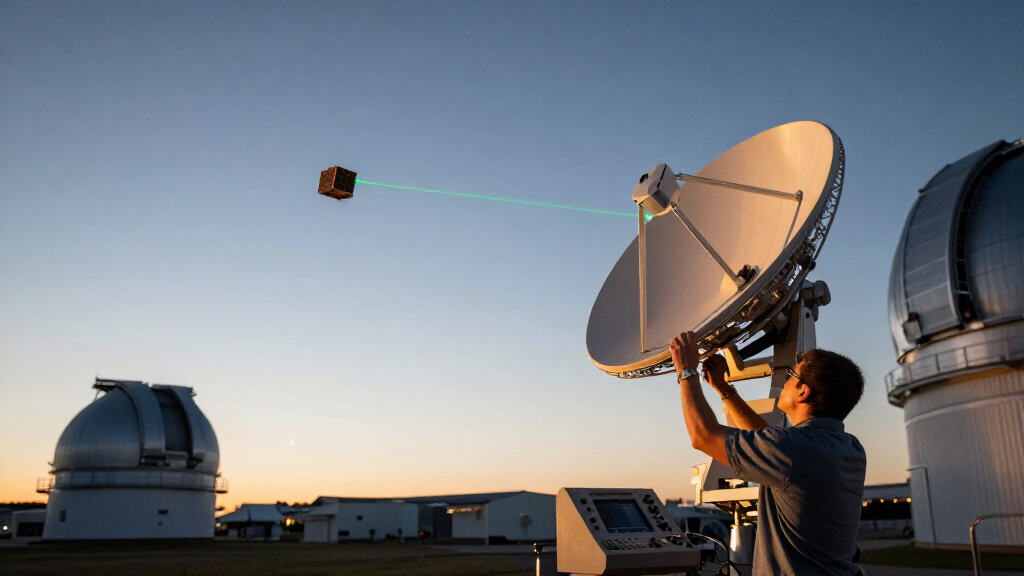
ERMIS-3, an 8U CubeSat developed by the National and Kapodistrian University of Athens, established an optical communications link with Greece’s Holomondas ground station. The ESA-supported demonstration tested the satellite’s ability to point, acquire and track a laser link; it is described by project participants as Greece’s first optical link with a low Earth orbit satellite.
ERMIS-3, an 8U CubeSat developed by the National and Kapodistrian University of Athens, has established a laser communications link with an optical ground station in Greece, the European Space Agency reported November 2. The ESA-supported demonstration tested a key capability for small satellites: accurately pointing, acquiring and tracking an optical signal while passing through orbit.
The satellite connected with Holomondas Optical Ground Station (HolOGS-1), developed by the Aristotle University of Thessaloniki. ERMIS-3 carries an ATLAS-1 optical terminal made by Lithuanian company Astrolight, paired with a terminal at the ground station. ESA said the link was established only weeks after the satellite’s commissioning.
The operation demonstrated one of the mission’s stated objectives: precise pointing, acquisition and tracking, often shortened to PAT. Optical communications use narrow laser beams rather than conventional radio-frequency signals. The spacecraft and ground station must point toward one another and maintain the connection during a limited pass, while the satellite travels at several kilometres per second.
ESA contributed technical expertise, including environmental testing and optical alignment at its European Space Research and Technology Centre in the Netherlands. ERMIS-3 launched on March 30, 2026, alongside ERMIS-1 and ERMIS-2 as part of an in-orbit demonstration programme for small-satellite communications technologies. The ESA report identifies this as Greece’s first optical link with a low Earth orbit satellite.
Laser Links Could Move More Data
The demonstration matters because optical links could give small satellites another way to send large volumes of data to Earth. Missions such as Earth observation can generate high-resolution and hyperspectral imagery that may be difficult to transmit quickly using limited communications capacity. Laser links offer the potential for high data rates, although this test does not by itself establish operational performance or a routine service.
For ERMIS-3, the reported connection shows that a small satellite equipped with a miniaturized terminal could establish and track an optical link with a ground facility. That is a practical step beyond designing or testing equipment on the ground. It also brings together a university-built spacecraft, a commercial terminal supplier, a university ground station and ESA support under Greece’s national space programme.
Optical communications have a demanding operating environment. The narrow beam needs accurate pointing, and clouds can block the signal while atmospheric turbulence can reduce its quality. The achievement is therefore relevant as an in-orbit technology demonstration, rather than evidence that laser links are already a dependable replacement for radio communications across all conditions.
Popular right now

KitchenAid Artisan 5-Quart Tilt-Head Stand Mixer, Almond Cream

Dyson Car+Boat Cordless Handheld Vacuum

Ninja SP151 Flip Toaster Oven and Air Fryer
As an affiliate, we earn on qualifying purchases.
A Greek Small-Satellite Programme
ERMIS-3 is part of Greece’s National Space Programme, implemented by ESA on behalf of the Greek government. The three ERMIS satellites launched together on March 30, 2026, with the programme testing technologies intended for small spacecraft. ERMIS-3’s optical communications test focuses on whether a compact satellite can establish a laser connection with a ground station.
The ground facility, HolOGS-1 at Holomondas, was developed by the Aristotle University of Thessaloniki. The spacecraft was developed by the National and Kapodistrian University of Athens, while Astrolight supplied the ATLAS-1 terminal. ESA says its support included technical supervision and engineering work as well as testing and alignment at ESTEC. Those roles place the link within a collaboration involving Greek academic institutions, a European supplier and the agency.
Unlike radio-frequency signals, laser beams are narrow and require precise alignment between transmitter and receiver. A satellite’s fast movement leaves a short opportunity for communication during a pass. Conditions in the atmosphere can also affect whether a ground station can maintain a link. These constraints make pointing and tracking central to assessing the demonstration.
“Using ATLAS-1 as a laser communications terminal has led to a unique collaboration and the first operations of a laser optical link on the CubeSat.”
— Professor Vaios Lappas and Antonis Paschalis, ERMIS principal investigators
Link Performance Details Not Reported
The ESA report confirms that a link was established and says it demonstrated precise pointing, acquisition and tracking. It does not provide data rates, link duration, data volume, error rates or details of what information was transmitted. It also does not say how many attempts were needed or whether the connection has been repeated since the reported demonstration.
It remains unclear how the system performs under different weather and atmospheric conditions, including how often clouds or turbulence prevent or degrade a connection. The report describes a milestone in validating optical communications on a small satellite, but offers no figures that would establish the link’s reliability over time or its performance relative to radio communications.
The characterization of the event as Greece’s first optical link with a LEO satellite comes from ESA and project participants. The available account does not provide a wider survey of other links or independent confirmation beyond the organizations involved.
Further On-Orbit Testing Needed
The next meaningful indicators will be whether ERMIS-3 can establish the link repeatedly and how the terminal performs across additional satellite passes. Further reporting on link duration, transmitted data and reliability would help show what the demonstration achieved beyond establishing a connection.
ESA and the mission teams have not announced a schedule for further tests or published a specific next milestone in the available report. The programme’s wider aim is to test communications technologies for small satellites, but whether ERMIS-3’s optical system will support regular operational data transfers remains to be seen.
Key Questions
What did ERMIS-3 achieve?
The 8U CubeSat established a laser communications link with the Holomondas Optical Ground Station in Greece. ESA said the demonstration tested precise pointing, acquisition and tracking.
Who built the satellite and its optical terminal?
The National and Kapodistrian University of Athens developed ERMIS-3. The spacecraft carries an ATLAS-1 terminal developed by Lithuanian company Astrolight.
Why use a laser instead of radio?
Optical links use narrow laser beams and can support high data rates, which may help satellites transfer data-intensive imagery. They also require accurate pointing and can be disrupted by clouds or affected by atmospheric turbulence.
Was this Greece’s first optical link with a satellite?
ESA and project participants describe it as Greece’s first optical link with a low Earth orbit satellite. The report does not provide independent verification beyond the organizations involved.
How much data did the link transmit?
The ESA report does not state the data rate, duration or volume of the connection, or specify what data was sent. Those performance details remain unreported.
Source: esa.int