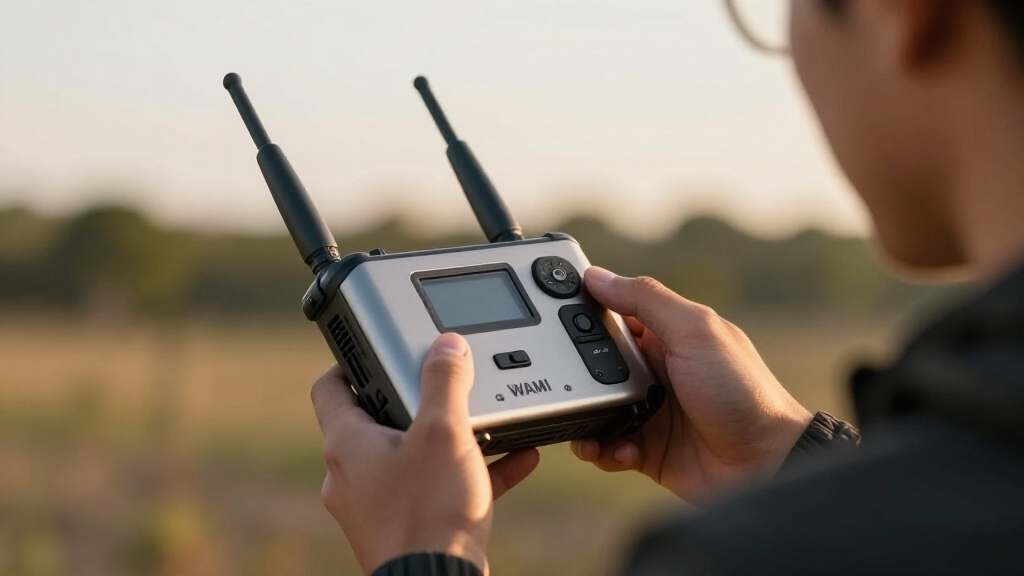

📊 Full opportunity report: Building Corvus ISR in Public, Day 1: A WAMI Exploitation Stack, Starting from Synthetic Data on ThorstenMeyerAI.com — validation score, market gap, and execution plan.

Prime made for students and young adults
- Fast, free delivery for dorm and study essentials
- Prime Video and Amazon Music included
- Member-only deals
TL;DR
Corvus ISR begins public development of a wide-area motion imagery exploitation stack, starting with synthetic data. The first artifact is a live browser demo showing detection and tracking in a simulated scene.
Thorsten Meyer has publicly initiated the development of Corvus ISR, a new exploitation stack for wide-area motion imagery (WAMI), starting with a synthetic scene and live detection in the browser. This marks the first day of a build-in-public effort aimed at addressing the exploitation gap in WAMI data, a sensor class with immense collection capacity but limited open software tools.
The first artifact released is a synthetic WAMI scene featuring a procedurally generated urban environment with hundreds of moving vehicles. The scene is accompanied by a live, browser-based detection and tracking system that identifies moving objects, assigns persistent IDs, and visualizes their trajectories. This demonstration is deliberately minimal, focusing on geometric detection without deep learning models, to showcase the core pipeline.
According to Meyer, the project aims to build an exploitation software stack that can operate within customer-controlled infrastructure, offering both sovereign and governed editions tailored for different legal jurisdictions. The approach emphasizes starting with synthetic data to overcome legal, privacy, and data accessibility barriers associated with real WAMI footage.
CORVUS ISR · synthetic WAMI scene — live detect & track
BUILD IN PUBLIC · DAY 1 ARTIFACTImplications for WAMI Exploitation and European Market
This development signals a shift towards open, customizable exploitation tools for WAMI sensors, which are increasingly proliferating across military and civilian platforms. By releasing a functional prototype publicly, Meyer challenges the dominance of closed, US-controlled software and opens a pathway for European and other non-US actors to develop independent exploitation capabilities. The emphasis on synthetic data as a foundation allows for rapid iteration, benchmarking, and eventual transfer to real data, potentially transforming how WAMI data is processed and used.
As an affiliate, we earn on qualifying purchases.
Addressing the Exploitation Gap in WAMI Data
WAMI sensors produce massive volumes of imagery, capturing entire cities in gigapixel frames at high frame rates. Historically, the bottleneck has been the software capable of analyzing this data in real-time or near-real-time, leading to reliance on manual analysis or proprietary solutions. The proliferation of WAMI platforms—mounted on drones, aerostats, and aircraft—has outpaced the development of open exploitation software, especially outside the US. Meyer’s project responds to this gap by focusing on building an open, flexible pipeline that can be deployed in various jurisdictions, starting with synthetic data to avoid legal and privacy issues.
“The core idea is that whoever owns the software that reads the sensor owns the value of the constellation above it.”
— Thorsten Meyer
As an affiliate, we earn on qualifying purchases.
Uncertainties Around Transition to Real Data
It remains unclear how well the synthetic-based pipeline will transfer to real WAMI data, which involves complex variations, noise, and occlusions. The project’s roadmap acknowledges that synthetic-to-real transfer is not trivial, and the effectiveness of models trained on synthetic scenes in operational environments has yet to be demonstrated.
real-time object detection software
As an affiliate, we earn on qualifying purchases.
As an affiliate, we earn on qualifying purchases.
Next Steps for Corvus ISR Development
The immediate focus will be on refining detection and tracking algorithms, introducing more realistic scene variations, and testing the system against real or more complex simulated data. Meyer plans to release incremental updates, improve the pipeline’s robustness, and explore integration with actual WAMI sensors when feasible. The project aims to demonstrate a fully operational exploitation stack capable of deploying in diverse legal jurisdictions.
airborne surveillance tracking tools
As an affiliate, we earn on qualifying purchases.
As an affiliate, we earn on qualifying purchases.
Key Questions
Why is synthetic data important for Corvus ISR?
Synthetic data allows for legal, privacy-safe, and cost-effective development and benchmarking of the exploitation pipeline, enabling rapid iteration without relying on restricted real-world datasets.
Will this system work with real WAMI data eventually?
That is the goal, but the transfer from synthetic to real data remains a challenge. The project’s roadmap includes steps to bridge this gap through further testing and model refinement.
What are the main advantages of Corvus ISR’s approach?
It offers open, customizable software that can operate within customer-controlled infrastructure, reducing dependency on US-based proprietary solutions and supporting European and other jurisdictions’ autonomy.
How does this project impact the broader WAMI market?
By demonstrating a functional, build-in-public exploitation pipeline, it could lower barriers for new entrants, foster innovation, and challenge incumbent closed systems, especially outside the US.
Source: ThorstenMeyerAI.com
Fall Picks
fall essentials
As an affiliate, we earn on qualifying purchases.