
TL;DR

Prime made for students and young adults
- Fast, free delivery for dorm and study essentials
- Prime Video and Amazon Music included
- Member-only deals
Researchers have developed a robotic insect with an underwater suit that can dive and move between land and water. This innovation could impact exploration, surveillance, and environmental monitoring.
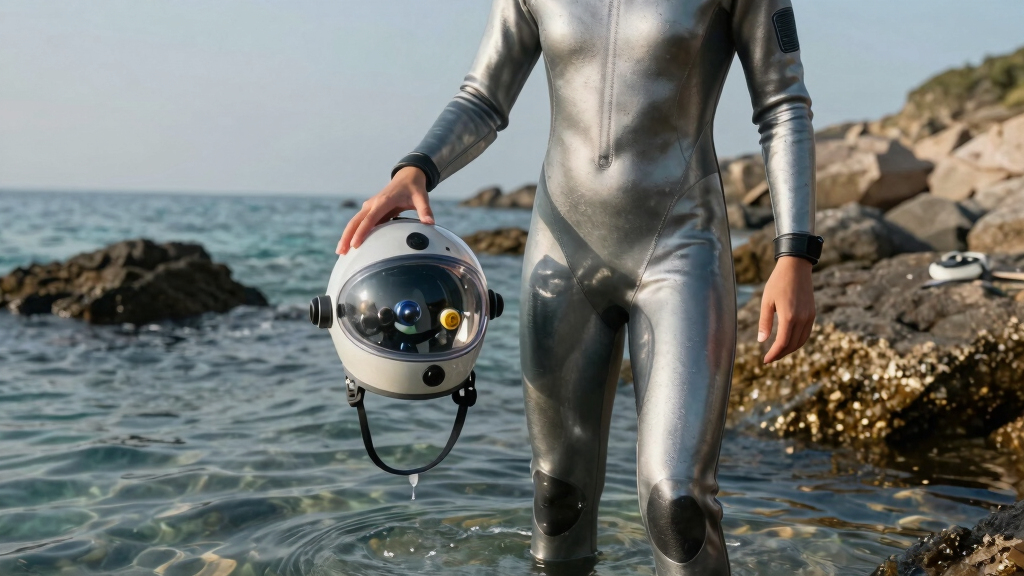
Scientists have unveiled a robotic insect with an integrated underwater suit capable of diving underwater and moving seamlessly between terrestrial and aquatic environments. This development represents a major step in biomimetic robotics, with potential applications in exploration, environmental monitoring, and surveillance, according to the research team.
The robotic insect, designed by a team of engineers and biologists, features a compact, insect-like body fitted with a specialized underwater suit that provides buoyancy control and protection against water pressure. The device has demonstrated the ability to dive underwater, traverse land, and transition smoothly between the two environments. The project was first publicly shown at the Robotics Innovation Conference in March 2024, with initial tests confirming its multi-environment mobility.
According to lead researcher Dr. Emily Chen of the Marine Robotics Institute, the robot uses a combination of miniature thrusters, flexible exoskeleton segments, and adaptive control systems to navigate complex terrains. The underwater suit is equipped with sensors and waterproof actuators, enabling the insect to perform precise movements underwater, including swimming and burrowing. The team emphasizes that this is the first robotic insect capable of such terra-aqua versatility with an integrated suit system.
Potential Impact on Exploration and Surveillance
This innovation could significantly enhance capabilities in environmental exploration, underwater research, and security surveillance. Its ability to operate in both land and aquatic environments allows for detailed inspection of ecosystems, submerged infrastructure, or hazardous zones that are difficult for traditional robots or humans to access. The development pushes forward the field of biomimicry, demonstrating how insect-inspired robotics can be adapted for complex, real-world tasks.
underwater exploration robotic insect
As an affiliate, we earn on qualifying purchases.
As an affiliate, we earn on qualifying purchases.
Advances in Biomimetic Robotics and Underwater Technology
Recent years have seen rapid progress in biomimetic robotics, with insects and marine creatures inspiring designs for versatile, efficient robots. Previous efforts focused mainly on land or water separately; the integration of both capabilities into a single device remains rare. The concept of terra-aqua robots has been explored in research labs, but practical, multi-environment robotic insects have yet to be demonstrated at this level of mobility and robustness. This project builds on earlier prototypes that could operate underwater or on land but lacked seamless transition capabilities.
“This robotic insect demonstrates a new level of adaptability, capable of navigating complex terrains both above and below water. It opens new possibilities for exploration and environmental monitoring.”
— Dr. Emily Chen, lead researcher
As an affiliate, we earn on qualifying purchases.
Limitations and Unanswered Questions About the Robot
It is not yet clear how durable the robotic insect is over extended periods underwater or in harsh environments. The scalability of the technology for larger or more complex tasks remains untested. Additionally, the team has not disclosed detailed performance metrics, such as battery life, speed, or load capacity. The long-term reliability and potential for autonomous operation are still under evaluation.
As an affiliate, we earn on qualifying purchases.
Next Steps for Testing and Deployment
The research team plans to conduct extended field trials in diverse environments, including deep-sea and rugged terrestrial terrains. They aim to improve the robot’s autonomy, sensory systems, and endurance. Further development may include integrating AI for autonomous navigation and task execution. Commercial and research applications are expected to be explored within the next year, pending successful testing outcomes.
As an affiliate, we earn on qualifying purchases.
Key Questions
What makes this robotic insect different from existing robots?
This robot combines insect-inspired mobility with an underwater suit, enabling it to operate seamlessly on land and underwater, which is a unique feature not present in most current robots.
What are potential uses for this technology?
Potential applications include environmental monitoring, underwater exploration, infrastructure inspection, and military surveillance in challenging terrains.
How long can the robot operate underwater?
Specific endurance metrics have not yet been disclosed; this remains an area for further testing and development.
Is this technology ready for commercial use?
Not yet. The project is still in the experimental stage, with further testing needed before commercial deployment is possible.
Source: hn
Columbus Day / Indigenous Peoples' Day Picks
long weekend sales
As an affiliate, we earn on qualifying purchases.