
TL;DR
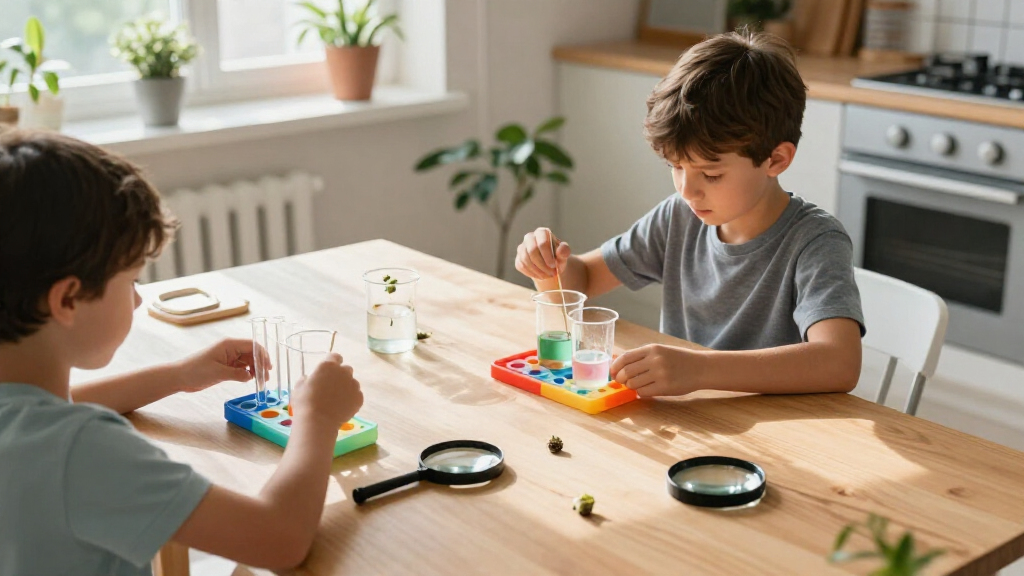
Educational science kits for kids offer hands-on ways to explore ideas in fields such as biology, physics, chemistry, engineering, and robotics. Choose a kit that matches your child’s interests and abilities, explains why an activity works, and gives them room to predict, observe, and try again. Check safety directions, what materials are included, and how many activities you can repeat.
A cardboard bridge that sags under a toy car can teach more than a page of definitions. Your child can spot the bend, add a support, and test again. That little moment—when a guess meets a result—is the real promise of educational science kits for kids.

Prime made for students and young adults
- Fast, free delivery for dorm and study essentials
- Prime Video and Amazon Music included
- Member-only deals
These kits give children materials and instructions to explore ideas from subjects such as chemistry, biology, physics, engineering, astronomy, and robotics. Some offer a single build; others include several experiments or reusable tools. The strongest activities connect what your child does with why it happened, so the fun leaves behind an idea they can explain.
You’ll find out what to look for, how to match a kit to your child, and how to make room for discovery without turning your kitchen table into a lab all week. A good choice isn’t necessarily the biggest or flashiest box. It’s a safe, workable invitation to ask, “What happens if I try this?”
Choose for your child’s interests and abilities, using the age label as a starting point.
Look for explanations and chances to predict, observe, compare, and try again.
Check warnings, supervision instructions, and included supplies before opening the kit.
Compare repeat use, refill needs, digital requirements, and total cost—not just the box price.
When results surprise your child, review the directions and talk through what they noticed.
What a Science Kit Gives Your Child Beyond a Finished Project
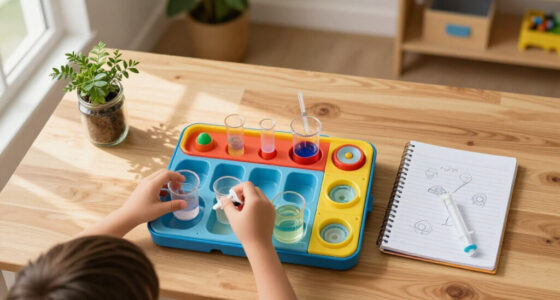
An educational science kit gives your child a hands-on way to explore a scientific idea through activities, materials, and explanation. The useful part isn’t just the finished model or fizzing cup; it’s the chance to predict, observe, compare, and ask what changed. Those steps matter because they help a child connect an outcome to the choices that produced it. If the activity only asks them to follow steps and admire the result, they may remember the spectacle but have little sense of why it happened.
Say your child builds a paper helicopter and drops it from a chair. It spins toward the floor. Change the blade length, drop it again, and watch closely: does it fall faster, slower, or with a different wobble? Changing one feature while keeping the rest steady gives your child a fairer comparison. The floor becomes a landing pad, and a scrap of paper becomes a question with wings.
Activities like this can introduce ideas such as forces, circuits, ecosystems, or chemical reactions. They can also make an adult and child into project partners: one reads the directions while the other holds the stopwatch. The conversation matters because children may observe a result without knowing which detail is evidence for the idea. Asking “What did you notice?” followed by “What might explain that?” helps them put an observation into words and consider a reason.
A completed project does not prove a child has understood the science, and a kit alone doesn’t guarantee learning. Look for directions that explain why a step matters and leave room for choices. Some structure helps a child get a reliable first result; too much step-by-step direction can leave little to investigate. Even a simple activity can be valuable if your child can explain what happened in their own words and suggest a sensible next test.
Popular right now

LG OLED evo C4 55-Inch 4K Smart OLED TV (OLED55C4PUA) with 144Hz Refresh Rate, HDMI Cable, 24-Month Protection Plan, and Streaming Bundle

Samsung 65-Inch 4K OLED Smart TV with Dolby Atmos, 120Hz Refresh Rate, and Amber Protection Bundle

Ninja Foodi 10-Qt DualZone 6-in-1 Air Fryer, Black (DZ302)
As an affiliate, we earn on qualifying purchases.
Match the Kit to Your Child, Not Just the Age Label
The right educational science kit for a child matches their current abilities, interests, and need for help. Use the age label as a first check, then look at the reading, the tools, the steps, and the adult supervision the activities require. Age guidance can flag broad concerns such as small parts, but children of the same age can differ in reading confidence, patience, coordination, and experience. A kit can be marked for an age group and still be a poor fit for one particular child.
Imagine a nine-year-old who loves animals but gets frustrated by tiny screws and dense instructions. A model-building robotics kit may be a mismatch today; a biology activity about seeds or insects may hold their attention longer. Meanwhile, a younger child with an older sibling might enjoy watching a simple circuit light up, with an adult handling the tricky connections. That difference matters: a project that demands constant help can make a child feel like a spectator, while a manageable challenge gives them meaningful decisions to make.
Interests offer an easy starting point. A builder may enjoy engineering, a stargazer astronomy, and an animal lover biology. From there, you can introduce a neighboring subject: a child making a bridge can explore forces and structure; someone growing beans can talk about sunlight, water, and living systems. Starting with a familiar interest can help a child stay with an unfamiliar concept long enough to understand it.
Think about access as well as age. Can your child read the directions, handle the parts, and do the tasks comfortably? Clear diagrams, larger pieces, adaptable steps, and an adult who can read aloud may make a project easier to enjoy. These supports can reduce frustration without removing the scientific challenge. The best match gives a child enough challenge to stay curious without making every step feel like a test.
Use This Five-Step Check Before You Buy
Choose an educational science kit by checking safety, learning value, completeness, repeat use, and total cost. These five checks can reveal whether a promising box will fit your child and your home. They also help distinguish the apparent price from the effort and extra supplies needed to use the kit. Read the product information before buying, since requirements and materials differ from kit to kit.
- Check age guidance and warnings. Look for small parts, chemicals, heat, sharp tools, magnets, or batteries, and note when an adult must supervise. A warning can affect when and where you can do an activity, and whether your child can use it independently.
- Read a sample activity. See whether the instructions explain what the child will explore, not only what to assemble. Directions that connect a step to an idea can help a child make sense of the result; unclear directions can turn an experiment into a guessing game.
- Check what’s in the box. A kit may include materials and tools for the project, or it may expect you to supply basics such as water or a measuring cup. Missing a small household item may be easy to manage, but several special supplies can delay the activity or add to its real cost.
- Count repeatable activities. Find out which equipment lasts and which supplies get used up. Repeat use matters when a child wants to test a new idea, though reusable parts are only valuable if the activity still interests them.
- Compare the full price. Include refills, shipping, and any recurring subscription charge. The lowest box price may not be the lowest cost per activity, especially if a project needs consumables or a compatible device.
Picture opening a kit on a rainy Saturday. One activity needs an adult to supervise a heat source, while another uses reusable parts and takes ten minutes. If you knew that before ordering, you could choose a time and setting that suit both the activity and your family. In practice, a kit’s value depends partly on whether its activities fit the time, space, and supervision you can provide.
Follow the manufacturer’s instructions, and don’t substitute household materials unless the maker says they are appropriate. Product details can change, so check the current packaging and instructions instead of relying on a general description or an old review.
Compare the Real Value of Different Kit Formats
Kit formats trade off convenience, flexibility, repeat use, and cost. A single project can make a clear gift; a reusable kit can support several rounds of testing; and a subscription can provide regular surprises. The useful comparison is not simply how many activities a box promises, but how often your child is likely to use them and what each activity requires. The best fit depends on how your child likes to play and what you can realistically use.
| Format | What works well | What to check |
|---|---|---|
| One-project kit | Focused activity with a clear finish | Whether it is mostly single-use |
| Reusable activity set | Repeat experiments and change one variable | What supplies you must replace |
| Robotics or coding kit | Combines building with programming ideas | Device, app, or account requirements |
| Subscription box | A regular stream of new activities | Total price, cancellation, and variety |
For example, a child who wants to rebuild a small vehicle again and again may get more from reusable wheels and a simple motor than from a one-time display model. Rebuilding lets them compare designs, but only if there is enough variety to keep the challenge alive. A family with limited storage might prefer a compact project they can finish and put away. Neither choice is automatically better; the child’s habits and your available space matter.
Current themes include robotics, interdisciplinary projects, sustainability, and digital support. Some activities combine coding and physical building; others explore gardening or renewable energy. These are broad market trends rather than guarantees about every product. Digital support can make instructions easier to follow, but it can also add screen time, account setup, or device requirements. Check the current description, and decide whether those tradeoffs fit your family.
Make a Failed Experiment Useful
When an experiment doesn’t work as expected, treat the result as a clue and help your child check what happened. Start with the instructions, measurements, and materials, then ask what they noticed. This check matters because a surprising result can come from an unexpected scientific effect, but it can also come from a missed step or a measurement that was off. A child can learn from either outcome, as long as you distinguish a fair test from an accidental one.
Suppose a paper bridge holds one coin but collapses under a second. Your child expected it to hold five. Instead of rushing to rescue the build, ask where the paper bent and what support might change that. They can fold the paper into an accordion shape, place it under the same coins, and compare. Keeping the coins and test position the same makes the comparison more meaningful: if the bridge holds more, the changed support is a plausible reason. One small adjustment turns disappointment into a fairer test.
For a kit activity, check that your child followed the manufacturer’s steps and used the stated amounts. Change only one part at a time where possible. If they change the liquid, container, and stirring all at once, it becomes hard to tell which change affected the result. This is a simple way to introduce the idea of testing one variable: it helps you connect a change in the setup to a change in what you observe, though real experiments can involve several interacting factors.
Stay within the kit’s directions when repeating an activity. Don’t improvise with chemicals, heat, batteries, magnets, or tools beyond what the manufacturer allows. The goal is curiosity with care: an unexpected result is worth talking about, and the safety instructions still set the boundaries.
Get More Learning From Each Activity Without Adding Homework
You can deepen a kit activity with a few curious questions and a chance to repeat it. A short conversation about what your child expected, observed, and might change often connects the fun to the science. Asking for a prediction makes their starting idea visible; comparing it with what happened gives them a reason to revise or refine that idea. Keep it light: your child doesn’t need a worksheet after every experiment.
Suppose you make a paper helicopter together. Before dropping it, ask which blade shape your child thinks will spin longest. Watch it fall, then try a second design and compare. Your child might notice that one helicopter turns steadily while another flutters. That comparison gives you a way to talk about design and motion using something they just saw. If the result is hard to judge, repeat the drop from the same height; a more consistent test makes the difference easier to notice.
Helpful prompts include:
- “What do you think will happen?”
- “What did you notice when you tried it?”
- “Which part would you change if we repeat it?”
- “What else could we test using this kit?”
Some kits use videos or apps to explain a demonstration, while others work entirely from printed directions. Digital extras can help a child follow a tricky step, but they may need a device or account. If you prefer an activity that starts quickly on the kitchen table, check whether the core project works without a screen. That detail can determine whether an activity is convenient to start or depends on setup you may not want to do each time.
Let your child lead where you can. If a seed-growing activity sparks questions about light, let them compare a sunny windowsill with a darker corner, following the kit’s guidance. Curiosity often sticks when a child gets to choose the next question. A small choice also gives them a reason to pay attention to the result and decide what they want to find out next.
Frequently Asked Questions
What is a good science kit for my child’s age?
Start with the manufacturer’s age guidance, then check reading level, task complexity, small parts, and required supervision. A child who enjoys animals may find a biology activity easier to engage with than a building set labeled for the same age.
Are educational science kits safe?
Safety depends on the specific kit and how your child uses it. Read the current warnings and instructions, supervise as directed, and store materials as the manufacturer advises. Pay close attention to activities involving chemicals, heat, sharp tools, magnets, batteries, or small parts.
Do adults need to help with science kits?
Some kits are designed for older children to use more independently, while others require an adult to set up, supervise, or explain steps. Check the instructions before starting so you can plan for the help the activity needs.
Are science kits reusable?
Some include reusable equipment, while other projects use up their materials. Check how many activities are included, which parts can be used again, and whether the manufacturer offers refills. A repeatable activity can be especially useful when a child wants to change one part and test again.
Are science subscription boxes worth the cost?
A subscription can suit a family that wants regular projects, but compare the full cost, shipping, cancellation terms, activity variety, and reusable materials. If your child loses interest after one activity, a single well-matched kit may offer better value.
Can a science kit replace school science lessons?
No single kit replaces a science curriculum. Kits can supplement learning by giving children a practical way to explore an idea and talk about what they observe. A model bridge, for example, can make an introduction to structures tangible, while classroom lessons cover a broader set of topics.
What should I do if an experiment doesn’t work?
Check the instructions, measurements, and materials first, then talk about what your child observed. If the activity is safe to repeat as directed, try changing one part at a time so you can compare results. Follow the kit’s guidance and don’t introduce substitute materials unless the manufacturer approves them.
Conclusion
Choose the kit that gives your child a safe, enjoyable way to ask a question and try an answer. Check the age guidance, read a sample activity, and look for a clear explanation alongside the materials. A handful of repeatable experiments can be a better fit than a box crowded with one-time projects.
Then make room for the best part: the moment your child spots a result, leans closer, and asks to try again. That small spark can light up the whole kitchen table.