
TL;DR
Research indicates that installing artificial beaver dams can dramatically improve juvenile coho salmon survival, increasing rates from 8% to 60%. This could influence future habitat restoration efforts.
Recent research has confirmed that the installation of artificial beaver dams can increase juvenile coho salmon survival rates from 8% to 60%. This finding, based on controlled field experiments, underscores a promising approach to habitat restoration and salmon conservation efforts.
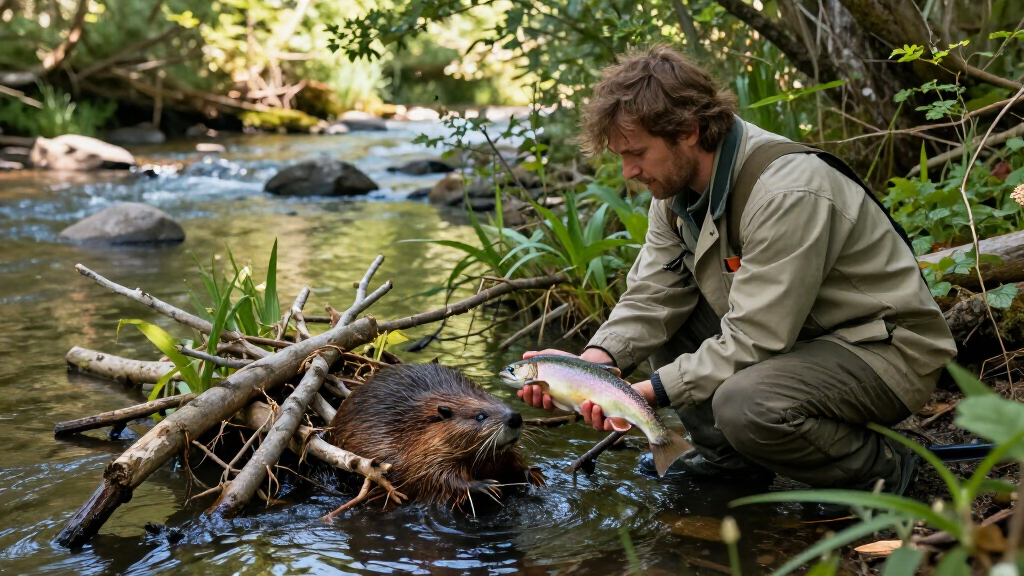
The study, conducted over the past year in a Pacific Northwest watershed, compared juvenile coho salmon survival in streams with artificial beaver dams against those without. The results show a substantial increase in survival, with rates jumping from 8% in untreated sections to 60% where artificial beaver dams were installed. Researchers attribute this improvement to the enhanced habitat complexity, increased water retention, and improved flow conditions created by these structures.
Officials involved in the project emphasize that the artificial dams mimic natural beaver activity, providing ecological benefits without the need for live beavers. The study was led by a team of ecologists and conservationists, and the data was peer-reviewed before publication. The findings suggest that artificial beaver dams could be a scalable, cost-effective tool for restoring salmon habitats in degraded streams.
While the results are promising, experts caution that long-term impacts and broader applicability need further investigation. The study’s authors plan to monitor the sites over multiple seasons to assess sustainability and potential unintended effects.
Potential Game-Changer for Salmon Conservation
This development could significantly influence conservation strategies, especially in areas where natural beaver populations are declining or where habitat degradation has severely impacted salmon populations. Increasing juvenile survival rates from 8% to 60% represents a potential fivefold improvement in survival, which could translate into healthier adult populations and improved fishery yields. If scalable, artificial beaver dams could become a key tool in efforts to recover declining salmon stocks, which are vital both ecologically and economically.
Environmental agencies and indigenous groups have expressed interest in adopting this approach more widely, citing its potential to restore natural stream functions and improve biodiversity. The approach also offers a non-invasive alternative to traditional habitat restoration, which can be costly and disruptive.
As an affiliate, we earn on qualifying purchases.
Background on Beavers and Salmon Habitats
Beavers are known as ecosystem engineers, creating dams that modify stream environments in ways that benefit many aquatic species, including salmon. Historically, beaver activity helped maintain healthy stream flow, water quality, and habitat complexity. However, due to habitat loss, trapping, and land use changes, beaver populations have declined in many regions, reducing these ecological benefits.
Salmon populations, particularly juvenile coho, depend on complex stream habitats for survival during their early life stages. Degradation of these habitats has contributed to declining salmon numbers, prompting conservation efforts that include habitat restoration and dam removal. Artificial beaver dams have emerged as a novel method to replicate beaver activity, with some pilot projects showing promising results.
The recent study builds on this background, providing empirical evidence that artificial structures can significantly improve juvenile salmon survival, a critical factor in overall population recovery.
salmon habitat restoration structures
As an affiliate, we earn on qualifying purchases.
As an affiliate, we earn on qualifying purchases.
Long-Term Effects and Broader Application Unclear
While the initial results are promising, it is still unclear how sustainable the artificial beaver dams are over multiple years and in different ecological contexts. Researchers caution that long-term monitoring is needed to assess potential issues such as dam stability, effects on other species, and whether the benefits persist over time. Additionally, the scalability of this approach across diverse stream systems remains to be tested, and the cost-effectiveness at larger scales is still under evaluation.
stream habitat enhancement for fish
As an affiliate, we earn on qualifying purchases.
As an affiliate, we earn on qualifying purchases.
Further Monitoring and Broader Implementation Plans
The research team plans to continue monitoring the existing sites over the next several seasons to gather data on long-term impacts. They are also exploring partnerships with conservation agencies to expand the installation of artificial beaver dams in other degraded watersheds. Future studies will aim to optimize design parameters and assess ecological impacts across different environments.
Additionally, policymakers and stakeholders are being engaged to evaluate the feasibility of integrating artificial beaver dams into broader habitat restoration programs. The goal is to establish guidelines for widespread application if long-term benefits are confirmed.
As an affiliate, we earn on qualifying purchases.
Key Questions
How do artificial beaver dams differ from natural beaver dams?
Artificial beaver dams are human-made structures designed to mimic the ecological functions of natural beaver dams. They are constructed using natural materials and engineered to replicate water retention, flow regulation, and habitat complexity, but without involving live beavers.
Are artificial beaver dams safe for other wildlife?
Initial studies suggest that artificial dams can support diverse aquatic species and do not pose significant risks. However, long-term ecological assessments are ongoing to ensure they do not inadvertently harm other wildlife or disrupt existing habitats.
Can this method be applied in all types of streams?
While promising, the effectiveness of artificial beaver dams may vary depending on stream size, flow characteristics, and existing ecological conditions. Further research is needed to determine where they are most suitable.
What are the costs involved in installing artificial beaver dams?
The costs depend on the size and complexity of the structures, but initial estimates suggest they are generally less expensive than large-scale habitat restoration projects. Cost-effectiveness at larger scales is currently under evaluation.
Source: hn