To size your water softener in grains per gallon, first determine your household’s daily water use and hardness level. Multiply gallons by grains per gallon to find your daily grain demand. Choose a softener capacity that matches or exceeds this number, ideally allowing for fewer regeneration cycles. Oversized units waste salt, while smaller ones need frequent regeneration. To optimize performance, consider your household’s needs; more details will help you make the right choice.
Key Takeaways
- Calculate household daily water consumption and multiply by water hardness to determine total daily grain demand.
- Match the softener’s grain capacity to your household’s calculated daily grain needs for optimal sizing.
- Larger capacities reduce regeneration frequency but may increase initial costs; smaller units regenerate more often.
- Consider household water usage patterns, including laundry and outdoor needs, to ensure sufficient softening capacity.
- Proper sizing prevents over- or under-sizing, optimizing efficiency, salt use, and system lifespan without focusing on sales tactics.
Choosing the right water softener size is essential to guarantee your system works efficiently and effectively. An improperly sized unit can lead to frequent regeneration cycles, high salt usage, and insufficient softening, which ultimately wastes money and reduces system lifespan. To avoid these issues, you need to understand your water’s hardness level, daily water consumption, and how your softener manages salt dosage during regeneration.
The salt dosage and regeneration cycle are closely connected. The regeneration cycle resets the resin beads in your softener, allowing them to attract and trap hardness minerals like calcium and magnesium again. During this process, your system uses a specific amount of salt—what’s called the salt dosage—to recharge the resin. If your softener is too small, it will cycle more often because it can’t handle your household’s water demands, leading to increased salt consumption and higher operational costs. Conversely, a unit that’s too large might go through regeneration less frequently but could be less efficient overall, wasting salt and water during each cycle.
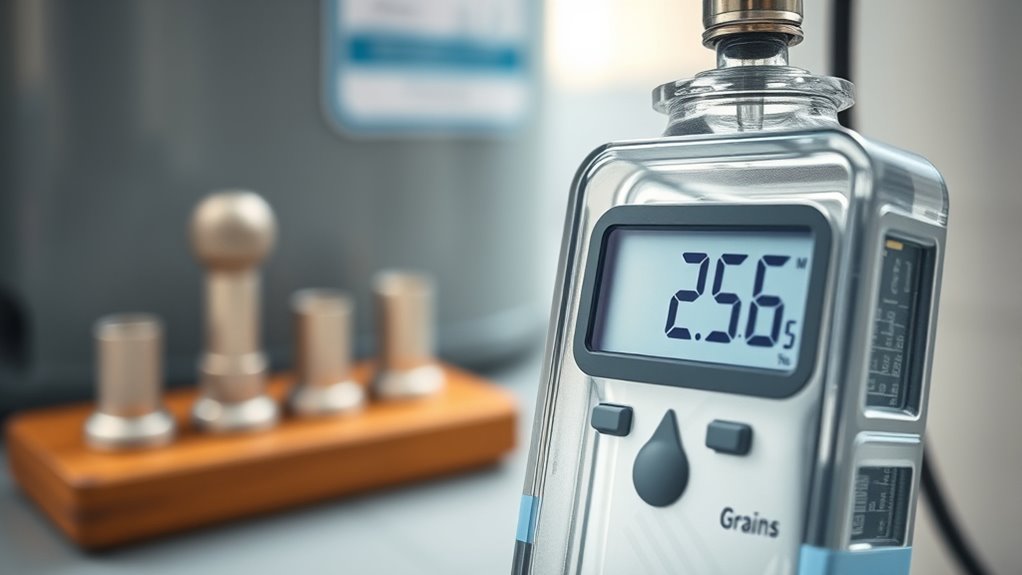
To determine the right size, start by calculating your household’s daily water use. Multiply the number of people in your home by the average daily per-person water consumption—usually around 75 gallons—then add a buffer for additional needs like laundry and watering. Next, find out your water’s hardness level, typically measured in grains per gallon (gpg). You can get this information from your water provider or test kits. Once you know the total hardness, multiply it by your daily water usage to get your household’s daily grain demand. This figure guides your choice of softener capacity, usually expressed in grains. For example, if your household uses 300 gallons daily and has a hardness of 10 gpg, your daily grain requirement is 3,000 grains. A softener with a capacity of 30,000 grains would last around ten days before needing regeneration, assuming typical salt dosage and cycle times. Additionally, understanding your household’s backup power needs can help ensure your softener remains operational during outages, especially if the unit is large or complex.

4500 Sq.Ft Energy Star Most Efficient 2025 Dehumidifier with Pump, AEOCKY Max 80 Pint/Day Smart Compressor Dehumidifier with Drain Hose, Intelligent Humidistat,for Basement,Bedroom,Home (White)
【The Undisputed Champion — Industry‑Leading Dehumidifier Brand】When you choose AEOCKY, you get double market validation. In 2025, AEOCKY...
As an affiliate, we earn on qualifying purchases.
Frequently Asked Questions
How Often Should I Regenerate My Water Softener?
You should regenerate your water softener when the regeneration frequency indicates it’s needed, usually every 7 to 14 days, depending on your water usage and hardness level. Regular softener maintenance ensures your system works efficiently, preventing scale buildup and extending its lifespan. Keep an eye on your softener’s salt levels and monitor the system’s performance, adjusting the regeneration cycle as necessary to maintain ideal softening and avoid mineral buildup.
Can I Install a Water Softener Myself?
Yes, you can attempt a DIY installation, but it’s often better to seek professional assistance. While installing a water softener yourself might save money, it requires plumbing skills, tools, and safety precautions. Mistakes can lead to leaks or ineffective softening. If you’re confident in your plumbing abilities, follow clear instructions carefully. Otherwise, hiring a professional guarantees proper setup, saves time, and ensures your water softener works efficiently.
What Is the Lifespan of a Typical Water Softener?
A typical water softener lasts about 10 to 15 years, depending on salt usage and resin durability. You’ll notice its lifespan shortens if you use too much salt or if the resin beads wear out faster. Regular maintenance, like cleaning and salt refilling, helps prolong its life. Keep an eye on performance, and replacing resin or the entire unit when efficiency drops ensures you get the most out of your softener.
How Does Water Temperature Affect Softener Performance?
Like Icarus flying too close to the sun, high water temperatures can melt away your softener’s efficiency. Elevated temperatures accelerate resin bead degradation, reducing the softener’s ability to remove minerals effectively. Conversely, colder water slows ion exchange, making the process less efficient. To optimize performance, keep water temperature within the recommended range, as temperature impact directly influences softener efficiency and prolongs system lifespan.
Are There Health Risks Associated With Water Softeners?
You might worry about health concerns with water softeners, but generally, they’re safe for most people. They mainly remove minerals like calcium and magnesium, which are beneficial for your health, and replace them with sodium. If you have health issues like heart disease or need low sodium intake, you should consult a doctor. Overall, water softeners efficiently handle mineral removal without posing significant health risks.

CADPXS Crawl Space Dehumidifier with Pump and Drain Hose, 80 Pint Crawlspace Dehumidifier for Commercial, Basement, Water Damage Use, Auto Defrost, Memory Start, cETL Certified, Up to 1000 Sq Ft
80 PINTS COMMERCIAL DEHUMIDIFIER: Control excess moisture efficiently with the CADPXS 80-pint crawl space dehumidifier with pump. Designed...
As an affiliate, we earn on qualifying purchases.
Conclusion
Choosing the right water softener size guarantees your system meets your household’s needs efficiently. Did you know that, on average, a typical family uses about 80 gallons of water daily, with softening requirements varying accordingly? Proper sizing can save you money and extend your unit’s lifespan. By understanding your grain capacity needs, you’ll avoid over- or under-sizing, ensuring soft, quality water every day. Make smart choices today for better water tomorrow.

Moiswell 70 Pints Commercial Dehumidifier with Pump, Portable Crawl Space Dehumidifiers for Basement and Home, Energy Star Efficient Certified, Automatic Defrost
Energy Star Certified Portable Dehumidifier: Moiswell commercial dehumidifier ME-7S is efficiently removes up to 70 pints at saturation,...
As an affiliate, we earn on qualifying purchases.

Waykar 70 Pint Energy Star Crawl Space Dehumidifier with Drain Hose, Commercial Dehumidifier for Basements and Home, for Spaces up to 5000 Square Feet, Smart Humidity Control - 5-Year Quality Coverage
【70-Pint Crawl Space Dehumidifier】 This commercial dehumidifier features a high-performance motor and 160CFM airflow, capable of removing up...
As an affiliate, we earn on qualifying purchases.