
📊 Full opportunity report: Parental Consent Operations For Youth-Service Providers on IdeaNavigator AI — validation score, market gap, and execution plan.

Prime made for students and young adults
- Fast, free delivery for dorm and study essentials
- Prime Video and Amazon Music included
- Member-only deals
TL;DR
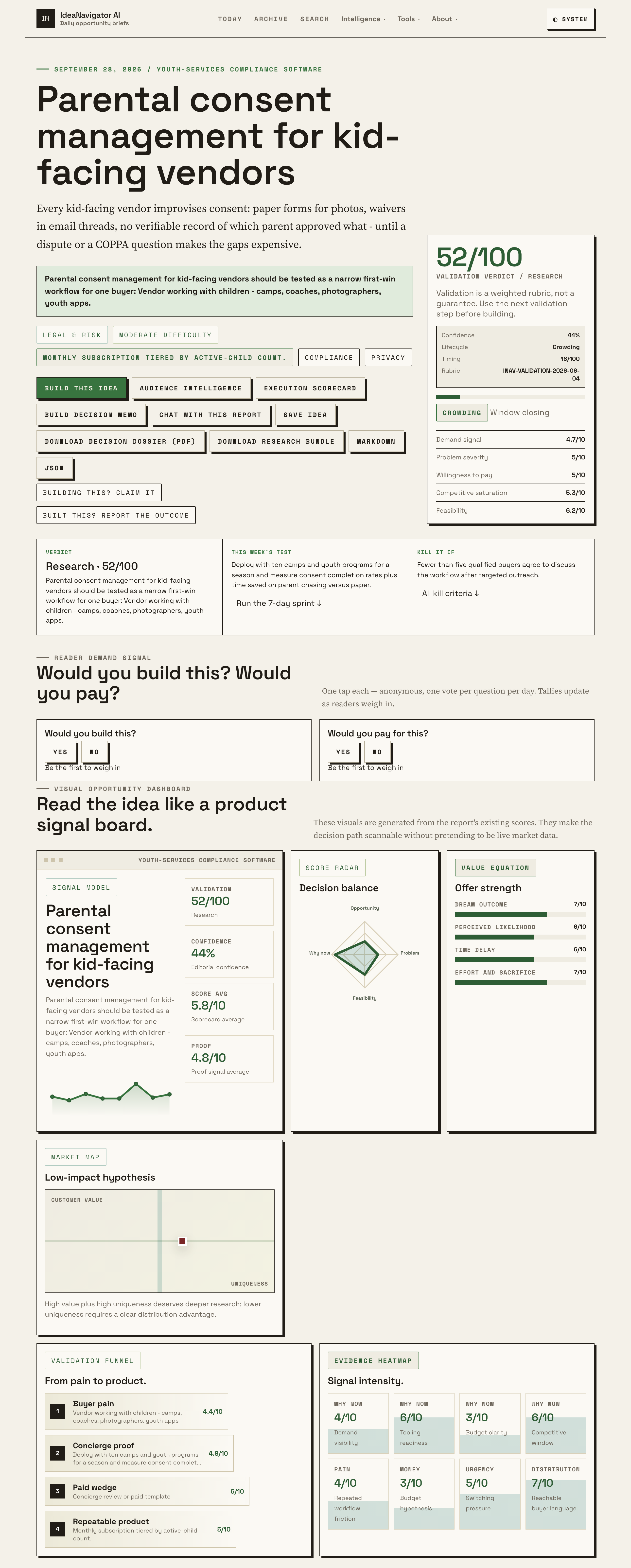
IdeaNavigator AI’s product proposal identifies parental consent management as a potential software opportunity for camps, coaches, photographers and youth apps. It recommends testing a vendor-branded mobile workflow with ten youth programs; the proposal reports no product launch, pilot results or adoption figures.
IdeaNavigator AI’s product proposal recommends testing a parental consent-management service with camps and other youth-service providers. The proposal aims to replace paper forms and email records with approvals parents can complete on their phones. It recommends a pilot involving ten camps and youth programs, but reports no deployment or results.
IdeaNavigator AI’s proposal focuses on organizations that work with children, including camps, coaches, photographers and youth apps. It describes a recurring administrative problem: providers may collect permission for photos, data use, medical matters or liability through separate paper forms and email threads, leaving staff without a clear, verifiable record of which parent approved which activity.
The suggested minimum product would let each provider use a branded mobile consent flow. It would keep a per-child record of approvals, track when consent expires, offer identity checks matched to the perceived risk of the request, and allow providers to export records for an audit. These are proposed features; the proposal provides no evidence that a service with them has been built or tested.
The proposal suggests a monthly subscription tiered by active-child count. To assess demand and usefulness, it recommends a season-long trial with ten programs, measuring how often parents complete consent requests and how much staff time is spent following up compared with paper processes. It provides no pricing, completion targets or measured savings.
A Record of Each Parent’s Approval
IdeaNavigator AI’s proposal says that permission records can affect youth-service organizations’ day-to-day operations and their responses to complaints. It argues that a searchable record tied to a child and a specific use could help staff determine whether a parent approved a photograph, data collection or another activity, and whether that approval is current. The proposal presents this as a way to make consent handling more consistent and auditable.
The potential value depends on whether providers and families find the process easier than existing forms. A digital ledger alone does not establish that the person giving permission has the right authority, that the request was clearly explained, or that a provider has met its legal obligations. The proposed risk-based identity checks and expiry tracking have not been tested, and the proposal provides no evidence about their effect on completion.
The proposal cites regulatory attention to children’s privacy and disputes over the use of children’s photos or data as reasons to explore the idea. It identifies no particular enforcement action, law change or documented rise in disputes. Those points are the proposal’s stated rationale, not reported evidence of a market trend.
From Paper Forms to Digital Ledgers
IdeaNavigator AI’s proposal says youth-service providers handle different permissions for different activities. A camp might need medical and liability information, while a photographer or youth app may seek permission to use images or collect data. It describes these processes as often improvised across paper and email, which can make it harder to track approvals and retain a single record.
The proposal frames the possible product as a focused first workflow for vendors working with children. Its scope is consent collection and recordkeeping, rather than a general compliance system. It references COPPA updates and state laws as part of the timing rationale, but provides no legal analysis, jurisdiction list or account of which requirements a product would address.
The proposal recommends validation with a small group of camps and youth programs over one season. The suggested trial would test whether the described administrative problem is common and whether mobile forms and centralized records improve completion and reduce follow-up work. It names no participating organizations and gives no launch date.
Pilot, Compliance and Demand Remain Open
Whether the product exists is not established by IdeaNavigator AI’s proposal, which describes what to build and how to validate it but reports no launched service, completed pilot or customer commitments. The suggested ten-program trial is a plan, not a confirmed deployment.
The proposal reports no findings on parent completion rates, staff time saved, subscription pricing or willingness to pay. It does not specify how identity verification would differ across risk tiers, how records would be protected and retained, or how providers would handle a parent changing or withdrawing permission.
The legal references in the proposal remain broad. It does not identify which specific COPPA provisions or state laws the proposed workflow would support, or whether the system would receive legal review. It provides no independent legal assessment or claim of compliance.
A Season-Long Test Is Proposed
IdeaNavigator AI’s proposal recommends a season-long pilot with ten camps and youth programs. The stated measures are consent completion rates and staff time spent following up with parents compared with paper-based processes. The proposal gives no start date or recruitment plan and reports no results.
If a pilot proceeds, its findings could show whether providers adopt the workflow and whether it saves time while preserving parents’ understanding of what they are approving. The proposal does not provide details about security, legal review, pricing or the handling of consent changes.
Source: IdeaNavigator AI
Key Questions
Has a parental consent platform for these vendors launched?
IdeaNavigator AI’s proposal describes a product to build. It does not report a launch or a completed pilot.
Who is the proposed service for?
The proposal targets vendors working with children, including camps, coaches, photographers and youth apps.
What would the proposed tool do?
It would provide branded mobile consent requests, per-child approval records, expiry tracking, identity checks matched to risk and audit exports.
What evidence would a pilot collect?
The proposal recommends a season-long trial with ten programs to measure consent completion rates and staff time spent following up with parents compared with paper processes. It reports no results.
Source: IdeaNavigator AI
Fall Picks
fall essentials
As an affiliate, we earn on qualifying purchases.