
📊 Full opportunity report: Employee handbook change digest for small employers on IdeaNavigator AI — validation score, market gap, and execution plan.

Prime made for students and young adults
- Fast, free delivery for dorm and study essentials
- Prime Video and Amazon Music included
- Member-only deals
TL;DR
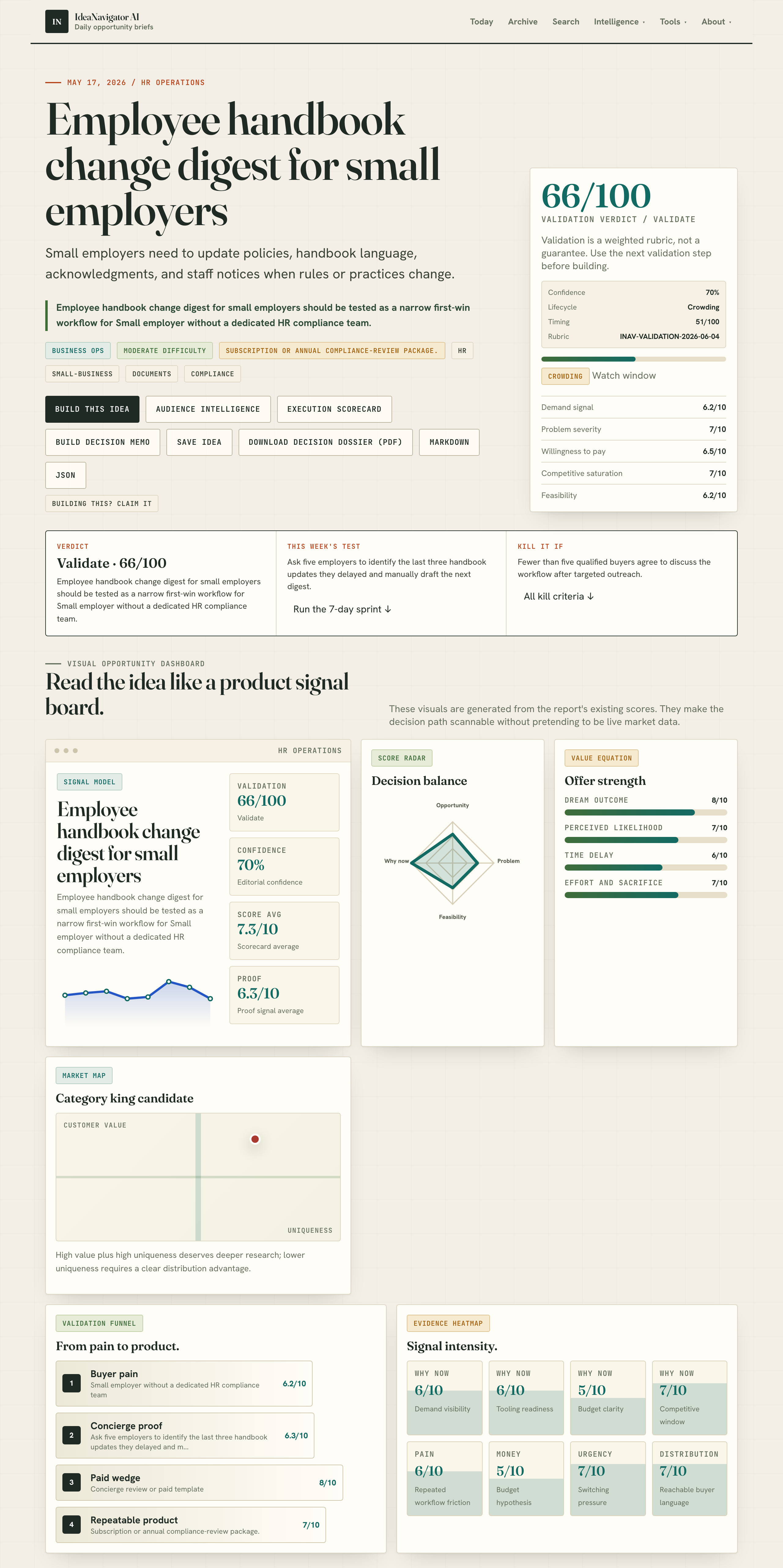
A new workflow for small employers to manage employee handbook updates is being tested. It aims to streamline policy changes and acknowledgments without a dedicated HR team. This could improve compliance and reduce delays.
Small employers without dedicated HR compliance teams are testing a new workflow designed to simplify updating employee handbooks and tracking employee acknowledgments. The initiative aims to address the increasing complexity of policy changes driven by remote work, AI tools, and evolving state employment laws, which often lead to delays and compliance risks.
The proposed workflow, developed by IdeaNavigator AI, involves logging policy topics, drafting digest change notes, and tracking employee acknowledgment status. The pilot targets small businesses that typically lack the resources for comprehensive HR compliance management.
According to an anonymous researcher, this approach offers a practical solution for small employers to stay current with legal and operational updates without the need for a full-time HR team. The workflow is designed to be tested with five employers, who will identify recent handbook updates they delayed and manually draft the next digest to validate the process.
Why Small Employers Need an Efficient Update System
This initiative could significantly improve compliance management for small businesses, which often struggle with policy updates due to limited resources. By streamlining the process, employers can reduce legal risks, ensure staff are informed of current policies, and adapt more quickly to regulatory changes. The success of this workflow may lead to broader adoption and influence future HR tech solutions tailored for small teams.employee handbook management software
As an affiliate, we earn on qualifying purchases.
As an affiliate, we earn on qualifying purchases.
Growing Complexity of Policy Management for Small Employers
Small employers face increasing challenges in maintaining up-to-date employee handbooks amid rapid changes in employment law, remote work practices, and technological tools like AI. Many delay or overlook handbook revisions, risking compliance violations. The lack of dedicated HR staff exacerbates these issues, prompting the development of simplified workflows. Prior efforts have focused on larger organizations, leaving small employers underserved in this area.“This workflow aims to provide small employers with a manageable way to stay compliant without a dedicated HR team.”
— an anonymous researcher
HR compliance tracking tools for small business
As an affiliate, we earn on qualifying purchases.
As an affiliate, we earn on qualifying purchases.
Uncertainties Around Workflow Effectiveness and Adoption
It is not yet clear how effectively the workflow will streamline updates in practice or how many small employers will adopt it. The pilot is ongoing, and results are pending. Additionally, questions remain about scalability and integration with existing HR systems.employee acknowledgment tracking system
As an affiliate, we earn on qualifying purchases.
As an affiliate, we earn on qualifying purchases.
Next Steps for Validation and Broader Implementation
The initial testing involves five small employers who will manually draft and review the digest process. Based on feedback, the workflow may be refined before broader rollout. Further studies could evaluate its long-term impact on compliance and operational efficiency for small businesses.small business HR policy update tools
As an affiliate, we earn on qualifying purchases.
As an affiliate, we earn on qualifying purchases.
Key Questions
How does this workflow differ from traditional handbook updates?
It simplifies the process by logging policy topics, drafting digest change notes, and tracking acknowledgments, reducing the need for dedicated HR staff.
Will small employers need special software to use this workflow?
The initial version is designed to be manual or semi-automated, with potential future integration into existing HR platforms.
What are the benefits of using this workflow?
It can help small employers stay compliant, reduce delays in policy updates, and ensure employees acknowledge current policies more efficiently.
When will the results of the pilot be available?
Results are expected after the pilot phase, which is currently ongoing, with findings anticipated within the next few months.
Could this workflow be expanded to larger organizations?
While designed for small employers, the core principles could be adapted for larger organizations seeking streamlined policy management.
Source: IdeaNavigator AI
Fall Picks
fall essentials
As an affiliate, we earn on qualifying purchases.