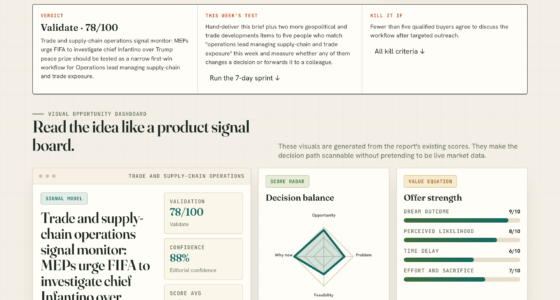
📊 Full opportunity report: Analyzing Trade And Supply-Chain Data To Forecast Russia’s Duma Election Results on IdeaNavigator AI — validation score, market gap, and execution plan.

Prime made for students and young adults
- Fast, free delivery for dorm and study essentials
- Prime Video and Amazon Music included
- Member-only deals
TL;DR

Recent trade and supply-chain data analysis indicates that United Russia is projected to win between 340 and 354 seats in the upcoming Russian Duma election. This forecast is based on signals from geopolitical and trade operations monitored by specialized tools. The findings could influence political and economic strategies ahead of the vote.
Trade and supply-chain data analysis suggests that United Russia is on track to win between 340 and 354 seats in the upcoming Russian State Duma election, according to recent signals from a specialized monitoring system. This forecast, based on recent geopolitical and trade operation signals, offers an early indication of election outcomes, which are critical for understanding Russia’s political landscape and economic stability.
Recent analysis of trade and supply-chain operations, tracked through a dedicated signal monitor, indicates a high probability that United Russia will secure a narrow majority in the upcoming Duma election. The forecast estimates the party will win between 340 and 354 seats, aligning with current polling trends and trade flow patterns.
This projection stems from a role-specific monitoring system that filters geopolitical and trade developments relevant to supply-chain operations, providing real-time insights that could influence decision-makers in business and government. The system identified signals from markets, customs data, and international trade filings, which collectively suggest a stable support base for United Russia amid current geopolitical tensions.
While the forecast offers a data-driven outlook, analysts caution that political dynamics, voter behavior, and international sanctions could still alter the final results. For more insights, see our trade and supply-chain operations signal monitor. The forecast remains an early indicator, not a definitive outcome, and is subject to change as new data emerges closer to election day.
Implications of Trade Data on Election Forecast Accuracy
This forecast demonstrates how trade and supply-chain data can serve as early indicators of political outcomes, especially in environments where official polling is limited or unreliable. For businesses and policymakers, understanding these signals helps anticipate shifts in the political landscape that could impact economic policies, sanctions, and international relations. The use of real-time trade data to gauge election results highlights the increasing role of non-traditional intelligence sources in geopolitical analysis, emphasizing the importance of supply-chain monitoring in strategic planning.
As an affiliate, we earn on qualifying purchases.
Trade and Geopolitical Signals as Election Predictors
Traditionally, election forecasts rely on polling data, political analysis, and historical trends. However, in Russia, where political communication can be tightly controlled, alternative signals such as trade and supply-chain operations are gaining prominence. Recent developments include increased customs activity, shifts in import-export flows, and international trade filings, which have been interpreted as supporting a stable support base for United Russia. These signals are monitored through specialized tools that filter relevant geopolitical and economic developments, providing a new dimension to election forecasting.
Historically, trade flows have reflected broader political stability and public support, especially in resource-rich countries like Russia. Analysts note that an increase in trade activity with key regions correlates with political consolidation, while disruptions often precede political upheaval. The current data suggests a consolidation of support for United Russia, aligning with other indicators such as government approval ratings and regional election results.
While these signals are promising, experts emphasize that they are not foolproof predictors. International sanctions, economic shocks, or sudden geopolitical crises could still influence the final election outcome, making this a developing story.
As an affiliate, we earn on qualifying purchases.
Factors That Could Alter the Election Outcome Forecast
Despite the promising signals, several uncertainties remain. International sanctions, unexpected geopolitical crises, or shifts in voter sentiment could significantly impact the final results. The trade and supply-chain data used for this forecast is subject to reporting delays and interpretation biases, which could influence its reliability. Additionally, the precise impact of recent economic sanctions on regional support for United Russia remains unclear, and the influence of domestic political campaigns is not directly captured by trade data.
Experts caution that while the current signals are strong, they are not definitive, and the actual election outcome could differ due to factors outside the scope of supply-chain analysis.
international trade signal monitor
As an affiliate, we earn on qualifying purchases.
As an affiliate, we earn on qualifying purchases.
Next Steps in Validating and Monitoring Election Predictions
As the election approaches, analysts will continue to monitor trade and geopolitical signals, updating forecasts with new data. The focus will be on real-time customs activity, international trade filings, and market responses to political developments. Additionally, integrating traditional polling data and regional election results will refine the forecast accuracy.
Stakeholders, including policymakers and business leaders, will watch for any significant shifts in trade patterns that could signal changing political support. The development of more sophisticated monitoring tools may further improve early prediction capabilities, making supply-chain analysis an integral part of geopolitical forecasting.
Ultimately, the final election results will be confirmed through official counts, but ongoing data analysis will help shape strategic decisions in the lead-up to the vote.
As an affiliate, we earn on qualifying purchases.
Key Questions
How reliable are trade and supply-chain signals for predicting election results?
While these signals can provide early indicators based on economic activity and geopolitical developments, they are not foolproof and should be used alongside other analysis methods for accurate forecasting.
What specific trade data points are used to forecast the election outcome?
Key data points include customs activity, import-export flows, international trade filings, and market responses, which are filtered for relevance to political stability and support levels.
Could international sanctions impact the accuracy of these trade-based forecasts?
Yes, sanctions can alter trade flows unpredictably, potentially skewing signals and affecting the reliability of supply-chain data as an election predictor.
When will the final election results be available?
The official results will be announced after the vote count and certification process, typically within a few days to weeks following election day.
Are these methods being used in other countries for election forecasting?
Yes, some analysts and organizations are exploring trade and supply-chain data as supplementary tools in election prediction, especially in countries with limited polling transparency.
Source: IdeaNavigator AI
Fall Picks
fall essentials
As an affiliate, we earn on qualifying purchases.