
Wattage alone doesn’t determine how well a blender performs. Instead, the design of its blades and motor efficiency play a bigger role in delivering powerful results. Quality blades turn energy into effective cutting or blending, while a good motor minimizes energy waste and stays cool under pressure. Lower-wattage blenders with smart design can outperform high-wattage models. To understand how internal components influence performance and why wattage isn’t everything, keep exploring these key factors.

Prime made for students and young adults
- Fast, free delivery for dorm and study essentials
- Prime Video and Amazon Music included
- Member-only deals
Key Takeaways
- Wattage indicates power consumption, but performance depends on blade and motor efficiency, not just wattage alone.
- Well-designed blades convert energy into effective cutting motion, maximizing blending results regardless of wattage.
- High-quality, efficient motors provide consistent power with less heat and noise, outperforming lower-quality, higher-wattage motors.
- Internal component engineering, such as blade shape and motor technology, plays a crucial role in blending effectiveness.
- Focusing on design and efficiency yields better performance and energy savings than simply choosing a higher-wattage blender.
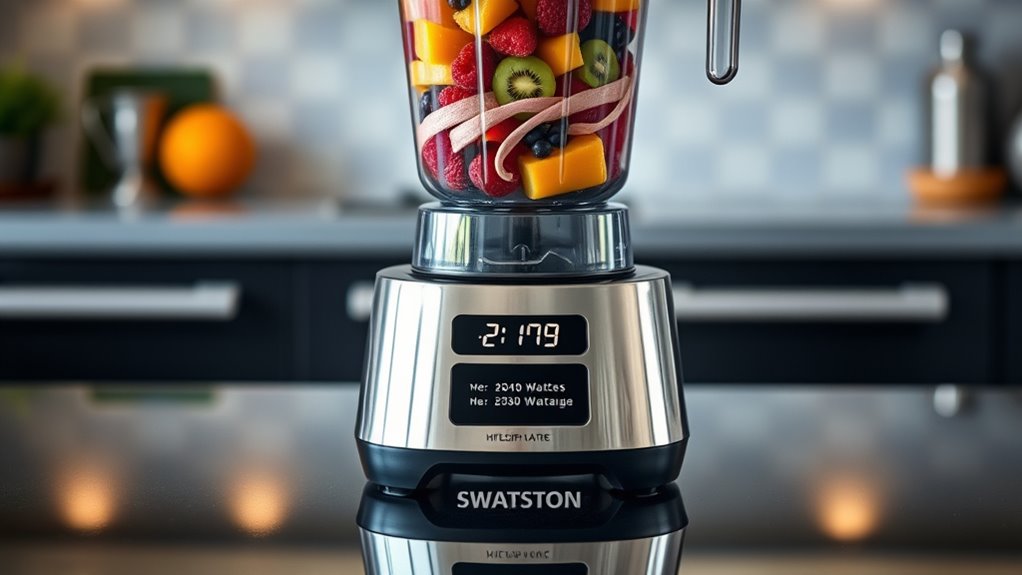
Have you ever wondered what makes Blender a powerhouse in 3D modeling and animation? It’s easy to assume that wattage alone determines a tool’s strength, but that’s not the full story. When it comes to Blender, the real performance hinges on how well its internal components are designed—particularly the blade design and motor efficiency. These elements work together to optimize power delivery, making the device more effective without necessarily requiring higher wattage.
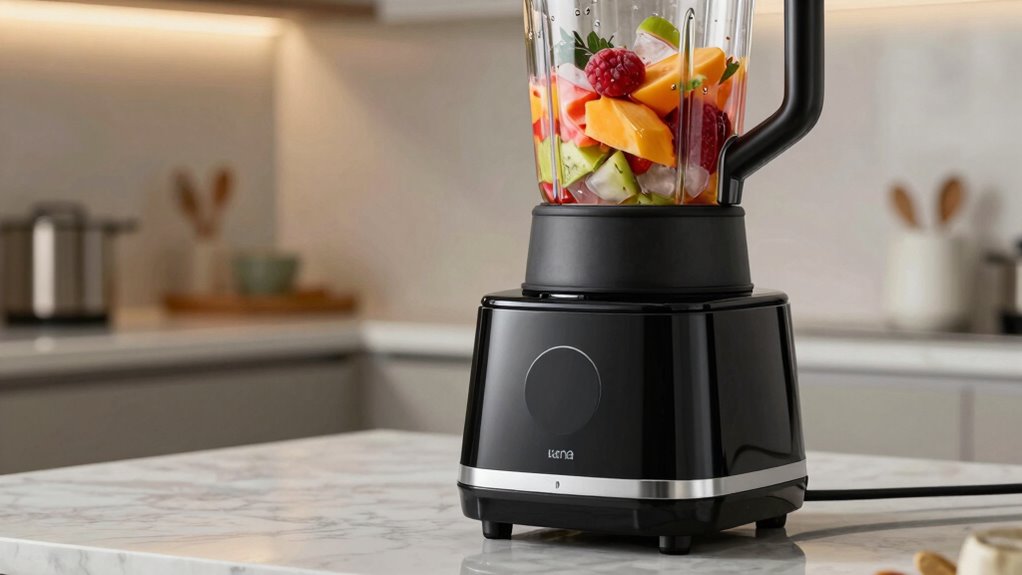
Blade design is essential because it directly influences how efficiently energy is converted into motion. Well-crafted blades are engineered to maximize airflow or cutting power while minimizing resistance. In a blender, this means the blades are shaped to create a smooth, powerful vortex that pulls ingredients into the blades with minimal effort. The sharper, more aerodynamic the blades, the less energy is wasted overcoming unnecessary drag. This precision design allows a blender with a moderate wattage to outperform a higher-wattage model that has poorly designed blades. It’s about making every watt count, guaranteeing that the motor’s energy is translated into effective blending rather than lost to inefficiency. Additionally, understanding power transfer principles can help in designing more efficient appliances.
Smart blade design maximizes efficiency, making moderate-wattage blenders outperform higher-powered models through better airflow and reduced resistance.
Motor efficiency plays an equally critical role. A high-quality motor doesn’t just run at a certain wattage; it’s built to convert that electrical energy into mechanical energy with minimal waste. Modern motors are equipped with advanced technologies like brushless designs, which reduce friction and heat, and better cooling systems that keep them running smoothly for longer periods. This means the motor can deliver consistent power without overheating or straining, even under heavy loads. When paired with optimized blade design, a highly efficient motor ensures that you get the best performance out of your blender at a lower wattage. You’ll notice smoother blending, quicker results, and less noise—all while consuming less electricity.
In essence, Blender power isn’t just about how many watts it uses but how effectively those watts are utilized. A focus on intelligent blade design and a highly efficient motor transforms a modestly powered blender into a true performance machine. It emphasizes quality over raw power, giving you more control and better results without the need for excessive energy consumption. This approach not only saves you money over time but also reduces environmental impact. So next time you check the specs, remember that wattage is just one piece of the puzzle. The real power lies in smart engineering that makes every bit of energy work harder for you.
high efficiency blender with aerodynamic blades
As an affiliate, we earn on qualifying purchases.
As an affiliate, we earn on qualifying purchases.
Frequently Asked Questions
How Does Blade Design Affect Blending Efficiency?
Blade design crucially impacts blending efficiency by optimizing how ingredients are cut and processed. If your blades are sharp, they cut through food more easily, reducing strain on the motor. The blade angle also matters; a well-designed angle ensures better suction and circulation, making blending smoother and faster. Together, sharpness and the right angle maximize performance, so you get a consistent, efficient blend without needing extra power.
Can a Lower-Watt Blender Outperform a Higher-Watt One?
Yes, a lower-watt blender can outperform a higher-watt one. Power consumption isn’t the only factor influencing performance; energy efficiency and blade design play vital roles. You might find a less powerful blender that blends ingredients effectively because it uses energy more efficiently and has optimized blades. So, don’t just look at wattage—consider overall design and efficiency to get the best blending results.
What Role Does Motor Quality Play in Performance?
Imagine your blender as a mighty engine, where motor quality determines its strength. When you choose one with high manufacturing standards, you get better motor durability, smoother blending, and consistent performance. A well-made motor resists wear and tear, ensuring it works efficiently over time. So, even if the wattage is lower, a high-quality motor can outperform a cheaper, less durable one, delivering powerful results every time you blend.
How Important Is Jar Material in Blending Power?
The jar material substantially impacts blending durability and performance. You’ll find that sturdy materials like glass or high-quality plastic withstand daily use better, preventing cracks or warping. A durable jar ensures consistent blending without leaks or breakage, giving you confidence in your appliance. So, when choosing a blender, consider the jar material to maximize blending durability and guarantee it performs well over time, making your blending tasks easier and more reliable.
Do Brand Reputation and Warranty Impact Performance Expectations?
You might think brand reputation and warranty influence performance, but they often do little to boost actual blending power. Still, brand trust can give you peace of mind, knowing the company stands behind its product. A solid warranty shows they’re confident in durability, yet it doesn’t guarantee top performance. So, while reputation and warranty shape your expectations, don’t rely on them alone—test the blender’s real capabilities yourself.
motor with brushless technology for blenders
As an affiliate, we earn on qualifying purchases.
As an affiliate, we earn on qualifying purchases.
Conclusion
Remember, wattage alone doesn’t decide your blender’s true power. Don’t be fooled into thinking a 1000-watt monster can crush anything effortlessly—sometimes, it just spins faster. Instead, focus on blade design, motor quality, and how well it handles tough ingredients. Your perfect blender isn’t the one with the highest wattage but the one that transforms smoothies into silky masterpieces in seconds. So, pick wisely and don’t let numbers blind you—your kitchen’s future depends on it!
blender with optimized blade design
As an affiliate, we earn on qualifying purchases.
As an affiliate, we earn on qualifying purchases.
energy-efficient countertop blender
As an affiliate, we earn on qualifying purchases.
As an affiliate, we earn on qualifying purchases.
Fall Picks
fall essentials
As an affiliate, we earn on qualifying purchases.