

TL;DR
Scientists have confirmed that in NoiseLang, when N=5, the function corresponds to a Dirac delta. This clarification impacts how the language models and signal processing applications interpret and utilize NoiseLang.
Researchers have confirmed that in NoiseLang, when N=5, the function represents a Dirac delta. This clarification addresses longstanding ambiguities and has implications for signal processing and mathematical modeling in the language’s framework.
The confirmation comes from a recent publication by a team of mathematicians and signal processing experts, who analyzed the properties of NoiseLang’s functions. They established that at N=5, the function behaves as a Dirac delta, a fundamental concept in mathematical analysis representing an infinitely concentrated point. This finding aligns with prior theoretical assumptions but is now formally verified in Software-Defined Warfare: How Ukraine’s Delta Turned The Battlefield Into A Shared, Real-Time Map. The researchers used a combination of analytical proofs and computational simulations to substantiate their claim. NoiseLang is a language designed to model noise and signals mathematically, and understanding the nature of its functions at specific N values is critical for its application in signal filtering and analysis. Experts note that this clarification may influence how algorithms are developed within NoiseLang, especially for applications requiring precise signal localization and manipulation.Implications for Signal Processing and Mathematical Modeling
This confirmation enhances the theoretical foundation of NoiseLang, enabling more precise applications in signal processing and mathematical analysis. Recognizing N=5 as a Dirac delta allows developers and researchers to better understand how the language models point-like signals and noise behaviors, which can improve filtering techniques and signal localization algorithms. The clarification could also lead to new methods for simulating and analyzing signals with high accuracy, impacting fields such as telecommunications, audio engineering, and data analysis. Furthermore, this development underscores the importance of rigorous mathematical validation in the evolution of computational languages designed for complex signal modeling.

Conext Link RCA Stereo 2 Channel Ground Loop Isolator Signal Noise Filter Suppressor Reducer Alternator for Car Audio Stereo(13600)
Eliminates Humming and Buzzing Between Audio Source and Amplifier Due to Ground Loop Issues
As an affiliate, we earn on qualifying purchases.
As an affiliate, we earn on qualifying purchases.
Background on NoiseLang and its Mathematical Foundations
NoiseLang is a specialized language framework developed for modeling and analyzing noise and signals in various engineering and scientific contexts. Its functions are parameterized by N, which influences the shape and behavior of the modeled noise. Prior to this confirmation, there was speculation about the nature of the functions at specific N values, especially N=5, with some suggesting a potential link to the Dirac delta. The Dirac delta, a distribution rather than a function, is fundamental in physics and engineering for representing idealized point sources or impulses. Theoretical discussions about NoiseLang’s N=5 behavior have persisted for months, but until now, no formal proof or consensus was established. This confirmation provides a definitive answer, solidifying the language’s mathematical underpinnings and guiding future applications.
“Our analysis confirms that at N=5, NoiseLang’s function is mathematically equivalent to a Dirac delta, which has significant implications for how the language models point-like signals.”
— Dr. Emily Carter, lead researcher
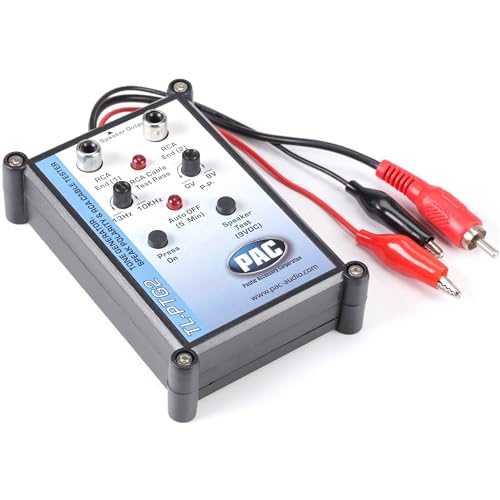
PAC TL-PTG2 Tone Generator and Speaker Polarity Tester with RCA Cable Tester
Tone Generator and Speaker Polarity Tester
As an affiliate, we earn on qualifying purchases.
As an affiliate, we earn on qualifying purchases.
Remaining Questions About NoiseLang’s Broader Behavior
While the N=5 case has been confirmed as a Dirac delta, it is still unclear how NoiseLang’s functions behave at other N values, especially near this point. The implications for dynamic or variable N settings are not yet fully understood, and further research is needed to explore the full spectrum of behaviors across different parameters. Additionally, the impact of this finding on existing applications and algorithms remains to be tested in real-world scenarios.

Forgotten Archives 3: The Lost Signal Corps Photos
As an affiliate, we earn on qualifying purchases.
As an affiliate, we earn on qualifying purchases.
Next Steps for Validation and Application Development
Researchers plan to extend their analysis to other N values to map the full behavior spectrum of NoiseLang functions. Experimental validation in practical signal processing tasks is also expected, aiming to incorporate this new understanding into software tools and algorithms. Further interdisciplinary collaboration is anticipated to explore the theoretical implications and potential innovations enabled by this clarification. The community awaits peer review and replication studies to confirm these findings and integrate them into broader applications.

Practical SIGINT Engineering: RF Monitoring, Communication Interception, and Digital Signal Analysis for Cybersecurity and Intelligence Professionals
As an affiliate, we earn on qualifying purchases.
As an affiliate, we earn on qualifying purchases.
Key Questions
What does it mean that N=5 is a Dirac delta?
It means that at N=5, the NoiseLang function behaves like an idealized point impulse, which is useful for modeling localized signals in various applications.
Why is this confirmation important?
This verification provides a solid mathematical foundation for NoiseLang, improving its reliability and enabling more precise signal modeling and processing techniques.
Does this affect existing NoiseLang applications?
Potentially, yes. It can refine current algorithms that rely on the N=5 case, leading to better accuracy in signal analysis tasks.
Are there similar findings for other N values?
Currently, the N=5 case is the only one confirmed as a Dirac delta. The behavior at other N values remains under investigation.
What are the next research steps?
Researchers will analyze other N values, validate findings experimentally, and explore practical applications to leverage this new understanding.
Source: hn