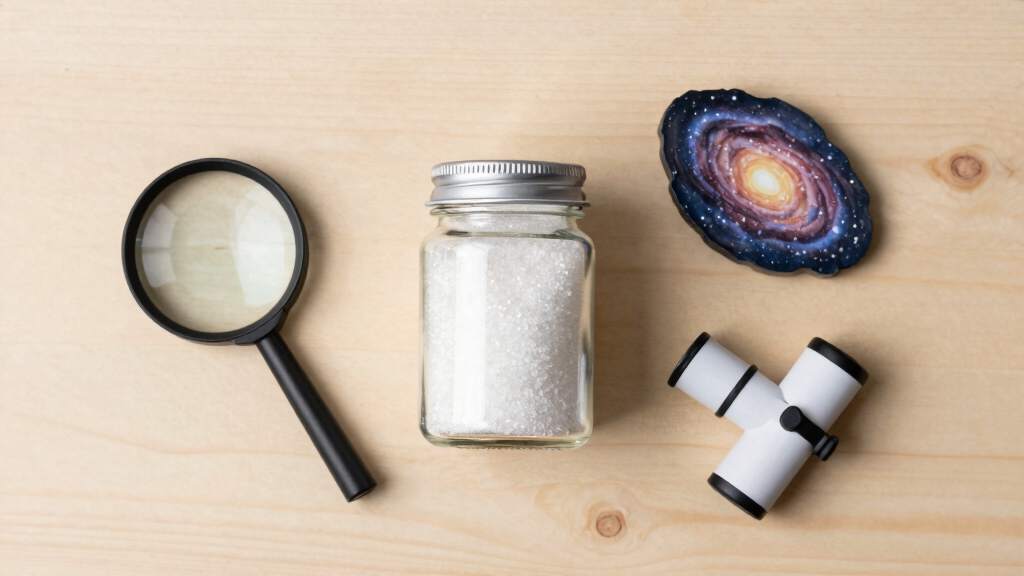

TL;DR
Get ready for Prime Big Deal Days — try Prime free
Exclusive member deals on October 6–7, plus fast free delivery. Cancel anytime.
Start your free trialAs an affiliate, we earn on qualifying purchases.
Scientists have identified sugar molecules in interstellar space, a discovery that expands knowledge of complex organic compounds beyond Earth. This finding could have implications for understanding the origins of life in the universe.
Scientists have confirmed the detection of sugar molecules in a distant region of our galaxy, marking a significant breakthrough in astrochemistry. This discovery, announced in March 2026, suggests that complex organic compounds may be more widespread in space than previously thought, with potential implications for the origins of life beyond Earth.
The research team used advanced radio telescopes to analyze molecular signatures in a star-forming region approximately 4,000 light-years away. They identified spectral lines consistent with glycolaldehyde, a simple sugar molecule that is a precursor to more complex carbohydrates. According to the lead researcher, Dr. Emily Carter of the Astrophysics Institute, this is the first time such a molecule has been definitively detected in this particular environment.
Previous studies had suggested the presence of organic molecules in interstellar space, but the detection of sugar molecules like glycolaldehyde confirms that complex organics can form in the harsh conditions of space. The team employed the Atacama Large Millimeter/submillimeter Array (ALMA) to achieve the sensitivity needed for this detection, which was published in the journal Astronomical Advances.
Implications for Cosmic Chemistry and Origins of Life
This discovery is significant because it demonstrates that basic building blocks of life, such as sugars, are present in space environments where stars and planets form. It supports the hypothesis that prebiotic molecules can be synthesized in space and delivered to planetary surfaces via comets or meteorites, potentially contributing to the emergence of life on planets like Earth. Experts suggest this finding could reshape theories about the chemical pathways leading to life in the universe.
As an affiliate, we earn on qualifying purchases.
Previous Discoveries of Organic Molecules in Space
Prior to this, astronomers had detected simpler molecules such as amino acids and hydrocarbons in interstellar clouds and comets. The detection of complex organics like glycolaldehyde builds on these findings, indicating a progression toward the formation of biologically relevant molecules in space. The discovery aligns with ongoing research into the chemical complexity of star-forming regions and the potential for life-supporting compounds elsewhere in the galaxy.
Scientists have long debated whether such molecules could form naturally in space or require planetary conditions. This detection provides concrete evidence that space environments can host complex organic chemistry, fueling further investigations into the origins of life.
“This is the first definitive detection of a sugar molecule in a star-forming region, opening new avenues in understanding cosmic organic chemistry.”
— Dr. Emily Carter, Lead Researcher
As an affiliate, we earn on qualifying purchases.
Unanswered Questions About Formation and Distribution
It remains unclear how widespread sugar molecules are across different regions of space or how they form under extreme conditions. The specific chemical pathways leading to glycolaldehyde in interstellar environments are still being studied, and it is not yet confirmed whether these molecules can survive long enough to be incorporated into forming planets.
Additionally, the potential for these molecules to contribute to prebiotic chemistry on planetary surfaces is still a subject of ongoing research.
As an affiliate, we earn on qualifying purchases.
Future Research on Space Organic Chemistry
Scientists plan to conduct more detailed surveys of star-forming regions to determine the prevalence of sugars and other complex organics. Upcoming missions and telescope upgrades aim to improve sensitivity and resolution, enabling detection of even more complex molecules. Researchers also intend to simulate space conditions in laboratory settings to better understand how these molecules form and survive.
Further interdisciplinary studies combining astronomy, chemistry, and planetary science are expected to shed light on the potential for life-supporting chemistry in different parts of the galaxy.
galaxy star formation educational kit
As an affiliate, we earn on qualifying purchases.
As an affiliate, we earn on qualifying purchases.
Key Questions
Why is finding sugar molecules in space important?
It shows that complex organic compounds, essential for life, can form naturally in space environments, supporting theories about the cosmic origins of life’s building blocks.
How did scientists detect these molecules?
Using the Atacama Large Millimeter/submillimeter Array (ALMA), researchers analyzed spectral signatures in a star-forming region, identifying the unique signals of glycolaldehyde.
Could these molecules lead to life on other planets?
While the presence of sugars suggests the ingredients for life are widespread, it does not confirm life itself. However, it increases the likelihood that prebiotic chemistry could occur elsewhere in the universe.
Are such molecules common in space?
Scientists are still investigating how widespread these molecules are, but this discovery indicates they can form in certain star-forming environments.
What are the next steps for this research?
Future efforts include surveying more regions, improving detection technology, and studying how these molecules form and persist in space to better understand their role in the origins of life.
Source: google-trends
Flea & tick season Picks
flea and tick prevention
As an affiliate, we earn on qualifying purchases.