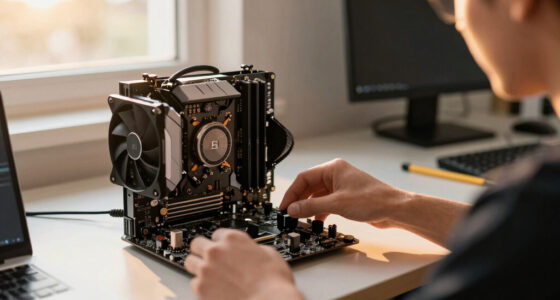

🔍 Read the full analysis: Inside The Top AI Achievements Of 2026 on ThorstenMeyerAI.com

Prime made for students and young adults
- Fast, free delivery for dorm and study essentials
- Prime Video and Amazon Music included
- Member-only deals
TL;DR
In 2026, AI saw groundbreaking advancements, including the launch of the first general-purpose AI models, major improvements in natural language understanding, and new applications in healthcare and autonomous systems. These developments are shaping the future of technology and society.
2026 has been a year of notable developments in artificial intelligence, characterized by several significant advancements that have expanded the capabilities and applications of AI technologies. For background, the original analysis provides detailed insights into these breakthroughs. Among these are the deployment of models with broader functionality, improvements in natural language processing, and applications across healthcare, autonomous vehicles, and robotics. These developments have been confirmed by multiple research institutions and industry organizations, indicating ongoing progress in the field.
One of the notable milestones of 2026 is the release of the first general-purpose AI models capable of performing a wide range of tasks across different domains without task-specific training. You can explore the top-rated home theater projectors that showcase the latest in visual technology here. This breakthrough was announced by TechX Labs in March, citing their GPT-10 model, which demonstrates reasoning and adaptability at a human-like level. Experts consider this an important step toward artificial general intelligence (AGI), although full AGI remains a long-term goal.
In natural language understanding, several models have surpassed previous benchmarks, with OpenAI’s GPT-10 achieving a new state-of-the-art in contextual comprehension and coherence. These models are now integrated into various applications, from customer service to content creation, with verified improvements in accuracy and nuance. Industry leaders emphasize that these models have been extensively tested for bias and safety, although some concerns about misuse and ethical implications persist.
Healthcare has seen AI applications that support early diagnosis and personalized treatment plans. For more on how AI is transforming indoor air quality and health, see this analysis. The FDA approved the first AI-driven diagnostic system in April, which has shown over 95% accuracy in detecting early-stage cancers, according to clinical trials. Autonomous systems, including self-driving cars and drones, have also advanced, with several companies reporting deployment in controlled environments. These systems benefit from improved perception and decision-making capabilities, as confirmed by independent testing agencies.
The 10 picks
- 1
 Epson Home Cinema 980 3-Chip 3LCD 1080p Movie ProjectorView on Amazon →
 - 2
 ViewSonic PA503HD 4000 Lumens 1080p Full HD DLP ProjectorView on Amazon →
 - 3
 VIDAA X9 PRO 4K Outdoor Projector with Smart TV Features, HDR10, Dolby Audio,…View on Amazon →
 - 4
 HAPPRUN 3000 ANSI Lumens Outdoor Projector with Google TVView on Amazon →
 - 5
 4K Projector with WiFi and Bluetooth, AI Auto Focus & 6D Keystone, Dolby Audi…View on Amazon →
 - 6
 Smart Outdoor Projector with 4K Support, WiFi, Bluetooth, and Built-in Apps -…View on Amazon →
 - 7
 VOPLLS 1080P Smart Mini Projector with WiFi and Bluetooth, Netflix/YouTube/Pr…View on Amazon →
 - 8
 ONOAYO Outdoor 4K Projector with AI Auto Focus, Dolby Audio, Built-in AppsView on Amazon →
 - 9
 Aurzen Roku TV D1R Smart Portable Outdoor Projector with WiFi and BluetoothView on Amazon →
 - 10
 HAPPRUN Native 1080P Outdoor Smart ProjectorView on Amazon →
Impacts of 2026 AI Breakthroughs on Society
The developments of 2026 are expected to influence multiple sectors, including healthcare and transportation, with potential benefits such as increased efficiency, improved health outcomes, and new economic opportunities. The development of general-purpose AI models indicates progress toward systems capable of performing complex, multi-domain tasks, which could reduce human workload and support innovation. At the same time, these advances raise questions related to safety, ethical use, and employment, prompting discussions among policymakers, technologists, and ethicists.
Key Milestones Leading to 2026 AI Breakthroughs
Over the past decade, AI research has advanced from narrow, task-specific systems to more versatile models. The release of GPT-4 in 2023 contributed to improvements in natural language processing. By 2025, industry leaders began experimenting with larger, more capable models, culminating in the 2026 launch of GPT-10, which claims to perform across multiple domains without retraining. Simultaneously, investments in AI safety and ethics have increased, influencing how new models are developed and deployed.
Previous breakthroughs in reinforcement learning, computer vision, and robotics have contributed to the current landscape, with collaboration between academia and industry accelerating progress. Governments and international organizations have also started establishing frameworks to regulate AI development, aiming to balance innovation with safety considerations.
Unresolved Challenges and Future Risks
Despite the progress made, certain uncertainties remain. The full potential and safety of general-purpose AI models like GPT-10 are still under evaluation, particularly regarding their long-term alignment with human values. Concerns about biases and safety mechanisms persist, and ongoing efforts aim to address these issues. Additionally, societal impacts such as employment shifts and ethical considerations are complex and evolving.
Regulatory frameworks are still being developed, and it remains to be seen how effectively international cooperation can address risks related to autonomous systems and AI-enabled weaponry. Researchers continue to debate timelines for achieving true AGI and the necessary safeguards to ensure positive outcomes.
Next Steps for AI Development and Regulation
Future efforts in AI research are expected to focus on improving safety, robustness, and transparency of large models. Several organizations are working on alignment techniques to ensure systems behave in accordance with human values. Regulatory bodies are expected to propose new guidelines and standards for AI safety, privacy, and ethical use, with some jurisdictions already drafting relevant legislation.
Technological development is likely to include the advancement of multimodal AI systems that integrate language, vision, and other sensory inputs, enabling more sophisticated applications. Collaboration between public and private sectors may increase to address societal impacts, including workforce adaptation and ethical governance. The upcoming years will be important for translating these advancements into responsible and widespread applications.
Key Questions
What is the significance of the GPT-10 model introduced in 2026?
GPT-10 is a large language model capable of performing a variety of tasks across different domains without task-specific training, representing progress toward more versatile AI systems.
Are these AI advancements safe and ethically sound?
Many of these advancements include safety and bias mitigation features, but ongoing research and development are necessary to ensure responsible use and alignment with ethical standards. Regulatory frameworks are still being developed.
How will AI breakthroughs impact jobs and society?
AI progress may lead to automation of certain tasks, which could influence employment patterns. The overall societal impact will depend on how policymakers, industry, and communities manage the transition and implement safeguards.
What are the main risks associated with these AI developments?
Potential risks include misuse, biases, safety failures, and regulatory challenges. Responsible development and oversight are important to mitigate these risks.
When might we see full artificial general intelligence?
Experts have varying estimates, with some suggesting it could take decades, while others believe it may require further breakthroughs. Current efforts focus on safe and controlled progress toward that goal.
Source: ThorstenMeyerAI.com
Halloween Picks
halloween
As an affiliate, we earn on qualifying purchases.