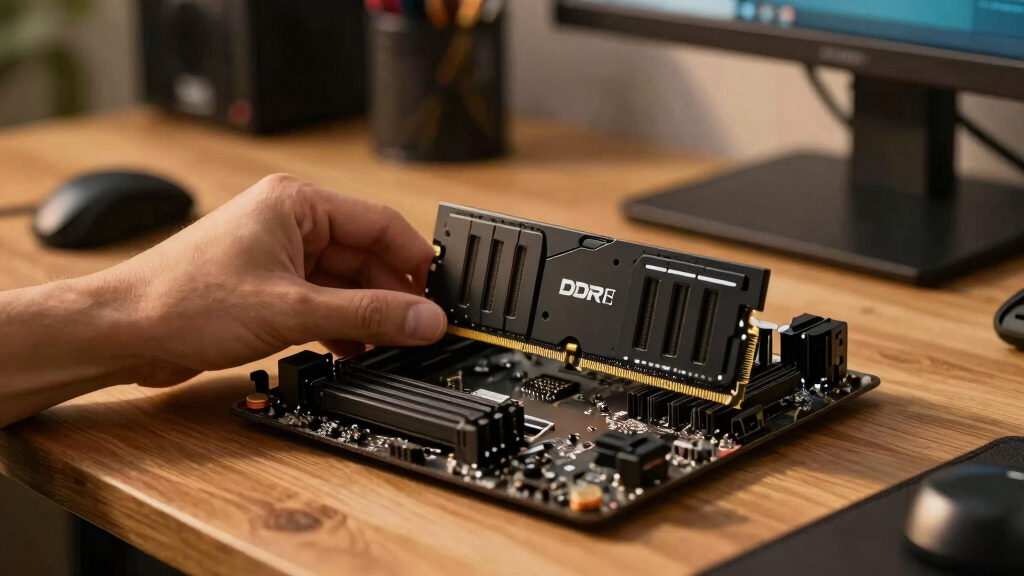

📊 Full opportunity report: DDR5 Now, DDR6 Soon: A Buyer’s Field Guide on ThorstenMeyerAI.com — validation score, market gap, and execution plan.

Prime made for students and young adults
- Fast, free delivery for dorm and study essentials
- Prime Video and Amazon Music included
- Member-only deals
TL;DR
With memory prices high and DDR6 still in development, this guide advises buyers to invest in DDR5 now rather than waiting for DDR6 in 2027. DDR6 will arrive at a premium and is not yet ready for mainstream adoption.
Memory prices remain elevated in 2026, and the arrival of DDR6 is still years away, with mainstream adoption not expected until 2027. Experts advise consumers to purchase DDR5 now for current and near-future builds, as waiting for DDR6 may result in higher costs and delays.
Despite widespread speculation about DDR6’s imminent release, the first DDR6 modules are not expected until 2027, with enterprise and high-end server markets leading the rollout. DDR6 promises significant bandwidth improvements, with speeds starting around 8,800 MT/s and scaling toward 17,600 MT/s, compared to DDR5’s maximum of approximately 8,400 MT/s. However, DDR6 is not backwards compatible with DDR5 or DDR4, requiring new motherboards, CPUs, and modules, and initial pricing is projected to be 2-3 times higher per gigabyte.
Meanwhile, current DDR5 options remain the recommended choice for mainstream users. The sweet spot remains DDR5-6000 with CL30 timings, offering the best balance of performance and price. For capacity, 32GB is sufficient for most gaming and desktop tasks, while 64GB suits content creators and heavy multitaskers. Buying larger capacities like 128GB now is discouraged due to high prices and uncertain future utility.
Attempting to save money by sticking with DDR4 is no longer advisable, as DDR4 is being phased out and now costs roughly the same as DDR5, with no future upgrade path. Building on DDR5 ensures compatibility with upcoming platforms and avoids the obsolescence risk of DDR4.
DDR5 now, DDR6 soon
A buyer’s field guide. The 20-year instinct — wait for prices to drop, or wait for the next generation — is broken this cycle. Buy the DDR5 you actually need now; don’t wait for DDR6. Here’s the reasoning.
Driven to end-of-life, production slashed. Same money, dead-end socket. Leave a working DDR4 box alone — but never start a new build on DDR4 to “save.”
A framework, not a gamble. Buy the DDR5 you need now, at the sweet spot, in the capacity you’ll actually use — don’t buy DDR4, don’t wait for DDR6. The two costliest mistakes in this market are the ones that feel prudent: waiting for a price drop that isn’t coming, and waiting for a next-gen part that launches dearer than what’s on the shelf. Next: The SSD Squeeze.
Impact of DDR5 and DDR6 on Future PC Builds
This guidance influences how consumers and builders approach upcoming PC upgrades and new builds. Investing in DDR5 now avoids the higher costs and limited capacities associated with DDR6’s early stages, while waiting for DDR6 could delay upgrades and incur premium prices. Understanding the timing and platform requirements helps prevent over-investment in incompatible or prematurely expensive hardware.
As an affiliate, we earn on qualifying purchases.
2026 Memory Market and Future Technology Roadmap
The memory market in 2026 faces a prolonged shortage and high prices, driven by supply constraints and increased demand. DDR5 has become the standard for new builds, with a mature ecosystem and stable performance. DDR6, initially targeted at enterprise and AI applications, is still in development, with mass adoption not expected until 2027 or later. The transition from DDR4 to DDR5 has largely completed, but DDR4 remains available only for existing systems.
Historically, new memory standards take several years to reach mainstream adoption, with DDR4’s full market penetration occurring around 2018. DDR6’s rollout is expected to follow a similar pattern, starting with high-end and server markets before trickling down to consumer desktops around 2027-2030.
“DDR6 offers significant bandwidth improvements, but early modules will be expensive and incompatible with current systems.”
— Hardware manufacturing executive
As an affiliate, we earn on qualifying purchases.
Unconfirmed Aspects of DDR6 Adoption Timeline
While DDR6 specifications are finalized and modules are in development, the exact timing of widespread adoption remains uncertain. Market entry depends on chipset and CPU support, which are still in development, and actual prices at launch are not yet known. Additionally, the impact of early DDR6 modules on performance and compatibility is still being evaluated.
As an affiliate, we earn on qualifying purchases.
Next Steps for Consumers and Builders in 2026-2027
Consumers should focus on selecting high-quality DDR5-6000 kits for current builds, ensuring compatibility with their platforms. Watch for motherboard and CPU support for DDR6, which will become relevant around 2027. Early adopters interested in DDR6 should monitor JEDEC standard approvals and motherboard compatibility lists, but mainstream adoption is expected to lag behind initial announcements.
As an affiliate, we earn on qualifying purchases.
Key Questions
Should I buy DDR4 or DDR5 in 2026?
Buy DDR5 for new builds and upgrades, as DDR4 is being phased out and offers no future upgrade path. DDR5 provides better performance and compatibility with upcoming platforms.
Is DDR6 worth waiting for?
For most users, waiting for DDR6 is not advisable in 2026-2027. It will arrive at a higher cost, require new hardware, and provide benefits mainly for specialized workloads like AI and scientific computing.
When will DDR6 become mainstream?
DDR6 is expected to become mainstream around 2027-2030, starting with enterprise and high-end desktop platforms, with broader adoption following several years later.
Will DDR6 be compatible with current systems?
No, DDR6 modules will require new motherboards and CPUs, as they are not backward compatible with DDR5 or DDR4.
How should I plan my upgrade in 2026?
Invest in a well-specced DDR5 system, focusing on DDR5-6000 CL30 memory, and avoid overbuying capacity. Keep an eye on platform support for DDR6 if you plan to upgrade later.
Source: ThorstenMeyerAI.com
Halloween Picks
halloween
As an affiliate, we earn on qualifying purchases.


![The early History of the Singular Value Decomposition (1993) [pdf]](https://micronomicon.com/wp-content/uploads/2026/07/the-early-history-of-the-singular-value-decomposition-1993-pdf-featured-1-560x300.jpg)