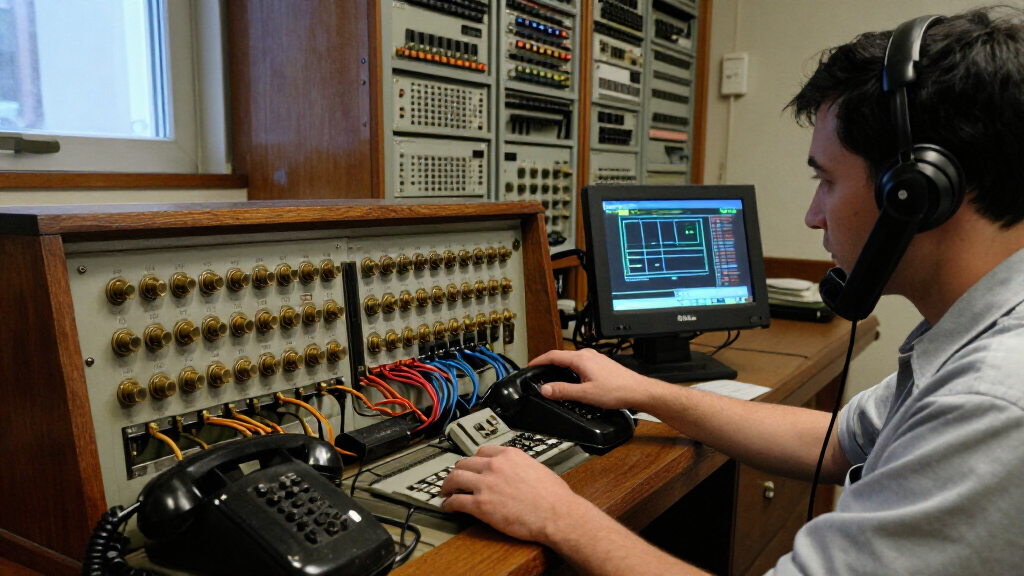

🔍 Read the full analysis: The Rise And Decline Of Telephone Operators In The AI Age on ThorstenMeyerAI.com

Prime made for students and young adults
- Fast, free delivery for dorm and study essentials
- Prime Video and Amazon Music included
- Member-only deals
TL;DR
A November 19, 2026, article from ThorstenMeyerAI.com revisits the shift from manual telephone switchboards to automatic dialing in the United States. It says young operators’ numbers fell sharply in cities after conversion, while younger women moved into other occupations; the account draws a parallel with women’s exposure to generative AI, not a direct forecast of job losses.
A November 19 article from ThorstenMeyerAI.com traces how automatic telephone exchanges displaced many U.S. switchboard operators and finds that young women’s employment did not fall overall as the dial spread. The account matters now because it compares that shift with generative AI’s exposure of clerical work, while cautioning that workers already in affected jobs often bore the heaviest costs.
The article reports that telephone operators made up roughly 2% of working women in the United States in 1920. Drawing on an estimate by economists James Feigenbaum and Daniel Gross, it says about 13.7% of white, American-born women born around 1900 worked as operators at some point between 1910 and 1940. The source emphasizes that the estimate excludes Black women, whom AT&T did not hire as operators until after 1940.
Automatic switching did not replace manual exchanges everywhere at once. Almon Strowger received a patent for an automatic telephone exchange in 1891; the Bell System began conversions in 1919. The source says 32% of Bell telephones were on dial by 1930 and 60% by 1940. Wartime copper restrictions slowed the work, and conversion across the Bell network continued until 1978.
According to the article’s account of the economists’ research, after a city changed to dial service, the number of young operators fell by 50% to 80%. Operators already in the job were less likely to be working a decade later, and those who remained employed more often held lower-paid work. Younger women, however, moved into roles such as typing, secretarial work and food service. These findings concern historical labor patterns; they do not establish what AI will do to employment.
Infographic 01 · Rise and fall
The switchboard job: 70 years up, half a century down
The dial arrived city by city from 1919. Yet the number of telephone operators kept growing until 1970, because calls, long distance and office switchboards grew too.
All telephone operators in the US census · thousands
Share of Bell System telephones on dial
Census counts: persons 14 and over, economically active (1950 in the 1950 classification); they include operators at private switchboards. After 1970: −75,000 telephone operator jobs in 1972-1980 (BLS), all of them held by women. 2025: wage and salary jobs (BLS survey), split into telephone operators (3,430) and switchboard operators incl. answering services (34,280). Definitions differ: compare orders of magnitude only.
Sources: US Census Bureau, Historical Statistics of the United States (1975), series D 351; J. Feigenbaum & D. P. Gross, Quarterly Journal of Economics 139(3), 2024 (AT&T archive data, 1930 count, 1 in 7 estimate); C. B. Leon, Monthly Labor Review (June 1982); BLS, Occupational Employment and Wage Statistics, May 2025.
Powered by Thorsten Meyer AI
What Switchboard Automation Shows
The history separates two outcomes that can be obscured by broad employment figures: the occupation can shrink sharply even when the wider employment of a demographic group does not. For individual operators, displacement and movement into lower-paid work could still mean a lasting loss, even as younger workers found jobs elsewhere.
The parallel offered by the article is relevant because the International Labour Organization ranks clerical work among the occupations most exposed to generative AI, with exposure in wealthy countries falling more heavily on women’s jobs than men’s, according to the source. Exposure is not the same as confirmed job elimination. The telephone case is a reminder to ask who bears adjustment costs, what replacement work is available and whether new roles offer comparable pay and prospects.
It also cautions against treating past adaptation as proof that future disruption will be painless. The historical account describes a labor market in which new roles absorbed younger women, but it also reports poorer outcomes for many incumbents. The source does not establish that AI will follow the same path or at the same speed.
Popular right now

Ninja Prestige Smart XL 10-in-1 Air Fryer and Countertop Oven with Pro Cook System, Stainless Steel, DT551

Ninja Kitchen System Blender and Food Processor with BlendSense Technology, 1800-Watt, 72 oz, Black (TB401)

Roborock Q7 M5+ Robot Vacuum and Mop with Self-Emptying Dock
As an affiliate, we earn on qualifying purchases.
From Manual Exchanges to Dial Service
The first telephone exchanges required operators to connect calls by inserting cords into switchboard jacks. The source says Bell opened an exchange in New Haven, Connecticut, in 1878, and that operators were initially boys and young men. Companies later hired mostly young women, describing expectations such as a high-school education, good hearing and a steady manner with customers. The work could offer better pay and social contact than factory jobs, while demanding rapid, sustained attention.
As the telephone network expanded, manual switching required more operators. The source counts about 182,000 telephone-industry operators in 1930, plus 23,000 at private switchboards in places such as hotels, hospitals and large businesses. Turnover was high: the article cites internal AT&T memoranda describing annual turnover of up to 40%.
Strowger’s 1891 patent described a system in which dialing sent pulses to switches that connected calls automatically. The source says AT&T experimented with the technology from 1902, but manual switching remained cheaper and more effective for some uses. City conversions took years to prepare, even though the final transfer of wires from a switchboard to a machine could take only minutes. The article also says a commonly repeated story about Strowger’s motive could not be confirmed in primary sources and should be treated as legend.
“Where did all those women go?”
— Thorsten Meyer, ThorstenMeyerAI.com
Limits of the Historical Parallel
The article presents telephone automation as a historical comparison, not evidence that AI will produce the same employment outcomes. The scale, pace and effects of generative AI adoption remain uncertain, as do the number and quality of jobs that may be created or changed. The source supplies no AI-specific forecast of net employment losses.
The operator estimate applies to white, American-born women born around 1900, and cannot describe the experience of all women workers. The source notes that AT&T did not hire Black operators until after 1940 but does not provide comparable estimates for Black workers or other excluded groups. Its summary also does not give detailed methods for every reported employment effect, so those findings should be understood as claims attributed to the cited historical research rather than as a complete account of every worker’s outcome.
Questions for AI and Work
The historical account does not announce a new policy, study release or scheduled milestone beyond its publication. Its next step is analytical: compare the experience of telephone operators with current evidence about which tasks generative AI affects, how employers deploy it and what happens to workers whose roles change.
For readers tracking the issue, the key evidence to watch is whether AI exposure leads to fewer positions, altered duties or new roles—and how those outcomes vary by occupation, gender, pay and career stage. The article’s central warning is narrower than a prediction: aggregate employment can conceal concentrated losses among workers already in the affected job.
Key Questions
When did automatic telephone switching begin?
Almon Strowger received a patent for an automatic exchange in 1891. The Bell System began converting exchanges in 1919, and the source says the process across its network continued until 1978.
How many women worked as telephone operators?
The article says operators were roughly 2% of U.S. working women in 1920. It cites an estimate that about 13.7% of white, American-born women born around 1900 worked as operators at some point from 1910 to 1940. That estimate does not cover all women.
Did automation reduce young women’s employment overall?
According to the article, young women’s employment did not fall overall as dial service spread. Younger women moved into jobs including typing, secretarial work and food service, while many operators already in the job had worse employment outcomes.
Does this history prove AI will eliminate clerical jobs?
No. The source uses telephone automation as a comparison, not as a forecast. It says clerical jobs are highly exposed to generative AI, but exposure does not by itself show that a job will disappear or establish the net effect on employment.
Source: ThorstenMeyerAI.com