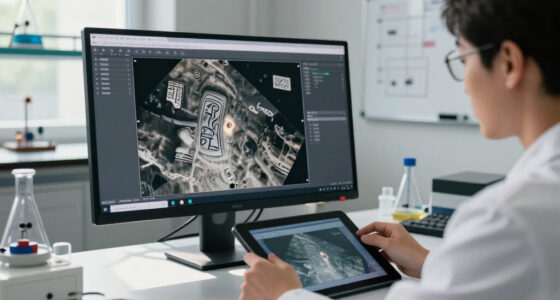

📊 Full opportunity report: Why Desktop Automation Benefits From Watch-Once Voice Commands on IdeaNavigator AI — validation score, market gap, and execution plan.

Prime made for students and young adults
- Fast, free delivery for dorm and study essentials
- Prime Video and Amazon Music included
- Member-only deals
TL;DR
Watch-once voice commands enable desktop automation by recording workflows with a single spoken instruction. This approach simplifies setup for power users, promising improved productivity and new market opportunities.
Watch-once spoken commands for desktop workflows are emerging as a promising tool for power users, allowing them to record a task once and replay it with a single voice command. This development addresses longstanding barriers in automation setup, such as scripting complexity and brittle hotkey apps, by enabling workflows to generalize after a single demonstration. The approach aims to make desktop automation more accessible and trustworthy for users who spend hours on repetitive tasks weekly.
According to sources familiar with the initiative, the concept involves users performing a workflow—such as batch renaming files, resizing images, or transferring data between applications—once while the system observes and records every step, including clicks, drags, and data inputs. After this initial demonstration, a spoken command can trigger the entire sequence, with the system visually replaying each step and pausing to confirm risky actions or allow user approval. If a step fails or encounters an error, the system offers rollback options, returning to the last safe checkpoint, thus increasing trustworthiness.
Developers see this as an evolution of existing automation tools, which often require scripting or hotkey setup that can be brittle and time-consuming. The new approach leverages advances in screen-understanding models that can generalize from a single demonstration, reducing setup friction significantly. The initial target market is power users—such as content creators, data analysts, and administrative professionals—who perform similar tasks repeatedly and could benefit from quick, reliable automation.
To validate this concept, a beta version is planned to handle five common workflow archetypes, including batch file renaming, report reformatting, and data transfer between applications. The goal is to measure weekly retention among approximately 200 early adopters, focusing on how well the system integrates into their routines and whether it reduces task completion time.
Why Watch-Once Voice Commands Transform Desktop Productivity
This innovation could significantly impact how power users approach repetitive desktop tasks, reducing setup time and increasing reliability compared to traditional scripting or hotkey-based automation. By enabling workflows to be recorded once and triggered with a natural language command, it lowers the barrier to automation adoption, especially for users who lack programming skills. The approach also promises to enhance trust in automation systems, as users can visually verify each step and intervene if necessary. Ultimately, this could lead to broader adoption of automation tools, freeing users from manual chores and allowing them to focus on higher-value work.
Furthermore, the market potential extends beyond individual professionals to teams and organizations seeking scalable, easy-to-maintain automation solutions. Subscription models targeting prosumers and team tiers for shared workflows could foster a new segment within productivity software, emphasizing accessibility and user trust. The success of early pilots may influence future development of desktop automation platforms, integrating watch-once voice commands as a core feature.
desktop automation voice command software
As an affiliate, we earn on qualifying purchases.
As an affiliate, we earn on qualifying purchases.
Background of Desktop Automation and Voice Command Advances
Desktop automation has traditionally relied on scripting languages, macro recorders, and hotkey configurations, which often require technical expertise and can be fragile when applications or workflows change. Recent advances in AI-driven screen understanding and pattern recognition have begun to address these limitations, enabling systems to observe and generalize user actions from a single demonstration. Voice command integration has also evolved, but most implementations require predefined commands or complex setup processes.
The current development builds on these trends, combining AI-powered workflow recognition with natural language interfaces. The concept of watch-once commands—where a workflow is recorded once and then triggered by a simple voice prompt—aims to make automation more intuitive and less brittle. Early prototypes have shown promise in handling common repetitive tasks, but large-scale validation and user testing are still underway.
As an affiliate, we earn on qualifying purchases.
Unconfirmed Aspects and Development Challenges
It is not yet clear how well the system will perform across diverse workflows or how reliably it will generalize in real-world scenarios with complex or variable tasks. The effectiveness of visual step verification and rollback features remains to be validated in broader user testing. Additionally, the extent to which this approach can replace traditional scripting and hotkey setups is still uncertain, as some workflows may require more precise control or customization.
workflow automation for power users
As an affiliate, we earn on qualifying purchases.
As an affiliate, we earn on qualifying purchases.
Upcoming Validation and Deployment Milestones
The development team plans to release a beta version handling five common workflow archetypes within the next few months. They will closely monitor user retention, task success rates, and user feedback to refine the system. If the beta demonstrates strong engagement and reliability, a wider rollout could follow, with integrations into existing productivity platforms and expanded workflow templates. Further research will also explore how well the system adapts to more complex or multi-step workflows.
voice activated file renaming software
As an affiliate, we earn on qualifying purchases.
As an affiliate, we earn on qualifying purchases.
Key Questions
How does watch-once voice command differ from traditional automation?
Traditional automation often requires scripting, hotkeys, or predefined commands, which can be brittle and complex to set up. Watch-once voice commands record a workflow in a single demonstration and then trigger it with a spoken prompt, simplifying setup and increasing flexibility.
What types of workflows can this system handle?
Initial targets include repetitive tasks like batch renaming, image resizing, report reformatting, and data transfer between applications. The system aims to generalize to other workflows as development progresses.
Will this replace scripting for advanced automation needs?
It is unlikely to fully replace scripting for highly customized or complex workflows, but it can serve as a powerful tool for non-technical users and quick automation of common tasks.
When will the beta version be available?
The beta handling five common workflow archetypes is planned for release within the next few months, with ongoing user testing and refinement.
What are the main benefits for users?
Users will benefit from faster setup, easier automation, visual verification of steps, and increased trust in the system’s reliability, all without scripting or complex configuration.
Source: IdeaNavigator AI
Halloween Picks
halloween
As an affiliate, we earn on qualifying purchases.