📊 Full opportunity report: What Your Workflow Reveals About Automation Readiness on IdeaNavigator AI — validation score, market gap, and execution plan.

Prime made for students and young adults
- Fast, free delivery for dorm and study essentials
- Prime Video and Amazon Music included
- Member-only deals
TL;DR
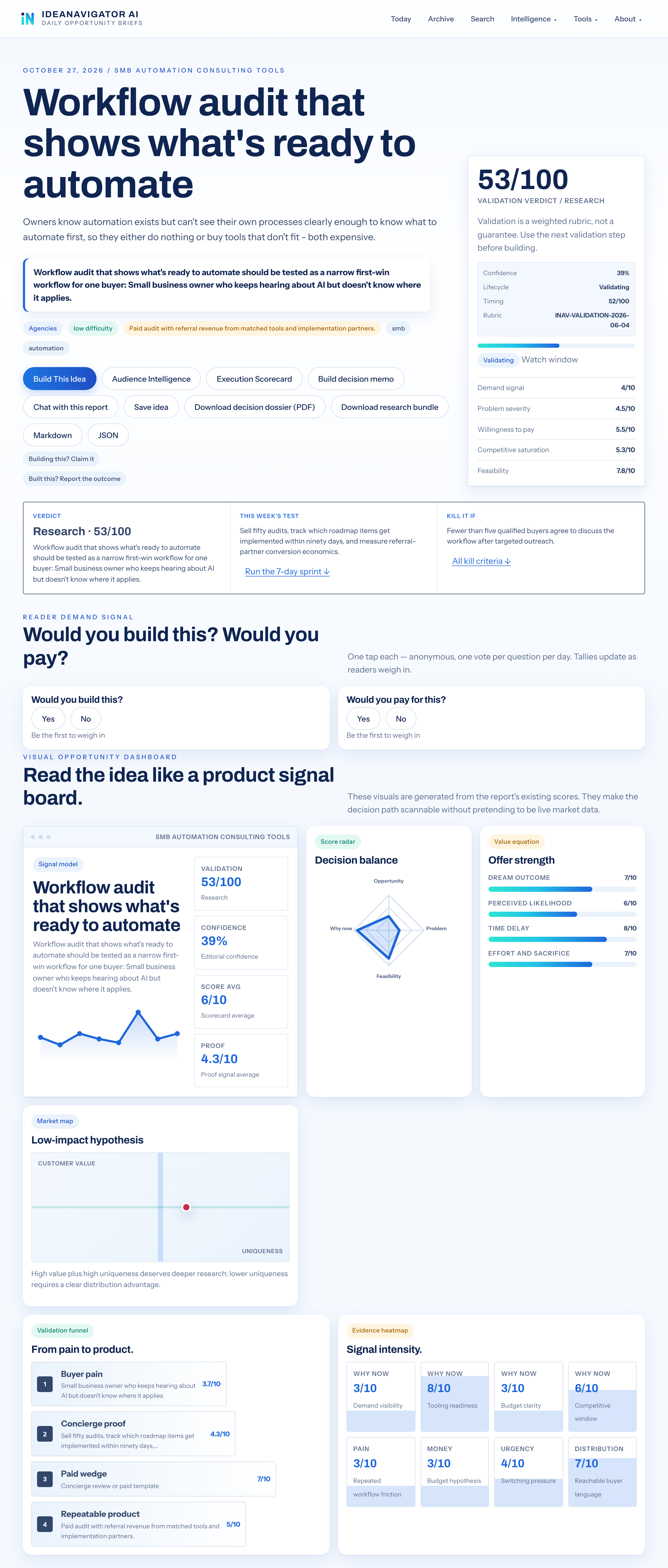
IdeaNavigator AI has outlined a proposed workflow-audit service to help small-business owners identify which processes may be suitable for automation. The concept includes a guided interview, readiness and ROI scores, and a 90-day roadmap, but there is no evidence yet that the service has launched or that customers will implement its recommendations.
IdeaNavigator AI’s proposal describes a workflow-audit service to help small-business owners decide which tasks may be suitable for automation, with a guided operations interview, ranked recommendations and a 90-day implementation roadmap. The proposal presents a business concept to validate, not a launched product or proven service, and reports no results showing whether owners would buy an audit or act on its recommendations.
In its proposal, IdeaNavigator AI targets small-business owners who hear about AI and automation but are unsure where either applies to their operations. The proposal’s premise is that owners may lack a clear view of their own processes, making it difficult to choose a first task to automate. It says that uncertainty can lead either to inaction or to spending on tools that do not fit the business.
For an initial product, IdeaNavigator AI suggests a guided interview about how a business operates. The resulting process map would score tasks for automation readiness, potential return on investment and difficulty, then place possible projects into a sequenced 90-day roadmap, drawing on AI automation readiness considerations. The service would also suggest AI workflow automation tools for individual steps. These features are proposed; the available description does not document a working product, scoring method, or tool-matching system.
The proposal suggests a business model combining a paid audit with referral revenue from recommended software tools and implementation partners. To test demand, it calls for selling 50 audits, tracking which roadmap items customers implement within 90 days, and measuring conversion economics for referral partners. The proposal does not report that these sales or measurements have taken place.
Workflow audit · Concept stage
What Your Workflow Reveals About Automation Readiness
IdeaNavigator AI proposes a guided audit that maps small-business operations, ranks possible automation projects and lays out a 90-day roadmap. The service is a concept to validate; no launch or customer results are reported.
01 / Proposed service
Turn operational uncertainty into a ranked starting point
The premise: owners may hear about automation without knowing which task fits their business. IdeaNavigator AI would map existing work before suggesting tools.
Guided interview
Collect details on how the business operates and where time, effort or handoffs accumulate.
Ranked opportunities
Score candidate tasks for readiness, potential return on investment and implementation difficulty.
90-day roadmap
Sequence possible projects and suggest AI workflow tools for individual steps.
02 / What a score would need
Useful recommendations depend on the details behind the numbers
These are proposed scoring dimensions, not published scores. No calculation method or tested scoring system is described.
A process map can make planning concrete, especially for a firm without dedicated operations or technology staff. But a readiness score or ROI estimate is only useful if its assumptions reflect the owner’s actual workflow.
Costs, current software, staff capacity, integration needs, exceptions and operational risks can change whether a task is a sensible candidate. The proposal does not explain how these factors would be measured or weighed.
Tracking implementation over 90 days could offer a stronger signal than interest alone. The outline does not define implementation or explain how resulting business value would be measured.
Proposed assessment lenses
Illustrative dimensions only. No scores, formula, customer data or validated estimates are supplied.
03 / Proposed customer journey
From AI interest to a testable workflow plan
The concept puts process mapping before product selection, aiming to connect a real business task with a suitably scoped tool.
Interview the owner about operations and current processes.
Document tasks, handoffs and possible bottlenecks.
Rank candidate projects by readiness, return and effort.
Suggest tools and sequence work across 90 days.
Every step is part of the proposal. The available description does not document a working product, interview format or tool-matching system.
04 / Validation plan
A 50-audit test is proposed, with outcomes still unknown
Audits to sell, according to the proposal
The suggested test would follow customers’ roadmap actions over the next 90 days and assess whether referrals to software or implementation partners convert into revenue.
No trial dates, audit price, success threshold or results are reported. A useful evaluation would also explain what prevented customers from acting and whether changes produced measurable value.
05 / Open questions
Demand, accuracy and incentives remain untested
The proposal describes a business hypothesis, but provides no market research, competitor analysis, pricing or operating-cost estimates.
Will owners buy?
No customer research, launch status, pricing or evidence of willingness to pay is provided.
Can scores be trusted?
Methods, supporting data, exception handling and treatment of sensitive business information are unspecified.
How are tools matched?
Referral income may shape recommendations. Partner terms and disclosure practices are not described.
Key questions
What the proposal does—and does not—establish
What is the proposed workflow audit?
An owner interview, process map, ranked automation opportunities and a sequenced roadmap with suggested tools.
Is the audit available now?
The proposal does not establish that a product has launched or that customers can buy it. Current status and launch plans are unspecified.
How would the service make money?
The suggested model combines paid audits with referral revenue from software tools and implementation partners. Prices and partner terms are absent.
How would the concept be tested?
Sell 50 audits, track roadmap implementation within 90 days and measure referral conversion economics. No schedule or results are reported.
Testing Automation Advice With Buyers
IdeaNavigator AI’s proposal focuses on a practical barrier to business automation: choosing a useful first project rather than simply selecting a tool. If an audit can reliably connect an owner’s day-to-day processes with feasible, appropriately scoped recommendations, it could make planning more concrete. That possibility is particularly relevant to firms without staff dedicated to process improvement or technology selection.
But the concept’s value depends on more than producing a process map. Recommendations would need to reflect each business’s costs, existing software, staff capacity and operational risks. A readiness score or estimated return could create false confidence if its assumptions are not transparent or grounded in the owner’s actual workflow. The proposal’s suggested test of implementation within 90 days would offer a more practical signal than interest alone, although the outline does not specify how implementation or business benefit would be measured.
The referral model described in the proposal also raises a question for buyers: whether suggested tools are matched to their needs or influenced by the possibility of referral income. Clear disclosure and a distinction between independent recommendations and paid referrals would matter if the service is developed.
Popular right now

Dyson Car+Boat Cordless Handheld Vacuum

Ninja Flip Toaster Oven and Air Fryer, 8-in-1, Stainless Steel, SP151

Dyson Ball Animal 2 Plus Corded Vacuum
As an affiliate, we earn on qualifying purchases.
From AI Interest to Process Mapping
IdeaNavigator AI presents the concept against a backdrop of expanding AI and automation options. The company’s proposal argues that the range of available tools can leave small-business owners uncertain about where to start. Its proposed response is to map existing work first, then identify possible uses for tools, rather than begin with a product and search for a task to apply it to.
That approach is a product hypothesis, not evidence that the wider market has a specific level of unmet demand. IdeaNavigator AI names the market as small-business automation consulting tools but supplies no market-size estimate, customer research, competitor analysis, pricing, or operating costs. Its description also does not say which types of businesses or workflows would be included in an initial test.
The suggested 50-audit trial is therefore a proposed validation step, not a reported experiment. IdeaNavigator AI says it would test whether owners will pay, whether they follow the resulting roadmap, and whether referrals can generate viable partner economics. The proposal provides no timeline, audit price, or threshold for interpreting the results.
Demand, Accuracy and Results
IdeaNavigator AI reports no customer results. Its proposal does not establish whether the audit has been built, whether any small businesses have tested it, or whether the proposed 50-audit experiment has begun. The description provides no launch date, price, interview format, or evidence that owners would pay for this kind of assessment.
The proposal does not specify the scoring system. It gives no information about how readiness, ROI or difficulty would be calculated, what data would support estimates, or how recommendations would account for exceptions and sensitive business information. It also does not say how the service would handle tasks that require human judgment, integration work, or changes to staff responsibilities.
Finally, referral economics and implementation outcomes remain unknown. IdeaNavigator AI’s description identifies no partner terms, existing tool relationships, or definition of what counts as a roadmap item being implemented. Without those details, it is not possible to assess the service’s likely accuracy, financial viability or effect on customers.
A 50-Audit Market Test
The next step described in IdeaNavigator AI’s proposal is to sell 50 audits and follow customers’ roadmaps over the subsequent 90 days. The proposed test would track which recommended items are implemented and assess whether referrals to tools or implementation partners convert into revenue. The proposal announces no dates for the trial.
Useful results would need to show more than completed interviews or tool clicks: they would clarify how many customers act on recommendations, what prevents action, and whether the changes produce measurable value. Pricing, the criteria used to score workflows, and disclosures around referrals would also help readers judge the offer if it reaches customers. Until those details and results are available, the audit remains a proposed business idea rather than a demonstrated solution.
Source: IdeaNavigator AI proposal
Key Questions
What is the proposed workflow audit?
According to IdeaNavigator AI’s proposal, it would interview a small-business owner about operations, map processes, score possible automation projects and provide a sequenced roadmap with suggested tools.
Is the audit available now?
IdeaNavigator AI’s proposal does not establish that a product has launched or that customers can buy it. Its current status and any launch plans are not specified.
How would the service make money?
The proposal suggests combining customer payments for audits with referral revenue from matched software tools and implementation partners. It gives no prices or partner terms.
How does IdeaNavigator AI propose to test the concept?
The proposal says the validation would involve selling 50 audits, tracking which recommended roadmap items customers implement within 90 days, and measuring referral-partner conversion economics. It reports no results or trial schedule.
Source: IdeaNavigator AI