
📊 Full opportunity report: Quiet GPUs for Local AI: Acoustic and Thermal Roundup on ThorstenMeyerAI.com — validation score, market gap, and execution plan.

Get school and study supplies delivered free — and shop member deals
- Fast, free delivery on millions of items
- Access to Prime Big Deal Days deals on October 6–7
- Prime Video, Amazon Music and more included
TL;DR
In 2026, the RTX 5090 is the top choice for quiet, high-performance local AI, with power-capping and cooling design key to reducing noise and heat. Other options include the RTX 4090 and 5080 for budget and efficiency, respectively.
The RTX 5090 emerges as the quietest high-performance GPU for local AI in 2026, thanks to effective power management and cooling options, despite its high thermal output.
The RTX 5090 with 32GB of GDDR7 memory is considered the best consumer GPU for local AI, capable of running 70B models at Q4 quantization without offloading. Its 575W TDP can be significantly reduced through undervolting and power capping to approximately 70%, which results in lower heat and noise levels. Partner cards with large triple-fan open-air coolers and zero-RPM idle modes are recommended for maintaining quiet operation under sustained loads.
Other notable options include the RTX 4090 and used RTX 3090, both with 24GB VRAM, offering reliable performance at lower power and heat. The RTX 5080 and RTX 4060 Ti 16GB are highlighted as efficient, low-power choices suitable for smaller models in the 7–34B range, emphasizing their thermal and acoustic advantages. The RTX PRO 6000 Blackwell with 96GB VRAM targets professional workloads, providing ample memory for large models but with a focus on thermal management.
Quiet GPUs
for local AI.
The GPU makes ~70% of your heat and most of your noise. But here’s the secret: the chip doesn’t decide how loud your card is — the cooler design and your power settings do. Match your VRAM tier in Part 2, then make it quiet.
Capping to 70–80% sheds a huge amount of heat for almost no inference loss — because inference is memory-bound. A capped 5090 is dramatically cooler & quieter than stock. Do this first.
Within one GPU model, partner cards differ enormously. For a single card, a large triple-fan open-air with zero-RPM idle runs slow & quiet. For multi-GPU, the calculus flips →
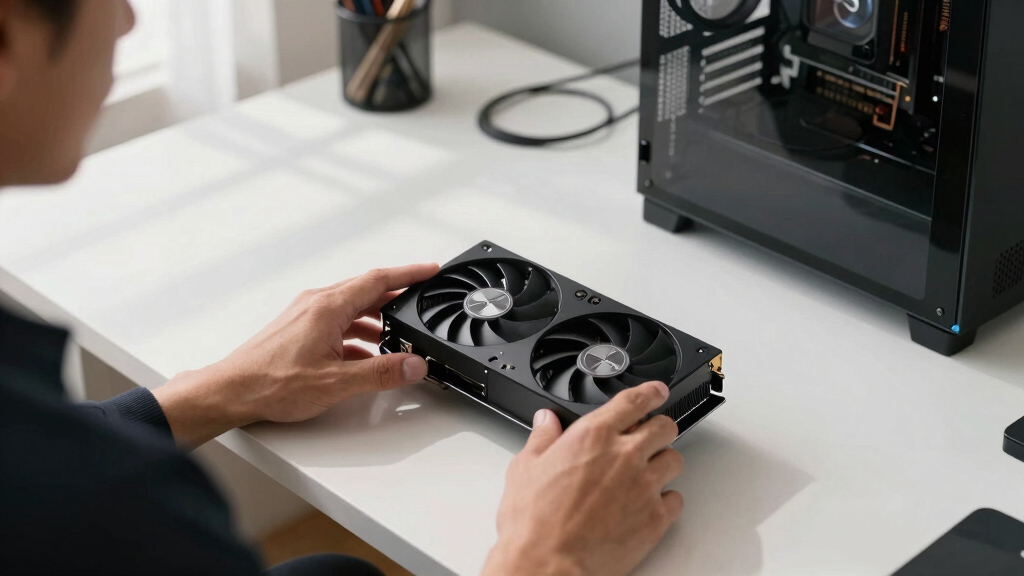
With room to breathe, a large triple-fan open-air cooler spreads heat across a big fin stack and runs its fans slowly. The quietest choice — what most people should buy.
Impact of Cooler Design and Power Management on GPU Noise
The ability to run high-performance GPUs quietly is crucial for local AI setups, especially in office or home environments. Power-capping and high-quality cooling solutions can transform otherwise loud and hot cards into near-silent, manageable components, expanding the practicality of deploying advanced AI models on consumer hardware. This development emphasizes that cooling design and power settings are more influential on noise and heat than the silicon itself, affecting user choices and system design.
As an affiliate, we earn on qualifying purchases.
2026 GPU Landscape and Noise-Reduction Strategies
The GPU market in 2026 is characterized by a focus on VRAM capacity, efficiency, and thermal management. The rise of power-capping techniques and cooler designs from partner manufacturers has made it possible to operate high-end GPUs with significantly reduced noise levels. Historically, GPUs have been the loudest component in AI rigs, but recent advancements aim to mitigate this issue through better cooling and thermal management, making high-performance local AI more accessible and practical.
"A well-chosen triple-fan cooler with zero-RPM idle mode can make even high-TDP cards like the RTX 5090 run quietly under load."
— A cooling solutions engineer
GPU cooling solutions for AI workloads
As an affiliate, we earn on qualifying purchases.
As an affiliate, we earn on qualifying purchases.
Remaining Uncertainties in Noise Optimization Techniques
It is still unclear how widespread and consistent the performance of power-capped, cooled GPU variants will be across different brands and models. Long-term reliability and real-world noise levels under continuous load require further testing and user feedback. Additionally, the availability and pricing of optimized partner cards may vary, affecting adoption.
As an affiliate, we earn on qualifying purchases.
Future Developments in Quiet GPU Design and AI Deployment
Expect ongoing innovations in cooling technology, power management, and GPU architecture aimed at further reducing noise and heat. Manufacturers are likely to release new models with integrated quieter cooling solutions and more efficient power capping features. Monitoring real-world performance and user experiences will determine how these advancements influence mainstream local AI setups in 2026 and beyond.
GPU power capping and undervolting tools
As an affiliate, we earn on qualifying purchases.
As an affiliate, we earn on qualifying purchases.
Key Questions
Can I make any high-power GPU run quietly?
Yes, by undervolting, power-capping, and choosing a partner card with an effective cooling solution, most high-TDP GPUs can be operated quietly under sustained load.
Is the RTX 5090 suitable for home or office environments?
With proper cooling and power management, the RTX 5090 can operate quietly enough for home or office use, despite its high thermal output in stock form.
Are there trade-offs between noise and performance?
Power-capping and undervolting can slightly reduce peak performance, but for inference workloads, the impact is often minimal while significantly improving noise and thermal characteristics.
Will future GPUs be quieter by design?
It is likely that future GPU models will incorporate more advanced cooling and power management features aimed at reducing noise, driven by user demand and technological progress.
How important is VRAM size compared to acoustics?
VRAM size is the primary factor for model capacity; acoustic and thermal performance depend more on cooling design and power settings. Both are essential for optimal local AI operation.
Source: ThorstenMeyerAI.com
Halloween Picks
halloween
As an affiliate, we earn on qualifying purchases.