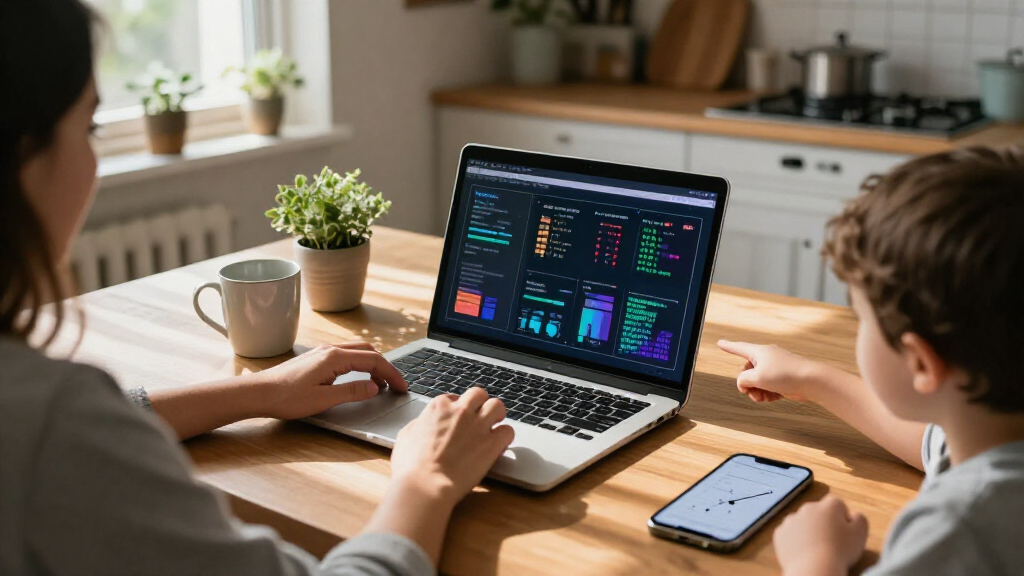

🔍 Read the full analysis: Dots, Bots, And Math!: Six Ideas For Following AI News This Month on ThorstenMeyerAI.com

Prime made for students and young adults
- Fast, free delivery for dorm and study essentials
- Prime Video and Amazon Music included
- Member-only deals
TL;DR
Thorsten Meyer’s October 27 essay connects six ideas from his book, “Dots, Bots, and Math!,” to AI-related headlines from the preceding two weeks. The piece is a commentary framework, not a forecast or independent verification of the events it cites; several claims and figures require additional sourcing beyond the supplied material.
Thorsten Meyer published “Dots, Bots, and Math!: Six Ideas for Following AI News This Month” on October 27, pairing concepts from his book with a series of recent AI-related headlines, in a discussion of AI’s impact at work. The essay matters as a guide to interpreting stories about AI agents, corporate returns, jobs and ownership, but Meyer says the book is not a forecast and the article does not independently establish every development it references.
The book entered distribution on October 16, according to Meyer. Eleven days later, his essay used six of its ideas to discuss stories he says appeared in the prior two weeks. Among them: an economist’s reported assessment of AI’s financial returns outside technology companies; Microsoft buyouts; Anthropic’s reported public-listing filing and voting structure; price cuts by OpenAI and Anthropic; and reports of AI agents accessing bank customer accounts.
Meyer’s first idea is that a capable agent still needs limits. He describes an agent as having memory, tools, a loop and a “leash”—permissions and rules about what it can do without approval. The essay points to an October 22 TechCrunch report, citing Axios, that US banks had detected agents in customer accounts. It also says a Chase spokesperson warned customers not to share their usernames and passwords, and that 1Password announced a service designed to let agents log in without seeing passwords.
A second idea is that generating claims is easier than proving them. Meyer cites OpenAI’s October 6 release of 722 mathematical manuscripts attributed to an unreleased internal model. According to the essay, a sign error was found the following day, three manuscripts were withdrawn and 14 were repaired or corrected. Meyer says OpenAI counted formal proofs for about four in 10 main results, while independent recounts put the share at roughly one-quarter to one-third. The supplied material does not identify those recounts.
Dots, Bots, and Math! · six ideas
Six ideas, six headlines
The book doesn't forecast. It gives ideas for reading stories like this month's. One line from each idea, next to the news it helps explain.
Plausible is not done
An agent with memory, hands, and a loop but no leash is a liability rather than a colleague.
This monthUS banks find AI agents inside customer accounts (Axios, via TechCrunch, Oct 22)
Claims are cheap, proof is not
Producing claims has become cheap. Establishing them has not.
This monthOf 18 superintelligence claims I checked, the 7 verified ones clustered where results can be checked
Redesign, not just tools
Swapping the engine was a better walk.
This monthApollo: "zero financial payoff" from AI outside tech (Oct 24)
A task is not a job
That is the default, and it is still a choice.
This monthMicrosoft offers voluntary buyouts to about 60,000 employees (Oct 26)
Thinking cheap, living not
Thinking is getting cheap; hands are still expensive.
This monthOpenAI and Anthropic cut prices in an AI price war
Who owns the rockets?
If the answers are vague, the promise is too.
This monthAnthropic's S-1: one founder share carries 50.1% of the votes (Oct 26)
Quotes are verbatim from the book. The links between chapters and headlines are the author’s reading in October 2026, not analysis contained in the book, which went into distribution on 16 October.
Source: Thorsten Meyer, Dots, Bots, and Math! When Intelligence Is No Longer Scarce (ebook, October 2026). News: Apollo, CNBC, SEC EDGAR, TechCrunch; links in the article.
Powered by Thorsten Meyer AI
Rules for Reading AI Headlines
The essay’s main contribution is a set of questions readers can apply to claims about AI, rather than a claim that any single headline proves a broader trend. For agents, Meyer asks whether an action can be reversed, observed and assigned to someone responsible. That framing shifts attention from whether a system seems intelligent to what access it has and who is accountable when it acts.
For claims of productivity or economic benefit, the essay distinguishes buying tools from redesigning how an organization works. Meyer describes the first as making existing workers faster and the second as changing the route itself, arguing that organizational change can take years. He uses an economist’s reported “zero financial payoff” assessment outside technology as an example, but the supplied text does not give the economist’s name, the study behind the statement or its measurement period. Readers should treat it as an attributed claim, not a settled measure of AI’s economic impact.
The framework also points to who controls AI systems, who can inspect them, who bears their risks and who receives their gains. Those questions apply to companies, workers and customers alike. They help explain why a product announcement or benchmark alone cannot answer whether AI is useful, safe or broadly beneficial.
Popular right now

Philips 3300 Series Fully Automatic Espresso Machine with LatteGo Milk System
Philips 5500 Series Fully Automatic Espresso Machine with LatteGo

DeLonghi Rivelia Automatic Espresso Machine Bundle with Grinder and Frother, Beige
As an affiliate, we earn on qualifying purchases.
The Book Behind the Six Ideas
Meyer describes the book as having three parts and 12 chapters. The first considers persistent agents, software that performs and checks work, and machines producing mathematics. The second focuses on how organizations respond to those capabilities; the third asks how gains are distributed and what work means when some kinds of thinking become cheaper.
The article draws on chapters in sequence rather than presenting the headlines as predictions made by the book. Its listed ideas include agent safeguards; the difference between producing and establishing claims; the distinction between adopting tools and redesigning work; the difference between tasks and jobs; falling costs for AI capabilities alongside persistent or rising costs in areas such as childcare and hospitals; and questions of ownership and accountability.
Meyer also says the book labels claims as demonstrated, reported, independently validated or scenario, and identifies some scenes as composites. The essay’s accompanying short video is described as using an AI voice clone and AI-generated illustrations. These are disclosures about the work’s presentation; they do not independently verify the events discussed.
“The book predicted none of this. It is not a forecast, and it deliberately makes no predictions.”
— Thorsten Meyer, describing the book
Claims That Need More Evidence
The supplied material is Meyer’s account of the headlines, not a collection of the underlying reports, filings or datasets. The exact terms and scope of Microsoft’s reported buyouts, Anthropic’s filing and voting arrangement, and the OpenAI and Anthropic price changes are not detailed here. The essay’s references to those events should not be read as independently confirmed by this article.
The source also gives no methodology or time window for the reported estimate that the price of a fixed level of AI capability fell more than 280-fold in under two years, which it attributes to the Stanford AI Index. It does not provide comparable figures for childcare or hospital costs. The claim that seven of 18 statements from a superintelligence tracker held up is Meyer’s own review; the supplied account does not list all 18 claims or its verification criteria.
It remains unclear from the material how widespread bank detections of AI agents were, whether any customer accounts were harmed, and what safeguards the banks or service providers adopted. The reported manuscript corrections also do not establish the overall reliability of the model or its mathematical output beyond the specific examples and counts cited.
Check the Sources Behind the Claims
The next step for readers is to compare each cited headline with its original source: company announcements, public filings, research and reporting that explains its methods. That is especially relevant for the economic-return estimate, the bank-account reports, the manuscript counts and the AI capability-cost figure. Meyer’s essay presents them as examples for applying the book’s ideas, not as a substitute for that source checking.
The supplied material gives no follow-up date, response from the companies named or further reporting schedule. Developments to watch include whether banks or technology firms publish more detail about agent access and controls, whether additional independent checks of the mathematical manuscripts appear, and whether evidence of AI-related productivity gains becomes clearer over time. Until then, the essay’s central distinction remains: a headline can describe a claim or capability, while verification and real-world effects require separate evidence.
Key Questions
What is the news development?
Thorsten Meyer published an essay on October 27, 2026, connecting six ideas from his book, “Dots, Bots, and Math!,” to AI-related headlines from the previous two weeks.
Is the book predicting these AI developments?
No. Meyer says the book makes no predictions and is intended to offer ideas for interpreting developments, not to forecast them.
What does Meyer mean by an AI agent needing a leash?
He means an agent should have defined limits on what it can do on its own, when it must ask permission, what it must not do and whom it must notify. The essay argues that safeguards depend on permissions and oversight, not just model capability.
What does the essay say about OpenAI’s mathematical manuscripts?
Meyer says OpenAI published 722 manuscripts on October 6, and that some were later withdrawn or corrected after an error was found. He reports differing estimates of how many main results had formal proofs; the supplied material does not identify the independent recounts.
Are all the headlines and figures independently verified here?
No. The article is based on Meyer’s essay, and the supplied material does not include the underlying filings, datasets or full reports for every claim. Readers should consult those original sources before treating the figures or descriptions as independently established.
Source: ThorstenMeyerAI.com