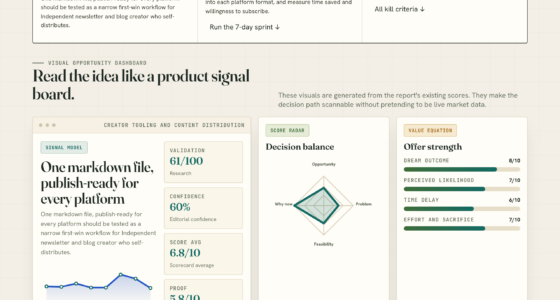

📊 Full opportunity report: AI's Hidden Value: Preventing A $425 Billion Signal Drain on ThorstenMeyerAI.com — validation score, market gap, and execution plan.
TL;DR
Google’s delay in launching its flagship Gemini 3.5 Pro AI model has resulted in a $425 billion decline in market value. The delay is linked to internal development challenges, affecting investor trust and competitive positioning.
Google’s Gemini 3.5 Pro AI model has not launched as scheduled, leading to a $425 billion decline in market capitalization over the past month.
This delay, confirmed by multiple reports, underscores the challenges faced by Google in delivering its flagship AI on time, which has shaken investor confidence and affected the company’s market value.
On May 19, 2026, Google announced at I/O that Gemini 3.5 Pro would be available in June 2026. However, as of mid-July, the model remains unreleased, with internal sources indicating it is months behind schedule due to difficulties in enhancing coding capabilities and reliability issues, including hallucination rates.
Bloomberg reported on July 16, citing anonymous current and former Google employees, that the team is reworking the model from scratch after discarding a near-ready version. Google has not publicly confirmed these claims. Meanwhile, the company has released Gemini 3.5 Flash, a lower-tier model, which is publicly available and competitive in some benchmarks.
The market reacted sharply: Alphabet’s stock fell 4.4% the day after Bloomberg’s report, equating to roughly $200 billion in lost value, following a prior $225 billion decline linked to DeepMind researcher departures. This combined loss of approximately $425 billion highlights the market’s sensitivity to delays in flagship AI development, despite strong financials in other areas like Google Cloud and advertising.
The cost of absence
now has a number: ~$425B.
Gemini 3.5 Pro has missed three deadlines since Google I/O. Bloomberg (Jul 16, ten sources): months behind, coding the sticking point. The market’s verdict came in two selloffs — with zero change to reported fundamentals.
Two selloffs, one story
That’s what absence costs when a market prices it: not countable lost deals — a repricing of whether the company still sets the pace.
Three deadlines, zero launches
Rebuild, hallucination, and stopgap-Flash details rest on third-party reporting Google has not confirmed — labeled accordingly.
Contracts sign on schedules, not roadmaps. Pressure from above (shipped flagships) and below (monthly open-weight cadence): the floor rises whether or not the ceiling does.
- Holding may be right: if the reliability reporting is even directionally true, shipping broken costs more than shipping late. Restarting a failed model is judgment, not weakness.
- Narrative cuts both ways: $425B evaporated on story; Google’s distribution didn’t shrink. A strong launch restores on story too.
- Watch what shipped: Gemini Flash-class models are out — and topping at least one independent document-parsing leaderboard. Small-and-available beating large-and-promised is this week’s thesis wearing a Google badge.

Yahboom K230 AI Development Board 1.6GHz High-performance chip/2.4-inch Display/Open Source Robot Maker Python, Supports AI Visual Recognition CanMV Sensor (with Heightened Bracket)
【Flagship performance, extremely fast response】Equipped with a 1.6GHz main frequency chip, the KPU computing power is 13.7 times…
As an affiliate, we earn on qualifying purchases.
As an affiliate, we earn on qualifying purchases.
Market Impact of AI Development Delays
The delay of Google’s flagship AI model illustrates how development setbacks can significantly influence investor confidence and company valuation, even when financial fundamentals remain strong. The $425 billion loss demonstrates that market perception of AI leadership is a critical asset, and delays can cause substantial revaluations, affecting future investments and competitive positioning.

Intended for A-26410044-AI Repair KIT Parts 259-175
Intended for A-26410044-AI REPAIR KIT DESCRIPTION One AftermarGasket REPAIR KIT Parts 259-175
As an affiliate, we earn on qualifying purchases.
As an affiliate, we earn on qualifying purchases.
Recent AI Development Challenges at Google
Google announced Gemini 3.5 Pro at I/O in May, with a planned June release. However, reports from Bloomberg and other outlets now indicate that the project has faced substantial delays, primarily due to difficulties in improving coding capabilities and reliability issues like hallucinations. The internal effort to rebuild the model from scratch, as reported, has not been officially confirmed by Google. Meanwhile, competitors like GPT-5.6 Sol and Grok 4.5 launched publicly in early July, adding pressure on Google to catch up in the AI race.
This development occurs amid a broader context of rapid AI model releases, with multiple labs shipping new models monthly, and a market increasingly valuing AI leadership as a key driver of growth and competitive advantage.
“The model is months behind schedule, primarily over efforts to improve its coding capabilities, and a late-June training-data update produced disappointing results.”
— Bloomberg, Julia Love and Davey Alba

Coding with AI For Dummies (For Dummies: Learning Made Easy)
As an affiliate, we earn on qualifying purchases.
As an affiliate, we earn on qualifying purchases.
Unconfirmed Details About Gemini 3.5 Pro Development
It remains unclear whether Google has completely abandoned the original Gemini 3.5 Pro design, is actively rebuilding from scratch, or is facing other undisclosed technical challenges. Specific specs, such as the 2-million-token context window, pricing, and exact timelines, have not been officially confirmed by Google or independent sources. The extent of reliability issues and whether the model will meet revised release targets also remains uncertain.

OBD2 Scanner Reader for iOS & Android, Ai Diagnostic Tool for Car Buying & Repairs, No Subscription Fee, Lifetime Free Updates, Check & Clear Engine Codes, Real-Time Data, All 1996+
Comprehensive Performance Testing: OBD2 Scanner provides a complete diagnostic solution, giving you a thorough understanding of your vehicle's…
As an affiliate, we earn on qualifying purchases.
As an affiliate, we earn on qualifying purchases.
Next Steps for Google’s AI Model Rollout
Google is expected to provide an official update on Gemini 3.5 Pro’s development timeline in the coming months. Meanwhile, competitors continue to ship and improve their models, increasing pressure on Google to re-establish leadership. The company may also focus on releasing the lower-tier Gemini 3.5 Flash or other interim solutions to maintain market presence while addressing internal challenges. The next few quarters will likely reveal how the delay impacts Google’s strategic positioning in AI.
Key Questions
Why did Google delay the Gemini 3.5 Pro launch?
According to reports, the delay is due to internal challenges in improving the model’s coding capabilities and reliability, including high hallucination rates. Google has not officially confirmed these reasons but is reportedly rebuilding the model from scratch.
How much market value has Google lost due to the delay?
Google’s market capitalization has decreased by approximately $425 billion over the past month, primarily driven by investor concerns over the delayed flagship AI model.
Will Google release a lower-tier model in the meantime?
Yes, Google has released Gemini 3.5 Flash, a more limited model that is publicly available and shows competitive performance in some benchmarks, serving as an interim solution.
What are the implications for Google’s AI leadership?
The delay puts Google behind competitors like OpenAI and Anthropic, who have launched new models recently. Maintaining AI leadership now depends on how quickly Google can resolve its development issues and deliver a flagship product.
Source: ThorstenMeyerAI.com