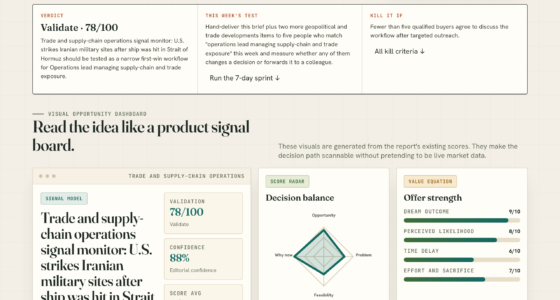
📊 Full opportunity report: The AI Strategy Behind Ukraine’s Digital Resistance To Russia’s Amazon on ThorstenMeyerAI.com — validation score, market gap, and execution plan.
TL;DR
Ukraine has developed a digital and AI-enabled strategy to weaken Russia’s logistics and military supply networks by attacking key e-commerce hubs like Wildberries. This approach aims to hinder Russian military procurement and damage the civilian economy, marking a new phase in cyber and economic warfare.
Ukraine has launched a systematic digital campaign targeting Russia’s largest online marketplace, Wildberries, and its logistics network, using sophisticated AI and cyber tactics to disrupt supply chains and hinder military procurement. This strategy marks a significant evolution in Ukraine’s hybrid warfare approach, aiming to weaken Russia’s economic and military infrastructure from within.
Since July 18, Ukraine has conducted near-nightly drone strikes on Wildberries logistics facilities across Russia, damaging or destroying over 1.18 million square meters of warehouse space, according to satellite imagery reviewed by Reuters. These strikes are not merely targeting commercial warehouses but are aimed at the broader network that connects Russian soldiers, volunteer groups, and civilian merchants, facilitating the acquisition of military equipment outside official channels.
Wildberries functions as a decentralized supply system, enabling individual soldiers and volunteers to purchase tactical gear, drones, and electronic components directly from the platform, bypassing traditional military procurement. The platform’s extensive catalog includes items like body armor, FPV drones, and fibre-optic cables, which are crucial for modern battlefield technology such as fibre-guided drones resistant to electronic warfare. Ukraine’s targeted strikes aim to disrupt the availability and logistics of these components, making procurement more difficult and costly.
Additionally, the campaign impacts Russia’s civilian economy. Wildberries handles goods worth approximately 3% of Russia’s total economic output, with thousands of independent sellers relying on its platform. Damage to warehouses results in significant financial losses for these merchants, with inventory, seasonal stock, and logistics infrastructure all affected, thereby creating economic friction that extends beyond military logistics.
Since 18 July, Ukrainian drones have hit ~20 Wildberries logistics sites. It looks like an odd target — until you see that one strike can hit three systems at once: the battlefield supply chain, the civilian economy, and the banks.
Wildberries is a consumer marketplace, a national logistics network, a decentralised military-supply channel, and an increasingly important node in Russia’s banking system. Hit a warehouse and the cost propagates outward.
Implications of Ukraine’s Digital Disruption Strategy
This strategy demonstrates a shift towards using cyber and AI-enabled tactics to target the logistical and economic foundations of Russia’s war effort. By attacking decentralized supply hubs and critical components like fibre-optic cables, Ukraine aims to increase procurement costs, delay military supplies, and weaken Russia’s economic resilience. The approach signifies a new phase of hybrid warfare where digital infrastructure and civilian commerce are integral to military success, potentially setting a precedent for future conflicts.
As an affiliate, we earn on qualifying purchases.
Background of Ukraine’s Digital and Cyber Warfare Tactics
Since 2022, Ukraine has increasingly integrated cyber operations and digital tactics into its defense strategy. While traditional military engagements continue, Ukraine’s use of drones, cyberattacks, and targeted strikes on supply networks has expanded. The focus on Wildberries reflects a broader effort to undermine Russia’s logistical and economic capabilities by disrupting the civilian infrastructure that supports military procurement and civilian commerce alike.
Previous efforts included cyberattacks on Russian financial institutions and government networks, but the current campaign emphasizes physical strikes on logistics hubs combined with digital disruption, leveraging AI tools to identify and target critical supply nodes more precisely.
"We are targeting the backbone of Russian logistics—disrupting their supply chains and making it harder for them to sustain their military efforts."
— Ukrainian military official
As an affiliate, we earn on qualifying purchases.
Unclear Scope and Effectiveness of the Campaign
It remains uncertain how long Ukraine’s digital and physical strikes will continue or how effective they will be in significantly disrupting Russia’s military procurement and civilian economy. The full extent of damage to the logistics network and whether Russia can adapt quickly to these disruptions are still developing issues.
As an affiliate, we earn on qualifying purchases.
Expected Developments in Ukraine’s Digital Offensive
Future actions may include expanded cyber operations, more targeted physical strikes on logistics hubs, and increased use of AI to identify critical supply nodes. Monitoring will focus on whether Russia adapts its supply chain resilience and whether Ukraine’s campaign causes sustained economic and military impacts.
As an affiliate, we earn on qualifying purchases.
Key Questions
Why is Ukraine targeting Wildberries specifically?
Wildberries functions as a decentralized logistics platform enabling individual soldiers and volunteers to acquire military gear and electronic components directly, bypassing official procurement channels. Disrupting it hampers Russia’s ability to supply its military and maintain its logistical network.
How does AI play a role in Ukraine’s strategy?
Ukraine leverages AI to identify critical supply hubs, optimize strike targeting, and analyze supply chain vulnerabilities, making their physical and cyber attacks more precise and effective.
What types of goods are being targeted?
Key items include fibre-optic cables, electronic components, drones, body armor, and tactical gear—items essential for modern battlefield technology and military logistics.
Could Russia recover from these disruptions?
While Russia may adapt over time, the ongoing strikes aim to increase procurement costs and cause delays, which can significantly impact military readiness and civilian economic stability in the short to medium term.
Is this an isolated tactic or part of a broader strategy?
This is part of Ukraine’s broader hybrid warfare approach, combining cyber operations, physical strikes, and economic disruption to weaken Russia’s military and civilian infrastructure.
Source: ThorstenMeyerAI.com