

📊 Full opportunity report: Harness AI For Better Notes: 11 Apps To Try In 2026 on ThorstenMeyerAI.com — validation score, market gap, and execution plan.
TL;DR
In 2026, eleven AI-enhanced note apps are transforming how users capture and organize information. These tools combine voice recognition, handwriting, and smart summaries to boost productivity.
Multiple AI-powered note-taking applications are now available in 2026, offering features such as voice transcription, handwriting recognition, and smart organization tools. These developments are reshaping how students, professionals, and casual users capture and manage information, with some apps gaining widespread adoption.
Recent releases and updates include the iFLYTEK AINOTE Air 2, a versatile AI paper tablet known for its excellent transcription capabilities and note-taking features. Other notable options include Plaud Note AI, which excels in quick voice transcription, and apps that integrate AI with existing note ecosystems for seamless workflows. These tools often require tradeoffs like device compatibility or learning curves but are praised for their AI capabilities and ease of use.
Evaluations in 2026 show that the best apps combine high-quality transcription, intuitive organization features, and support for multiple input methods—voice, handwriting, and typing. Device compatibility remains a key factor, with some apps optimized for specific hardware like e-ink tablets or mainstream tablets such as iPads and Android devices. Pricing varies, with free options offering basic features and premium subscriptions providing access to the best AI-powered note apps.
The 11 picks
- 1
 iFLYTEK AINOTE 2 Paper Tablet, 10.65" Electronic Notebook with Pen, Powered b…View on Amazon →
 - 2
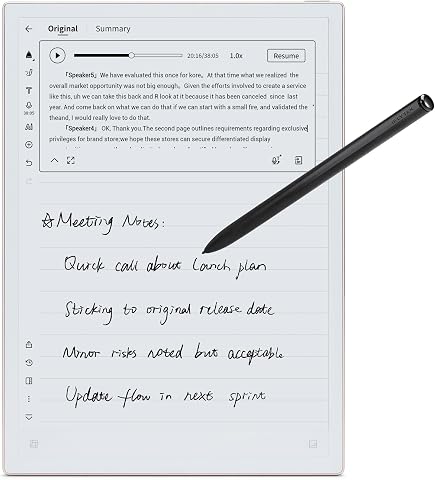 iFLYTEK AINOTE 2 AI Digital Notebook, 10.65" E-Ink Tablet with AI Assistant a…View on Amazon →
 - 3
 iFLYTEK AINOTE Air 2 Bundle with Black Folio Case, 8.2-inch AI Paper Tablet f…View on Amazon →
 - 4
 AINOTE Air 2 8.2" AI E Ink Tablet with Stylus and Adjustable LightView on Amazon →
 - 5
 Plaud Note Pro AI Voice Recorder Transcribe & Summarize for Meetings Calls, U…View on Amazon →
 - 6
 Plaud Note AI Voice Recorder Transcribe & Summarize, Black, Non-Pro VersionView on Amazon →
 - 7
 Pocket AI Voice Recorder with Auto Transcription and AI Note TakerView on Amazon →
 - 8
 Comulytic Note Pro AI Voice Recorder, Meeting Recorder & Note TakerView on Amazon →
 - 9
 Comulytic Note Pro AI Voice Recorder, AI Taking Device and Meeting Recorder w…View on Amazon →
 - 10
 AI Voice Recorder with Transcription & Summarization, 64GB, 100H Battery, App…View on Amazon →
 - 11
 128GB AI Voice Recorder with Transcription and Noise CancellationView on Amazon →
Why AI Note Apps Matter in 2026
These AI-powered note apps significantly enhance productivity by reducing manual effort in capturing and organizing information. For students, they enable faster note-taking during lectures; for professionals, they streamline meeting documentation. The integration of AI features like smart summaries and keyword extraction allows users to quickly review and find relevant content, saving time and improving accuracy. As AI becomes more embedded in daily workflows, these tools are expected to become essential for efficient knowledge management.
Evolution of AI in Note-Taking Technologies
Over the past few years, AI integration into note-taking has progressed from basic voice recognition to sophisticated systems offering multi-modal input, smart organization, and ecosystem integration. In 2024, several apps introduced AI features that improved transcription accuracy and handwriting recognition. By 2026, these tools have matured, with new hardware like AI paper tablets and enhanced software capabilities, making AI-powered notes more accessible and versatile for a broad user base.
“The best AI note apps in 2026 seamlessly blend voice, handwriting, and smart summaries, transforming how users capture and retrieve information.”
— Thorsten Meyer, AI note expert
Unconfirmed Aspects of AI Note App Performance
While many apps boast advanced AI features, real-world performance can vary depending on device hardware, background noise, and user familiarity. It is not yet clear how well these tools perform across diverse environments or with different accents and handwriting styles. Additionally, some claims about AI capabilities, such as perfect speaker diarization or context-aware suggestions, remain to be fully validated in everyday use.
Future Developments and Adoption Trends in 2026
In the coming months, expect further updates to existing apps, with increased focus on ecosystem integration, offline capabilities, and user customization. Developers are likely to release new hardware optimized for AI note-taking, such as enhanced stylus support and multi-modal input devices. Widespread adoption will depend on improvements in AI accuracy, device compatibility, and user education about maximizing these tools’ potential.
Key Questions
Can AI note apps transcribe multiple speakers accurately?
Many advanced AI note apps support speaker differentiation, but accuracy varies based on audio quality and background noise. Apps with speaker diarization perform better, though perfect accuracy in noisy environments remains challenging.
Are AI note apps suitable for handwriting recognition on all devices?
Handwriting recognition depends on device hardware and software. E-ink tablets like AINOTE Air 2 excel for stylus input but may lack voice features. Compatibility with existing devices like iPads varies by app and stylus used.
What should I consider when choosing an AI note app?
Focus on transcription accuracy, input methods (voice, handwriting, typing), device compatibility, ease of use, and ecosystem integration. Balance features with cost and your specific workflow needs.
Are these apps suitable for professional use?
Yes, many AI note apps offer features tailored for professional environments, such as meeting transcription, smart summaries, and integration with productivity tools. However, evaluating their accuracy and ecosystem support is essential for critical tasks.
Will AI note apps replace traditional note-taking methods?
While AI apps significantly enhance efficiency, they are unlikely to fully replace manual note-taking for all users. Instead, they serve as powerful supplements, especially for digital workflows and quick information retrieval.
Source: ThorstenMeyerAI.com