
📊 Full opportunity report: The Essential Role Of FERPA In Student Record Management on IdeaNavigator AI — validation score, market gap, and execution plan.
TL;DR
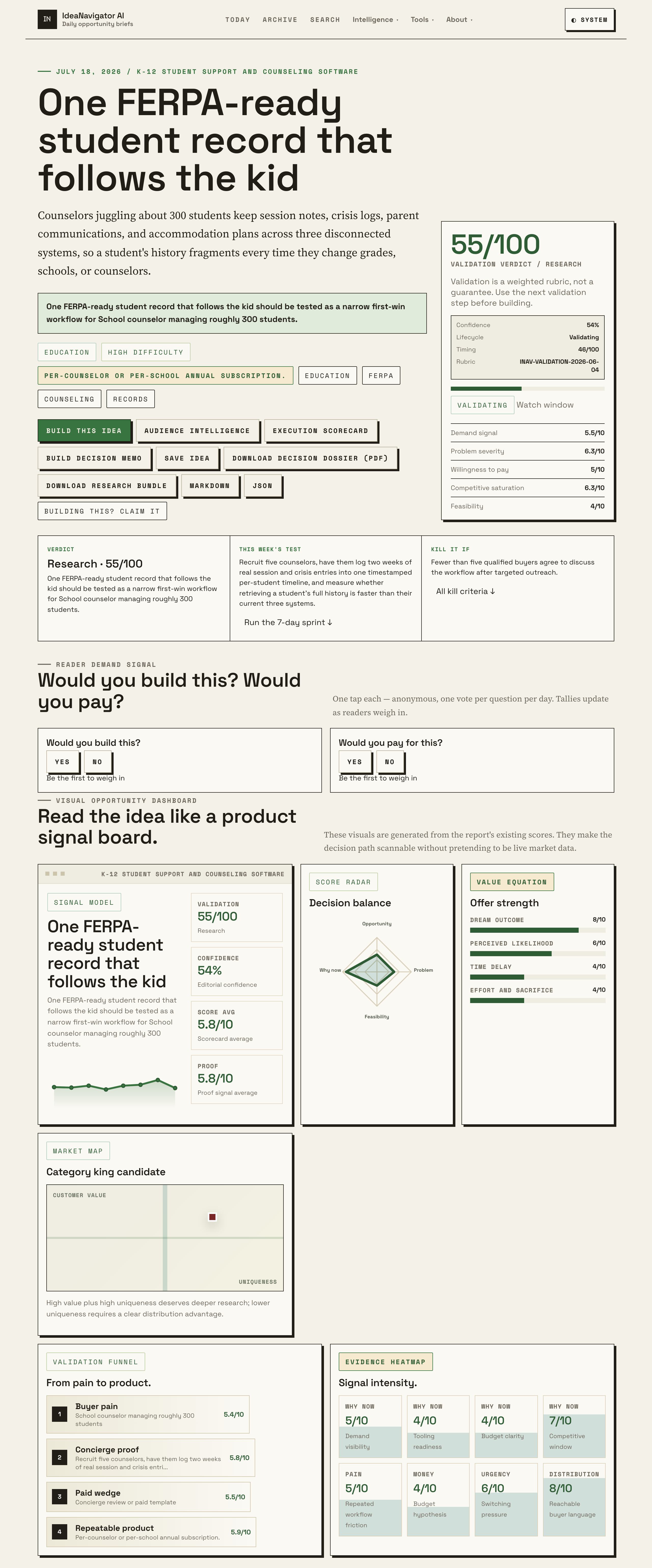
A new initiative aims to create FERPA-compliant, unified student records for school counselors managing hundreds of students. This development addresses record fragmentation and compliance challenges, with pilot testing underway.
A new pilot project is testing a FERPA-compliant, unified student record system for school counselors managing approximately 300 students. This development aims to address record fragmentation and enhance compliance with federal privacy laws, making student data more accessible and audit-ready.
The initiative focuses on creating a per-student timeline where counselors can log session notes, crisis entries, parent communications, and accommodation plans in a single interface. Each entry is automatically timestamped and audit-ready, ensuring compliance with the Family Educational Rights and Privacy Act (FERPA).
Currently, counselors handle student records across three disconnected systems, leading to fragmented histories and inefficient workflows. The new system consolidates these records, allowing faster retrieval of a student’s full history and reducing the risk of privacy violations.
According to an anonymous researcher involved in the project, the MVP (minimum viable product) involves logging one note or crisis entry per student with a timestamp, with the goal of making record retrieval at least 30% faster during pilot testing. The project is set to validate whether this simplified workflow improves efficiency and compliance.
Why FERPA Compliance Is Essential for Student Data
This development underscores the importance of FERPA compliance in student record management, especially as mental health caseloads surge and records become more sensitive. A unified, audit-ready system helps schools avoid legal risks and maintain student privacy while enabling counselors to access comprehensive histories quickly.
As federal scrutiny of data privacy intensifies, schools need reliable systems that not only streamline workflows but also adhere strictly to FERPA regulations. The project highlights a broader shift towards privacy-conscious digital record-keeping in education.
FERPA compliant student record management software
As an affiliate, we earn on qualifying purchases.
As an affiliate, we earn on qualifying purchases.
Background on Student Record Fragmentation and FERPA Challenges
Many K-12 schools currently manage student records through multiple disconnected systems, including separate platforms for counseling notes, crisis logs, and parent communications. This fragmentation complicates record retrieval and increases the risk of privacy breaches.
FERPA, enacted in 1974, mandates strict controls over access to educational records, requiring schools to ensure only authorized personnel view sensitive information. Recent increases in mental health cases and heightened privacy concerns have made compliance more critical than ever.
Previous efforts to unify records have faced technical and legal hurdles, including ensuring that systems are audit-ready and maintain strict access controls. The current pilot aims to test a practical, FERPA-compliant solution tailored for counselors managing large caseloads.
“The goal is to create a system that consolidates student histories in a way that is both efficient and compliant with FERPA.”
— an anonymous researcher
K-12 student data privacy system
As an affiliate, we earn on qualifying purchases.
As an affiliate, we earn on qualifying purchases.
Unresolved Questions About System Effectiveness and Adoption
It is not yet clear how quickly schools will adopt the new system or whether it will fully meet all FERPA compliance standards in practice. The pilot is ongoing, and results are expected in the next two months, but wider implementation details remain uncertain.
Further questions include how the system will integrate with existing school infrastructure and whether it will scale effectively for different school sizes and districts.
school counselor student record system
As an affiliate, we earn on qualifying purchases.
As an affiliate, we earn on qualifying purchases.
Next Steps for Pilot Testing and Broader Implementation
The pilot project is scheduled to run for two months, during which participating counselors will log real session and crisis data to evaluate efficiency gains and compliance. Following this, developers will analyze the results and determine whether to expand the system to additional schools or districts.
Schools and software providers will monitor for compliance issues and user feedback to refine the system before broader rollout, potentially setting a new standard for FERPA-compliant student record management.
digital student record platform for schools
As an affiliate, we earn on qualifying purchases.
As an affiliate, we earn on qualifying purchases.
Key Questions
How does the new system improve FERPA compliance?
The system automatically timestamps and consolidates student records into a single, audit-ready timeline, reducing risks of unauthorized access and ensuring compliance with FERPA’s privacy requirements.
Will this system replace existing student record platforms?
The initial pilot aims to test integration with current workflows. Depending on results, it may be adopted as a supplementary or replacement system for record management in participating schools.
What are the privacy protections built into the system?
The system enforces strict access controls, logs all record modifications with timestamps, and ensures that only authorized personnel can view sensitive student information, aligning with FERPA regulations.
When will broader adoption occur?
Wider implementation depends on pilot outcomes, expected in the next two months. If successful, schools could begin adopting the system in the following academic year.
What challenges remain for this project?
Key uncertainties include system scalability, integration with diverse existing platforms, and ensuring consistent FERPA compliance across different districts.
Source: IdeaNavigator AI