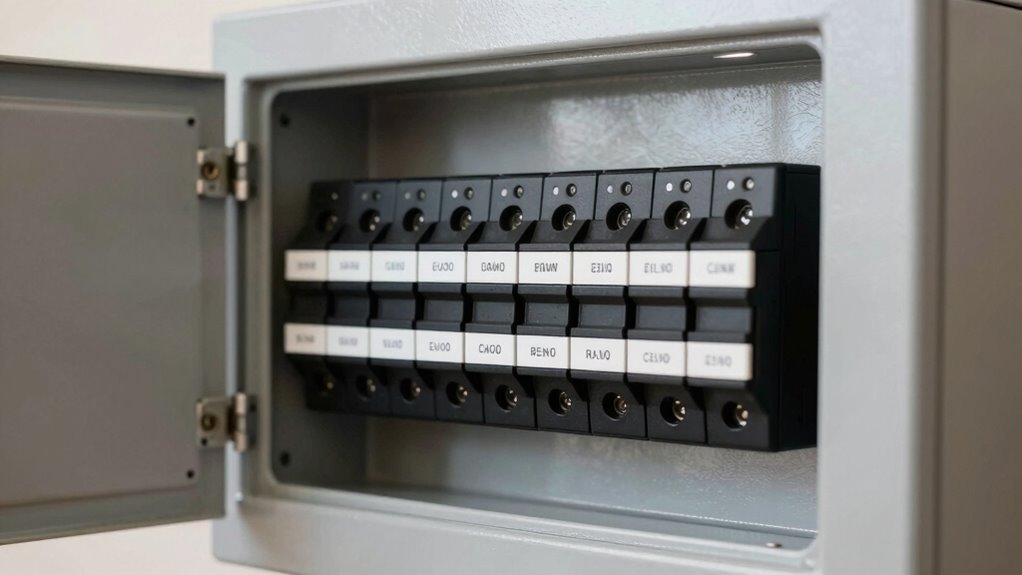

To label your breaker panel like a pro, start by turning off the main power and carefully turning on each breaker one by one to see what it controls. Use a label maker or permanent marker to clearly mark each circuit with descriptive names, like “Living Room Outlets.” Be sure to update labels when changes occur, and keep safety notices or emergency instructions visible. Mastering these steps will make managing your electrical system safer and easier—keep going for more detailed tips.

Prime made for students and young adults
- Fast, free delivery for dorm and study essentials
- Prime Video and Amazon Music included
- Member-only deals
Key Takeaways
- Turn off the main power before opening the breaker panel to ensure safety during labeling.
- Identify each circuit by turning on breakers individually and noting the controlled areas.
- Use durable labels or a label maker to clearly mark each breaker with descriptive names.
- Include safety notices or emergency instructions on the panel for quick reference.
- Regularly update labels when adding circuits or making electrical system changes for accuracy.
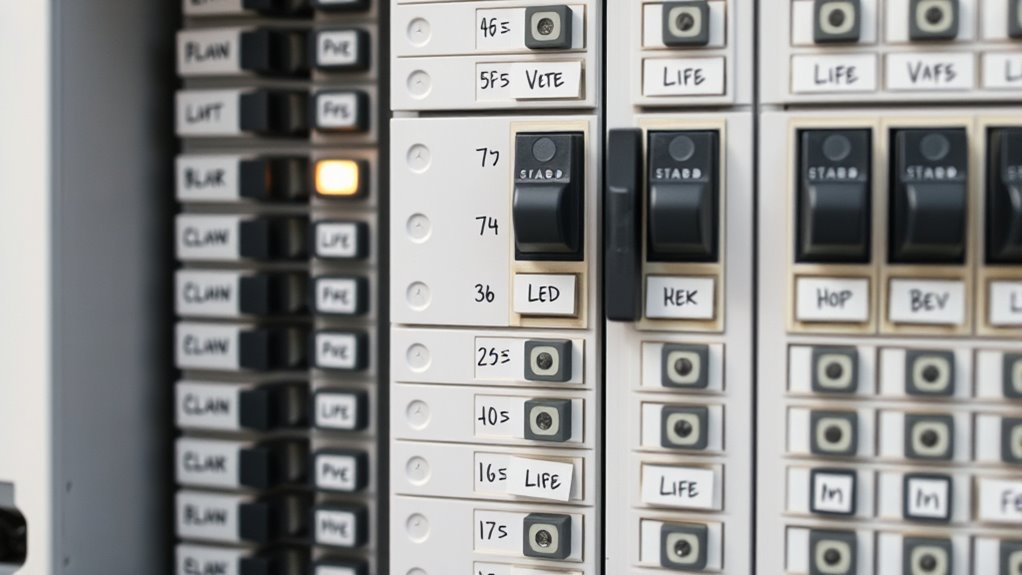
Breaker panels, also known as circuit breaker boxes, are indispensable components of your home’s electrical system. They distribute electricity to different areas of your house and protect wiring from overloads or short circuits. To guarantee safe and efficient operation, it’s essential to understand circuit identification and safety labeling. Properly labeling your breaker panel makes it easier to identify which switch controls specific circuits, saving time during maintenance or emergencies. It also reduces the risk of accidental power cuts or electrical mishaps by clearly indicating what each breaker manages.
Proper labeling of breaker panels enhances safety and simplifies home electrical management.
Start by turning off the main power before opening your breaker panel. Once inside, you’ll see a series of switches, each corresponding to a different part of your home. To identify each circuit, turn on a breaker and check which outlets, lights, or appliances lose power. You might use a circuit tester or plug in a small device to verify it’s the correct circuit. Record this information carefully—knowing exactly which breaker controls your kitchen outlets or outdoor lighting is fundamental. This process is called circuit identification, and it forms the foundation for effective safety labeling.
When it comes to safety labeling, clarity is key. Use a permanent marker or a label maker to mark each breaker with a description that’s easy to understand. For example, label a breaker as “Living Room Outlets” or “Garage Lights.” Keep labels concise but descriptive enough that anyone can quickly recognize what each switch controls. For circuits that serve multiple rooms or areas, specify the main function, like “Upstairs Bedrooms.” Remember to update labels if you add new circuits or make changes to your electrical system. Well-maintained labels help prevent accidental de-energization of critical circuits, such as those for medical equipment or security systems.
Additionally, understanding your home’s electrical capacity and load is crucial to prevent overloads and ensure safe operation. It’s also wise to include safety notices on your panel, such as warnings about high voltage or instructions for emergency shutoff. Make sure labels are legible, weather-resistant, and securely attached. If you’re unsure about your labeling or circuit identification, consider consulting a licensed electrician. Proper circuit identification and safety labeling not only make your home safer but also streamline repairs and troubleshooting. By taking the time to do it right, you guarantee that everyone in your household can operate the breaker panel confidently and safely. Remember, a well-labeled breaker panel is a small investment in safety that pays off in peace of mind and convenience.
label maker for circuit breaker panels
As an affiliate, we earn on qualifying purchases.
As an affiliate, we earn on qualifying purchases.
Frequently Asked Questions
How Often Should I Update My Breaker Panel Labels?
You should update your breaker panel labels whenever you add new circuits or notice outdated labels during panel maintenance. Regularly reviewing and updating labels helps with circuit troubleshooting and guarantees safety. If you experience frequent trips or plan renovations, it’s wise to check and refresh labels at least once a year. Clear, accurate labels make future panel maintenance easier and prevent confusion during emergencies or repairs.
Can I Re-Label My Breaker Panel Myself?
You can definitely re-label your breaker panel yourself. Imagine flipping the switch to a specific circuit and knowing exactly what it powers—clear circuit identification makes your home safer. Use simple labeling techniques like waterproof markers or pre-made labels, and guarantee each breaker is accurately marked with the area it controls. With careful attention, you’ll create a neat, professional-looking panel, making future trips to the breaker easy and stress-free.
What Tools Do I Need to Label a Breaker Panel?
To label your breaker panel, you’ll need a marker or label maker for clear panel identification, and a circuit map for accurate circuit mapping. A screwdriver helps remove panel covers if needed. Start by turning off power, then identify each circuit and label them accordingly. This guarantees safe panel identification, making future work easier. Double-check labels against your circuit map before finishing to avoid mistakes.
Are There Safety Precautions for Labeling Breaker Panels?
Think of labeling your breaker panel as drawing a safety map—you want it clear and precise. Always turn off the main breaker before starting to avoid accidental shocks, ensuring circuit safety. Wear insulated gloves and use a non-contact voltage tester for added protection. Double-check your labels for accuracy, because a mistake can turn a simple task into a dangerous situation. Prioritize safety to keep your home and yourself protected.
How Do I Identify Unknown Circuits in My Breaker Panel?
To identify unknown circuits, start by turning off the main breaker, then switch each breaker one at a time. Use a circuit tester or outlet to check which areas lose power, noting the corresponding breaker. Apply clear labeling techniques like color-coding or numbered tags to match circuits with their functions. This process helps you accurately label your breaker panel, making future maintenance safer and more straightforward.
permanent marker for electrical labels
As an affiliate, we earn on qualifying purchases.
As an affiliate, we earn on qualifying purchases.
Conclusion
By properly labeling your breaker panel, you make future trips to the box quick and stress-free. For instance, imagine needing to reset a circuit during a power outage—clear labels like “Living Room Outlets” or “Kitchen Lights” save you time and frustration. Taking a few minutes now to organize and label your panel guarantees you’re prepared for emergencies and simplifies maintenance. A well-labeled breaker panel truly keeps your home safer and more manageable.
weather-resistant labels for electrical panels
As an affiliate, we earn on qualifying purchases.
As an affiliate, we earn on qualifying purchases.
circuit tester for home electrical system
As an affiliate, we earn on qualifying purchases.
As an affiliate, we earn on qualifying purchases.
Evergreen bestsellers Picks
bestsellers
As an affiliate, we earn on qualifying purchases.